Louisiana: Emergencies — Part 1 Practice Test
Skids, hydroplaning, brake failure, tire blowouts, a stuck accelerator, fires, a car in water, bad weather and what to do after a crash. — Part 1
Independent educational site · not affiliated with any government agency or DMV
Ready? Test yourself
- Instant feedback with an explanation
- Every answer cites its source in the manual
- Your best score is saved on this device
Questions are original and based on the official manual "Class D & E Driver’s Guide" (Revised August 2025 (DPSMV2052 R08/25)), Louisiana Office of Motor Vehicles.
All 35 questions in this practice test
Take the test above first, then use this list to study. Tap “Show answer” to see the correct answer and explanation.
Show the questions and answersHide the questions
-
When a car oversteers, what does the rear of the vehicle do?
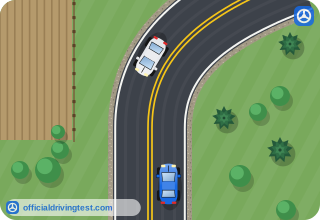
- Slides toward the inside of the corner and holds the road
- Lifts off the road and the front wheels slide
- Slides toward the outside of the corner
- Stays in line with the front wheels
Show answer
Correct answer: Slides toward the outside of the corner
The manual says oversteer causes the rear of the vehicle to slide toward the outside of the corner, creating a feeling that the car is trying to spin.
Source: Class D & E Driver’s Guide (Revised August 2025 (DPSMV2052 R08/25)), page 48 · Open this page in the manual (Manual page 48)
-
What is the correct reaction when a vehicle begins to oversteer?
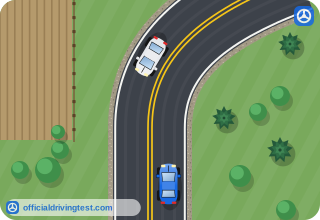
- Gently reduce steering angle and ease off the gas
- Slam on the brakes to slow the car down quickly
- Turn the steering wheel more sharply to correct it
- Press harder on the accelerator to pull out of it
Show answer
Correct answer: Gently reduce steering angle and ease off the gas
The manual says the correct reaction to oversteer is to reduce the steering angle gently and ease off the accelerator.
Source: Class D & E Driver’s Guide (Revised August 2025 (DPSMV2052 R08/25)), page 48 · Open this page in the manual (Manual page 48)
-
Why does slamming on the brakes when a vehicle begins to oversteer make things worse?
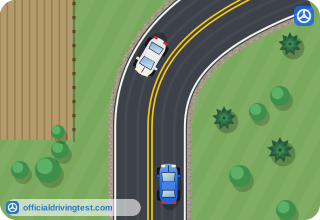
- It causes the front tires to lock first
- It turns the car in a smaller circle
- It causes the rear tires to lose more traction
- It spins the engine too fast
Show answer
Correct answer: It causes the rear tires to lose more traction
The manual says slamming the brakes aggravates oversteer, causing the rear tires to lose more traction.
Source: Class D & E Driver’s Guide (Revised August 2025 (DPSMV2052 R08/25)), page 48 · Open this page in the manual (Manual page 48)
-
If a car oversteers and the situation is not corrected, how does it end?
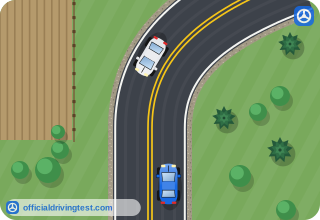
- The car turns a wider corner than intended but stays stable
- The front wheels lose total grip while the rear wheels hold
- The rear wheels lose grip, the car spins, control is lost
- The car straightens out on its own
Show answer
Correct answer: The rear wheels lose grip, the car spins, control is lost
The manual says oversteer worsens until the rear wheels lose total grip, the car spins and all directional control is lost.
Source: Class D & E Driver’s Guide (Revised August 2025 (DPSMV2052 R08/25)), page 48 · Open this page in the manual (Manual page 48)
-
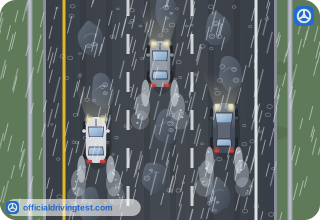
In fall rain, if you feel like you are floating, what should you do?
- Brake hard to regain traction
- Turn the wheel sharply toward the shoulder
- Steer straight and gently release the gas pedal
- Accelerate to power out of the water
Show answer
Correct answer: Steer straight and gently release the gas pedal
If you feel like you are floating, steer straight and gently release the gas pedal until the tires make contact with the road surface.
Source: Class D & E Driver’s Guide (Revised August 2025 (DPSMV2052 R08/25)), page 52 · Open this page in the manual (Manual page 52)
-
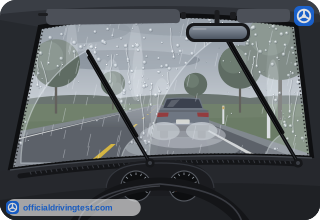
In an especially heavy downpour, what does the manual say you may want to do?
- Follow the tail lights of the vehicle ahead closely
- Pull off the road until it's safe to continue
- Drive faster to leave the storm behind
- Stop in the travel lane with the flashers on
Show answer
Correct answer: Pull off the road until it's safe to continue
In an especially heavy downpour, you may want to pull off the road until it is safe to continue.
Source: Class D & E Driver’s Guide (Revised August 2025 (DPSMV2052 R08/25)), page 52 · Open this page in the manual (Manual page 52)
-
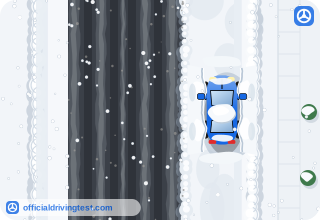
If you become stranded due to weather conditions, what should you do?
- Start walking toward the nearest town
- Do not leave your vehicle
- Leave the vehicle and wait beside the roadway
- Walk along the road to flag down a driver
Show answer
Correct answer: Do not leave your vehicle
Should you become stranded due to weather conditions, do not leave your vehicle.
Source: Class D & E Driver’s Guide (Revised August 2025 (DPSMV2052 R08/25)), page 52 · Open this page in the manual (Manual page 52)
-
Which item does the manual list among the emergency supplies to carry in your car in winter?
- A set of heavy jumper cables
- A tow rope for the vehicle
- A bag of rock salt for traction
- A flashlight with batteries
Show answer
Correct answer: A flashlight with batteries
The winter emergency supplies listed include blankets, food, water, spare fuses, a flashlight with batteries, an ice scraper, flares and a first-aid kit.
Source: Class D & E Driver’s Guide (Revised August 2025 (DPSMV2052 R08/25)), page 52 · Open this page in the manual (Manual page 52)
-
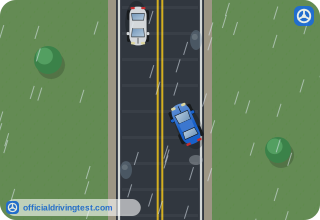
Your car starts to skid on wet pavement. What should you do with your foot on the gas pedal?
- Press the gas firmly to regain traction
- Pump the gas pedal quickly
- Hold the gas pedal perfectly steady
- Ease your foot off the gas
Show answer
Correct answer: Ease your foot off the gas
In a skid, remain calm and ease your foot off the gas while you look and carefully steer where you want the car to go.
Source: Class D & E Driver’s Guide (Revised August 2025 (DPSMV2052 R08/25)), page 74 · Open this page in the manual (Manual page 74)
-
In a skid on wet pavement, where should you look and carefully steer?
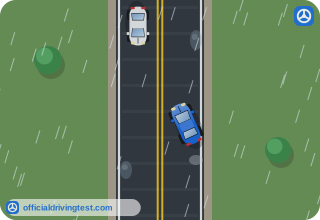
- In the direction you want the car to go
- Toward the nearest shoulder of the road
- Straight down at the hood of the car
- Away from the direction you want to go
Show answer
Correct answer: In the direction you want the car to go
If you find yourself in a skid, look and carefully steer in the direction you want the car to go.
Source: Class D & E Driver’s Guide (Revised August 2025 (DPSMV2052 R08/25)), page 74 · Open this page in the manual (Manual page 74)
-
After your first steering correction in a skid, what should you be prepared to do?
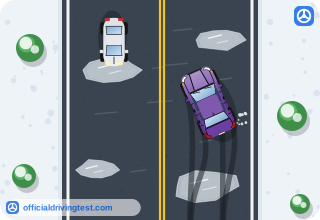
- Shift into neutral at once
- Turn off the engine quickly
- Counter-steer, if necessary
- Pull the parking brake hard
Show answer
Correct answer: Counter-steer, if necessary
Be prepared to counter-steer, if necessary, after the initial correction is made.
Source: Class D & E Driver’s Guide (Revised August 2025 (DPSMV2052 R08/25)), page 74 · Open this page in the manual (Manual page 74)
-
What happens when your tires lose all contact with the pavement while hydroplaning?
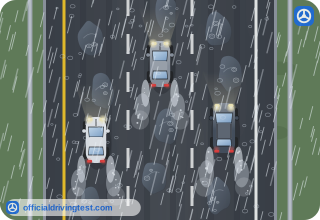
- You lose traction and cannot brake, accelerate or turn
- The tires grip the road better than before
- The car quickly slows down on its own and stops
- The anti-lock brakes take over the steering for you
Show answer
Correct answer: You lose traction and cannot brake, accelerate or turn
When the tires lose all contact with the pavement, you lose traction and cannot brake, accelerate or turn.
Source: Class D & E Driver’s Guide (Revised August 2025 (DPSMV2052 R08/25)), page 74 · Open this page in the manual (Manual page 74)
-
How do you recover when your car is hydroplaning?
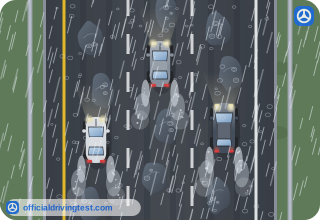
- Accelerate firmly to push through the water quickly
- Turn the wheel sharply toward the shoulder of the road
- Keep steering where you want to go and ease off the gas
- Shift into a lower gear at once to slow the wheels down
Show answer
Correct answer: Keep steering where you want to go and ease off the gas
Stay calm, keep looking and steering where you want to go as you ease off the gas pedal so the tires and the road can regain contact.
Source: Class D & E Driver’s Guide (Revised August 2025 (DPSMV2052 R08/25)), page 74 · Open this page in the manual (Manual page 74)
-
Which driving habit does the manual say helps you avoid becoming a victim of a staged automobile crash?
- Giving yourself plenty of space behind the vehicle in front
- Staying close behind the vehicle ahead so no one can cut in
- Passing slower vehicles as soon as you can
- Stopping suddenly when a vehicle follows closely
Show answer
Correct answer: Giving yourself plenty of space behind the vehicle in front
The manual says to avoid tailgating and always give yourself plenty of space between you and the vehicle in front of you.
Source: Class D & E Driver’s Guide (Revised August 2025 (DPSMV2052 R08/25)), page 98 · Open this page in the manual (Manual page 98)
-
If you are in a crash, what should you obtain when you call the police immediately?
- The home phone number of the officer
- A copy of the other drivers' insurance policies
- The tow company's invoice number
- An item number for the crash report
Show answer
Correct answer: An item number for the crash report
The manual says to call the police immediately and obtain an item number for the crash report.
Source: Class D & E Driver’s Guide (Revised August 2025 (DPSMV2052 R08/25)), page 98 · Open this page in the manual (Manual page 98)
-
At a crash, what should you make sure you use to obtain valid information from the other drivers?
- A business card
- A current driver's license
- A telephone number given by voice
- The license plate number alone
Show answer
Correct answer: A current driver's license
The manual says to make sure you use a current driver's license to obtain valid information.
Source: Class D & E Driver’s Guide (Revised August 2025 (DPSMV2052 R08/25)), page 98 · Open this page in the manual (Manual page 98)
-
In a crash, the other drivers refuse to exchange contact information. What does the manual say to do?
- Follow the other drivers until they provide it
- Leave the scene and file a report later
- Ask the police officer for the contact information
- Write down only the license plate numbers
Show answer
Correct answer: Ask the police officer for the contact information
The manual says that if the other drivers refuse, you should ask the police officer to provide the contact information of all parties involved.
Source: Class D & E Driver’s Guide (Revised August 2025 (DPSMV2052 R08/25)), page 98 · Open this page in the manual (Manual page 98)
-
What does the manual say to document with a camera after a crash?
- Only the damage to your own vehicle
- Only the weather and road conditions
- The vehicle damage and the number of passengers in each
- Only the license plates of the other vehicles involved
Show answer
Correct answer: The vehicle damage and the number of passengers in each
The manual says to document the damages to the vehicles involved and the number of passengers in each vehicle at the time of the collision.
Source: Class D & E Driver’s Guide (Revised August 2025 (DPSMV2052 R08/25)), page 98 · Open this page in the manual (Manual page 98)
-
At the scene of a collision, people who are not involved ask whether you have a lawyer or a doctor. What does the manual say to do?
- Avoid them
- Give them the names of your lawyer and doctor
- Refer them to your insurance producer
- Accept their help in arranging repairs
Show answer
Correct answer: Avoid them
The manual says to avoid people at the scene who are not involved, especially if they ask whether you have a lawyer or a doctor.
Source: Class D & E Driver’s Guide (Revised August 2025 (DPSMV2052 R08/25)), page 98 · Open this page in the manual (Manual page 98)
-
Your vehicle needs towing after a crash and you have road assistance. What does the manual say to do?
- Accept the first tow truck that arrives at the scene
- Let a tow truck operator choose the repair shop
- Wait for the police officer to choose a tow service
- Make your own arrangements
Show answer
Correct answer: Make your own arrangements
The manual says to make your own arrangements and to avoid tow trucks that happen to show up at the scene offering assistance.
Source: Class D & E Driver’s Guide (Revised August 2025 (DPSMV2052 R08/25)), page 98 · Open this page in the manual (Manual page 98)
-
If you choose a towing service that arrives at the collision scene, what should you make sure you have?
- A written estimate of the cost of the tow
- A designated repair shop available to receive your vehicle
- A tow truck operator who recommends a repair shop
- A signed release from the other driver
Show answer
Correct answer: A designated repair shop available to receive your vehicle
The manual says to make sure you have a designated repair shop available to receive your vehicle.
Source: Class D & E Driver’s Guide (Revised August 2025 (DPSMV2052 R08/25)), page 98 · Open this page in the manual (Manual page 98)
-
What does the manual say you should not allow the tow truck operator to do?
- Photograph the damage to your vehicle
- Recommend a repair shop you have not heard of
- Tow your vehicle to the designated repair shop
- Ask for your insurance information
Show answer
Correct answer: Recommend a repair shop you have not heard of
The manual says not to allow the tow truck operator to recommend a repair shop that you have not heard of and did not make prior arrangements with.
Source: Class D & E Driver’s Guide (Revised August 2025 (DPSMV2052 R08/25)), page 98 · Open this page in the manual (Manual page 98)
-
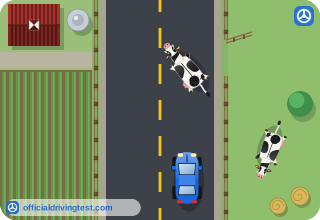
Why should you not swerve into oncoming traffic or off the roadway to avoid hitting an animal that suddenly runs in front of your vehicle?
- It may result in a more serious crash than hitting the animal
- It is against the law to leave your lane for any reason
- It makes the animal run toward your vehicle instead
- It cannot be done at a safe speed on a rural road
Show answer
Correct answer: It may result in a more serious crash than hitting the animal
The manual says swerving may result in a more serious crash than if the vehicle collided with the animal.
Source: Class D & E Driver’s Guide (Revised August 2025 (DPSMV2052 R08/25)), page 104 · Open this page in the manual (Manual page 104)
-
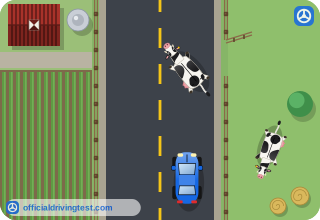
What should you concentrate on before, during and after a collision with an animal?
- Looking at the animal
- Counting the animals nearby
- Regaining control of the vehicle
- Moving the animal off the road
Show answer
Correct answer: Regaining control of the vehicle
The manual says to concentrate on regaining control of the vehicle before, during and after the collision with the animal.
Source: Class D & E Driver’s Guide (Revised August 2025 (DPSMV2052 R08/25)), page 104 · Open this page in the manual (Manual page 104)
-
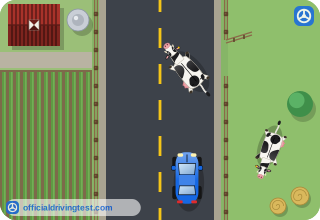
If you have time to avoid hitting an animal and no vehicles are close behind you, how should you brake?
- Tap the brakes lightly and coast up to the animal
- Brake hard, but do not lock the wheels and cause a skid
- Lock the wheels so the car stops in less distance
- Do not brake, and let the vehicle coast to a stop
Show answer
Correct answer: Brake hard, but do not lock the wheels and cause a skid
The manual says that if no vehicles are close behind you, you should brake hard but not lock the wheels causing a skid.
Source: Class D & E Driver’s Guide (Revised August 2025 (DPSMV2052 R08/25)), page 105 · Open this page in the manual (Manual page 105)
-
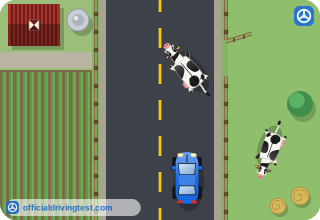
If a collision with an animal is inevitable, where should you keep your vehicle?
- Under control and on the roadway
- Off the roadway on the shoulder
- In the oncoming lane
- Angled across both lanes
Show answer
Correct answer: Under control and on the roadway
The manual says not to swerve but to keep your vehicle under control and on the roadway when you hit the animal.
Source: Class D & E Driver’s Guide (Revised August 2025 (DPSMV2052 R08/25)), page 105 · Open this page in the manual (Manual page 105)
-
If a collision with a single animal is inevitable, in which direction does the manual suggest you steer?
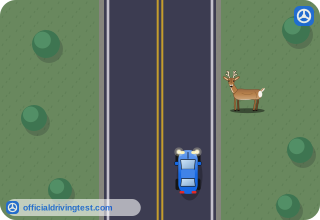
- Away from the area the animal came from
- Straight at the animal
- Toward the area the animal came from
- Into the oncoming lane
Show answer
Correct answer: Toward the area the animal came from
The manual suggests steering toward the area the animal came from, since the animal is more likely to keep moving forward than backtrack; this works only for one animal, not a herd.
Source: Class D & E Driver’s Guide (Revised August 2025 (DPSMV2052 R08/25)), page 105 · Open this page in the manual (Manual page 105)
-
Why should you shift your line of eyesight to the spot you are steering toward instead of looking at the animal?
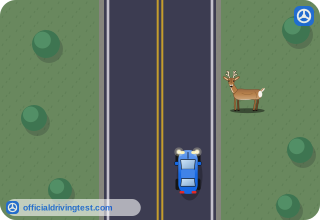
- The animal will move toward your gaze
- If you look at the animal you will steer that way
- Your headlights will not reach the animal
- The animal will not see your vehicle
Show answer
Correct answer: If you look at the animal you will steer that way
The manual says not to look at the animal or you will steer that way.
Source: Class D & E Driver’s Guide (Revised August 2025 (DPSMV2052 R08/25)), page 105 · Open this page in the manual (Manual page 105)
-
If a collision with an animal is inevitable, what kind of impact should you try for?
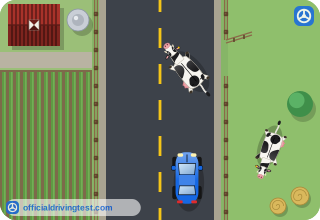
- A full head-on impact to stop quickly
- A side impact with the wheels locked
- An impact at the highest safe speed
- A skimming impact rather than a full one
Show answer
Correct answer: A skimming impact rather than a full one
The manual says to try to skim rather than fully impact the animal.
Source: Class D & E Driver’s Guide (Revised August 2025 (DPSMV2052 R08/25)), page 105 · Open this page in the manual (Manual page 105)
-
What should you do with the brake at the moment of impact with an animal?
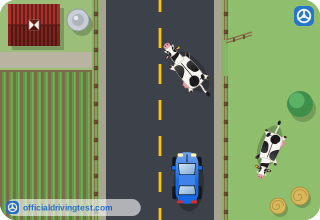
- Take your foot off the brake
- Press the brake harder to stop
- Pump the brake rapidly
- Hold the wheels locked
Show answer
Correct answer: Take your foot off the brake
The manual says to brake firmly, angle the vehicle and take your foot off the brake as you impact, which lifts the vehicle slightly.
Source: Class D & E Driver’s Guide (Revised August 2025 (DPSMV2052 R08/25)), page 105 · Open this page in the manual (Manual page 105)
-
When should you report a collision with an animal to the police?
- Only when the animal that was hit is a domestic pet
- Only when the animal dies and is left in the road
- When it involves a large animal such as a deer or farm animal
- Only when your vehicle cannot be driven away
Show answer
Correct answer: When it involves a large animal such as a deer or farm animal
The manual says to report the crash to the police if it involves a large animal such as a deer or farm animal.
Source: Class D & E Driver’s Guide (Revised August 2025 (DPSMV2052 R08/25)), page 105 · Open this page in the manual (Manual page 105)
-
If you hit a domestic pet and homes are nearby, what does the manual say to do?
- Go inside the nearest home to look for the pet’s owner
- Try to notify the pet’s owner without going inside the home
- Leave a note on the pet and drive away from there
- Move the pet to the side of the road and leave
Show answer
Correct answer: Try to notify the pet’s owner without going inside the home
The manual says to try to notify the pet’s owner if possible and not to go inside someone’s home.
Source: Class D & E Driver’s Guide (Revised August 2025 (DPSMV2052 R08/25)), page 105 · Open this page in the manual (Manual page 105)
-
Why does the manual say to take an extra set of keys on a trip?
- In case you lock your keys in the vehicle or lose them
- In case the ignition switch stops working
- In case a passenger wants to take a turn driving
- In case your vehicle is stolen
Show answer
Correct answer: In case you lock your keys in the vehicle or lose them
The manual says to take an extra set of keys in case you lock your keys in the vehicle or lose them.
Source: Class D & E Driver’s Guide (Revised August 2025 (DPSMV2052 R08/25)), page 109 · Open this page in the manual (Manual page 109)
-
Why does the manual say to take your insurance information on a trip?
- In case you are stopped at a toll booth
- In case you need to rent a trailer
- In case you are in a crash
- In case you lose your keys
Show answer
Correct answer: In case you are in a crash
The manual says to take insurance information in case you are in a crash.
Source: Class D & E Driver’s Guide (Revised August 2025 (DPSMV2052 R08/25)), page 109 · Open this page in the manual (Manual page 109)
-
Why does the manual say to take the vehicle owner’s manual on a trip?
- In case you get lost
- In case your vehicle breaks down
- In case you are in a crash
- In case you run out of money
Show answer
Correct answer: In case your vehicle breaks down
The manual says to take the vehicle owner’s manual in case your vehicle breaks down.
Source: Class D & E Driver’s Guide (Revised August 2025 (DPSMV2052 R08/25)), page 109 · Open this page in the manual (Manual page 109)