Louisiana: Distracted and drowsy driving — Part 3 Practice Test
Questions in this part include: “When does the manual advise using your cell phone while driving?” · “If one person will be doing all of the driving, what is the limit on driving time in any one day?”
Independent educational site · not affiliated with any government agency or DMV
Ready? Test yourself
- Instant feedback with an explanation
- Every answer cites its source in the manual
- Your best score is saved on this device
Questions are original and based on the official manual "Class D & E Driver’s Guide" (Revised August 2025 (DPSMV2052 R08/25)), Louisiana Office of Motor Vehicles.
All 19 questions in this practice test
Take the test above first, then use this list to study. Tap “Show answer” to see the correct answer and explanation.
Show the questions and answersHide the questions
-
When does the manual advise using your cell phone while driving?
- Only on rural highways
- Only in emergencies
- Only in light traffic
- Only below 25 mph
Show answer
Correct answer: Only in emergencies
Use your cell phone only in emergencies, and if possible have a passenger make the call.
Source: Class D & E Driver’s Guide (Revised August 2025 (DPSMV2052 R08/25)), page 77 · Open this page in the manual (Manual page 77)
-
How does the manual advise handling incoming calls while you are driving?
- Answer them only at red lights
- Answer them in the right lane
- Answer them when traffic is light
- Let your voice mail answer them
Show answer
Correct answer: Let your voice mail answer them
Let your voice mail answer incoming calls while you are driving.
Source: Class D & E Driver’s Guide (Revised August 2025 (DPSMV2052 R08/25)), page 77 · Open this page in the manual (Manual page 77)
-
Which of these does the manual tell you not to do while driving?
- Check your mirrors often
- Scan the road well ahead
- Look up telephone numbers
- Use your turn signals before turning
Show answer
Correct answer: Look up telephone numbers
Do not take notes or look up telephone numbers while driving.
Source: Class D & E Driver’s Guide (Revised August 2025 (DPSMV2052 R08/25)), page 77 · Open this page in the manual (Manual page 77)
-
Under Louisiana law, who is prohibited from writing, sending, or reading a text-based communication while driving?
- Only drivers with a learner's permit
- Only drivers of commercial vehicles
- Only drivers under the age of 21
- Anyone, regardless of age
Show answer
Correct answer: Anyone, regardless of age
Louisiana law prohibits anyone, regardless of age, from writing, sending, or reading a text-based communication while driving.
Source: Class D & E Driver’s Guide (Revised August 2025 (DPSMV2052 R08/25)), page 78 · Open this page in the manual (Manual page 78)
-
Which of these does Louisiana law prohibit for drivers of every age while driving?
- Posting to a social networking site
- Listening to music on the radio
- Talking with passengers in the car
- Driving with the windows rolled down
Show answer
Correct answer: Posting to a social networking site
Louisiana law prohibits anyone, regardless of age, from accessing, reading, or posting to a social networking site while driving.
Source: Class D & E Driver’s Guide (Revised August 2025 (DPSMV2052 R08/25)), page 78 · Open this page in the manual (Manual page 78)
-
According to the manual, what is at the root of teens being influenced to take higher driving risks?
- Not knowing the traffic laws
- The teen's need to impress peers
- Driving cars that are too powerful
- Too little sleep before driving
Show answer
Correct answer: The teen's need to impress peers
Many teens are influenced to take a higher driving risk by another teen's suggestion; at the root of this problem is the teen's need to impress his peers.
Source: Class D & E Driver’s Guide (Revised August 2025 (DPSMV2052 R08/25)), page 78 · Open this page in the manual (Manual page 78)
-
Risky behaviors such as racing or swerving to music are more likely in young drivers mainly because of what?
- Poor eyesight at a young age
- Driving mostly on rural roads
- Older cars with worn-out brakes
- Lack of experience behind the wheel
Show answer
Correct answer: Lack of experience behind the wheel
Engaging in risky behaviors is more likely due to the young driver's lack of experience behind the wheel.
Source: Class D & E Driver’s Guide (Revised August 2025 (DPSMV2052 R08/25)), page 79 · Open this page in the manual (Manual page 79)
-
Can peer pressure have a positive influence on a young driver?
- Yes; peers can encourage you and warn you of mistakes
- No; peer pressure always leads to more risk-taking
- Only when a parent is riding in the car too
- Only for drivers who already hold a full license
Show answer
Correct answer: Yes; peers can encourage you and warn you of mistakes
Peer pressure can have a positive influence: peers can offer encouragement, advice on a problem, or tell you when you are about to make a mistake.
Source: Class D & E Driver’s Guide (Revised August 2025 (DPSMV2052 R08/25)), page 79 · Open this page in the manual (Manual page 79)
-
Why does the manual say not to use cell phones or headphones around railroad tracks?
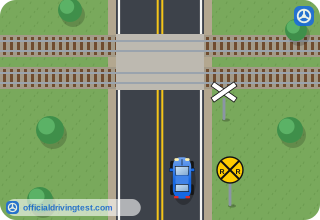
- They can interfere with the crossing's warning signals
- They are banned by law anywhere near a railroad
- They make it harder to see the cross buck sign
- They could prevent you from hearing an approaching train
Show answer
Correct answer: They could prevent you from hearing an approaching train
The manual says to stay alert and not use cell phones, headphones or other distractions that would prevent you from hearing an approaching train.
Source: Class D & E Driver’s Guide (Revised August 2025 (DPSMV2052 R08/25)), page 95 · Open this page in the manual (Manual page 95)
-
What does Louisiana law say about wearing headphones while driving?
- Headphones in both ears are prohibited, but in one ear alone is allowed
- Headphones are prohibited in either ear or in both ears
- Headphones in both ears are allowed if the volume is low
- Headphones in one ear are prohibited, but in both ears are allowed
Show answer
Correct answer: Headphones in both ears are prohibited, but in one ear alone is allowed
The manual says wearing headphones in both ears is prohibited, while wearing them in one ear alone is allowed.
Source: Class D & E Driver’s Guide (Revised August 2025 (DPSMV2052 R08/25)), page 97 · Open this page in the manual (Manual page 97)
-
If one person will be doing all of the driving, what is the limit on driving time in any one day?
- 3 to 4 hours
- 9 to 10 hours
- 6 to 8 hours
- 12 to 14 hours
Show answer
Correct answer: 6 to 8 hours
The manual says that if one person does all the driving, 6 to 8 hours in any one day should be considered the limit.
Source: Class D & E Driver’s Guide (Revised August 2025 (DPSMV2052 R08/25)), page 108 · Open this page in the manual (Manual page 108)
-
When two or more people can share the driving, what should total driving time not exceed?
- 4 to 5 hours
- 10 to 11 hours
- 14 to 16 hours
- 18 to 20 hours
Show answer
Correct answer: 10 to 11 hours
The manual says that when two or more people share the driving, total driving time should not exceed 10 to 11 hours.
Source: Class D & E Driver’s Guide (Revised August 2025 (DPSMV2052 R08/25)), page 109 · Open this page in the manual (Manual page 109)
-
After what time are you more apt to fall asleep while driving?
- 8 p.m.
- 9 p.m.
- 10 p.m.
- 11 p.m.
Show answer
Correct answer: 11 p.m.
The manual says to avoid driving after dark and particularly after 11 p.m., when you are more apt to fall asleep while driving.
Source: Class D & E Driver’s Guide (Revised August 2025 (DPSMV2052 R08/25)), page 109 · Open this page in the manual (Manual page 109)
-
When should distractions be eliminated, according to the list of things to remember before you start your engine?
- Once you reach the highway
- Only when it is dark outside
- Prior to driving
- After an hour of driving
Show answer
Correct answer: Prior to driving
The manual says to eliminate distractions prior to driving.
Source: Class D & E Driver’s Guide (Revised August 2025 (DPSMV2052 R08/25)), page 110 · Open this page in the manual (Manual page 110)
-
How does the manual define distracted driving?
- Any non-driving activity that can distract you from driving and increase crash risk
- Only the use of a hand-held phone while the vehicle is moving on a public road
- Only driving while very tired or without having had enough sleep at night
- Only looking away from the road for more than ten seconds at one time while driving
Show answer
Correct answer: Any non-driving activity that can distract you from driving and increase crash risk
Distracted driving is any non-driving activity with the potential to distract a person from the primary task of driving and increase the risk of crashing.
Source: Class D & E Driver’s Guide (Revised August 2025 (DPSMV2052 R08/25)), page 110 · Open this page in the manual (Manual page 110)
-
Taking your eyes off the road to look at something else is which type of distraction?
- Manual
- Cognitive
- Auditory
- Visual
Show answer
Correct answer: Visual
The manual names visual distraction as taking your eyes off the road to look at something else.
Source: Class D & E Driver’s Guide (Revised August 2025 (DPSMV2052 R08/25)), page 110 · Open this page in the manual (Manual page 110)
-
Taking your hands off the wheel to do something, such as adjusting the radio, is which type of distraction?
- Visual
- Manual
- Cognitive
- Auditory
Show answer
Correct answer: Manual
The manual names manual distraction as taking your hands off the wheel to do something.
Source: Class D & E Driver’s Guide (Revised August 2025 (DPSMV2052 R08/25)), page 110 · Open this page in the manual (Manual page 110)
-
Taking your mind off what you are doing is which type of distraction?
- Cognitive
- Visual
- Manual
- Auditory
Show answer
Correct answer: Cognitive
The manual names cognitive distraction as taking your mind off what you are doing.
Source: Class D & E Driver’s Guide (Revised August 2025 (DPSMV2052 R08/25)), page 110 · Open this page in the manual (Manual page 110)
-
Why does the manual call texting the most alarming distraction?
- It is the most common distraction among adults
- It takes more than a minute each time
- It involves all three types of distraction
- It is the only distraction that Louisiana law bans
Show answer
Correct answer: It involves all three types of distraction
Texting is the most alarming distraction because it involves visual, manual and cognitive distraction together.
Source: Class D & E Driver’s Guide (Revised August 2025 (DPSMV2052 R08/25)), page 110 · Open this page in the manual (Manual page 110)