Louisiana: Alcohol and drugs — Part 1 Practice Test
Questions in this part include: “At what BAC level can a driver younger than 21 lose the driving privilege after submitting to an alcohol analysis test?” · “If you are not sure whether it is safe to take a drug and drive, whom does the manual say to ask about side effects?”
Independent educational site · not affiliated with any government agency or DMV
Ready? Test yourself
- Instant feedback with an explanation
- Every answer cites its source in the manual
- Your best score is saved on this device
Questions are original and based on the official manual "Class D & E Driver’s Guide" (Revised August 2025 (DPSMV2052 R08/25)), Louisiana Office of Motor Vehicles.
All 19 questions in this practice test
Take the test above first, then use this list to study. Tap “Show answer” to see the correct answer and explanation.
Show the questions and answersHide the questions
-
At what BAC level can a driver 21 years of age or older lose the driving privilege after submitting to an alcohol analysis test?
- 0.05% or more
- 0.10% or more
- 0.12% or more
- 0.08% or more
Show answer
Correct answer: 0.08% or more
The results show a BAC of 0.08% or more for those 21 or older as grounds for losing driving privilege.
Source: Class D & E Driver’s Guide (Revised August 2025 (DPSMV2052 R08/25)), page 12 · Open this page in the manual (Manual page 12)
-
At what BAC level can a driver younger than 21 lose the driving privilege after submitting to an alcohol analysis test?
- 0.04% or more
- 0.05% or more
- 0.02% or more
- 0.10% or more
Show answer
Correct answer: 0.02% or more
For those younger than 21, results showing a BAC of 0.02% or more are grounds for losing the driving privilege.
Source: Class D & E Driver’s Guide (Revised August 2025 (DPSMV2052 R08/25)), page 12 · Open this page in the manual (Manual page 12)
-
You can lose your driving privilege in Louisiana for refusing to do what when you are arrested for DWI?
- Take an alcohol analysis test
- Take a vision exam
- Attend a driver improvement class
- Sign the citation
Show answer
Correct answer: Take an alcohol analysis test
Refusal to take an alcohol analysis test when arrested for DWI is grounds for losing your driving privilege.
Source: Class D & E Driver’s Guide (Revised August 2025 (DPSMV2052 R08/25)), page 12 · Open this page in the manual (Manual page 12)
-
What does the manual say about over-the-counter allergy drugs and driving?
- They are safe to take before driving because they need no prescription
- They improve alertness and driving ability in the spring season
- They affect driving only when taken at night or with food
- They can have side effects that diminish your driving ability
Show answer
Correct answer: They can have side effects that diminish your driving ability
Over-the-counter allergy drugs can have side effects or interact with other medications to diminish your driving ability.
Source: Class D & E Driver’s Guide (Revised August 2025 (DPSMV2052 R08/25)), page 51 · Open this page in the manual (Manual page 51)
-
If you plan to drink, what does the National Safety Council guideline in the manual tell you to do?
- Designate a driver who won’t drink
- Drive with the windows open
- Eat a large meal before you drive
- Drink only a little and drive slowly
Show answer
Correct answer: Designate a driver who won’t drink
The guideline says that if you plan to drink, you should designate a driver who won’t drink.
Source: Class D & E Driver’s Guide (Revised August 2025 (DPSMV2052 R08/25)), page 54 · Open this page in the manual (Manual page 54)
-
According to the manual, which behavior by another driver may mean that the driver is impaired?
- Driving with the turn signal on early
- Staying in the right lane
- Following the vehicle ahead at a safe distance
- Straddling the center line or weaving
Show answer
Correct answer: Straddling the center line or weaving
The manual says a car straddling the center line, weaving, making wide turns, stopping abruptly or responding slowly to traffic signals may be driven by an impaired driver.
Source: Class D & E Driver’s Guide (Revised August 2025 (DPSMV2052 R08/25)), page 54 · Open this page in the manual (Manual page 54)
-
How does the manual say you can avoid an impaired driver?
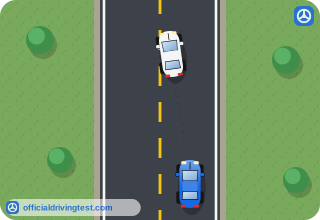
- Speed up to get ahead of the driver
- Turn right at the nearest corner or nearest exit
- Stop in the traffic lane and wait
- Stay close behind the driver to watch the driving
Show answer
Correct answer: Turn right at the nearest corner or nearest exit
The manual says to avoid an impaired driver by turning right at the nearest corner or exiting at the nearest exit.
Source: Class D & E Driver’s Guide (Revised August 2025 (DPSMV2052 R08/25)), page 54 · Open this page in the manual (Manual page 54)
-
How does the manual say the effects of drugs on driving compare with alcohol?
- They can be like those of alcohol, or even worse
- They are always milder than those of alcohol
- Only illegal drugs have effects like alcohol
- Only prescription drugs have effects like alcohol
Show answer
Correct answer: They can be like those of alcohol, or even worse
The manual says drugs can have effects like those of alcohol, or even worse, and this is true of many prescription drugs and many over-the-counter drugs.
Source: Class D & E Driver’s Guide (Revised August 2025 (DPSMV2052 R08/25)), page 58 · Open this page in the manual (Manual page 58)
-
What can over-the-counter drugs taken for headaches, colds, hay fever or other allergies do?
- Make you more alert and improve your reactions
- Have no effect because no prescription is needed
- Affect only your vision, not your alertness
- Make you drowsy and affect your driving
Show answer
Correct answer: Make you drowsy and affect your driving
The manual says over-the-counter drugs taken for headaches, colds, hay fever or other allergies, or to calm nerves, can make you drowsy and affect your driving.
Source: Class D & E Driver’s Guide (Revised August 2025 (DPSMV2052 R08/25)), page 58 · Open this page in the manual (Manual page 58)
-
What can pep pills, “uppers” and diet pills make you feel, according to the manual?
- Calm, alert and able to focus well
- Nervous, dizzy and unable to concentrate
- Sleepy and slow to react to hazards
- Relaxed and free of stress or worry
Show answer
Correct answer: Nervous, dizzy and unable to concentrate
The manual says pep pills, “uppers” and diet pills can make you feel nervous, dizzy, unable to concentrate, and they can affect your vision.
Source: Class D & E Driver’s Guide (Revised August 2025 (DPSMV2052 R08/25)), page 58 · Open this page in the manual (Manual page 58)
-
If you are not sure whether it is safe to take a drug and drive, whom does the manual say to ask about side effects?
- Your doctor or pharmacist
- Your insurance agent
- A police officer
- A driver’s license examiner
Show answer
Correct answer: Your doctor or pharmacist
The manual says to ask your doctor or pharmacist about any side effects if you are not sure it is safe to take the drug and drive.
Source: Class D & E Driver’s Guide (Revised August 2025 (DPSMV2052 R08/25)), page 58 · Open this page in the manual (Manual page 58)
-
According to the manual, some prescription drugs can affect which of these in ways similar to alcohol?
- Your hearing, balance and sense of smell
- Only your skin and muscles
- Your reflexes, judgment, vision and alertness
- Only your sense of direction
Show answer
Correct answer: Your reflexes, judgment, vision and alertness
The manual says some prescription drugs can affect your reflexes, judgment, vision and alertness in ways similar to alcohol.
Source: Class D & E Driver’s Guide (Revised August 2025 (DPSMV2052 R08/25)), page 58 · Open this page in the manual (Manual page 58)
-
Before taking a drug and driving, where does the manual say to check for warnings about its effect?
- On the back of your driver’s license card
- On the label of the product or prescription
- In the owner’s manual of your vehicle
- On your vehicle’s registration certificate
Show answer
Correct answer: On the label of the product or prescription
The manual says to check the label on the product or prescription before you take a drug for warnings about its effect.
Source: Class D & E Driver’s Guide (Revised August 2025 (DPSMV2052 R08/25)), page 58 · Open this page in the manual (Manual page 58)
-
According to the manual, how long does it take alcohol to reach your brain after it enters your stomach?
- About 20 minutes
- About 5 minutes
- About 1 hour
- About 3 hours
Show answer
Correct answer: About 20 minutes
The manual says alcohol goes into the bloodstream and reaches the brain in about 20 minutes.
Source: Class D & E Driver’s Guide (Revised August 2025 (DPSMV2052 R08/25)), page 122 · Open this page in the manual (Manual page 122)
-
How does the manual describe alcohol in terms of its effect on the brain?
- A stimulant that raises alertness
- A neutral substance with no effect on the brain
- A depressant, not a stimulant
- A vitamin that helps the brain stay awake
Show answer
Correct answer: A depressant, not a stimulant
Alcohol is a depressant with an anesthetic effect on the brain, not a stimulant.
Source: Class D & E Driver’s Guide (Revised August 2025 (DPSMV2052 R08/25)), page 122 · Open this page in the manual (Manual page 122)
-
Why might a person feel stimulated after drinking alcohol?
- Alcohol speeds up normal reflexes and reaction time
- Lowered inhibitions cause loss of caution and self-control
- Alcohol increases alertness and sharpens the vision
- Alcohol gives the brain extra energy while driving
Show answer
Correct answer: Lowered inhibitions cause loss of caution and self-control
The manual says the feeling of stimulation is simply caused by lowered inhibitions, which cause loss of caution and self-control.
Source: Class D & E Driver’s Guide (Revised August 2025 (DPSMV2052 R08/25)), page 122 · Open this page in the manual (Manual page 122)
-
According to the manual, what matters when you drink beer, wine, whiskey or another alcoholic beverage?
- Only whether the drink is beer or liquor
- Only how fast you finish the first drink
- Only the color of the drink
- The amount of alcohol that enters your blood
Show answer
Correct answer: The amount of alcohol that enters your blood
The manual says it does not matter which beverage you drink; the amount of alcohol that enters your blood causes the problem.
Source: Class D & E Driver’s Guide (Revised August 2025 (DPSMV2052 R08/25)), page 122 · Open this page in the manual (Manual page 122)
-
How does a small amount of alcohol on an empty stomach affect you compared with after you have recently eaten?
- It affects you less rapidly
- It affects you in exactly the same way
- It has no effect until you have eaten
- It affects you more rapidly
Show answer
Correct answer: It affects you more rapidly
A small amount on an empty stomach affects you more rapidly than it would if you had recently eaten.
Source: Class D & E Driver’s Guide (Revised August 2025 (DPSMV2052 R08/25)), page 122 · Open this page in the manual (Manual page 122)
-
Once alcohol has entered your blood, what can you do to lessen its effect?
- Drink black coffee until you feel alert
- Nothing; the body needs time to process it
- Take a cold shower before you drive
- Exercise for a few minutes
Show answer
Correct answer: Nothing; the body needs time to process it
The manual says there is nothing you can do to lessen the effect, and black coffee, exercise or a cold shower will not sober you up.
Source: Class D & E Driver’s Guide (Revised August 2025 (DPSMV2052 R08/25)), page 122 · Open this page in the manual (Manual page 122)