Kentucky: Signals and vehicle controls — Part 4 Practice Test
Checking your vehicle, seat and mirror adjustment, starting, stopping, steering and backing, turn signals, lights, the horn, driver-assistance features and towing a trailer. — Part 4
Independent educational site · not affiliated with any government agency or DMV
Ready? Test yourself
- Instant feedback with an explanation
- Every answer cites its source in the manual
- Your best score is saved on this device
Questions are original and based on the official manual "Kentucky Driver Manual" (Updated July 23, 2026), Kentucky State Police.
All 34 questions in this practice test
Take the test above first, then use this list to study. Tap “Show answer” to see the correct answer and explanation.
Show the questions and answersHide the questions
-
Which of these is a time when you may give your horn a light tap?
- You are waiting behind a vehicle that has stopped to turn
- You are approaching a car that is parked at the curb
- You are driving past a school bus with its lights off
- You are passing a driver who starts to turn into your lane
Show answer
Correct answer: You are passing a driver who starts to turn into your lane
The manual lists passing a driver who starts to turn into your lane as a time to give a light tap on the horn.
Source: Kentucky Driver Manual (Updated July 23, 2026), page 54 · Open this page in the manual (Manual page 54)
-
When should you use your horn?
- Whenever traffic ahead is moving slowly
- Only when you need to communicate with other road users
- Any time that you pass another vehicle
- To show another driver that you are upset or in a hurry
Show answer
Correct answer: Only when you need to communicate with other road users
The manual says you should only use your horn when you need to communicate with other road users, because using it inappropriately could scare or anger another road user.
Source: Kentucky Driver Manual (Updated July 23, 2026), page 54 · Open this page in the manual (Manual page 54)
-
Near which road users should you not use your horn?
- Blind pedestrians
- Pedestrians in a crosswalk
- Drivers in a parking lot
- Drivers merging onto a freeway
Show answer
Correct answer: Blind pedestrians
The manual says you should not use your horn when near blind pedestrians.
Source: Kentucky Driver Manual (Updated July 23, 2026), page 54 · Open this page in the manual (Manual page 54)
-
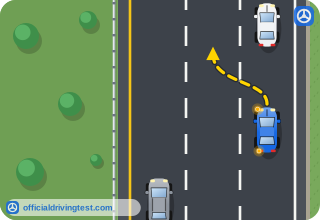
When must you use the appropriate turn signal?
- Only when other vehicles are visible nearby
- Only after you begin to turn
- Before changing direction or slowing the vehicle
- Only when you are turning left
Show answer
Correct answer: Before changing direction or slowing the vehicle
The manual says you must use the appropriate turn signal before changing direction or slowing the vehicle to inform and warn other roadway users.
Source: Kentucky Driver Manual (Updated July 23, 2026), page 54 · Open this page in the manual (Manual page 54)
-
Before which action should you also use your turn signal?
- Driving straight ahead at a steady speed
- Pulling away from the curb
- Checking your blind spots
- Turning on your headlights
Show answer
Correct answer: Pulling away from the curb
The manual lists pulling away from the curb among the times to use your turn signal, along with making a turnabout, entering or leaving a freeway, and pulling over to the side of the road.
Source: Kentucky Driver Manual (Updated July 23, 2026), page 54 · Open this page in the manual (Manual page 54)
-
Why should you signal every time you change direction, even if you do not see anyone else around?
- Other drivers expect it only when no one else is near
- The signal tells approaching traffic to yield to you
- Your signal lights cannot be seen by drivers who are far away
- The vehicle you do not see is the most dangerous
Show answer
Correct answer: The vehicle you do not see is the most dangerous
The manual says to signal every time you change direction because the vehicle you do not see is the most dangerous.
Source: Kentucky Driver Manual (Updated July 23, 2026), page 54 · Open this page in the manual (Manual page 54)
-
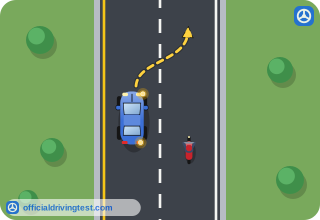
How should you check your blind spots?
- By relying only on your rearview mirror
- By tapping your horn lightly
- By looking over your shoulder
- By flashing your headlights
Show answer
Correct answer: By looking over your shoulder
The manual says to check your blind spots by looking over your shoulder.
Source: Kentucky Driver Manual (Updated July 23, 2026), page 54 · Open this page in the manual (Manual page 54)
-
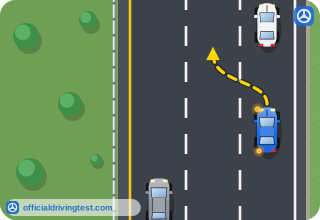
Do you have the right-of-way just by turning on your turn signals?
- No, you do not
- Yes, other drivers must yield once you signal
- Yes, but only on a freeway or interstate
- Yes, but only when you signal well in advance
Show answer
Correct answer: No, you do not
The manual reminds drivers that they do not have the right-of-way just by turning on their turn signals.
Source: Kentucky Driver Manual (Updated July 23, 2026), page 54 · Open this page in the manual (Manual page 54)
-
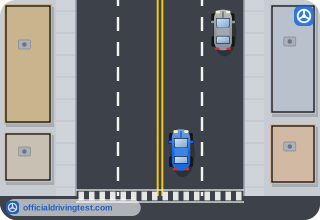
Why should you cancel your turn signals after you finish a turn or lane change?
- To keep your signal lights from wearing out
- To tell other drivers that you have the right-of-way
- To let other drivers know your vehicle is stopping
- To avoid confusing other drivers
Show answer
Correct answer: To avoid confusing other drivers
The manual says to make sure you cancel your signals to avoid confusing other drivers.
Source: Kentucky Driver Manual (Updated July 23, 2026), page 54 · Open this page in the manual (Manual page 54)
-
What kind of signals must your vehicle have?
- Hand signals only, given with your left arm
- Mechanical signals, because hand signals cannot be used
- Either mechanical signals or hand signals
- Mechanical signals, with hand signals as a backup
Show answer
Correct answer: Mechanical signals, because hand signals cannot be used
The manual says your vehicle must have mechanical signals and that hand signals cannot be used.
Source: Kentucky Driver Manual (Updated July 23, 2026), page 54 · Open this page in the manual (Manual page 54)
-
What lets other roadway users know that the vehicle in front of them is slowing down?
- Brake lights
- Hazard flashers
- Headlights
- The horn
Show answer
Correct answer: Brake lights
The manual says brake lights let other roadway users know that the vehicle in front is slowing down.
Source: Kentucky Driver Manual (Updated July 23, 2026), page 54 · Open this page in the manual (Manual page 54)
-
You should signal before reducing speed when you are doing which of these?
- Driving straight through an intersection at a steady speed in the lane
- Increasing your speed to merge onto a freeway
- Turning off a roadway that does not have separate turning or exiting lanes
- Passing a parked vehicle on a wide street
Show answer
Correct answer: Turning off a roadway that does not have separate turning or exiting lanes
The manual says to signal before reducing speed when turning off a roadway that does not have separate turning or exiting lanes.
Source: Kentucky Driver Manual (Updated July 23, 2026), page 54 · Open this page in the manual (Manual page 54)
-
What greatly reduces the chance that your vehicle will have a problem while driving?
- Checking the tire pressure only before long trips
- Replacing the tires every year regardless of wear
- Having the vehicle inspected after every collision
- Following the maintenance schedule in the owner’s manual
Show answer
Correct answer: Following the maintenance schedule in the owner’s manual
Following the recommended maintenance schedule in the owner’s manual greatly reduces the chance of a vehicle problem.
Source: Kentucky Driver Manual (Updated July 23, 2026), page 57 · Open this page in the manual (Manual page 57)
-
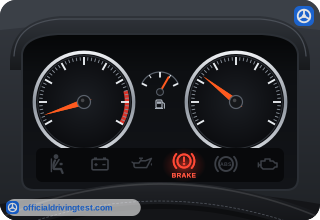
What does a brake warning light tell you?
- Your tires need more air
- Your anti-lock system has been turned off
- Your brakes are not working properly
- Your brake pads are due for replacement
Show answer
Correct answer: Your brakes are not working properly
A brake warning light tells you your brakes are not working properly.
Source: Kentucky Driver Manual (Updated July 23, 2026), page 57 · Open this page in the manual (Manual page 57)
-
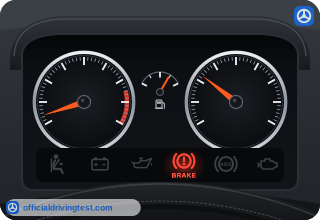
What does the manual say to do if you see your brake warning light?
- Do not drive
- Drive slowly to the nearest repair shop
- Use the parking brake as your main brake
- Keep driving but avoid freeways
Show answer
Correct answer: Do not drive
The manual says not to drive if you see the brake warning light.
Source: Kentucky Driver Manual (Updated July 23, 2026), page 57 · Open this page in the manual (Manual page 57)
-
Compared with low beams, how far do high beams let you see?
- Half as far
- The same distance
- Twice as far
- Three times as far
Show answer
Correct answer: Twice as far
High beams let a driver see twice as far as low beams do.
Source: Kentucky Driver Manual (Updated July 23, 2026), page 68 · Open this page in the manual (Manual page 68)
-
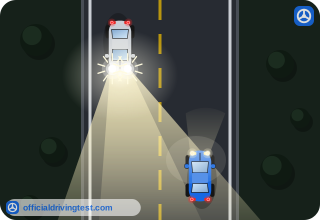
When an oncoming vehicle has its high beams on, where should you look to avoid being distracted or momentarily blinded?
- Directly at the oncoming headlights
- Toward the right side of the road
- Toward the center line
- Toward the left side of the road
Show answer
Correct answer: Toward the right side of the road
Looking toward the right side of the road keeps you from being distracted or momentarily blinded by the oncoming headlights.
Source: Kentucky Driver Manual (Updated July 23, 2026), page 68 · Open this page in the manual (Manual page 68)
-
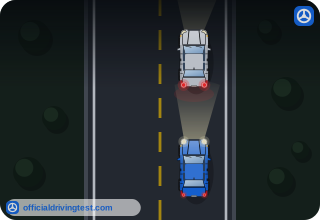
Which headlight setting should you use when following another vehicle, and in fog, rain, or snow?
- High beams
- Parking lights only
- Hazard flashers
- Low beams
Show answer
Correct answer: Low beams
Light from high beams may cause glare, making it more difficult to see ahead, so low beams are used when following another vehicle and in fog, rain, or snow.
Source: Kentucky Driver Manual (Updated July 23, 2026), page 68 · Open this page in the manual (Manual page 68)
-
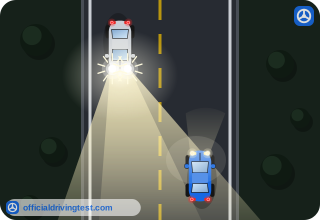
Within what distance of oncoming vehicles should you dim your lights?
- 250 feet
- 1,000 feet
- 100 feet
- 500 feet
Show answer
Correct answer: 500 feet
Lights should be dimmed whenever you come within 500 feet of oncoming vehicles.
Source: Kentucky Driver Manual (Updated July 23, 2026), page 68 · Open this page in the manual (Manual page 68)
-
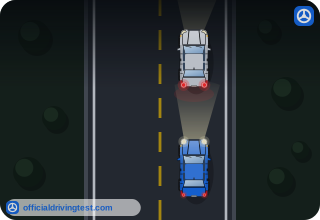
Within what distance of a vehicle you are following should you dim your lights?
- 150 feet
- 300 feet
- 200 feet
- 600 feet
Show answer
Correct answer: 300 feet
Lights should be dimmed whenever you come within 300 feet of any vehicle you are following.
Source: Kentucky Driver Manual (Updated July 23, 2026), page 68 · Open this page in the manual (Manual page 68)
-
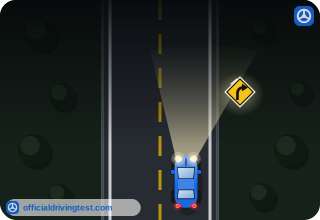
Why should you not wear sunglasses or colored lenses when driving at night or on overcast days?
- They make headlights shine brighter
- They are not allowed under Kentucky law
- Tinted or colored lenses reduce your vision
- They make it harder to hear traffic
Show answer
Correct answer: Tinted or colored lenses reduce your vision
Tinted or colored lenses reduce your vision, so they should not be worn at night or on overcast days.
Source: Kentucky Driver Manual (Updated July 23, 2026), page 68 · Open this page in the manual (Manual page 68)
-
According to the best rule in the manual, when should you turn your headlights on?
- Only after the sun has fully set and it is dark outside
- Only when it is raining
- Whenever you have trouble seeing other vehicles
- Only when driving on unfamiliar roads
Show answer
Correct answer: Whenever you have trouble seeing other vehicles
If you have trouble seeing another vehicle, chances are the other driver is having trouble seeing yours, so headlights should be on.
Source: Kentucky Driver Manual (Updated July 23, 2026), page 68 · Open this page in the manual (Manual page 68)
-
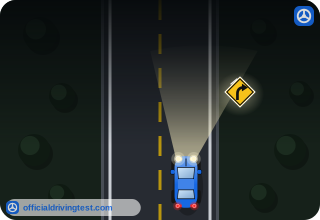
At night, what should you try to look for well ahead of your headlight beams?
- Reflections from the center line only
- Dark shapes on the roadway
- Brake lights of vehicles in other lanes
- The tops of road signs
Show answer
Correct answer: Dark shapes on the roadway
Searching well ahead of your headlight beams for dark shapes on the roadway gives you time to react to hazards.
Source: Kentucky Driver Manual (Updated July 23, 2026), page 68 · Open this page in the manual (Manual page 68)
-
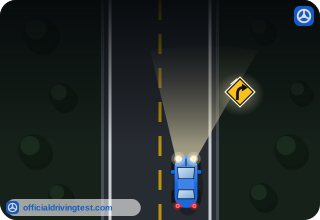
Why should you glance occasionally to the right and left when driving at night?
- To check your mirrors for vehicles following too closely
- To keep your eyes from adjusting to oncoming headlights
- To read road signs before they reach your beams
- To find the edge of the pavement and hazards coming from the sides
Show answer
Correct answer: To find the edge of the pavement and hazards coming from the sides
Glancing right and left helps you determine where the edge of the pavement is and what hazards may come from the sides.
Source: Kentucky Driver Manual (Updated July 23, 2026), page 68 · Open this page in the manual (Manual page 68)
-
How many wheels of an autocycle are in contact with the ground?
- Two
- Four
- Six
- Three
Show answer
Correct answer: Three
An autocycle travels with three wheels in contact with the ground.
Source: Kentucky Driver Manual (Updated July 23, 2026), page 70 · Open this page in the manual (Manual page 70)
-
An autocycle operates at a speed that exceeds how many miles per hour?
- 45 mph
- 40 mph
- 50 mph
- 55 mph
Show answer
Correct answer: 40 mph
One characteristic of an autocycle is operating at a speed that exceeds forty (40) miles per hour.
Source: Kentucky Driver Manual (Updated July 23, 2026), page 70 · Open this page in the manual (Manual page 70)
-
How is an autocycle designed to be controlled?
- With handlebars and hand grips
- With handlebars and foot pedals
- With a steering wheel and pedals
- With a joystick and hand levers
Show answer
Correct answer: With a steering wheel and pedals
An autocycle is designed to be controlled with a steering wheel and pedals.
Source: Kentucky Driver Manual (Updated July 23, 2026), page 70 · Open this page in the manual (Manual page 70)
-
How are the operator and passenger seated in an autocycle?
- As they would be in a passenger car
- Astride a saddle, as on a motorcycle
- Standing on a platform
- Only inside a sidecar
Show answer
Correct answer: As they would be in a passenger car
Autocycle seating is like that of a passenger car.
Source: Kentucky Driver Manual (Updated July 23, 2026), page 70 · Open this page in the manual (Manual page 70)
-
Loading heavier items in the front of a trailer reduces the possibility of what?
- Tire wear
- Sway
- Fuel use
- Hitch damage
Show answer
Correct answer: Sway
Loading heavier items in the front of the trailer reduces the possibility of sway.
Source: Kentucky Driver Manual (Updated July 23, 2026), page 70 · Open this page in the manual (Manual page 70)
-
Where should heavy items be kept in a trailer?
- On top of other items
- Against the rear door of the trailer
- On the floor of the trailer
- Stacked above the axle
Show answer
Correct answer: On the floor of the trailer
Heavy items belong on the floor of the trailer, not packed on top of other items.
Source: Kentucky Driver Manual (Updated July 23, 2026), page 71 · Open this page in the manual (Manual page 71)
-
How should you secure partial loads in a trailer?
- With extra safety chains
- With tie-downs
- With a second hitch
- By placing them at the very back
Show answer
Correct answer: With tie-downs
Cargo should be packed tightly and any partial loads secured with tie-downs.
Source: Kentucky Driver Manual (Updated July 23, 2026), page 71 · Open this page in the manual (Manual page 71)
-
When backing up a trailer, where should you keep your hand on the steering wheel?
- At the top of the steering wheel
- At the bottom of the steering wheel
- At the left side of the wheel only
- With both hands at nine and three o’clock
Show answer
Correct answer: At the bottom of the steering wheel
When backing up a trailer you keep your hand at the bottom of the steering wheel.
Source: Kentucky Driver Manual (Updated July 23, 2026), page 71 · Open this page in the manual (Manual page 71)
-
When backing up a trailer, how do you make the trailer move to the left?
- Move your hand at the bottom of the wheel to the right
- Move your hand at the top of the wheel to the left
- Release the wheel and let the trailer roll
- Move your hand at the bottom of the wheel to the left
Show answer
Correct answer: Move your hand at the bottom of the wheel to the left
With your hand at the bottom of the steering wheel, moving it to the left moves the trailer left.
Source: Kentucky Driver Manual (Updated July 23, 2026), page 71 · Open this page in the manual (Manual page 71)
-
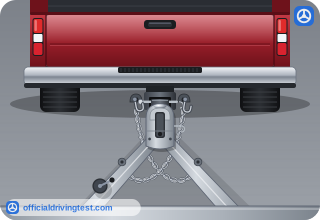
When should you walk around a vehicle-trailer combination to recheck the hitch, coupler, safety chains, lights, and tire pressures?
- Only before the first drive of the day
- Before driving and at each fuel stop
- Only after the trailer has started to sway
- Once a week
Show answer
Correct answer: Before driving and at each fuel stop
The manual says to walk around the combination and recheck the hitch, coupler, safety chains, lights, and tire pressures before driving and at each fuel stop.
Source: Kentucky Driver Manual (Updated July 23, 2026), page 71 · Open this page in the manual (Manual page 71)