Kentucky: Signals and vehicle controls — Part 3 Practice Test
Checking your vehicle, seat and mirror adjustment, starting, stopping, steering and backing, turn signals, lights, the horn, driver-assistance features and towing a trailer. — Part 3
Independent educational site · not affiliated with any government agency or DMV
Ready? Test yourself
- Instant feedback with an explanation
- Every answer cites its source in the manual
- Your best score is saved on this device
Questions are original and based on the official manual "Kentucky Driver Manual" (Updated July 23, 2026), Kentucky State Police.
All 35 questions in this practice test
Take the test above first, then use this list to study. Tap “Show answer” to see the correct answer and explanation.
Show the questions and answersHide the questions
-
Under which conditions does the manual say safety features may not work properly?
- Only in the dark
- Only on four-lane highways
- Rain, snow, ice, fog, hills, and curves
- Only at speeds of less than 25 miles per hour
Show answer
Correct answer: Rain, snow, ice, fog, hills, and curves
The manual says safety features may not work properly in conditions such as rain, snow, ice, fog, hills, and curves.
Source: Kentucky Driver Manual (Updated July 23, 2026), page 32 · Open this page in the manual (Manual page 32)
-
What does the manual say about vehicle sensors?
- Check them only when a warning light comes on
- Always keep them clean and damage free
- Cover them in winter weather
- Replace them each year
Show answer
Correct answer: Always keep them clean and damage free
The manual says to always keep vehicle sensors clean and damage free.
Source: Kentucky Driver Manual (Updated July 23, 2026), page 32 · Open this page in the manual (Manual page 32)
-
What does the manual say to do about the software technology in your vehicle's safety features?
- Update it only when the vehicle is taken to a dealer for a major repair or recall
- Update it once the vehicle is five years old
- Never change it from the factory settings
- Always keep it up to date and follow the manufacturer's recommendations
Show answer
Correct answer: Always keep it up to date and follow the manufacturer's recommendations
The manual says to always keep software technology up to date and follow the vehicle manufacturer's recommendations.
Source: Kentucky Driver Manual (Updated July 23, 2026), page 32 · Open this page in the manual (Manual page 32)
-
Before you turn the key to start the engine, what does the manual say to do?
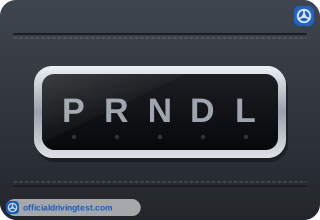
- Press the accelerator and check that the gear selector is in drive
- Place your left foot on the clutch pedal and set the gear selector lever to the neutral position
- Place your right foot on the brake pedal and check that the gear selector is in park
- Set the parking brake and check that the gear selector is in reverse
Show answer
Correct answer: Place your right foot on the brake pedal and check that the gear selector is in park
The manual says to place your right foot on the brake pedal and check the gear selector lever for park.
Source: Kentucky Driver Manual (Updated July 23, 2026), page 33 · Open this page in the manual (Manual page 33)
-
After you turn the ignition switch to the on position, what should you check?
- Indicator lights and gauges, such as fuel level, ABS, and air bags
- Only the tire pressure, the outside mirrors, the fuel level, and the radio
- Only the radio and the climate controls
- Only the mirrors and the head restraint
Show answer
Correct answer: Indicator lights and gauges, such as fuel level, ABS, and air bags
The manual says to check indicator lights and gauges such as fuel level, ABS, and air bags.
Source: Kentucky Driver Manual (Updated July 23, 2026), page 33 · Open this page in the manual (Manual page 33)
-
When moving the vehicle, where should your foot be when you move the gear selector to “D” (drive)?
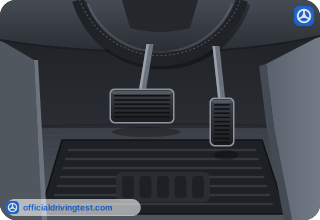
- On the accelerator
- Off both pedals
- On the parking brake
- On the brake pedal
Show answer
Correct answer: On the brake pedal
The manual says to move the gear selector to D while keeping your foot on the brake pedal.
Source: Kentucky Driver Manual (Updated July 23, 2026), page 33 · Open this page in the manual (Manual page 33)
-
Before moving the vehicle, what does the manual say to check?
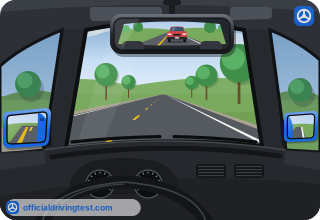
- Only for traffic ahead of your vehicle and for parked cars beside it
- Forward for a safe path, and for traffic to the sides and behind
- Only for traffic behind your vehicle
- Only the indicator lights and gauges
Show answer
Correct answer: Forward for a safe path, and for traffic to the sides and behind
The manual says to check forward for a safe path and for traffic to the sides and behind.
Source: Kentucky Driver Manual (Updated July 23, 2026), page 33 · Open this page in the manual (Manual page 33)
-
How should you accelerate when moving the vehicle?
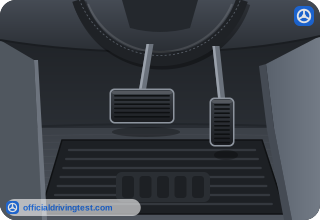
- Gradually and smoothly, with the top of your foot on the pedal, heel on the floor
- Quickly, with your whole foot flat on the pedal
- Gradually, with the heel of your foot on the pedal and the toes of your foot pointed down
- Gently, with your heel lifted off the floor
Show answer
Correct answer: Gradually and smoothly, with the top of your foot on the pedal, heel on the floor
The manual says to accelerate gradually and smoothly with the top of the foot on the pedal and the heel on the floor.
Source: Kentucky Driver Manual (Updated July 23, 2026), page 33 · Open this page in the manual (Manual page 33)
-
What is the first thing the manual says to do when stopping the vehicle?
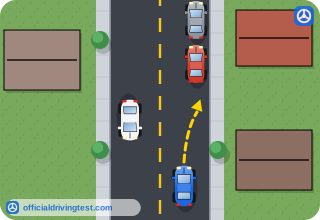
- Shift the gear selector to park before braking
- Sound the horn to warn drivers behind you
- Check your mirrors for traffic to the rear
- Turn on your hazard lights
Show answer
Correct answer: Check your mirrors for traffic to the rear
The manual's stopping steps begin with checking your mirrors for traffic to the rear of your vehicle.
Source: Kentucky Driver Manual (Updated July 23, 2026), page 33 · Open this page in the manual (Manual page 33)
-
How should you press the brake pedal to stop the vehicle?
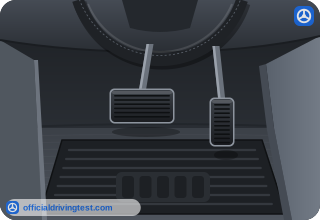
- With quick pumping of the pedal until the vehicle slows
- With steady pressure until the vehicle comes to a stop
- With light taps until the vehicle slows
- With full force until the wheels lock
Show answer
Correct answer: With steady pressure until the vehicle comes to a stop
The manual says to press with steady pressure until your vehicle comes to a stop.
Source: Kentucky Driver Manual (Updated July 23, 2026), page 33 · Open this page in the manual (Manual page 33)
-
In which direction should the steering wheel be turned when moving forward or in reverse?
- In the direction opposite to where the vehicle should move
- In the direction you want the rear of the vehicle to avoid
- In the direction of the nearest curb
- In the direction you want the vehicle to move
Show answer
Correct answer: In the direction you want the vehicle to move
The manual says the steering wheel is always turned in the direction you want the vehicle to move, forward or in reverse.
Source: Kentucky Driver Manual (Updated July 23, 2026), page 33 · Open this page in the manual (Manual page 33)
-
Why is placing your hands at the 2 and 10 o’clock positions no longer recommended?
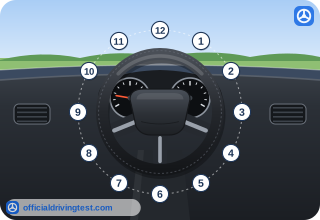
- It reduces your view of the dashboard gauges and mirrors
- It makes the steering wheel hard to turn
- It can be dangerous in a vehicle equipped with air bags
- It tires the arms and shoulders too quickly
Show answer
Correct answer: It can be dangerous in a vehicle equipped with air bags
The manual says the 2 and 10 o'clock hand position can be dangerous in a vehicle equipped with air bags.
Source: Kentucky Driver Manual (Updated July 23, 2026), page 33 · Open this page in the manual (Manual page 33)
-
Where should both hands be placed on the steering wheel to maintain control of the vehicle?
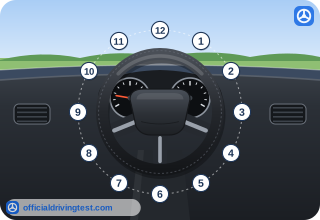
- On the outside of the wheel on opposite sides, at 3 and 9 o’clock
- On the outside of the wheel on opposite sides, at 2 and 10 o’clock
- On the top of the wheel, at 11 and 1 o’clock
- On the inside of the wheel, at 4 and 8 o’clock
Show answer
Correct answer: On the outside of the wheel on opposite sides, at 3 and 9 o’clock
The manual says both hands go on the outside of the wheel on opposite sides, at the 3 and 9 o'clock positions.
Source: Kentucky Driver Manual (Updated July 23, 2026), page 33 · Open this page in the manual (Manual page 33)
-
How does the manual say to grip the steering wheel?
- Tightly, using the palms of your hands with your thumbs wrapped around the rim of the steering wheel
- Loosely, using the palms of your hands with thumbs tucked inside the rim
- Firmly, using your fingertips with thumbs pointing down along the inner rim
- Firmly but gently, using fingers instead of palms, with thumbs up along the face of the wheel
Show answer
Correct answer: Firmly but gently, using fingers instead of palms, with thumbs up along the face of the wheel
The manual says the grip should be firm but gentle, with fingers instead of palms and thumbs up along the face of the wheel.
Source: Kentucky Driver Manual (Updated July 23, 2026), page 33 · Open this page in the manual (Manual page 33)
-
Which of these must you never do while turning the steering wheel?
- Hold it with a firm but gentle grip
- Grip it from the inside of the steering wheel
- Keep your thumbs up along the face of the wheel
- Hold it at the 3 and 9 o’clock positions
Show answer
Correct answer: Grip it from the inside of the steering wheel
The manual says never to turn the wheel while gripping it from the inside of the steering wheel.
Source: Kentucky Driver Manual (Updated July 23, 2026), page 33 · Open this page in the manual (Manual page 33)
-
Why should you check behind your vehicle before you get in to back up?
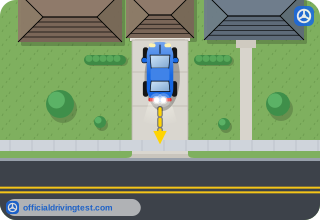
- Children and small objects cannot be seen from the driver’s seat
- Your mirrors fold in when the vehicle is parked
- Your backup lights may not work until the engine has fully warmed up
- Other drivers may be waiting to back out
Show answer
Correct answer: Children and small objects cannot be seen from the driver’s seat
The manual says children and small objects cannot be seen from the driver's seat.
Source: Kentucky Driver Manual (Updated July 23, 2026), page 33 · Open this page in the manual (Manual page 33)
-
When backing up, where should you grasp the steering wheel with your left hand?
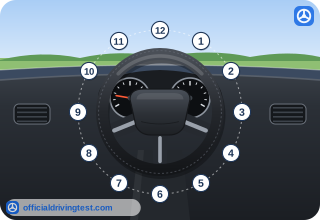
- At the 3 o’clock position
- At the 4 o’clock position
- At the 12 o’clock position
- At the 9 o’clock position
Show answer
Correct answer: At the 12 o’clock position
The manual says to grasp the steering wheel at the 12 o'clock position with your left hand when backing.
Source: Kentucky Driver Manual (Updated July 23, 2026), page 33 · Open this page in the manual (Manual page 33)
-
When backing up, where should you place your right arm and look?
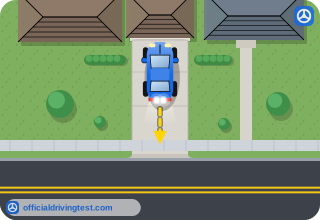
- Right arm on the steering wheel, looking only in the side mirror
- Right arm on the back of the seat, looking directly through the rear window
- Right arm on the dashboard, looking only in the rearview mirror and backup camera
- Right arm on the door, looking only at the backup camera
Show answer
Correct answer: Right arm on the back of the seat, looking directly through the rear window
The manual says to place your right arm on the back of the seat and look directly through the rear window.
Source: Kentucky Driver Manual (Updated July 23, 2026), page 33 · Open this page in the manual (Manual page 33)
-
What should you keep in mind when you use your mirrors for backing up?
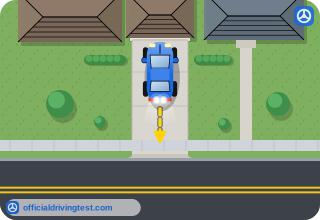
- They show the whole area directly behind and below your vehicle
- They show only the area beside your vehicle
- They work only for the right-hand side
- They do not show the area immediately behind your vehicle
Show answer
Correct answer: They do not show the area immediately behind your vehicle
The manual says mirrors do not show the area immediately behind the vehicle.
Source: Kentucky Driver Manual (Updated July 23, 2026), page 33 · Open this page in the manual (Manual page 33)
-
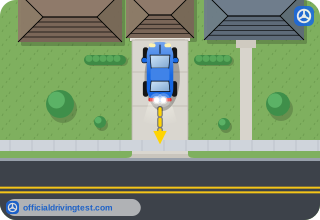
How does the manual say your vehicle steers while you are backing up?
- It is easier to steer
- It steers the same as going forward
- It is much harder to steer
- It steers best at higher speeds
Show answer
Correct answer: It is much harder to steer
The manual says your vehicle is much harder to steer while you are backing up, so you should keep your speed slow.
Source: Kentucky Driver Manual (Updated July 23, 2026), page 33 · Open this page in the manual (Manual page 33)
-
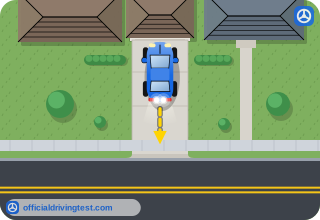
When backing up, in which direction should you steer?
- Slightly in the direction the rear of the vehicle should move
- Sharply in the direction the front of the vehicle should be moving
- Slightly in the direction opposite to the rear's movement
- Sharply toward the curb on the right
Show answer
Correct answer: Slightly in the direction the rear of the vehicle should move
The manual says to steer slightly in the direction the rear of the vehicle should move.
Source: Kentucky Driver Manual (Updated July 23, 2026), page 33 · Open this page in the manual (Manual page 33)
-
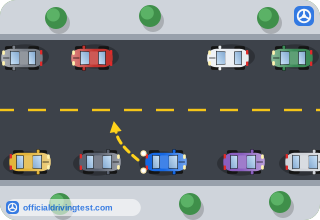
If you are backing up while turning, what does the manual say to do?
- Look only to the rear
- Look only at the side mirrors until the turn ends
- Use only the horn to warn others
- Make quick checks to the front and sides
Show answer
Correct answer: Make quick checks to the front and sides
The manual says to make quick checks to the front and sides when backing up while turning.
Source: Kentucky Driver Manual (Updated July 23, 2026), page 33 · Open this page in the manual (Manual page 33)
-
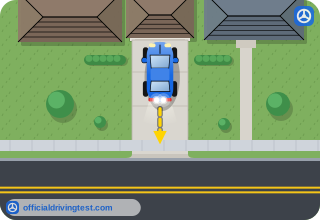
How long should you continue looking to the rear when backing up?
- Until the vehicle starts moving
- Until coming to a complete stop
- Until the vehicle is halfway there
- Until you pass the first car
Show answer
Correct answer: Until coming to a complete stop
The manual says to continue looking to the rear until coming to a complete stop.
Source: Kentucky Driver Manual (Updated July 23, 2026), page 33 · Open this page in the manual (Manual page 33)
-
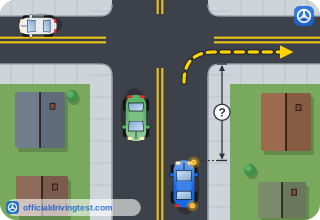
If you plan to turn at an intersection, how far before the turn should you signal?
- 100 feet
- 25 feet
- 50 feet
- 200 feet
Show answer
Correct answer: 100 feet
The manual says to signal 100 feet before a turn at an intersection.
Source: Kentucky Driver Manual (Updated July 23, 2026), page 42 · Open this page in the manual (Manual page 42)
-
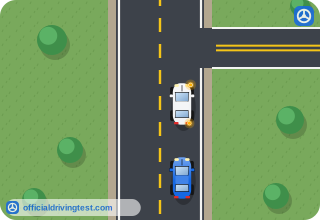
The driver in front of you is signaling for a turn. What should you do about your own turn signal?
- Signal too, so the driver behind you is warned
- Signal only after the other driver has turned
- Signal only if you are also going to turn
- Flash your headlights instead of signaling
Show answer
Correct answer: Signal only if you are also going to turn
You should not signal just because the driver ahead is signaling; signal only if you are also going to turn.
Source: Kentucky Driver Manual (Updated July 23, 2026), page 42 · Open this page in the manual (Manual page 42)
-
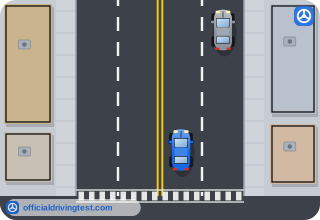
After you turn, what should you make sure of as you accelerate smoothly to an appropriate speed?
- That your headlights are on high beam
- That your hazard lights are flashing
- That your turn signal is cancelled
- That your mirrors are folded in
Show answer
Correct answer: That your turn signal is cancelled
After a turn you accelerate smoothly, make sure your turn signal is cancelled, and check traffic to the rear.
Source: Kentucky Driver Manual (Updated July 23, 2026), page 42 · Open this page in the manual (Manual page 42)
-
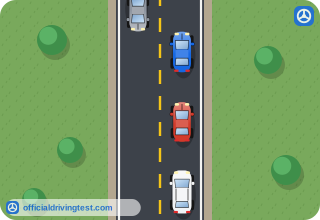
What should you use to check the traffic behind your vehicle?
- Your mirrors
- Your horn
- Your turn signals
- Your headlights
Show answer
Correct answer: Your mirrors
The manual says to use your mirrors to check traffic behind your vehicle. This is very important when changing lanes, slowing down or stopping, and entering an intersection.
Source: Kentucky Driver Manual (Updated July 23, 2026), page 49 · Open this page in the manual (Manual page 49)
-
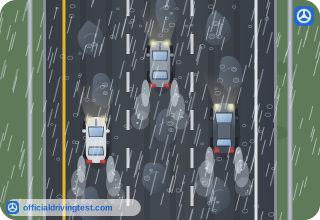
Which headlights should you use in a heavy rain, a snowstorm, or a thick fog?
- High beam headlights
- Parking lights only
- Fog lamps with no headlights
- Low beam headlights
Show answer
Correct answer: Low beam headlights
The manual says you should use low beam headlights when rain, fog, or snow limits how far you can see.
Source: Kentucky Driver Manual (Updated July 23, 2026), page 50 · Open this page in the manual (Manual page 50)
-
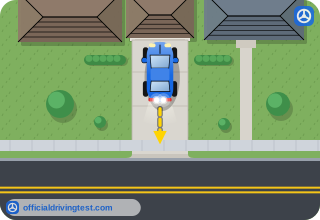
Why does backing require extra caution?
- Your vehicle has less braking power in reverse
- Other drivers cannot see your brake lights
- Your turn signals do not work in reverse
- It is difficult to see behind your vehicle
Show answer
Correct answer: It is difficult to see behind your vehicle
The manual says backing requires extra caution because it is difficult to see behind your vehicle.
Source: Kentucky Driver Manual (Updated July 23, 2026), page 53 · Open this page in the manual (Manual page 53)
-
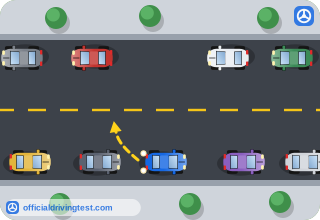
When backing, what should you do whenever possible?
- Back with your horn sounding to warn nearby drivers
- Avoid backing into traffic, or use a person outside the car to help you
- Back up quickly so that you clear the area for other vehicles
- Back only while looking in your rearview mirror
Show answer
Correct answer: Avoid backing into traffic, or use a person outside the car to help you
The manual says to avoid backing into traffic whenever possible or, if possible, to use a person outside the car to help you back.
Source: Kentucky Driver Manual (Updated July 23, 2026), page 53 · Open this page in the manual (Manual page 53)
-
Whose responsibility is it to make sure your vehicle is visible to other roadway users?
- The other drivers
- The police
- Your own
- The pedestrians
Show answer
Correct answer: Your own
The manual says it is your responsibility to make sure your vehicle is visible to other roadway users.
Source: Kentucky Driver Manual (Updated July 23, 2026), page 53 · Open this page in the manual (Manual page 53)
-
During which period must headlights be illuminated?
- From sunset to sunrise
- From one-half hour after sunset to one-half hour before sunrise
- From one hour after sunset to one hour before sunrise
- From one-half hour before sunset to one-half hour after sunrise
Show answer
Correct answer: From one-half hour after sunset to one-half hour before sunrise
Kentucky requires headlights to be illuminated from one-half hour after sunset to one-half hour before sunrise.
Source: Kentucky Driver Manual (Updated July 23, 2026), page 54 · Open this page in the manual (Manual page 54)
-
You are having trouble seeing other vehicles. What should you do?

- Turn your hazard flashers on
- Sound your horn repeatedly
- Drive closer to the other vehicles
- Turn your headlights on
Show answer
Correct answer: Turn your headlights on
The manual says to turn your headlights on whenever you have trouble seeing other vehicles. If you have trouble seeing them, chances are they are having trouble seeing you.
Source: Kentucky Driver Manual (Updated July 23, 2026), page 54 · Open this page in the manual (Manual page 54)
-
Under normal circumstances, how much should you use your horn to get the attention of other road users?
- A long, steady blast
- Two or three short blasts
- A light tap on the horn
- A tap on the horn every few seconds
Show answer
Correct answer: A light tap on the horn
The manual says a light tap on the horn should be all that is needed under normal circumstances.
Source: Kentucky Driver Manual (Updated July 23, 2026), page 54 · Open this page in the manual (Manual page 54)
-
In which situation may you give a light tap on your horn?
- Pedestrians or bicyclists appear to be moving into your lane of travel
- A driver ahead is waiting for a traffic light to change
- A blind pedestrian is crossing the road in front of you
- You want a slower driver who is in front of you to speed up now
Show answer
Correct answer: Pedestrians or bicyclists appear to be moving into your lane of travel
The manual lists pedestrians or bicyclists who appear to be moving into your lane of travel as a time to give a light tap on the horn.
Source: Kentucky Driver Manual (Updated July 23, 2026), page 54 · Open this page in the manual (Manual page 54)