Kentucky: Signals and vehicle controls — Part 1 Practice Test
Checking your vehicle, seat and mirror adjustment, starting, stopping, steering and backing, turn signals, lights, the horn, driver-assistance features and towing a trailer. — Part 1
Independent educational site · not affiliated with any government agency or DMV
Ready? Test yourself
- Instant feedback with an explanation
- Every answer cites its source in the manual
- Your best score is saved on this device
Questions are original and based on the official manual "Kentucky Driver Manual" (Updated July 23, 2026), Kentucky State Police.
All 35 questions in this practice test
Take the test above first, then use this list to study. Tap “Show answer” to see the correct answer and explanation.
Show the questions and answersHide the questions
-
Where does the manual say a moped rider can become familiar with the vehicle’s controls?
- On a limited-access highway with a licensed driver
- On a busy street during rush hour
- Only at an approved rider training course
- In a parking lot or other off-street area
Show answer
Correct answer: In a parking lot or other off-street area
Familiarity with the controls can be learned by operating the vehicle in a parking lot or other off-street area.
Source: Kentucky Driver Manual (Updated July 23, 2026), page 3 · Open this page in the manual (Manual page 3)
-
Which of these must the applicant show knowledge of how to operate during the vehicle inspection?
- The dimmer switch
- The cruise control
- The air conditioner
- The rear window defroster
Show answer
Correct answer: The dimmer switch
The applicant must show how to operate the headlights, dimmer switch, horn, windshield wipers, turn signals, emergency brake, emergency flashers, and brake lights.
Source: Kentucky Driver Manual (Updated July 23, 2026), page 11 · Open this page in the manual (Manual page 11)
-
Each separate means of applying a vehicle's brakes must be effective on at least how many wheels?
- One
- Three
- Four
- Two
Show answer
Correct answer: Two
The brakes must have separate means of applying them, each effective on at least two wheels.
Source: Kentucky Driver Manual (Updated July 23, 2026), page 11 · Open this page in the manual (Manual page 11)
-
How many headlights and taillights must a vehicle have?
- Two headlights and one taillight
- Two headlights and two taillights
- One headlight and two taillights
- One headlight and one taillight
Show answer
Correct answer: Two headlights and two taillights
A vehicle must have two headlights and two taillights.
Source: Kentucky Driver Manual (Updated July 23, 2026), page 12 · Open this page in the manual (Manual page 12)
-
High-beam headlights must be strong enough to light the road sufficiently to reveal a person how far ahead?
- 350 feet
- 150 feet
- 250 feet
- 450 feet
Show answer
Correct answer: 350 feet
On high beam, headlights must reveal a person 350 feet ahead.
Source: Kentucky Driver Manual (Updated July 23, 2026), page 12 · Open this page in the manual (Manual page 12)
-
Low-beam headlights must be strong enough to light the road sufficiently to reveal a person how far ahead?
- 50 feet
- 150 feet
- 100 feet
- 250 feet
Show answer
Correct answer: 100 feet
On low beam, headlights must reveal a person 100 feet ahead.
Source: Kentucky Driver Manual (Updated July 23, 2026), page 12 · Open this page in the manual (Manual page 12)
-
Which requirement applies to a vehicle's headlights?
- On low beam, they must reveal a person 350 feet ahead
- They must not glare into the eyes of an oncoming driver
- On high beam, they must reveal a person 100 feet ahead
- They must be red and visible from 500 feet away
Show answer
Correct answer: They must not glare into the eyes of an oncoming driver
Headlights must not shine a glaring light into the eyes of an oncoming driver.
Source: Kentucky Driver Manual (Updated July 23, 2026), page 12 · Open this page in the manual (Manual page 12)
-
A taillight must be lighted and placed so it can be seen how far behind the vehicle?
- 150 feet
- 250 feet
- 350 feet
- 500 feet
Show answer
Correct answer: 500 feet
The taillight must be red and visible 500 feet behind the vehicle.
Source: Kentucky Driver Manual (Updated July 23, 2026), page 12 · Open this page in the manual (Manual page 12)
-
What color must the rear light, or taillight, be?
- White
- Amber
- Red
- Yellow
Show answer
Correct answer: Red
The rear light, or taillight, must be red.
Source: Kentucky Driver Manual (Updated July 23, 2026), page 12 · Open this page in the manual (Manual page 12)
-
The mechanical signal device that shows an intention to stop or suddenly decrease speed must light at least how many red lights on the rear of the vehicle?
- Two
- One
- Three
- Four
Show answer
Correct answer: Two
Brake lights must illuminate at least two red lights on the rear of the vehicle.
Source: Kentucky Driver Manual (Updated July 23, 2026), page 12 · Open this page in the manual (Manual page 12)
-
Which statement about the registration plate is correct?
- It must be legible only during daylight hours
- It must be illuminated only in rain or fog
- It may be partly covered if it is kept clean and dry
- It must be kept legible at all times and illuminated at night
Show answer
Correct answer: It must be kept legible at all times and illuminated at night
The registration plate must be kept legible at all times and must be illuminated at night.
Source: Kentucky Driver Manual (Updated July 23, 2026), page 12 · Open this page in the manual (Manual page 12)
-
Which of these is acceptable on a vehicle's windshield?
- A small sign in the lower corner
- Sun screening material along a strip at the top
- Sun screening material across the whole windshield
- A decorative sticker above the dashboard
Show answer
Correct answer: Sun screening material along a strip at the top
Only certificates or papers required by law and sun screening material along a strip at the top of the windshield are acceptable.
Source: Kentucky Driver Manual (Updated July 23, 2026), page 12 · Open this page in the manual (Manual page 12)
-
What is required on the driver's side of the windshield?
- A windshield wiper
- A sun visor
- A tinted strip
- A defroster vent
Show answer
Correct answer: A windshield wiper
A windshield wiper is required on the driver's side of the windshield.
Source: Kentucky Driver Manual (Updated July 23, 2026), page 12 · Open this page in the manual (Manual page 12)
-
Which vehicles must be equipped with a horn or other device that makes an abrupt sound when in use on a highway?
- Only motor vehicles, but not bicycles
- Only trucks and buses on a highway
- Every motor vehicle and every bicycle
- Only vehicles used in business
Show answer
Correct answer: Every motor vehicle and every bicycle
Every motor vehicle, and bicycle, in use on a highway must have a horn or other device loud enough to be heard under ordinary traffic conditions.
Source: Kentucky Driver Manual (Updated July 23, 2026), page 12 · Open this page in the manual (Manual page 12)
-
What is the purpose of the muffler on the exhaust?
- To increase engine power and improve fuel economy
- To reduce noise and smoke and protect occupants from fumes
- To help the engine start quickly in cold weather
- To keep rain and snow out of the exhaust pipe
Show answer
Correct answer: To reduce noise and smoke and protect occupants from fumes
A muffler reduces noise and annoying smoke while protecting the occupants from poisonous fumes.
Source: Kentucky Driver Manual (Updated July 23, 2026), page 12 · Open this page in the manual (Manual page 12)
-
Which mirror arrangement does the manual require?
- A single mirror mounted inside the vehicle only
- Two mirrors, both mounted on the right side of the vehicle
- A single mirror mounted on the left side only
- One on the left, one inside near center or on the right
Show answer
Correct answer: One on the left, one inside near center or on the right
A vehicle needs one mirror on the left side and one either inside near the center or on the right side.
Source: Kentucky Driver Manual (Updated July 23, 2026), page 12 · Open this page in the manual (Manual page 12)
-
What does the manual require of a vehicle's steering?
- It must be power-assisted
- It must be checked by a mechanic before the test
- It must not be defective and must be in good condition
- It must have a tilt adjustment
Show answer
Correct answer: It must not be defective and must be in good condition
Steering must not be defective and must be in good condition.
Source: Kentucky Driver Manual (Updated July 23, 2026), page 12 · Open this page in the manual (Manual page 12)
-
Which statement about turn signals as required vehicle equipment is correct?
- Mechanical turn signals are required and must work
- Turn signals are required only at night
- Turn signals are optional if the driver gives hand signals
- Turn signals are required only on vehicles made after 1981
Show answer
Correct answer: Mechanical turn signals are required and must work
Mechanical turn signals are required equipment and must be in working order.
Source: Kentucky Driver Manual (Updated July 23, 2026), page 12 · Open this page in the manual (Manual page 12)
-
What may happen if the test vehicle has missing or inoperable equipment that would make it unlawful or unsafe?
- The applicant continues with a warning
- The test may be canceled or rescheduled
- The applicant automatically fails the road test
- The applicant must repeat the written test
Show answer
Correct answer: The test may be canceled or rescheduled
Missing or inoperable equipment that would render the vehicle unlawful or unsafe may cause the test to be canceled or rescheduled.
Source: Kentucky Driver Manual (Updated July 23, 2026), page 12 · Open this page in the manual (Manual page 12)
-
Which of these could cause the examiner to reject the vehicle for use during a road test?
- Flashing lights other than the turn signals
- A mirror mounted inside near the center
- A horn that can be heard in ordinary traffic
- A license plate that is lighted at night
Show answer
Correct answer: Flashing lights other than the turn signals
Excessive window tint, flashing lights other than the turn signals, or any item that obstructs vision through the windshield could cause the examiner to reject the vehicle.
Source: Kentucky Driver Manual (Updated July 23, 2026), page 12 · Open this page in the manual (Manual page 12)
-
Motor vehicles are major contributors to which kind of pollution?
- Ground-level ozone
- Acid rain
- Water runoff
- Noise pollution
Show answer
Correct answer: Ground-level ozone
The manual states that motor vehicles are major contributors to ground level ozone.
Source: Kentucky Driver Manual (Updated July 23, 2026), page 21 · Open this page in the manual (Manual page 21)
-
Who is at the highest risk for health issues related to ground-level ozone?
- Only people who drive more than 100 miles every single day
- Only people who live in a house next to a busy highway
- Only people who own a vehicle that is more than ten years old
- Younger children, older adults, and people who work or play outside
Show answer
Correct answer: Younger children, older adults, and people who work or play outside
Younger children, older adults, and people who work or play outside are at the highest risk.
Source: Kentucky Driver Manual (Updated July 23, 2026), page 21 · Open this page in the manual (Manual page 21)
-
What happens to the emission levels of today’s new vehicles unless they are carefully maintained?
- Their emission levels stay at the new-vehicle level
- Their emission levels will increase
- Their emission levels drop as the engine wears in
- Their emission levels only change after ten years
Show answer
Correct answer: Their emission levels will increase
New vehicles emit fewer pollutants than older ones, but their emission levels will increase unless they are carefully maintained.
Source: Kentucky Driver Manual (Updated July 23, 2026), page 21 · Open this page in the manual (Manual page 21)
-
What do vehicle emissions testing programs in major population centers of Kentucky do?
- Identify vehicles with increased emission levels and alert owners
- Remove vehicles with high emissions from the road for good
- Lower the registration cost for vehicles that pass the test
- Require every vehicle owner to buy a newer vehicle model
Show answer
Correct answer: Identify vehicles with increased emission levels and alert owners
Emissions testing programs identify vehicles with increased emission levels, alerting the owner to needed maintenance.
Source: Kentucky Driver Manual (Updated July 23, 2026), page 21 · Open this page in the manual (Manual page 21)
-
As a vehicle is repaired and its emissions are reduced, what will the owner usually see?
- A lower registration renewal deadline
- Longer waits at emissions testing sites
- Improvements in performance and fuel economy
- Less need for any later maintenance
Show answer
Correct answer: Improvements in performance and fuel economy
As vehicles are repaired, emissions are reduced and the owner will usually see improvements in performance and fuel economy.
Source: Kentucky Driver Manual (Updated July 23, 2026), page 21 · Open this page in the manual (Manual page 21)
-
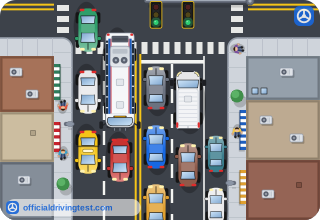
What does the manual advise about rush hours and congested areas to reduce driving pollution?
- Drive in them to keep up with traffic
- Avoid them when possible
- Use them to save time on long trips
- Drive through them only at night
Show answer
Correct answer: Avoid them when possible
The manual advises that you avoid rush hours and congested areas when possible.
Source: Kentucky Driver Manual (Updated July 23, 2026), page 21 · Open this page in the manual (Manual page 21)
-
What does the manual advise about trips to cut down on driving?
- Make a separate short trip for each errand
- Drive each trip at a different time of day
- Combine as many trips as you can
- Take the longest route to avoid traffic
Show answer
Correct answer: Combine as many trips as you can
The manual advises you to combine as many trips as you can.
Source: Kentucky Driver Manual (Updated July 23, 2026), page 21 · Open this page in the manual (Manual page 21)
-
According to the manual, when is your vehicle the safest and most economical?
- When it is parked
- When it is driven at night
- When it is driven on a freeway
- When it is warming up
Show answer
Correct answer: When it is parked
The manual states that your vehicle is the safest and most economical when it is parked.
Source: Kentucky Driver Manual (Updated July 23, 2026), page 21 · Open this page in the manual (Manual page 21)
-
Which of these does the manual suggest as a way to drive less?
- Driving only at night
- Buying a larger vehicle
- Taking longer routes
- Carpooling
Show answer
Correct answer: Carpooling
The manual suggests carpooling, taking a bus, using a bicycle, or walking.
Source: Kentucky Driver Manual (Updated July 23, 2026), page 21 · Open this page in the manual (Manual page 21)
-
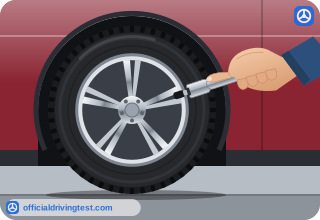
How often does the manual say you should check your tire pressure with a pressure gauge?
- Monthly
- Weekly
- Every six months
- Once a year
Show answer
Correct answer: Monthly
The manual's heading tells drivers to check tire pressure with a pressure gauge monthly.
Source: Kentucky Driver Manual (Updated July 23, 2026), page 28 · Open this page in the manual (Manual page 28)
-
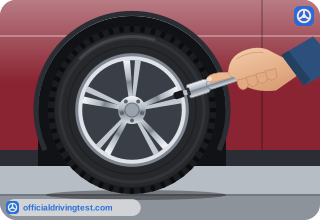
Where does the manual say to look for the sticker that gives the recommended tire pressure (PSI)?
- On the side of the spare tire
- Under the hood next to the battery
- On the inside jamb of the car door
- On a label inside the glove compartment lid or the trunk
Show answer
Correct answer: On the inside jamb of the car door
The manual says the PSI sticker is on the inside jamb when you open the car door.
Source: Kentucky Driver Manual (Updated July 23, 2026), page 28 · Open this page in the manual (Manual page 28)
-
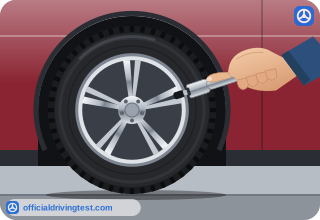
When should you check your tire pressure with a gauge?
- Right after a long highway drive
- When the tires are cold
- When the tires are hot
- Only after the tires have been rotated
Show answer
Correct answer: When the tires are cold
The manual says to make sure you check tire pressure when the tires are cold.
Source: Kentucky Driver Manual (Updated July 23, 2026), page 28 · Open this page in the manual (Manual page 28)
-
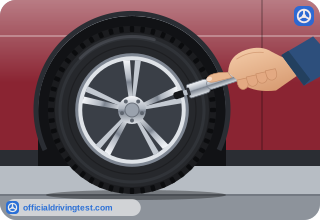
If the tire pressure gauge reads lower than the number on your door-jamb sticker, what should you do?
- Let some air out of the tires until they feel soft
- Leave the tires as they are
- Replace the valve stem cap
- Inflate the tires until the numbers match
Show answer
Correct answer: Inflate the tires until the numbers match
When the number is too low, the manual says to inflate the tires until the numbers match.
Source: Kentucky Driver Manual (Updated July 23, 2026), page 28 · Open this page in the manual (Manual page 28)
-
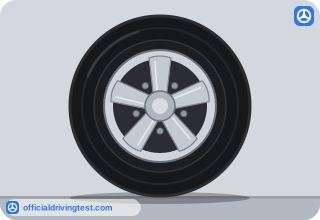
In the penny tread-depth test, how do you place the penny into the tire groove?
- Lincoln's head last, into the shallowest groove of the tire
- Flat against the side of the tire
- Lincoln's head first, into the deepest-looking groove
- Lincoln's body first, into the outer groove
Show answer
Correct answer: Lincoln's head first, into the deepest-looking groove
The manual says to place Lincoln's head first into the deepest-looking groove.
Source: Kentucky Driver Manual (Updated July 23, 2026), page 28 · Open this page in the manual (Manual page 28)
-
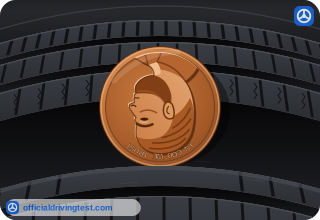
In the penny test, you can see all of Lincoln's head. What does this mean?
- The tires are too worn and should be replaced
- The tires have enough tread for a few more months
- The tires are overinflated and need air let out
- The tires have good tread and are safe to use
Show answer
Correct answer: The tires are too worn and should be replaced
If all of the head is visible, the tires are too worn and must not be driven on.
Source: Kentucky Driver Manual (Updated July 23, 2026), page 28 · Open this page in the manual (Manual page 28)