Kentucky: Pedestrians Practice Test
Yielding to pedestrians at crosswalks and corners, pedestrians stepping out between parked cars, and blind pedestrians.
Independent educational site · not affiliated with any government agency or DMV
Ready? Test yourself
- Instant feedback with an explanation
- Every answer cites its source in the manual
- Your best score is saved on this device
Questions are original and based on the official manual "Kentucky Driver Manual" (Updated July 23, 2026), Kentucky State Police.
All 21 questions in this practice test
Take the test above first, then use this list to study. Tap “Show answer” to see the correct answer and explanation.
Show the questions and answersHide the questions
-
What do crosswalks define?
- The area where drivers may park near an intersection
- The area where pedestrians must wait for traffic
- The area where vehicles must stop in all cases
- The area where pedestrians may cross the roadway
Show answer
Correct answer: The area where pedestrians may cross the roadway
Crosswalks define the area where pedestrians may cross the roadway.
Source: Kentucky Driver Manual (Updated July 23, 2026), page 39 · Open this page in the manual (Manual page 39)
-
What must you do when a pedestrian is entering or in a crosswalk?
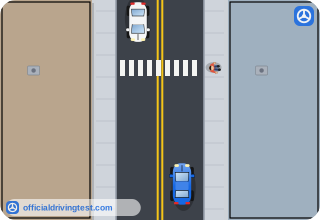
- Sound your horn and proceed
- Go ahead if the crosswalk is unmarked
- Yield to the pedestrian
- Yield only if there is a stop line
Show answer
Correct answer: Yield to the pedestrian
You must yield to pedestrians entering or in a crosswalk.
Source: Kentucky Driver Manual (Updated July 23, 2026), page 39 · Open this page in the manual (Manual page 39)
-
Which statement about crosswalks does the manual make?
- All of them are marked with painted lines
- Pedestrians may cross only where lines are painted
- Not all of them are marked
- Only crosswalks at traffic signals exist
Show answer
Correct answer: Not all of them are marked
The manual says not all crosswalks are marked, so you should be alert for pedestrians when crossing intersections.
Source: Kentucky Driver Manual (Updated July 23, 2026), page 39 · Open this page in the manual (Manual page 39)
-
In which situation should a driver always be prepared to yield to pedestrians?
- Even when the pedestrians are not in a crosswalk
- Only when pedestrians are in a marked crosswalk
- Only at intersections controlled by traffic lights
- Only when pedestrians are crossing in a school zone
Show answer
Correct answer: Even when the pedestrians are not in a crosswalk
The manual says you should always be prepared to yield to pedestrians even if they are not in a crosswalk.
Source: Kentucky Driver Manual (Updated July 23, 2026), page 59 · Open this page in the manual (Manual page 59)
-
A pedestrian is in a crosswalk that has no painted markings. What must a driver do?
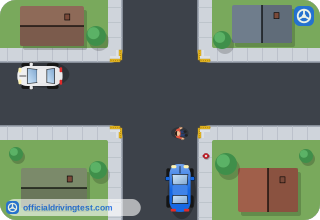
- Continue if the pedestrian is not in your lane
- Sound the horn so the pedestrian will wait
- Yield to the pedestrian
- Pass in front of the pedestrian if there is room
Show answer
Correct answer: Yield to the pedestrian
A driver must yield when a pedestrian is in a crosswalk, even if the crosswalk is unmarked.
Source: Kentucky Driver Manual (Updated July 23, 2026), page 59 · Open this page in the manual (Manual page 59)
-
Pedestrians are crossing in the intersection while your traffic light is green. What must you do?
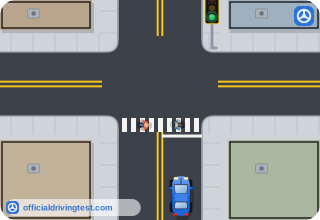
- Go ahead, because the green light gives you the right of way
- Yield the right of way to the pedestrians
- Go ahead if you are turning and the pedestrians are far away
- Stop only if the pedestrians are children
Show answer
Correct answer: Yield the right of way to the pedestrians
A driver must yield the right of way to all pedestrians in the intersection even if the traffic light is green.
Source: Kentucky Driver Manual (Updated July 23, 2026), page 59 · Open this page in the manual (Manual page 59)
-
What must you be prepared to do when making a right or left turn on red?
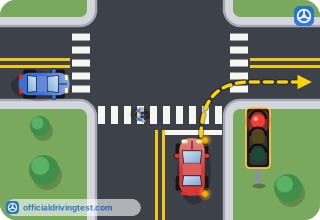
- Flash your headlights at pedestrians to warn them
- Sound your horn to clear the crosswalk
- Speed up to finish the turn before pedestrians step out
- Yield the right of way to pedestrians
Show answer
Correct answer: Yield the right of way to pedestrians
When turning on red, a driver must be prepared to yield the right of way to pedestrians.
Source: Kentucky Driver Manual (Updated July 23, 2026), page 59 · Open this page in the manual (Manual page 59)
-
You are driving next to parked or stopped vehicles. What should you do about pedestrians who may walk out from between them?
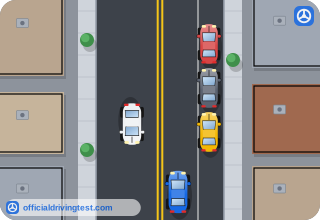
- Slow down and do not pass until you are sure no one is crossing in front of you
- Stay close to the parked vehicles so that pedestrians can see you clearly
- Sound your horn and keep passing at the same speed
- Move toward the center line and pass at the speed limit
Show answer
Correct answer: Slow down and do not pass until you are sure no one is crossing in front of you
Pedestrians can walk out between parked or stopped vehicles, so a driver must slow down and not pass until sure that no pedestrians are crossing in front of the vehicle.
Source: Kentucky Driver Manual (Updated July 23, 2026), page 59 · Open this page in the manual (Manual page 59)
-
Where is checking for pedestrians in your path before backing especially important?
- On interstate highway entrance ramps
- On open rural roads with few buildings and few pedestrians
- In parking lots or places where there are many pedestrians
- On roads with no sidewalks or crosswalks
Show answer
Correct answer: In parking lots or places where there are many pedestrians
The manual says to check for pedestrians in your path before backing, especially in parking lots or places where there are many pedestrians.
Source: Kentucky Driver Manual (Updated July 23, 2026), page 59 · Open this page in the manual (Manual page 59)
-
In playground and residential areas where children could run out from between parked vehicles, what is a good idea?
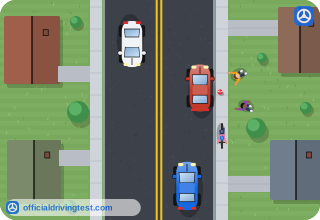
- Drive at exactly the posted speed limit and stay in the center of the road
- Drive slower than the speed limit and be prepared to stop quickly
- Sound your horn continuously until the area is behind you
- Drive as close to the parked vehicles as possible
Show answer
Correct answer: Drive slower than the speed limit and be prepared to stop quickly
Children could run out from between parked vehicles, so it is a good idea to drive slower than the speed limit and be ready to stop quickly.
Source: Kentucky Driver Manual (Updated July 23, 2026), page 59 · Open this page in the manual (Manual page 59)
-
When must you obey a slower speed limit in a school zone?
- Only when a police officer is in sight
- Only when a school bus is stopped nearby
- Only between sunrise and sunset
- When lights are flashing or children are present
Show answer
Correct answer: When lights are flashing or children are present
In a school zone, a slower speed limit must be obeyed when lights are flashing or children are present.
Source: Kentucky Driver Manual (Updated July 23, 2026), page 59 · Open this page in the manual (Manual page 59)
-
You approach a school crossing where there is traffic patrol and you are signaled to stop. What must you do?
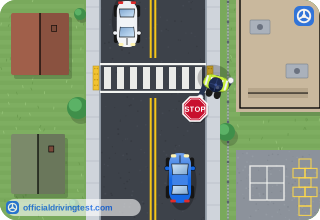
- Stop and yield
- Slow down and continue if no children are in your lane
- Slow down and pass on the left of the patrol
- Stop only if the crossing has a marked crosswalk
Show answer
Correct answer: Stop and yield
At a school crossing with traffic patrol, you must stop and yield if you are signaled to do so.
Source: Kentucky Driver Manual (Updated July 23, 2026), page 59 · Open this page in the manual (Manual page 59)
-
What must a pedestrian do when crossing a roadway at a point other than a marked crosswalk or an unmarked crosswalk at an intersection?
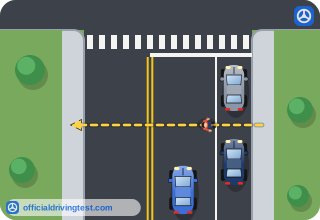
- Have the right-of-way over vehicles that are turning
- Wait for a police officer to give a signal
- Yield the right-of-way to all vehicles
- Cross only after vehicles in both directions have stopped
Show answer
Correct answer: Yield the right-of-way to all vehicles
A pedestrian crossing at such a point must yield the right-of-way to all vehicles.
Source: Kentucky Driver Manual (Updated July 23, 2026), page 59 · Open this page in the manual (Manual page 59)
-
Kentucky law requires drivers to yield the right-of-way to a blind pedestrian who has what?
- A reflective vest or a flashing light
- A clearly visible white cane or an assistance dog
- A companion walking on the traffic side
- A hand-held sign asking all drivers to stop
Show answer
Correct answer: A clearly visible white cane or an assistance dog
Kentucky law requires operators of a vehicle to yield to a blind pedestrian carrying a clearly visible white cane or accompanied by an assistance dog.
Source: Kentucky Driver Manual (Updated July 23, 2026), page 59 · Open this page in the manual (Manual page 59)
-
Failure to yield the right-of-way to a blind pedestrian could result in a fine of up to how much?
- $100
- $150
- $500
- $250
Show answer
Correct answer: $250
Failing to yield to a blind pedestrian is a violation that could result in a fine up to two hundred fifty dollars ($250).
Source: Kentucky Driver Manual (Updated July 23, 2026), page 59 · Open this page in the manual (Manual page 59)
-
At a stop light or sign, how far from the crosswalk should you avoid stopping your vehicle, unless there is an advanced stop bar, so a blind pedestrian can hear you?
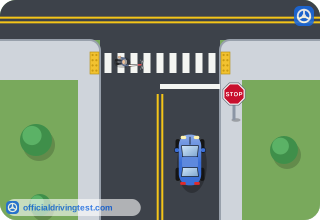
- More than 5 feet
- More than 2 feet
- More than 10 feet
- More than 15 feet
Show answer
Correct answer: More than 5 feet
A blind pedestrian uses the sound of your vehicle as a guide, so you should not stop more than five feet from the crosswalk unless there is an advanced stop bar.
Source: Kentucky Driver Manual (Updated July 23, 2026), page 59 · Open this page in the manual (Manual page 59)
-
Why must drivers of electric and hybrid vehicles be extra alert to blind pedestrians?
- These vehicles have larger blind spots than other vehicles
- These vehicles accelerate faster than other vehicles
- The pedestrians may be unaware of the vehicle because it is so quiet
- These vehicles cannot sound a horn as loudly
Show answer
Correct answer: The pedestrians may be unaware of the vehicle because it is so quiet
Because electric and hybrid vehicles are silent, blind pedestrians may be unaware of their presence.
Source: Kentucky Driver Manual (Updated July 23, 2026), page 59 · Open this page in the manual (Manual page 59)
-
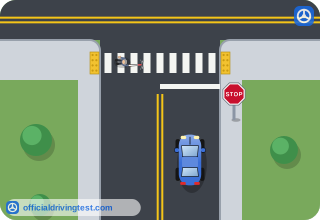
Why should you not give a blind pedestrian verbal directions?
- The pedestrian cannot hear a voice over the engine noise
- The pedestrian listens to all traffic sounds before deciding to cross
- It is against the law to speak to a pedestrian from a vehicle
- The pedestrian is probably wearing headphones
Show answer
Correct answer: The pedestrian listens to all traffic sounds before deciding to cross
A blind pedestrian listens to all traffic sounds before deciding to cross the street.
Source: Kentucky Driver Manual (Updated July 23, 2026), page 60 · Open this page in the manual (Manual page 60)
-
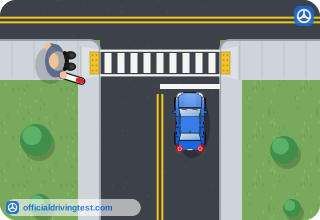
A blind pedestrian takes a step back and pulls in the cane. What does this mean?
- The pedestrian needs you to honk your horn
- The pedestrian is about to cross, so you should keep waiting
- The pedestrian is asking for directions
- It is a definite sign that you should go
Show answer
Correct answer: It is a definite sign that you should go
If the person takes a step back and pulls in the cane, that is a definite sign you should go.
Source: Kentucky Driver Manual (Updated July 23, 2026), page 60 · Open this page in the manual (Manual page 60)
-
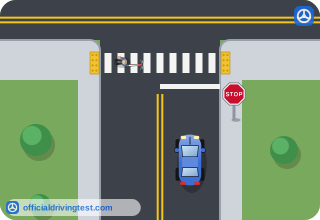
Why should you not stop in the middle of a crosswalk when a blind pedestrian is waiting to cross?
- It forces the pedestrian to go around your car into traffic
- It prevents the pedestrian from hearing your engine
- It blocks the view of drivers in other lanes
- It signals the pedestrian to cross too early
Show answer
Correct answer: It forces the pedestrian to go around your car into traffic
Stopping in the middle of a crosswalk forces the blind pedestrian to go around your car and into traffic outside of the crosswalk.
Source: Kentucky Driver Manual (Updated July 23, 2026), page 60 · Open this page in the manual (Manual page 60)
-
Why should you not honk your horn at a blind person?
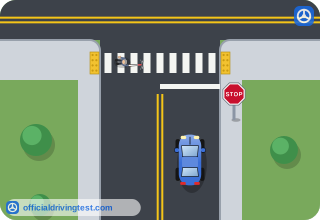
- The horn will make the person hurry across the street faster
- The horn tells the person that it is safe to cross
- The person has no idea who you are honking at and may be startled
- The law prohibits using a horn near any pedestrian
Show answer
Correct answer: The person has no idea who you are honking at and may be startled
A blind person cannot tell who is being honked at and may be startled by the noise.
Source: Kentucky Driver Manual (Updated July 23, 2026), page 60 · Open this page in the manual (Manual page 60)