Kentucky: Pavement markings Practice Test
Yellow and white lines, passing and no-passing markings, crosswalks and stop lines.
Independent educational site · not affiliated with any government agency or DMV
Ready? Test yourself
- Instant feedback with an explanation
- Every answer cites its source in the manual
- Your best score is saved on this device
Questions are original and based on the official manual "Kentucky Driver Manual" (Updated July 23, 2026), Kentucky State Police.
All 10 questions in this practice test
Take the test above first, then use this list to study. Tap “Show answer” to see the correct answer and explanation.
Show the questions and answersHide the questions
-
What are pavement markings?
- Signs mounted above the lanes to give drivers directions
- Lines, arrows, words, or symbols painted on the roadway
- Raised ridges on the road that warn you when you leave the lane
- Lights placed along the edge of the roadway for night driving
Show answer
Correct answer: Lines, arrows, words, or symbols painted on the roadway
Pavement markings are lines, arrows, words, or symbols painted on the roadway to give you directions or warnings.
Source: Kentucky Driver Manual (Updated July 23, 2026), page 39 · Open this page in the manual (Manual page 39)
-
Which is a purpose of pavement markings?
- Showing where you must stop for signs or traffic signals
- Showing the maximum speed limit for each lane of traffic
- Showing the distance to the next town or city ahead
- Showing which streets allow parking overnight for residents
Show answer
Correct answer: Showing where you must stop for signs or traffic signals
Pavement markings are used to show where you must stop for signs or traffic signals.
Source: Kentucky Driver Manual (Updated July 23, 2026), page 39 · Open this page in the manual (Manual page 39)
-
What does a center marking of two solid yellow lines mean on a two-direction roadway?
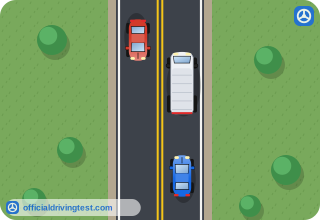
- Passing is permitted in both directions
- Passing is prohibited for one direction only
- Passing is prohibited in both directions
- Passing is permitted only during daylight hours
Show answer
Correct answer: Passing is prohibited in both directions
Two solid yellow center lines on a two-direction roadway mean passing is prohibited in both directions.
Source: Kentucky Driver Manual (Updated July 23, 2026), page 39 · Open this page in the manual (Manual page 39)
-
What does a single broken yellow center line on a two-direction roadway mean?
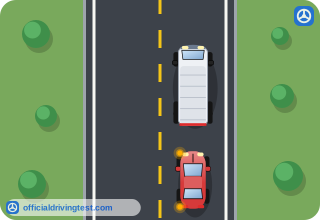
- Passing is prohibited in both directions
- Passing is permitted
- Passing is permitted in one direction only
- Passing is prohibited at night
Show answer
Correct answer: Passing is permitted
A broken yellow center line on a two-direction roadway means passing is permitted.
Source: Kentucky Driver Manual (Updated July 23, 2026), page 39 · Open this page in the manual (Manual page 39)
-
On a two-direction roadway with a solid yellow line beside a broken yellow line, when may you pass?
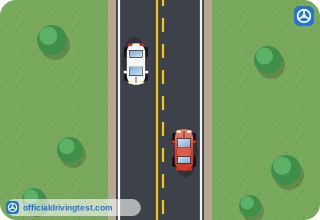
- When the solid line is on your side
- Only when no other vehicle is in sight
- Never, in either direction
- When the dashed line is on your side
Show answer
Correct answer: When the dashed line is on your side
Passing is permitted when the dashed line is on your side of the center markings.
Source: Kentucky Driver Manual (Updated July 23, 2026), page 39 · Open this page in the manual (Manual page 39)
-
On a one-direction roadway, what does a broken white line between lanes mean?
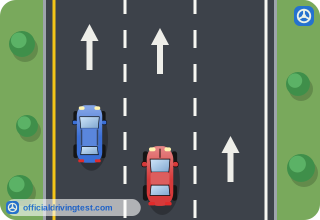
- Passing is prohibited
- Passing is permitted
- Passing is permitted only for emergency vehicles
- Passing is permitted only at night
Show answer
Correct answer: Passing is permitted
A broken white line between lanes on a one-direction roadway means passing is permitted.
Source: Kentucky Driver Manual (Updated July 23, 2026), page 39 · Open this page in the manual (Manual page 39)
-
When you are required to stop because of a sign or signal, where must you stop?
- Behind the stop line, crosswalk, or stop sign or signal
- Past the crosswalk but before you reach the intersection
- In the crosswalk, so that you can see all cross traffic
- Beyond the stop line, at the edge of the intersection
Show answer
Correct answer: Behind the stop line, crosswalk, or stop sign or signal
When required to stop because of a sign or signal, you must stop behind the stop line, crosswalk, or stop sign or signal.
Source: Kentucky Driver Manual (Updated July 23, 2026), page 39 · Open this page in the manual (Manual page 39)
-
If there is a stop line before the crosswalk, what must be obeyed first?
- The crosswalk lines
- The nearest pedestrian
- The nearest traffic sign
- The stop line
Show answer
Correct answer: The stop line
If there is a stop line before the crosswalk, the stop line must be obeyed first.
Source: Kentucky Driver Manual (Updated July 23, 2026), page 39 · Open this page in the manual (Manual page 39)
-
According to the lane markings, when may you not pass?
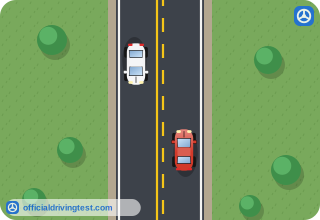
- When there is a broken line on your side of the road
- When there is a solid line on your side of the broken line
- When there is more than one vehicle ahead of you
- When the vehicle ahead is traveling below the speed limit
Show answer
Correct answer: When there is a solid line on your side of the broken line
You may not pass when there is a solid line on your side of the broken line of the road.
Source: Kentucky Driver Manual (Updated July 23, 2026), page 47 · Open this page in the manual (Manual page 47)
-
You may pass if there is which marking in the road?
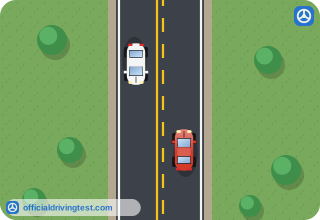
- A double solid yellow line in the center of the road
- A solid yellow line on your side of the broken yellow line
- A solid yellow line on both sides of the center
- A solid yellow line on the left side of the broken yellow line
Show answer
Correct answer: A solid yellow line on the left side of the broken yellow line
You may pass if there is a solid yellow line on the left side of the broken yellow line, and only if there are no oncoming vehicles.
Source: Kentucky Driver Manual (Updated July 23, 2026), page 47 · Open this page in the manual (Manual page 47)