Kentucky: Parking rules Practice Test
Parking on hills, parallel and angle parking, where Kentucky forbids parking, handicapped spaces and painted curbs.
Independent educational site · not affiliated with any government agency or DMV
Ready? Test yourself
- Instant feedback with an explanation
- Every answer cites its source in the manual
- Your best score is saved on this device
Questions are original and based on the official manual "Kentucky Driver Manual" (Updated July 23, 2026), Kentucky State Police.
All 25 questions in this practice test
Take the test above first, then use this list to study. Tap “Show answer” to see the correct answer and explanation.
Show the questions and answersHide the questions
-
What are you responsible for when you park your vehicle?
- Making sure a licensed driver stays inside
- Keeping the engine running in case it must be moved
- Making sure the vehicle is always parked within sight
- Making sure the vehicle is not a hazard when parked
Show answer
Correct answer: Making sure the vehicle is not a hazard when parked
You are responsible for making sure that your vehicle is not a hazard when it is parked.
Source: Kentucky Driver Manual (Updated July 23, 2026), page 44 · Open this page in the manual (Manual page 44)
-
Where should you always park?
- In a designated area
- In the first open space you find
- On the shoulder of the road
- Wherever the roadside is widest
Show answer
Correct answer: In a designated area
The manual says to always park in a designated area.
Source: Kentucky Driver Manual (Updated July 23, 2026), page 44 · Open this page in the manual (Manual page 44)
-
When parking along the roadway, where should you park your vehicle?
- Close to the center of the roadway for easy exit
- Wherever there is the most room
- As far away from the flow of traffic as possible
- Several feet from the curb so doors can open
Show answer
Correct answer: As far away from the flow of traffic as possible
When parking along the roadway you park as far away from the flow of traffic as possible.
Source: Kentucky Driver Manual (Updated July 23, 2026), page 44 · Open this page in the manual (Manual page 44)
-
If there is a curb where you park along the roadway, how close to it should you park?
- About one car width away
- As close to it as possible
- Far enough away that doors open freely
- Wide of it, leaving room for passing bicycles
Show answer
Correct answer: As close to it as possible
If there is a curb you park as close to it as possible.
Source: Kentucky Driver Manual (Updated July 23, 2026), page 44 · Open this page in the manual (Manual page 44)
-
Besides signs, what may indicate that parking is prohibited or limited?
- Reflectors on the curb face
- Raised bumps in the pavement edge
- Streetlights of a different color
- Painted or colored curbs
Show answer
Correct answer: Painted or colored curbs
Check for signs or painted curbs that may prohibit or limit parking; some restrictions are shown by colored curb markings.
Source: Kentucky Driver Manual (Updated July 23, 2026), page 44 · Open this page in the manual (Manual page 44)
-
When entering a perpendicular or angle parking space, what do you do right after you identify the space and check traffic?
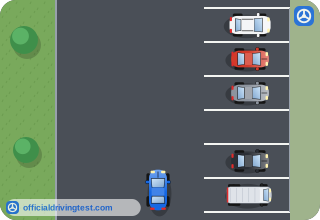
- Signal your intentions
- Turn the steering wheel sharply
- Back into the space
- Stop and secure the vehicle
Show answer
Correct answer: Signal your intentions
After identifying the space and checking traffic, you signal your intentions.
Source: Kentucky Driver Manual (Updated July 23, 2026), page 44 · Open this page in the manual (Manual page 44)
-
When entering a perpendicular or angle parking space, where do you finally stop and secure the vehicle?
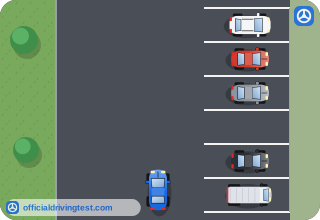
- At the rear of the space
- Partly in the traffic lane
- At the front of the parking space
- Straddling the line for an easier exit
Show answer
Correct answer: At the front of the parking space
The last step is to move to the front of the parking space, stop, and secure the vehicle.
Source: Kentucky Driver Manual (Updated July 23, 2026), page 45 · Open this page in the manual (Manual page 45)
-
When exiting a perpendicular or angle parking space, how far should you move straight back?
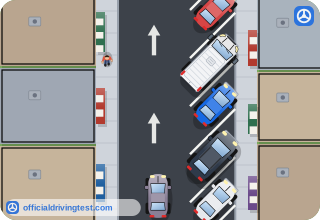
- Until your rear wheels reach the edge of the lane
- Until your front bumper clears the vehicle parked beside you
- Until your vehicle is halfway out of the space
- Until your side mirror is even with the next vehicle
Show answer
Correct answer: Until your front bumper clears the vehicle parked beside you
You continue to check traffic and move straight back until your front bumper clears the vehicle parked beside you.
Source: Kentucky Driver Manual (Updated July 23, 2026), page 45 · Open this page in the manual (Manual page 45)
-
While exiting a perpendicular or angle parking space, once your front bumper clears the vehicle beside you, how should you turn the steering wheel?
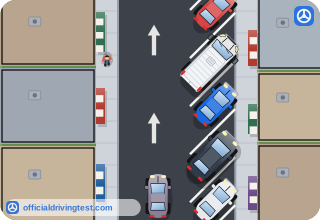
- Sharply in the direction the front should move
- Gently, keeping the wheels nearly straight
- Not at all until you shift to drive
- Sharply in the direction the rear should move
Show answer
Correct answer: Sharply in the direction the rear should move
You turn the steering wheel sharply in the direction that the rear of your vehicle should move.
Source: Kentucky Driver Manual (Updated July 23, 2026), page 45 · Open this page in the manual (Manual page 45)
-
When your vehicle clears the parking space as you exit a perpendicular or angle space, what should you do?
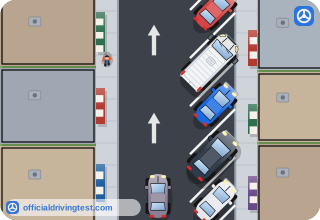
- Stop and shift to drive
- Accelerate immediately
- Shift to park and check traffic
- Keep backing into the lane while steering
Show answer
Correct answer: Stop and shift to drive
When the vehicle clears the parking area space, you stop and shift to drive.
Source: Kentucky Driver Manual (Updated July 23, 2026), page 45 · Open this page in the manual (Manual page 45)
-
In parallel parking, where should you look once you shift to reverse?
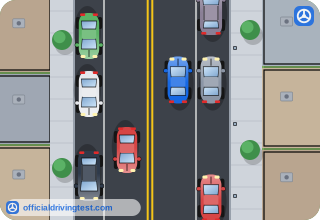
- Straight ahead, at the traffic approaching in your lane
- At the vehicle parked in front of the open space
- To the rear, in the direction the vehicle will be moving
- At the curb on the passenger side of the vehicle only
Show answer
Correct answer: To the rear, in the direction the vehicle will be moving
When traffic is clear you shift to reverse and look to the rear in the direction the vehicle will be moving.
Source: Kentucky Driver Manual (Updated July 23, 2026), page 45 · Open this page in the manual (Manual page 45)
-
In parallel parking, you keep backing until your front bumper is in line with what?
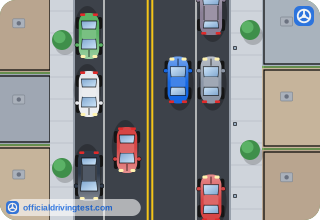
- The front bumper of the vehicle you are parking behind
- The rear bumper of the vehicle you are parking behind
- The center of the vehicle you are parking behind
- The headlights of the vehicle you are parking behind
Show answer
Correct answer: The rear bumper of the vehicle you are parking behind
You continue backing up until your front bumper is in line with the rear bumper of the vehicle you are parking behind.
Source: Kentucky Driver Manual (Updated July 23, 2026), page 45 · Open this page in the manual (Manual page 45)
-
When parallel parking, when should you stop backing?
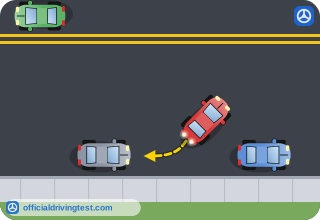
- Once your rear bumper lightly touches the vehicle behind you
- Once your rear wheels reach the curb
- When your front bumper passes the vehicle ahead
- Before touching the bumper of the vehicle to the rear
Show answer
Correct answer: Before touching the bumper of the vehicle to the rear
You stop before touching the bumper of the vehicle to the rear, then shift to drive and adjust the vehicle in the space.
Source: Kentucky Driver Manual (Updated July 23, 2026), page 45 · Open this page in the manual (Manual page 45)
-
After you park, you set your parking brake and shift to “park.” In a manual shift car, you shift to what instead?
- Reverse
- First gear
- Second gear
- Third gear
Show answer
Correct answer: Reverse
Set your parking brake and shift to “park” (or reverse in a manual shift car).
Source: Kentucky Driver Manual (Updated July 23, 2026), page 45 · Open this page in the manual (Manual page 45)
-
Which side of your vehicle is safest to get out on after parking?
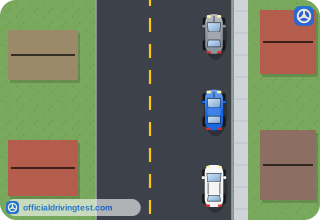
- The street side
- Whichever side has more room
- The curb side
- Whichever side is closest to the lock
Show answer
Correct answer: The curb side
It is safest to get out of your vehicle on the curb side, and if you must use the street side you check traffic first.
Source: Kentucky Driver Manual (Updated July 23, 2026), page 45 · Open this page in the manual (Manual page 45)
-
What does the law require you to do when you leave a vehicle?
- Turn off the headlights and leave the key in the ignition
- Turn off the engine and remove the key
- Leave the engine idling if you will be away briefly
- Lock the steering wheel and leave the hazard lights on
Show answer
Correct answer: Turn off the engine and remove the key
The law requires you to turn off the engine and remove the key when you leave a vehicle.
Source: Kentucky Driver Manual (Updated July 23, 2026), page 45 · Open this page in the manual (Manual page 45)
-
When should you lock your vehicle when you leave it?
- Only when you will be gone overnight or longer
- Only when it is parked in a public parking lot
- Only when you leave valuables visible inside
- Always, even if you will be away only a short time
Show answer
Correct answer: Always, even if you will be away only a short time
The manual says to always lock your vehicle when leaving it, even for a short period of time.
Source: Kentucky Driver Manual (Updated July 23, 2026), page 45 · Open this page in the manual (Manual page 45)
-
When exiting a parallel parking space, you shift to reverse and back as much as possible toward what?
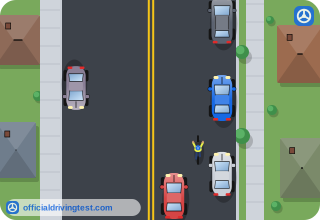
- The vehicle parked behind you
- The vehicle parked ahead of you
- The center line of the road
- The nearest driveway
Show answer
Correct answer: The vehicle parked behind you
To exit a parallel space you shift to reverse and back as much as possible to the vehicle parked behind you.
Source: Kentucky Driver Manual (Updated July 23, 2026), page 45 · Open this page in the manual (Manual page 45)
-
When leaving a parallel parking space, if your front bumper will not clear the vehicle ahead, what should you do?
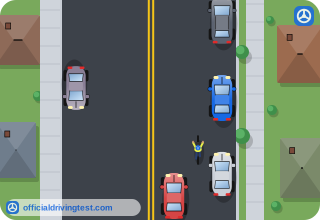
- Turn the wheel sharply and pull out anyway
- Sound your horn and wait
- Reverse and correct your steering
- Move forward until you touch the bumper ahead
Show answer
Correct answer: Reverse and correct your steering
If the front bumper will not clear the vehicle ahead, you reverse and correct steering.
Source: Kentucky Driver Manual (Updated July 23, 2026), page 45 · Open this page in the manual (Manual page 45)
-
When exiting a parallel parking space, when may you move forward into the appropriate lane of traffic?
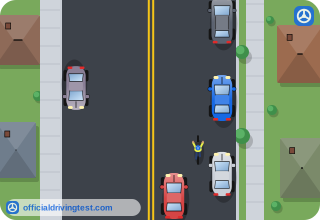
- When your front bumper reaches the rear bumper of the vehicle ahead
- When your door post clears the rear bumper of the vehicle parked ahead
- When your rear bumper clears the front bumper of the vehicle behind
- As soon as your front wheels turn into the lane
Show answer
Correct answer: When your door post clears the rear bumper of the vehicle parked ahead
You move forward into the lane when the door post of your vehicle clears the rear bumper of the vehicle parked ahead of you.
Source: Kentucky Driver Manual (Updated July 23, 2026), page 45 · Open this page in the manual (Manual page 45)
-
You are parked on a hill next to a curb. How should you turn your wheels?
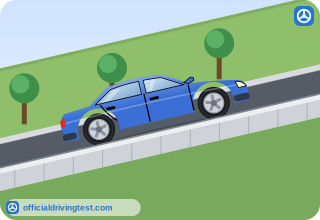
- So that the vehicle will touch the curb if it begins moving
- Straight ahead, parallel to the curb
- So that the vehicle will roll away from the curb if it begins moving
- So that the vehicle will roll into the traffic lane if it moves
Show answer
Correct answer: So that the vehicle will touch the curb if it begins moving
When parked on a hill, the wheels are turned so the vehicle will touch the curb if it begins moving.
Source: Kentucky Driver Manual (Updated July 23, 2026), page 46 · Open this page in the manual (Manual page 46)
-
You are parked on a hill where there is no curb. How should you turn your wheels?
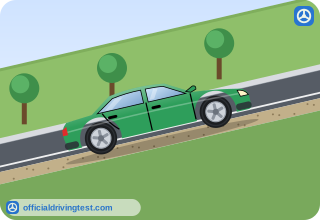
- So the vehicle will roll into the traffic lane
- Straight ahead, parallel to the road
- So the vehicle will go off the road should it roll
- Toward the center of the road
Show answer
Correct answer: So the vehicle will go off the road should it roll
With no curb, the wheels are turned so the vehicle will go off the road should it roll.
Source: Kentucky Driver Manual (Updated July 23, 2026), page 46 · Open this page in the manual (Manual page 46)
-
What is the result of unauthorized parking in a designated handicapped parking area?
- It is only a warning for a first offense
- It is unlawful and punishable by a fine
- It is allowed for up to 15 minutes
- It is allowed if you stay with your vehicle
Show answer
Correct answer: It is unlawful and punishable by a fine
Unauthorized parking in designated handicapped parking areas is unlawful and punishable by a fine.
Source: Kentucky Driver Manual (Updated July 23, 2026), page 46 · Open this page in the manual (Manual page 46)
-
Where should a person who needs handicapped parking privileges apply for special decals or plates?
- A Driver Licensing Regional Office
- The Kentucky State Police post
- The local police department
- The County Clerk’s Office
Show answer
Correct answer: The County Clerk’s Office
Persons needing handicapped parking privileges should apply to the County Clerk’s Office for special decals or plates.
Source: Kentucky Driver Manual (Updated July 23, 2026), page 46 · Open this page in the manual (Manual page 46)
-
Handicapped parking is only for vehicles that meet which condition?
- They display an official permit and are transporting a disabled person
- They are driven by a licensed driver who is 65 years of age or older
- They display a temporary pass issued by the local police department
- They are parked there for less than 30 minutes at a time
Show answer
Correct answer: They display an official permit and are transporting a disabled person
Handicapped parking is only for vehicles displaying an official permit and transporting a disabled person.
Source: Kentucky Driver Manual (Updated July 23, 2026), page 46 · Open this page in the manual (Manual page 46)