Kentucky: Exam Simulator
40 random questions from every topic, like a mini exam.
Independent educational site · not affiliated with any government agency or DMV
Ready? Test yourself
40 questions (the state does not publish how many its test has); pass mark 80%, as on the real test.
- Instant feedback with an explanation
- Every answer cites its source in the manual
- Your best score is saved on this device
Questions are original and based on the official manual "Kentucky Driver Manual" (Updated July 23, 2026), Kentucky State Police.
Sample questions
The exam simulator picks 40 random questions from every topic each time you start. Here are a few examples.
Show the questions and answersHide the questions
-
Who must first secure a Kentucky driver’s license, according to the manual?
- Any new or current resident who plans to drive a motor vehicle on Kentucky roadways
- Only new residents who plan to drive a motor vehicle on Kentucky roadways
- Only current residents who plan to drive a motor vehicle on Kentucky roadways
- Only drivers under 18 who plan to drive on Kentucky roadways
Show answer
Correct answer: Any new or current resident who plans to drive a motor vehicle on Kentucky roadways
Any new or current resident of Kentucky who plans to drive a motor vehicle on Kentucky roadways must first secure a Kentucky driver’s license.
Source: Kentucky Driver Manual (Updated July 23, 2026), page 1 · Open this page in the manual (Manual page 1)
-
Where does the manual say a moped rider can become familiar with the vehicle’s controls?
- On a limited-access highway with a licensed driver
- On a busy street during rush hour
- Only at an approved rider training course
- In a parking lot or other off-street area
Show answer
Correct answer: In a parking lot or other off-street area
Familiarity with the controls can be learned by operating the vehicle in a parking lot or other off-street area.
Source: Kentucky Driver Manual (Updated July 23, 2026), page 3 · Open this page in the manual (Manual page 3)
-
What are pavement markings?
- Signs mounted above the lanes to give drivers directions
- Lines, arrows, words, or symbols painted on the roadway
- Raised ridges on the road that warn you when you leave the lane
- Lights placed along the edge of the roadway for night driving
Show answer
Correct answer: Lines, arrows, words, or symbols painted on the roadway
Pavement markings are lines, arrows, words, or symbols painted on the roadway to give you directions or warnings.
Source: Kentucky Driver Manual (Updated July 23, 2026), page 39 · Open this page in the manual (Manual page 39)
-
Mopeds cannot be operated on limited-access highways where the minimum speed is more than what?
- 25 miles per hour
- 40 miles per hour
- 55 miles per hour
- 30 miles per hour
Show answer
Correct answer: 30 miles per hour
Mopeds cannot be operated on limited-access highways where the minimum speed is more than thirty (30) miles per hour.
Source: Kentucky Driver Manual (Updated July 23, 2026), page 3 · Open this page in the manual (Manual page 3)
-
What are you responsible for when you park your vehicle?
- Making sure a licensed driver stays inside
- Keeping the engine running in case it must be moved
- Making sure the vehicle is always parked within sight
- Making sure the vehicle is not a hazard when parked
Show answer
Correct answer: Making sure the vehicle is not a hazard when parked
You are responsible for making sure that your vehicle is not a hazard when it is parked.
Source: Kentucky Driver Manual (Updated July 23, 2026), page 44 · Open this page in the manual (Manual page 44)
-
What gives drivers clues to the type of information a traffic sign provides?
- Its shape, color, symbols, and words
- Only the words printed on it
- Its size and its height above the road
- The type of post it is mounted on
Show answer
Correct answer: Its shape, color, symbols, and words
The shape, color, symbols, and words of a sign give clues to the type of information it provides.
Source: Kentucky Driver Manual (Updated July 23, 2026), page 35 · Open this page in the manual (Manual page 35)
-
What are warning signs meant to alert drivers to do?
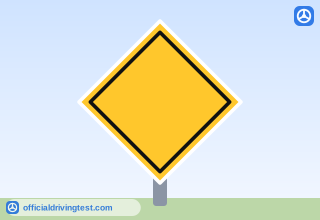
- Slow down and be prepared to stop if necessary
- Stop completely every time they see one
- Pull over and let other traffic pass
- Move to the left lane as soon as possible
Show answer
Correct answer: Slow down and be prepared to stop if necessary
Warning signs tell of possible danger ahead and alert the driver to slow down and be prepared to stop if necessary.
Source: Kentucky Driver Manual (Updated July 23, 2026), page 35 · Open this page in the manual (Manual page 35)
-
A police officer is directing traffic at an intersection that has traffic signals and signs. What should you do?
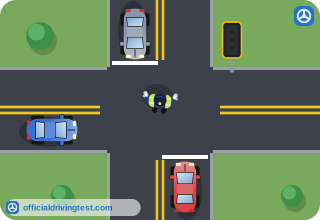
- Do what the officer instructs, regardless of the signals or signs
- Obey the traffic signals and signs and ignore the officer
- Obey the officer only if the signals are not working
- Stop and wait for the officer to wave you through, then follow the signs
Show answer
Correct answer: Do what the officer instructs, regardless of the signals or signs
When a police officer is directing traffic at an intersection, you do what the officer instructs regardless of traffic-control devices or signs.
Source: Kentucky Driver Manual (Updated July 23, 2026), page 34 · Open this page in the manual (Manual page 34)
-
Which driver should you yield the right of way to at an intersection?
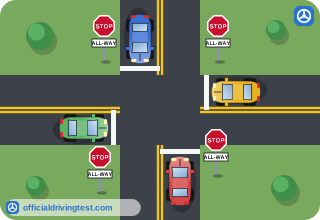
- The driver who is at or arrives before you at the intersection
- The driver who arrives after you at the intersection
- The driver in the larger vehicle at the intersection
- The driver who is traveling faster than you are
Show answer
Correct answer: The driver who is at or arrives before you at the intersection
You should yield to the driver who is at the intersection or arrives before you.
Source: Kentucky Driver Manual (Updated July 23, 2026), page 34 · Open this page in the manual (Manual page 34)
-
Two flashing red lights mark a railroad crossing. When may you proceed?
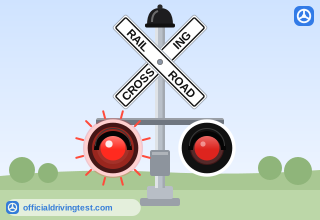
- After you slow down and look both ways for any train
- Once you have honked the horn to warn any approaching train
- Only after the lights stop flashing and no train is approaching
- As soon as you can see that the track is clear for about a mile
Show answer
Correct answer: Only after the lights stop flashing and no train is approaching
You stop, and proceed only after the red lights stop flashing and you determine that no train is approaching.
Source: Kentucky Driver Manual (Updated July 23, 2026), page 35 · Open this page in the manual (Manual page 35)