Kansas: Traffic signals Practice Test
Red, yellow and green lights, arrows, flashing signals and pedestrian signals.
Independent educational site · not affiliated with any government agency or DMV
Ready? Test yourself
- Instant feedback with an explanation
- Every answer cites its source in the manual
- Your best score is saved on this device
Questions are original and based on the official manual "Kansas Driving Handbook" (Revised February 2022), Kansas Department of Revenue, Division of Vehicles.
All 30 questions in this practice test
Take the test above first, then use this list to study. Tap “Show answer” to see the correct answer and explanation.
Show the questions and answersHide the questions
-
Besides signals, signs and pavement markings, who can provide traffic control that you must obey?
- Law enforcement, highway personnel and school crossing guards
- Only uniformed law enforcement officers
- Law enforcement officers and tow truck drivers
- Only police and crossing guards, not highway personnel
Show answer
Correct answer: Law enforcement, highway personnel and school crossing guards
Traffic control can also be provided by law enforcement, highway personnel or school crossing guards, and you must obey their directions.
Source: Kansas Driving Handbook (Revised February 2022), page 34
-
On a vertical traffic signal with three lights, what is the order of the lights from top to bottom?
- Green, yellow, red
- Yellow, red, green
- Red, green, yellow
- Red, yellow, green
Show answer
Correct answer: Red, yellow, green
When on the same signal, traffic lights are red, yellow and green from top to bottom.
Source: Kansas Driving Handbook (Revised February 2022), page 34
-
In some metropolitan areas traffic lights are horizontal. What is their order from left to right?
- Green, yellow, red
- Red, yellow, green
- Yellow, red, green
- Green, red, yellow
Show answer
Correct answer: Red, yellow, green
On a horizontal traffic light the red light is on the left, the yellow in the middle and the green on the right.
Source: Kansas Driving Handbook (Revised February 2022), page 34
-
What does a steady green traffic light mean?
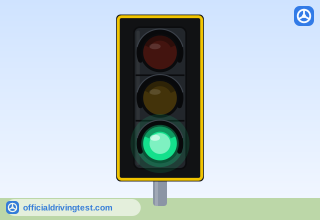
- You can go through the intersection if it is clear to do so
- You have the right-of-way over all other roadway users
- You may go through without checking for crossing traffic
- You must come to a stop before entering the intersection
Show answer
Correct answer: You can go through the intersection if it is clear to do so
A steady green light means you can go through the intersection if it is clear, and you must still yield to emergency vehicles and other roadway users as required by law.
Source: Kansas Driving Handbook (Revised February 2022), page 34
-
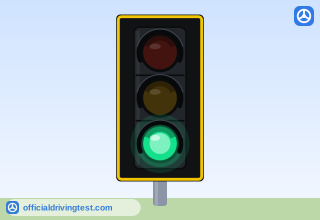
At a steady green light, who must you still yield to?
- Only pedestrians who are in a marked crosswalk
- Only vehicles that are approaching from behind you
- Emergency vehicles and other roadway users as required by law
- No one, because a green light gives you the right-of-way
Show answer
Correct answer: Emergency vehicles and other roadway users as required by law
On a steady green light you must yield to emergency vehicles and other roadway users as required by law.
Source: Kansas Driving Handbook (Revised February 2022), page 34
-
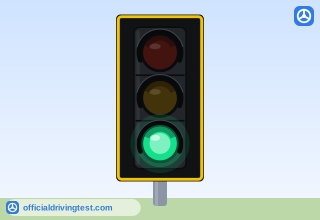
You are stopped at an intersection and the light turns green. What must you do before you go ahead?
- Honk to warn crossing traffic and then go
- Allow crossing traffic to clear the intersection
- Move ahead at once, since the green light gives you the right-of-way
- Wait until the light has stayed green for several seconds
Show answer
Correct answer: Allow crossing traffic to clear the intersection
If you are stopped at the intersection when the light turns green, you must allow crossing traffic to clear the intersection before you go ahead.
Source: Kansas Driving Handbook (Revised February 2022), page 34
-
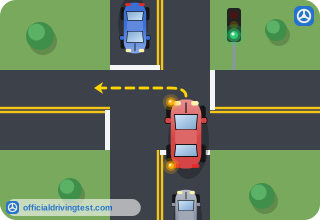
What must you do when turning left at a steady green traffic light?
- Speed up so that you clear the oncoming traffic first
- Turn first, because oncoming drivers must wait for you
- Yield only to pedestrians crossing in front of you
- Yield to the oncoming traffic flow and pedestrians
Show answer
Correct answer: Yield to the oncoming traffic flow and pedestrians
Turning left at a steady green light is allowed only when the intersection is clear, and you should always yield to oncoming traffic and pedestrians.
Source: Kansas Driving Handbook (Revised February 2022), page 34
-
What does a green arrow mean?
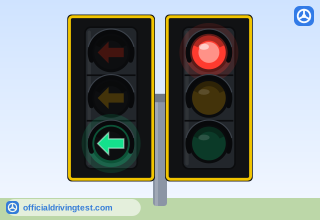
- The arrow is about to end and you should prepare to stop
- You must stop first and then turn when you are sure it is safe
- You may turn only if oncoming traffic has a red light
- You may turn in the direction of the arrow if the intersection is clear
Show answer
Correct answer: You may turn in the direction of the arrow if the intersection is clear
A green arrow means you can safely turn in the direction of the arrow if the intersection is clear of other roadway users.
Source: Kansas Driving Handbook (Revised February 2022), page 34
-
While you are turning on a green arrow, of whom should you be careful?
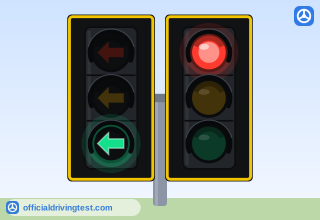
- Drivers on the cross street who are proceeding on a steady green light
- Others making a right turn on red from the other side of the intersection
- Cars waiting in the lane beside you at the same stop line
- Oncoming drivers who are going straight ahead on a green arrow
Show answer
Correct answer: Others making a right turn on red from the other side of the intersection
When the arrow is green, oncoming or crossing traffic should yield to you, but you should be careful of others making a right turn on red from the other side of the intersection.
Source: Kansas Driving Handbook (Revised February 2022), page 34
-
What does a steady yellow traffic light mean?
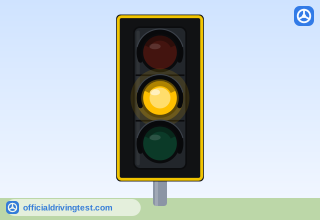
- The light is about to change to red
- The light is about to change to green
- You must stop immediately, wherever you are
- You may speed up and cross before it turns red
Show answer
Correct answer: The light is about to change to red
A steady yellow light means the traffic light is about to change to red.
Source: Kansas Driving Handbook (Revised February 2022), page 34
-
A traffic light turns steady yellow and you have not yet entered the intersection. What should you do?
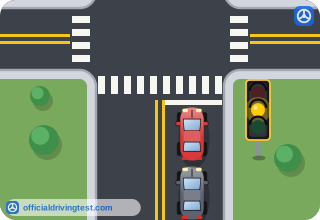
- Speed up to clear the intersection before the red
- Slow down and stop if traffic flow to the rear allows
- Stop abruptly, no matter what traffic is behind you
- Keep your speed and proceed with caution
Show answer
Correct answer: Slow down and stop if traffic flow to the rear allows
On a steady yellow light you should slow down and come to a complete stop if traffic flow to the rear allows.
Source: Kansas Driving Handbook (Revised February 2022), page 34
-
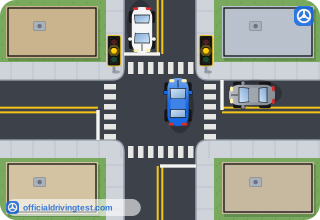
The light turns yellow when you are already in the intersection. What may you do?
- Stop in the intersection until the light turns green
- Back up to the stop line
- Turn on your hazard lights and stop
- Continue safely through the intersection
Show answer
Correct answer: Continue safely through the intersection
If you are already in the intersection when the yellow light comes on, you may continue safely through it.
Source: Kansas Driving Handbook (Revised February 2022), page 34
-
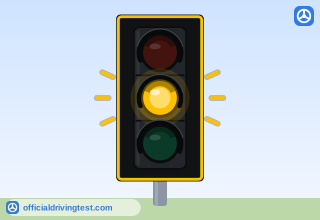
What does a flashing yellow traffic light mean?
- Slow down and proceed with caution
- Stop completely and then proceed when it is clear
- The light is about to change to red
- Stop and wait until the light turns green
Show answer
Correct answer: Slow down and proceed with caution
A flashing yellow light means slow down and proceed with caution, prepared to stop for any traffic entering the intersection.
Source: Kansas Driving Handbook (Revised February 2022), page 34
-
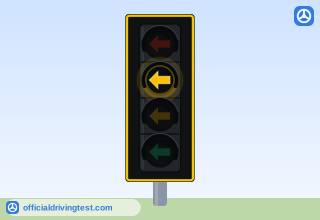
What does a yellow arrow mean?
- You may turn in the arrow's direction without yielding
- The light is about to turn green
- The green arrow is ending and you should prepare to stop
- You must stop until the arrow returns
Show answer
Correct answer: The green arrow is ending and you should prepare to stop
A yellow arrow means the green arrow is ending, so you should prepare to stop and yield the right-of-way to oncoming traffic or pedestrians.
Source: Kansas Driving Handbook (Revised February 2022), page 34
-
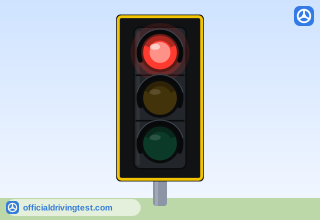
Where must you wait at a steady red traffic light?
- In the crosswalk, at the edge of the intersection
- Beside the stop line, in the oncoming lane
- Behind the stop line, crosswalk or intersection
- In the middle of the intersection, ready to turn
Show answer
Correct answer: Behind the stop line, crosswalk or intersection
At a steady red light you must stop before entering the intersection and wait behind the stop line, crosswalk or intersection until the light turns green.
Source: Kansas Driving Handbook (Revised February 2022), page 34
-
In some locations a small, very bright blinking light shows in the middle of the red light. What is it for?
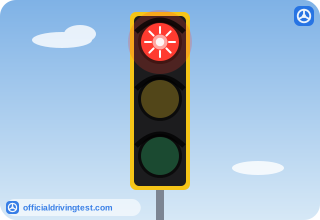
- To alert you to the red light and that you must stop
- To show that a right turn on red is allowed
- To show that the signal is about to turn green
- To warn that an emergency vehicle is approaching
Show answer
Correct answer: To alert you to the red light and that you must stop
The small, very bright blinking light in the red light alerts you that the light is red and that you must stop.
Source: Kansas Driving Handbook (Revised February 2022), page 34
-
When may you turn right at a red light?
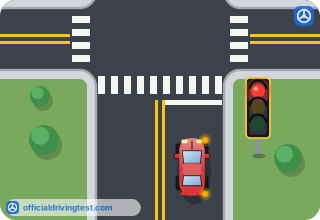
- Without stopping, if no cars are coming from the left
- Only when a sign permits a right turn on red
- Never, unless a police officer directs you
- After stopping and checking, if no sign prohibits it
Show answer
Correct answer: After stopping and checking, if no sign prohibits it
You may turn right on red after stopping and checking for traffic and pedestrians, if there is no sign prohibiting a right turn on a red light.
Source: Kansas Driving Handbook (Revised February 2022), page 34
-
Which left turn may be permitted on a red light?
- From a one-way street onto a two-way street
- From a two-way street onto a one-way street
- From a two-way street onto another two-way street
- From any street, if there is no oncoming traffic
Show answer
Correct answer: From a two-way street onto a one-way street
Some left turns may be permitted on red when moving from a one-way street onto another one-way street or from a two-way street onto a one-way street.
Source: Kansas Driving Handbook (Revised February 2022), page 34
-
What must you check for when you turn left on red where it is permitted?
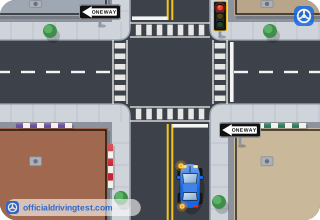
- Traffic and pedestrians crossing in front or to the side of your vehicle
- Only oncoming vehicles that are going straight through the intersection
- Only pedestrians who are in the crosswalk behind your vehicle
- Only vehicles that are stopped at the red light beside you
Show answer
Correct answer: Traffic and pedestrians crossing in front or to the side of your vehicle
When turning left on red where permitted, you must check for traffic and pedestrians crossing in front or to the side of your vehicle.
Source: Kansas Driving Handbook (Revised February 2022), page 34
-
What must you do at a flashing red traffic light?
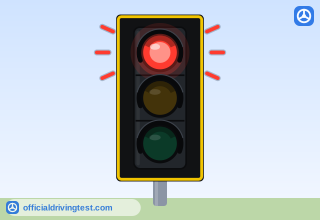
- Slow down and proceed with caution if no cars are coming
- Stop only if cross traffic is present in the intersection
- Come to a complete stop, as you would at a stop sign
- Stop and wait until the light turns green before moving
Show answer
Correct answer: Come to a complete stop, as you would at a stop sign
At a flashing red light you stop behind the stop line, crosswalk or intersection, look both ways and yield the right-of-way, using the same procedure as at a stop sign.
Source: Kansas Driving Handbook (Revised February 2022), page 35
-
What must you do at a red arrow?
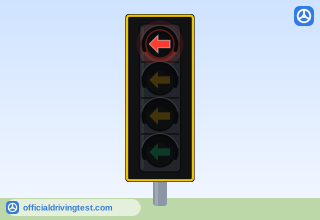
- Turn in the arrow's direction after stopping and checking
- Stop and wait until a green arrow or light returns
- Slow down and go only if no traffic is coming
- Proceed with caution in the direction of the arrow
Show answer
Correct answer: Stop and wait until a green arrow or light returns
A red arrow means you must stop and may not go in the direction of the arrow until the green arrow or light returns on the signal.
Source: Kansas Driving Handbook (Revised February 2022), page 35
-
What does a STOP HERE ON RED sign tell you?
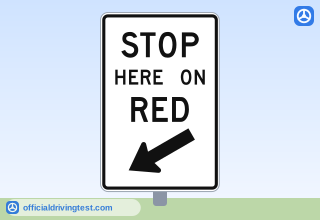
- Where you must stop if the traffic light is red
- That you must stop at every light
- That a right turn on red is never allowed
- That a red light is about to change
Show answer
Correct answer: Where you must stop if the traffic light is red
A Stop Here on Red sign tells you where to stop if the traffic light is red.
Source: Kansas Driving Handbook (Revised February 2022), page 40
-
How are reversible lanes used?
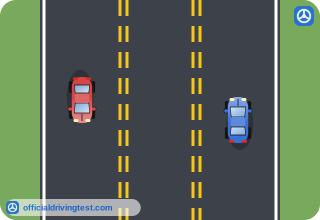
- They carry traffic in both directions at all times
- They are used only by buses and bicycles during rush hours
- They carry traffic one way at some times and the other way at others
- They are used only for left turns at all hours
Show answer
Correct answer: They carry traffic one way at some times and the other way at others
Some travel lanes are designed to carry traffic in one direction at certain times and in the opposite direction at other times.
Source: Kansas Driving Handbook (Revised February 2022), page 45
-
What designates the traffic flow in reversible lanes?
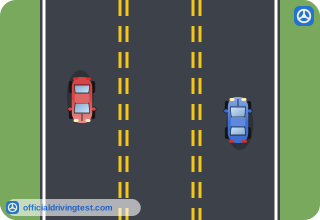
- Flashing lights on the shoulder
- Signals above the lanes
- Painted white arrows on the pavement
- Signs on the median strip
Show answer
Correct answer: Signals above the lanes
Signals above the lanes designate traffic flow in reversible lanes.
Source: Kansas Driving Handbook (Revised February 2022), page 45
-
What should you do before entering a reversible lane?
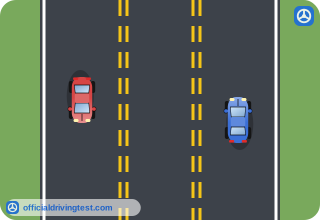
- Move in and wait for oncoming drivers to yield
- Signal and stop until the lane is clear of cars
- Assume the lane is open because it has dashed yellow lines
- Check to see which lanes can be used at that time
Show answer
Correct answer: Check to see which lanes can be used at that time
Before entering a reversible lane, check to see which lanes can be used at that time.
Source: Kansas Driving Handbook (Revised February 2022), page 45
-
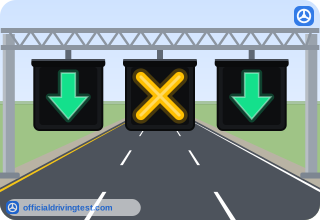
What does a green arrow over a reversible lane mean?
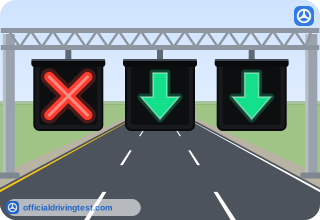
- You can use the lane beneath it
- The lane is for turning only
- Only buses may use the lane
- You must stop before entering the lane
Show answer
Correct answer: You can use the lane beneath it
A green arrow means you can use the lane beneath it.
Source: Kansas Driving Handbook (Revised February 2022), page 45
-
What does a red X over a reversible lane mean?
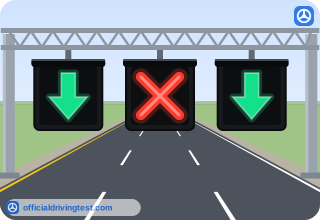
- You may use the lane only to turn left
- The lane is open to vehicles with two or more people
- The lane is not available
- The lane is open after you yield to oncoming traffic
Show answer
Correct answer: The lane is not available
A red X over a reversible lane means the lane is not available.
Source: Kansas Driving Handbook (Revised February 2022), page 45
-
What does a flashing yellow X over a reversible lane mean?
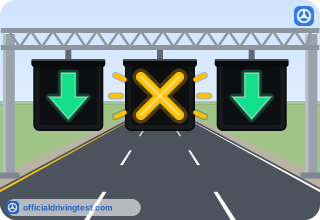
- The lane is open to all traffic
- The lane is for turning only
- The lane is reserved for buses at this time
- You may use the lane to pass slower vehicles
Show answer
Correct answer: The lane is for turning only
A flashing yellow X means the lane is for turning only.
Source: Kansas Driving Handbook (Revised February 2022), page 45
-
What does a steady yellow X over a reversible lane mean?
- The lane is open to traffic in both directions for a short time
- You may stay in the lane until the signal turns green
- Traffic in the lane must slow down and let others merge in
- Use of the lane is changing, so move out of it as soon as it is safe
Show answer
Correct answer: Use of the lane is changing, so move out of it as soon as it is safe
A steady yellow X means the use of the lane is changing and you should move out of it as soon as it is safe.
Source: Kansas Driving Handbook (Revised February 2022), page 45
-
Why should you be careful when using reversible lanes?
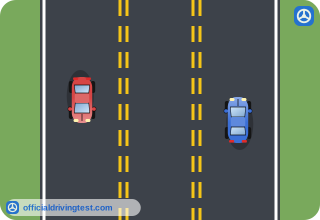
- Drivers traveling in the other direction could enter your lane by mistake
- The lane is narrower than other travel lanes on the road
- Vehicles behind you may use the same lane to pass on the left
- Vehicles ahead may stop suddenly to make left turns
Show answer
Correct answer: Drivers traveling in the other direction could enter your lane by mistake
Drivers traveling in the other direction could enter your lane by mistake, so you need to keep alert.
Source: Kansas Driving Handbook (Revised February 2022), page 45