Kansas: Speed and following distance — Part 3 Practice Test
Kansas speed limits, stopping distances, scanning ahead, space around your vehicle, night driving and driving in bad weather. — Part 3
Independent educational site · not affiliated with any government agency or DMV
Ready? Test yourself
- Instant feedback with an explanation
- Every answer cites its source in the manual
- Your best score is saved on this device
Questions are original and based on the official manual "Kansas Driving Handbook" (Revised February 2022), Kansas Department of Revenue, Division of Vehicles.
All 33 questions in this practice test
Take the test above first, then use this list to study. Tap “Show answer” to see the correct answer and explanation.
Show the questions and answersHide the questions
-
How much time does excessive speed save, according to the manual?
- No more than a few minutes an hour
- About 15 minutes an hour
- Up to half an hour on a long trip
- A great deal on any trip
Show answer
Correct answer: No more than a few minutes an hour
Excessive speed does not save more than a few minutes an hour and often leads to high-risk decision making.
Source: Kansas Driving Handbook (Revised February 2022), page 60
-
Driving how much slower than the traffic flow pattern can be just as dangerous as excessive speed?
- More than 5 mph slower
- More than 25 mph slower
- More than 15 mph slower
- More than 35 mph slower
Show answer
Correct answer: More than 15 mph slower
Driving more than 15 mph slower than the traffic flow pattern can be just as dangerous as excessive speed.
Source: Kansas Driving Handbook (Revised February 2022), page 60
-
Vehicles are bunched up behind you because you are driving slowly. What should you do?
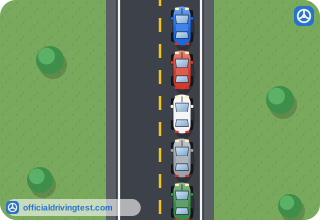
- Speed up above the legal limit to get away from them
- Pull over when safe to do so and let other vehicles pass
- Tap your brakes to make the other drivers back off
- Stay in your lane and keep driving at your present speed
Show answer
Correct answer: Pull over when safe to do so and let other vehicles pass
If vehicles are bunched up behind a slow-moving vehicle, it should pull over when safe to do so and let the others pass.
Source: Kansas Driving Handbook (Revised February 2022), page 60
-
Why may you need to slow down at toll plazas?
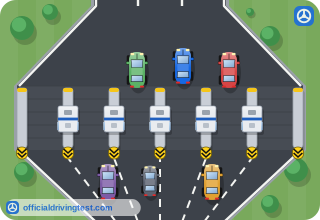
- Vehicles change lanes, stop and speed up, and the number of lanes can change
- Vehicles must always come to a complete stop for ten seconds first
- Lanes there are always much wider than the lanes on other roads
- Pedestrians always have the right of way over the vehicles in toll lanes
Show answer
Correct answer: Vehicles change lanes, stop and speed up, and the number of lanes can change
At toll plazas vehicles are changing lanes, preparing to stop and then speeding up again, and the number of lanes could change before and after the plaza.
Source: Kansas Driving Handbook (Revised February 2022), page 61
-
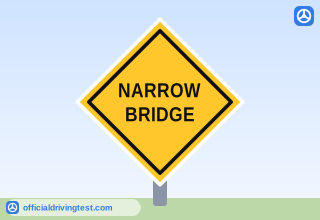
Why may you need to slow down on narrow bridges and tunnels?
- Bridges and tunnels never have any posted speed limit of their own
- Tires always lose all of their traction on bridge and tunnel floors
- Vehicles approaching each other have narrower lanes and are closer together
- Other drivers never use their headlights on bridges or in tunnels
Show answer
Correct answer: Vehicles approaching each other have narrower lanes and are closer together
On narrow bridges and tunnels, vehicles approaching each other have narrower lanes and are closer together.
Source: Kansas Driving Handbook (Revised February 2022), page 61
-
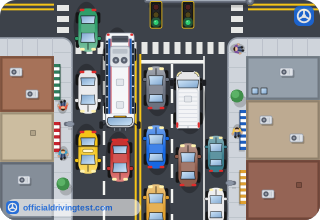
Why may you need to slow down during rush hours?
- Rush hour speed limits are always lower than normal by law
- Traffic is heavy and drivers always seem to be in a hurry
- Drivers use their hazard lights during the rush hour period
- Roads become narrower than they are at other times of the day
Show answer
Correct answer: Traffic is heavy and drivers always seem to be in a hurry
Rush hours often have heavy traffic and drivers that always seem to be in a hurry.
Source: Kansas Driving Handbook (Revised February 2022), page 61
-
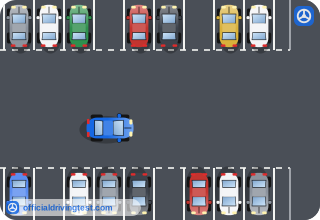
Why may you need to slow down in shopping centers, parking lots and downtown areas?
- Traffic signals in those areas are timed differently than elsewhere
- Vehicles in those areas always move at one steady, constant speed
- Pedestrians are not allowed to walk through those areas of the city
- Vehicles and people are stopping, starting and moving in different directions
Show answer
Correct answer: Vehicles and people are stopping, starting and moving in different directions
Shopping centers, parking lots and downtown areas are busy areas with vehicles and people stopping, starting and moving in different directions.
Source: Kansas Driving Handbook (Revised February 2022), page 61
-
How does excessive speed affect the driver?
- It decreases the level of fatigue
- It has no effect on fatigue
- It helps the driver stay alert
- It increases the level of fatigue
Show answer
Correct answer: It increases the level of fatigue
Excessive speed increases the level of fatigue for the driver.
Source: Kansas Driving Handbook (Revised February 2022), page 61
-
How does excessive speed affect tires and brakes?
- It increases tread wear on tires and wear on braking systems
- It reduces tread wear on tires and wear on braking systems
- It has no effect on the wear of tires or braking systems
- It makes the tires and braking systems last longer than normal
Show answer
Correct answer: It increases tread wear on tires and wear on braking systems
Excessive speed increases tread wear on tires and wear on braking systems.
Source: Kansas Driving Handbook (Revised February 2022), page 61
-
How does excessive speed affect the ability of guardrails and barriers to protect occupants?
- It increases their ability to protect
- It has no effect on them
- It decreases their ability to protect
- It makes them absorb the crash entirely
Show answer
Correct answer: It decreases their ability to protect
Excessive speed decreases the ability of guardrails and barriers to protect occupants.
Source: Kansas Driving Handbook (Revised February 2022), page 61
-
How does excessive speed affect the distance a vehicle travels while the driver reacts to a hazard?
- It decreases that distance
- It increases that distance
- It does not change that distance
- It doubles braking distance only
Show answer
Correct answer: It increases that distance
Excessive speed increases the distance a vehicle travels while the driver reacts to a hazard.
Source: Kansas Driving Handbook (Revised February 2022), page 61
-
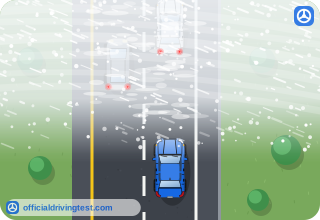
On a snowy road where the posted speed limit allows 55 mph, what does the manual say about driving 55 mph in a snowstorm?
- It is acceptable, because it matches the posted speed limit
- It is acceptable only if you drive in the right-hand lane
- It is acceptable as long as your headlights are turned on
- It is not recognized as an acceptable speed for a snowy roadway
Show answer
Correct answer: It is not recognized as an acceptable speed for a snowy roadway
Driving 55 mph in a snowstorm is not recognized as an acceptable speed for a snowy roadway, even when the posted limit allows 55 mph.
Source: Kansas Driving Handbook (Revised February 2022), page 62
-
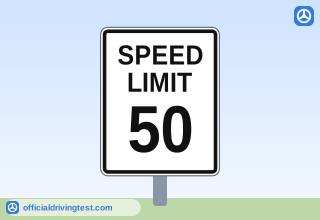
For what kind of conditions are speed limits posted, according to the manual?
- Heavy traffic
- Wet or icy roads
- Ideal conditions
- Nighttime driving
Show answer
Correct answer: Ideal conditions
Speed limits are posted for ideal conditions, so drivers must slow down when conditions are worse.
Source: Kansas Driving Handbook (Revised February 2022), page 62
-
If the roadway is wet or icy, you cannot see well, or traffic is heavy, what must you do?
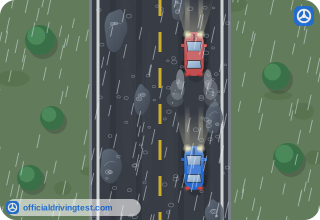
- Reduce speed so your vehicle can stop and steer as needed
- Keep to the posted limit because it is the legal maximum
- Speed up slightly to get out of the bad conditions sooner
- Drive at the posted limit but turn on your hazard flashers
Show answer
Correct answer: Reduce speed so your vehicle can stop and steer as needed
In wet, icy, low-visibility or heavy-traffic conditions you must reduce speed to be able to stop and steer as needed.
Source: Kansas Driving Handbook (Revised February 2022), page 62
-
On what are speed limit signs based, according to the manual?
- The type of vehicle, the weather forecast, and the time of day
- The number of lanes, the pavement color, and nearby businesses
- Crash records, vehicle ownership, and fuel prices
- Traffic congestion, intersections, and roadway conditions
Show answer
Correct answer: Traffic congestion, intersections, and roadway conditions
Speed limit signs are based on traffic congestion, intersections, and roadway conditions and are designed for the safety of all roadway users.
Source: Kansas Driving Handbook (Revised February 2022), page 62
-
What is the best way to avoid speeding?
- Follow the speed of the car ahead of you
- Check your speedometer frequently
- Judge your speed by how the road feels
- Watch the speed limit signs only
Show answer
Correct answer: Check your speedometer frequently
You may not judge your speed well without looking, so checking the speedometer frequently is the best way to avoid speeding.
Source: Kansas Driving Handbook (Revised February 2022), page 62
-
When is it especially easy to be traveling much faster than you perceive?
- When switching from low-speed single-lane roads to high-speed multiple-lane roadways
- When switching from high-speed multiple-lane roadways to lower speed single-lane roadways
- When driving at night on a rural road with no other traffic
- When driving in heavy traffic through a city
Show answer
Correct answer: When switching from high-speed multiple-lane roadways to lower speed single-lane roadways
It is easy to travel faster than you perceive, especially after leaving a high-speed multiple-lane roadway for a lower speed single-lane roadway.
Source: Kansas Driving Handbook (Revised February 2022), page 62
-
Which vehicles are more prone to rollovers and have special handling characteristics?
- Small passenger cars with a lower center of gravity
- Vehicles equipped with anti-lock braking systems
- Vehicles equipped with daytime running lights
- Larger vehicles with a higher center of gravity
Show answer
Correct answer: Larger vehicles with a higher center of gravity
Larger vehicles with a higher center of gravity have special handling characteristics and are more prone to rollovers.
Source: Kansas Driving Handbook (Revised February 2022), page 62
-
What should you do when driving a larger vehicle such as an SUV, van, pickup truck, or moving truck?
- Drive slower, avoid sudden changes in direction, and slow down before curves
- Drive at the posted limit, steer sharply to correct, and brake in curves
- Speed up through curves to keep the vehicle balanced and avoid braking
- Keep the same speed on curves as on straight roads and steer quickly
Show answer
Correct answer: Drive slower, avoid sudden changes in direction, and slow down before curves
With larger vehicles you should drive at a slower safe speed, avoid sudden changes in direction and slow down before curves.
Source: Kansas Driving Handbook (Revised February 2022), page 62
-
What do you gain from more distance between your vehicle and other roadway users?
- A higher safe speed limit
- Better fuel economy
- A lower chance of being cited
- More time to react
Show answer
Correct answer: More time to react
The more distance between your vehicle and other roadway users, the more time you have to react.
Source: Kansas Driving Handbook (Revised February 2022), page 62
-
According to the manual, what causes the very common rear-end crashes at intersections?
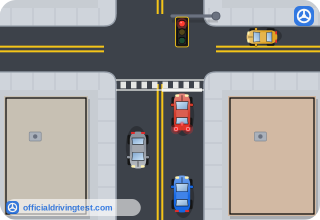
- Drivers who leave too much space and are passed by faster vehicles
- Drivers who brake too early when they approach a green signal
- Following too closely and being unable to stop when the vehicle ahead stops
- Drivers who change lanes too slowly while crossing the intersection
Show answer
Correct answer: Following too closely and being unable to stop when the vehicle ahead stops
Drivers following too closely, and then unable to stop before hitting the vehicle ahead when it stops too quickly, cause rear-end crashes.
Source: Kansas Driving Handbook (Revised February 2022), page 62
-
When you check your following distance using a sign, pole, or other stationary point that the vehicle ahead has just passed, what do you do next?
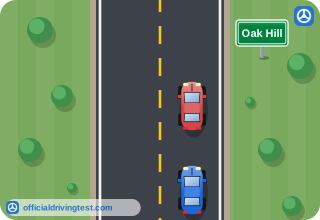
- Count the seconds it takes you to reach the same point
- Measure the number of car lengths to the vehicle ahead
- Check the speedometer reading as you reach the point
- Note how many feet the vehicle ahead has pulled away
Show answer
Correct answer: Count the seconds it takes you to reach the same point
To determine your following distance, count the seconds it takes you to reach the same stationary point the vehicle ahead passed.
Source: Kansas Driving Handbook (Revised February 2022), page 63
-
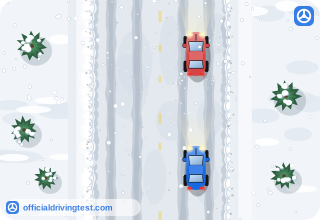
What should you do about the space in front of your vehicle on slippery roads, and why?
- Leave less space, so other drivers cannot cut in front of you
- Leave the same space, because slippery roads only affect steering
- Leave less space, because lower speeds shorten stopping time
- Leave more space, because you need extra distance to stop
Show answer
Correct answer: Leave more space, because you need extra distance to stop
You need more distance to stop on slippery roads, so you should leave more space in front of your vehicle.
Source: Kansas Driving Handbook (Revised February 2022), page 63
-
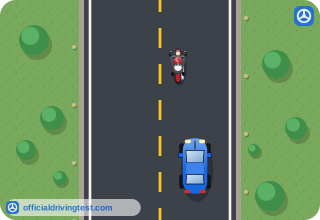
Why should you keep more space in front of your vehicle when following a motorcycle?
- Motorcycles always stop in a shorter distance than cars
- If the motorcycle falls, you need extra distance to stop or steer
- Motorcycle riders cannot see vehicles behind them
- A motorcycle's exhaust can blow debris onto your windshield
Show answer
Correct answer: If the motorcycle falls, you need extra distance to stop or steer
Motorcycles have different sizes and braking capabilities, and if one falls your vehicle needs extra stopping or steering distance to avoid the rider.
Source: Kansas Driving Handbook (Revised February 2022), page 63
-
What should you do when following a driver whose view to the rear is blocked, such as the driver of a truck, bus, van, or vehicle pulling a trailer?
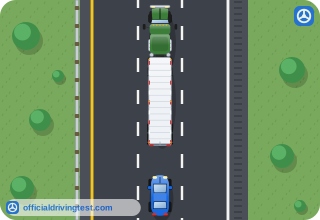
- Stay close behind so you stay in the driver's side mirrors
- Allow an extra cushion of space so the driver can see you
- Follow at a normal distance and flash your headlights often
- Match its speed and sound your horn as you approach
Show answer
Correct answer: Allow an extra cushion of space so the driver can see you
Drivers of trucks, buses, vans and vehicles pulling trailers may not see you directly behind them, so you should allow an extra cushion of space.
Source: Kansas Driving Handbook (Revised February 2022), page 63
-
What should you do when a large vehicle ahead blocks your view of the road?
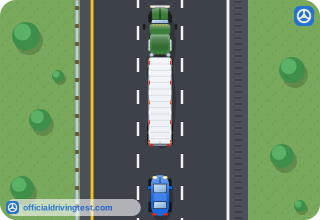
- Keep your speed and follow closely to see past the sides
- Move to the shoulder and follow it at the same speed
- Pass it right away so you can see the road for yourself
- Reduce your speed and allow more space so you can see around it
Show answer
Correct answer: Reduce your speed and allow more space so you can see around it
Large vehicles can block your view of the road ahead, so you should reduce your speed and allow more space so you can see around them.
Source: Kansas Driving Handbook (Revised February 2022), page 63
-
Why should you add more space in front of your vehicle when carrying a heavy load or pulling a trailer?
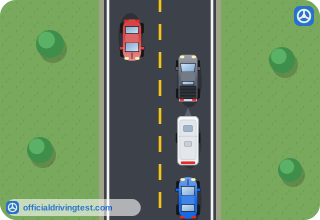
- The extra weight increases stopping time and decreases steering ability
- The extra weight makes the vehicle accelerate faster than normal
- The extra weight shortens the braking distance but hurts fuel use
- The trailer blocks your view of vehicles in the next lane
Show answer
Correct answer: The extra weight increases stopping time and decreases steering ability
The extra weight of a heavy load or trailer increases your vehicle's stopping time and decreases steering ability.
Source: Kansas Driving Handbook (Revised February 2022), page 63
-
What should you do with your following interval when it is hard to see ahead because of darkness or bad weather?
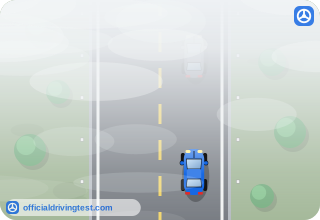
- Keep it the same
- Shorten it
- Increase it
- Reduce it only on freeways
Show answer
Correct answer: Increase it
The manual says to increase your following interval when it is hard to see ahead because of darkness or bad weather.
Source: Kansas Driving Handbook (Revised February 2022), page 63
-
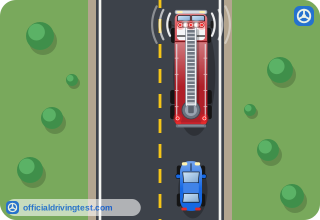
Why should you increase your following interval behind police vehicles, ambulances, and fire trucks?
- They never use warning lights while driving
- Their drivers cannot see vehicles behind them
- They are required to stop at every intersection
- They need more space to operate
Show answer
Correct answer: They need more space to operate
Police vehicles, law enforcement, ambulances and fire trucks need more space to operate, so you should increase your following interval.
Source: Kansas Driving Handbook (Revised February 2022), page 63
-
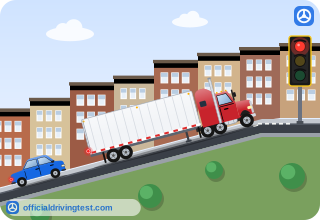
Why should you leave extra space in front of your vehicle when stopped behind another vehicle on a hill or incline?
- The vehicle ahead is required to stop twice on a hill
- The vehicle ahead may roll back before it begins to move forward
- Your brakes work less well when the vehicle is on an incline
- The driver ahead cannot see your vehicle on a hill
Show answer
Correct answer: The vehicle ahead may roll back before it begins to move forward
Leave extra space on a hill because the vehicle ahead may roll back before it begins to move forward.
Source: Kansas Driving Handbook (Revised February 2022), page 63
-
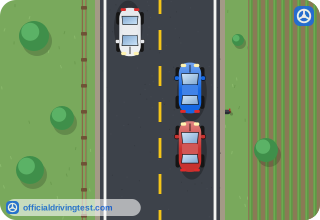
How can you help keep the driver behind you at a safe distance?
- Slow down and speed up often so the driver behind stays alert
- Change lanes often so the driver behind cannot keep up
- Keep a steady speed and signal in advance before slowing or turning
- Stay close to the vehicle ahead so the driver behind cannot pass
Show answer
Correct answer: Keep a steady speed and signal in advance before slowing or turning
Keeping a steady speed, signaling in advance, and keeping more space to the front before reducing speed or turning helps the driver behind stay at a safe distance.
Source: Kansas Driving Handbook (Revised February 2022), page 63
-
If you are tailgated and there is an empty lane, what should you do?
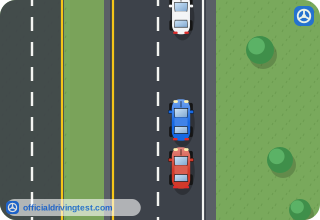
- Move over to the empty lane and allow a pass
- Stay in your lane and slow down quickly to discourage the driver
- Speed up to stay ahead of the tailgater
- Stay in your lane and turn on your hazard flashers
Show answer
Correct answer: Move over to the empty lane and allow a pass
If you are followed too closely and there is an empty lane, move over to it and allow a pass.
Source: Kansas Driving Handbook (Revised February 2022), page 64
-
If you are tailgated, there is no empty lane, and the roadway ahead is clear, what should you do?
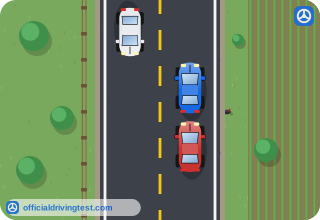
- Reduce speed slowly to encourage the tailgater to drive around you
- Brake hard so the tailgater sees your brake lights and backs off
- Speed up well above the limit to get away from the tailgater
- Move toward the center line so the tailgater cannot pass you
Show answer
Correct answer: Reduce speed slowly to encourage the tailgater to drive around you
With no empty lane, wait until the roadway ahead is clear and then reduce speed slowly to encourage the tailgater to drive around; never slow down quickly.
Source: Kansas Driving Handbook (Revised February 2022), page 64