Kansas: Speed and following distance — Part 1 Practice Test
Kansas speed limits, stopping distances, scanning ahead, space around your vehicle, night driving and driving in bad weather. — Part 1
Independent educational site · not affiliated with any government agency or DMV
Ready? Test yourself
- Instant feedback with an explanation
- Every answer cites its source in the manual
- Your best score is saved on this device
Questions are original and based on the official manual "Kansas Driving Handbook" (Revised February 2022), Kansas Department of Revenue, Division of Vehicles.
All 33 questions in this practice test
Take the test above first, then use this list to study. Tap “Show answer” to see the correct answer and explanation.
Show the questions and answersHide the questions
-
What does Kansas' basic speed law require?
- That you never drive faster than is reasonable and prudent for the conditions
- That you always drive at the maximum speed the law sets for the road
- That you drive at least 5 mph below the posted limit at all times
- That you match the speed of the vehicle ahead of you
Show answer
Correct answer: That you never drive faster than is reasonable and prudent for the conditions
The basic speed law bars driving at a speed greater than is reasonable and prudent under the conditions then existing.
Source: Kansas Driving Handbook (Revised February 2022), page 16
-
Besides road, weather and your vehicle's condition, what does the basic speed law tell you to consider?
- The speed of the driver behind you
- The number of passengers you carry
- Your own physical condition
- How many miles are left on your trip
Show answer
Correct answer: Your own physical condition
The manual tells drivers to consider road, weather and vehicle condition as well as their own physical condition when choosing a speed.
Source: Kansas Driving Handbook (Revised February 2022), page 16
-
Unless otherwise posted, what is the maximum speed in any urban district (in towns or cities) in Kansas?
- 25 mph
- 30 mph
- 35 mph
- 40 mph
Show answer
Correct answer: 30 mph
Kansas law sets thirty miles per hour as the maximum speed in any urban district unless a different limit is posted.
Source: Kansas Driving Handbook (Revised February 2022), page 16
-
Unless otherwise posted, what is the maximum speed on a separated, multilane highway outside of towns that the Secretary of Transportation has designated and posted?
- 65 mph
- 70 mph
- 80 mph
- 75 mph
Show answer
Correct answer: 75 mph
Seventy-five miles per hour is the maximum on a separated, multilane highway designated and posted by the Secretary of Transportation.
Source: Kansas Driving Handbook (Revised February 2022), page 16
-
Unless otherwise posted, what is the maximum speed on any State or Federal Highway outside of towns in Kansas?
- 65 mph
- 50 mph
- 60 mph
- 70 mph
Show answer
Correct answer: 65 mph
Kansas law sets sixty-five miles per hour as the maximum on any State or Federal Highway outside of towns unless a different limit is posted.
Source: Kansas Driving Handbook (Revised February 2022), page 16
-
Unless otherwise posted, what is the maximum speed on any County or Township road outside of towns in Kansas?
- 45 mph
- 50 mph
- 55 mph
- 60 mph
Show answer
Correct answer: 55 mph
Fifty-five miles per hour is the maximum on a County or Township road outside of towns unless a different limit is posted.
Source: Kansas Driving Handbook (Revised February 2022), page 16
-
Unless otherwise posted, what is the maximum speed in a school zone that is properly marked?
- 15 mph
- 25 mph
- 35 mph
- 20 mph
Show answer
Correct answer: 20 mph
A properly marked school zone has a maximum speed of 20 mph unless a different limit is posted.
Source: Kansas Driving Handbook (Revised February 2022), page 16
-
Unless otherwise posted, what is the maximum speed in a business district that is properly marked?
- 10 mph
- 20 mph
- 15 mph
- 25 mph
Show answer
Correct answer: 20 mph
A properly marked business district has a maximum speed of 20 mph unless a different limit is posted.
Source: Kansas Driving Handbook (Revised February 2022), page 16
-
What maximum speed applies to school buses under the Kansas speed limit rules?
- A flat 20 mph on every road, whatever the posting
- 35 mph on every road, whatever is posted there
- The posted speed limit unless district policy differs
- 10 mph below the posted limit on every road
Show answer
Correct answer: The posted speed limit unless district policy differs
For school buses the limit is the posted speed limit unless school district policy determines otherwise.
Source: Kansas Driving Handbook (Revised February 2022), page 16
-
Where a minimum speed limit is posted, how is driving below it treated under normal weather, road and traffic conditions?
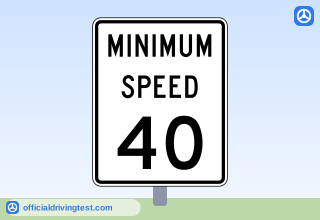
- It is unlawful
- It is lawful if you use your hazard lights
- It is lawful on any road with light traffic
- It is only a recommendation
Show answer
Correct answer: It is unlawful
Where minimum speed limits are posted, any speed below that is considered unlawful under normal conditions.
Source: Kansas Driving Handbook (Revised February 2022), page 16
-
If no minimum speed is posted, may you drive so slowly that you block the normal movement of traffic?
- Yes, because only a posted minimum speed limit can be enforced
- Yes, as long as you stay in the right lane
- No, with no exception of any kind
- No, unless safe operation under the basic speed law requires it
Show answer
Correct answer: No, unless safe operation under the basic speed law requires it
Even without a posted minimum, it is unlawful to impede or block normal traffic, except when slow driving is necessary for safe operation under the basic speed law.
Source: Kansas Driving Handbook (Revised February 2022), page 16
-
What must a safe following distance allow you to do?
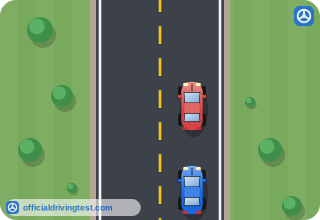
- Stop or turn to avoid a collision if the car ahead suddenly stops
- Keep the vehicle ahead in sight at all times, even on curves
- Pass the vehicle in front without needing to change lanes
- Keep pace with the speed of the vehicle behind you at all times
Show answer
Correct answer: Stop or turn to avoid a collision if the car ahead suddenly stops
The law bars following more closely than is reasonable and prudent, so you can stop or turn to avoid a collision if the vehicle ahead suddenly stops.
Source: Kansas Driving Handbook (Revised February 2022), page 17
-
What should you do when following vehicles that stop often or make sudden turns, such as buses, delivery vans and police cars?
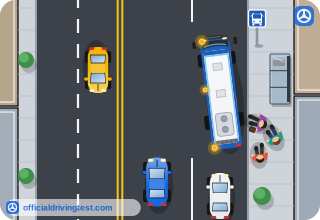
- Keep your normal following distance
- Follow closely so the driver can see you
- Follow in the lane to their left
- Increase your following distance
Show answer
Correct answer: Increase your following distance
Vehicles that stop often or turn suddenly call for a greater following distance, and bad weather calls for even more.
Source: Kansas Driving Handbook (Revised February 2022), page 18
-
How does following too closely affect a driver?
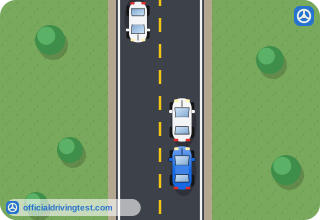
- It reduces your ability to see road and traffic conditions ahead
- It improves a driver's ability to see traffic conditions far ahead
- It has no effect on what the driver can see ahead
- It shortens the time needed to stop the vehicle
Show answer
Correct answer: It reduces your ability to see road and traffic conditions ahead
Following too closely reduces the ability to see road and traffic conditions ahead, making trouble harder to avoid as it develops.
Source: Kansas Driving Handbook (Revised February 2022), page 18
-
When should you drive at the maximum limit shown on a speed limit sign?
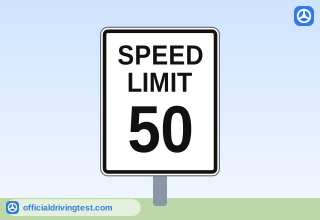
- Only in ideal driving conditions
- Whenever the road ahead appears empty
- Whenever other drivers are going faster
- Whenever you are on a major highway
Show answer
Correct answer: Only in ideal driving conditions
The maximum limit should be driven only in ideal driving conditions, and you must reduce speed when weather or traffic conditions require it.
Source: Kansas Driving Handbook (Revised February 2022), page 39
-
A sign on a high-speed road reads MINIMUM SPEED 40. What does it mean?
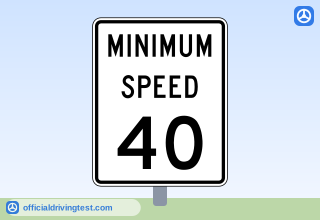
- You should travel at about 40 in all kinds of weather
- Traffic may not exceed 40 in the lane of travel
- You are legally required to travel at least that fast
- Drivers going over 40 must stay in the left lane
Show answer
Correct answer: You are legally required to travel at least that fast
Some high-speed roads have minimum speed limits, and you are legally required to travel at least that fast so as not to be a hazard to other drivers.
Source: Kansas Driving Handbook (Revised February 2022), page 39
-
On the highway, how far ahead should you look at the very least?
- One block
- A quarter of a mile
- About 100 feet
- One mile
Show answer
Correct answer: A quarter of a mile
On the highway you should look at least a quarter of a mile ahead.
Source: Kansas Driving Handbook (Revised February 2022), page 56
-
You see a traffic light that has been green for a long time as you approach. What should you do?
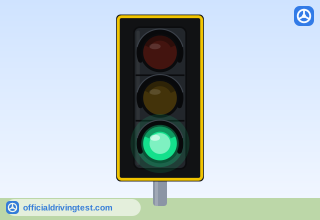
- Speed up to get through before it changes
- Keep the same speed because it is green
- Stop right away in the travel lane
- Start slowing down and be ready to stop
Show answer
Correct answer: Start slowing down and be ready to stop
A light that has been green for a long time may change to red before you get there, so you should start slowing down and be ready to stop.
Source: Kansas Driving Handbook (Revised February 2022), page 56
-
How can you calculate how many seconds ahead you are looking?
- Pick a stationary object far ahead and count seconds until you reach it
- Count the number of vehicles between you and the next intersection ahead
- Time how long the vehicle ahead takes to pass a sign beside the road
- Divide your speed by the number of lanes you can see ahead of you
Show answer
Correct answer: Pick a stationary object far ahead and count seconds until you reach it
You find a stationary object such as a sign or pole as far ahead as you can see and count one-thousand-one, one-thousand-two and so on until you reach it. The count is the number of seconds ahead you were looking.
Source: Kansas Driving Handbook (Revised February 2022), page 56
-
A visual lead is an area how far ahead of the front of your vehicle?
- 2 to 3 seconds
- 5 to 8 seconds
- 20 to 30 seconds
- About 1 second
Show answer
Correct answer: 20 to 30 seconds
The manual defines a visual lead as an area 20 to 30 seconds ahead from the front of the vehicle.
Source: Kansas Driving Handbook (Revised February 2022), page 56
-
Why does making driving changes well ahead of time help the drivers behind you?
- It lets them pass you sooner
- It gives them more time to react
- It keeps them from needing mirrors
- It lets them follow more closely
Show answer
Correct answer: It gives them more time to react
Changing speed or lanes early gives drivers behind you more time to react, and the earlier you act the less often someone behind you must react quickly.
Source: Kansas Driving Handbook (Revised February 2022), page 56
-
Which benefit does the manual give for looking well down the travel path?
- You can follow the vehicle ahead more closely
- You can stop checking your mirrors
- Your tires grip better on wet roads
- You can steer with less weaving
Show answer
Correct answer: You can steer with less weaving
Looking well down the travel path helps you steer with less weaving, as well as saving fuel and keeping traffic moving steadily.
Source: Kansas Driving Handbook (Revised February 2022), page 56
-
With good tires and brakes on dry pavement, about how far can it take to react to a problem and stop at 60 mph?
- 359 feet
- 190 feet
- 240 feet
- 520 feet
Show answer
Correct answer: 359 feet
At 60 mph it can take about 4 to 5 seconds or 359 feet to react to a problem and bring the vehicle to a stop.
Source: Kansas Driving Handbook (Revised February 2022), page 57
-
With good tires and brakes on dry pavement, about how far can it take to react to a problem and stop at 30 mph?
- 75 feet
- 98 feet
- 123 feet
- 210 feet
Show answer
Correct answer: 123 feet
At 30 mph it can take about 2 to 3 seconds or 123 feet to react to a problem and bring the vehicle to a stop.
Source: Kansas Driving Handbook (Revised February 2022), page 57
-
When do you need to check to the rear more often?
- When traffic is light
- Only when it is dark
- Only when driving below 25 mph
- When traffic is heavy
Show answer
Correct answer: When traffic is heavy
You need to check to the rear more often when traffic is heavy.
Source: Kansas Driving Handbook (Revised February 2022), page 57
-
According to the manual, checking traffic flow to the rear is the only way you will know what?
- Whether someone is following too closely or coming up too fast
- Whether the road ahead of your vehicle is clear of hazards
- Whether your brake lights and turn signals are working
- Whether your speedometer is showing an accurate reading
Show answer
Correct answer: Whether someone is following too closely or coming up too fast
Checking to the rear is the only way to know if someone is following too closely or coming up too fast, and it gives you time to change speed or lanes.
Source: Kansas Driving Handbook (Revised February 2022), page 57
-
Why should you check your mirrors when going down a long or steep hill?
- Vehicles often build up speed going down a steep grade
- Vehicles always slow down when they are on steep grades
- Your own brakes need more room on long downhill roads
- Mirrors show you the road ahead when on a steep hill
Show answer
Correct answer: Vehicles often build up speed going down a steep grade
Vehicles often build up speed going down a steep grade, so check your mirrors and be alert for large trucks and buses that may be going too fast.
Source: Kansas Driving Handbook (Revised February 2022), page 58
-
What is perception distance?
- How far your vehicle travels in ideal conditions while you are braking hard
- How far you will continue to travel before you physically hit the brakes
- How far your vehicle travels from the time your eyes see a hazard until your brain recognizes it
- The total distance needed to bring your vehicle to a complete stop, in ideal conditions
Show answer
Correct answer: How far your vehicle travels from the time your eyes see a hazard until your brain recognizes it
Perception distance is how far your vehicle travels, in ideal conditions, from the time your eyes see a hazard until your brain recognizes it.
Source: Kansas Driving Handbook (Revised February 2022), page 58
-
What is the average perception time for an alert driver?
- 1 to 2 seconds
- ¾ second to 1 second
- 2 to 3 seconds
- ¼ second to ½ second
Show answer
Correct answer: ¾ second to 1 second
The average perception time for an alert driver is ¾ second to 1 second.
Source: Kansas Driving Handbook (Revised February 2022), page 58
-
What is reaction distance?
- How far your vehicle travels from when your eyes see a hazard until your brain recognizes it
- How far your vehicle travels while you are braking
- The total distance from seeing a hazard to a complete stop
- How far you continue to travel before you physically hit the brakes in response to a hazard
Show answer
Correct answer: How far you continue to travel before you physically hit the brakes in response to a hazard
Reaction distance is how far you continue to travel, in ideal conditions, before you physically hit the brakes in response to a hazard seen ahead.
Source: Kansas Driving Handbook (Revised February 2022), page 58
-
What is the reaction time of the average driver?
- ¾ second to 1 second
- 1 to 2 seconds
- 2 to 3 seconds
- ½ second to ¾ second
Show answer
Correct answer: ¾ second to 1 second
The average driver has a reaction time of ¾ second to 1 second.
Source: Kansas Driving Handbook (Revised February 2022), page 58
-
At 50 mph, how many feet does the average driver travel during reaction time?
- 25 feet
- 80 feet
- 55 feet
- 110 feet
Show answer
Correct answer: 55 feet
At 50 mph the reaction time of ¾ second to 1 second accounts for 55 feet traveled.
Source: Kansas Driving Handbook (Revised February 2022), page 58
-
What is braking distance?
- How far you travel before you physically hit the brakes
- How far your vehicle travels while you are braking
- How far you travel from seeing a hazard until your brain recognizes it
- The total distance from seeing a hazard to a complete stop
Show answer
Correct answer: How far your vehicle travels while you are braking
Braking distance is how far your vehicle will travel, in ideal conditions, while you are braking.
Source: Kansas Driving Handbook (Revised February 2022), page 58