Kansas: Signals and vehicle controls — Part 5 Practice Test
Seat and mirror adjustment, starting, accelerating, stopping, steering methods, backing, turn signals, headlights, the horn and the pre-trip vehicle safety inspection. — Part 5
Independent educational site · not affiliated with any government agency or DMV
Ready? Test yourself
- Instant feedback with an explanation
- Every answer cites its source in the manual
- Your best score is saved on this device
Questions are original and based on the official manual "Kansas Driving Handbook" (Revised February 2022), Kansas Department of Revenue, Division of Vehicles.
All 33 questions in this practice test
Take the test above first, then use this list to study. Tap “Show answer” to see the correct answer and explanation.
Show the questions and answersHide the questions
-
Why is it important to check the mirrors, according to the pre-trip inspection section?
- They provide visibility to the sides and rear
- They show the speed of vehicles ahead
- They replace the need to look over your shoulder
- They warn you when a door is open
Show answer
Correct answer: They provide visibility to the sides and rear
Mirrors give visibility to the sides and rear, so they must be mounted securely, undamaged and adjusted.
Source: Kansas Driving Handbook (Revised February 2022), page 97
-
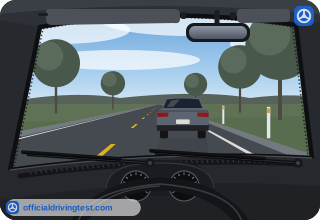
Why is it important that the windshield wipers are in good condition?
- They keep the windshield from cracking in cold weather
- They keep the headlights clean while driving at night
- They improve visibility during rain and other adverse conditions
- They prevent glare from the sun at dusk
Show answer
Correct answer: They improve visibility during rain and other adverse conditions
Wipers in good condition improve visibility during rain and other adverse conditions, while worn blades reduce visibility.
Source: Kansas Driving Handbook (Revised February 2022), page 97
-
How can you test the defroster?
- Spray washer fluid on the windshield and see how fast it clears
- Activate the fan and place your hand over the dashboard's vent
- Turn on the wipers and watch the windshield for fog
- Hold a paper towel against the back window while driving
Show answer
Correct answer: Activate the fan and place your hand over the dashboard's vent
The handbook says to test the defroster by activating the fan and placing your hand over the dashboard's vent.
Source: Kansas Driving Handbook (Revised February 2022), page 98
-
What is the purpose of the horn, according to the vehicle inspection section?
- To tell other drivers to move out of your way
- To signal to pedestrians that they should cross
- To let other drivers know you are about to turn
- To warn other roadway users of your presence, if needed
Show answer
Correct answer: To warn other roadway users of your presence, if needed
The horn must work to warn other roadway users such as vehicles, pedestrians and bicyclists of your presence, if needed.
Source: Kansas Driving Handbook (Revised February 2022), page 98
-
Why is it important that your dash indicator lights work?
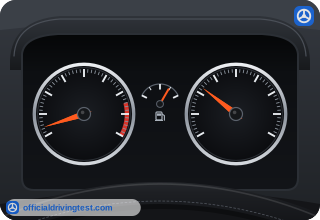
- They warn you if lights like high beams are still on
- They tell the examiner which gear you have selected
- They warn you when the tires need more air pressure
- They show when your brake lights need a new bulb
Show answer
Correct answer: They warn you if lights like high beams are still on
Indicator lights help warn you if external lights, such as turn signals and high beams, are still active when not appropriate.
Source: Kansas Driving Handbook (Revised February 2022), page 98
-
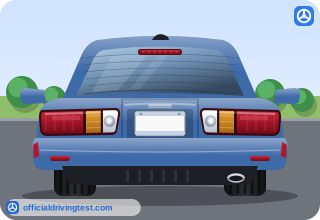
A friend stands behind your car while you step on the brake pedal and does not see both brake lights. What should you do?
- Replace the brake pads
- Add brake fluid to the reservoir
- Replace the bulb or fuse
- Tap the brake pedal until both lights turn on
Show answer
Correct answer: Replace the bulb or fuse
The handbook says that if the friend does not see both lights you should replace the bulb or fuse, or get a professional to do it.
Source: Kansas Driving Handbook (Revised February 2022), page 98
-
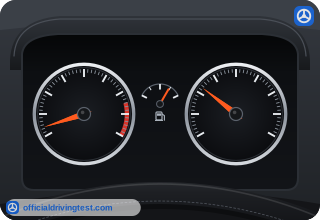
What should you check on the fuel gauge during the pre-trip inspection?
- That the tank is completely full before every exam
- That there is sufficient fuel and the gauge is not on empty
- That the fuel is the correct octane for the engine
- That the needle moves when the horn is pressed
Show answer
Correct answer: That there is sufficient fuel and the gauge is not on empty
The inspection checks that there is a sufficient amount of fuel and that the gauge is not on empty so the vehicle will start and drive properly.
Source: Kansas Driving Handbook (Revised February 2022), page 98
-
Which of these is listed as an in-vehicle item on the vehicle safety inspection study aid?
- Leaks
- Tires
- Rear lights
- Wipers and washers
Show answer
Correct answer: Wipers and washers
The study aid lists wipers and washers under the in-vehicle items, along with seats and safety belt, windows, mirrors, heater and horn.
Source: Kansas Driving Handbook (Revised February 2022), page 99
-
Which of these is one of the exercises that may be part of the basic vehicle control skills test?
- Three-point turnabout
- Four-point turnabout
- Angle parking
- Hill start
Show answer
Correct answer: Three-point turnabout
The basic control skills test consists of two or more of these exercises: forward and reverse two-point turnabouts, a three-point turnabout, and left-side and right-side parallel parks.
Source: Kansas Driving Handbook (Revised February 2022), page 100
-
The basic vehicle control skills test has five possible exercises. How many of them will your test consist of?
- Exactly one
- All five of them
- Two or more
- Exactly three
Show answer
Correct answer: Two or more
The basic control skills test consists of two or more of the five listed exercises.
Source: Kansas Driving Handbook (Revised February 2022), page 100
-
Where may the basic vehicle control skills test be performed?
- Only in an off-street area marked by cones
- Off-street, on-street during the road test, or both
- Only on-street during the road test
- Only in the parking lot of the licensing office
Show answer
Correct answer: Off-street, on-street during the road test, or both
The basic control skills test may be performed off-street, on-street during the road test, or both.
Source: Kansas Driving Handbook (Revised February 2022), page 100
-
In the basic vehicle control skills test, what counts as a reversal?
- Stopping the vehicle without changing direction
- Touching a cone with the vehicle's mirror
- Letting the turn signal cancel on its own
- Stopping and reversing direction for a better position
Show answer
Correct answer: Stopping and reversing direction for a better position
A reversal is when you stop and reverse direction to get a better position; each one counts as an error, but stopping without changing direction does not.
Source: Kansas Driving Handbook (Revised February 2022), page 100
-
Which part of your vehicle may touch or cross an exercise boundary line or cone without being an encroachment?
- The mirrors
- The front bumper
- The tires
- The rear bumper
Show answer
Correct answer: The mirrors
Touching or crossing a boundary line or cone with any part of the vehicle other than the mirrors is an encroachment.
Source: Kansas Driving Handbook (Revised February 2022), page 100
-
If your turn signal cancels automatically during a basic control skills exercise, what should you do?
- Leave it off until the exercise is over
- Honk once to show your intent
- Reactivate it when necessary
- Use hand signals instead
Show answer
Correct answer: Reactivate it when necessary
The handbook says that if your turn signal cancels automatically you must reactivate it when necessary.
Source: Kansas Driving Handbook (Revised February 2022), page 100
-
Before entering back into traffic or leaving the exercise area, what must you make sure of?
- That the roadway is clear only to your left
- That the roadway is clear in both directions
- That the examiner has finished giving instructions
- That the cones are still standing
Show answer
Correct answer: That the roadway is clear in both directions
You must make sure that it is safe and that the roadway is clear in both directions before entering back into traffic or leaving the exercise area.
Source: Kansas Driving Handbook (Revised February 2022), page 100
-
What happens if you do not maneuver the vehicle into the final position the examiner described?
- You automatically fail the entire road test
- The exercise is ignored if no cone was touched
- You get a warning, but no points are added
- Points are added to your score
Show answer
Correct answer: Points are added to your score
If you do not maneuver the vehicle into its final position as described, points will be added to your score.
Source: Kansas Driving Handbook (Revised February 2022), page 100
-
Before the basic control skills test exercises, what will the examiner do?
- Give detailed instructions and let you ask questions
- Demonstrate each exercise in your vehicle
- Let you practice each exercise twice before scoring
- Score you without any instructions
Show answer
Correct answer: Give detailed instructions and let you ask questions
The examiner gives detailed instruction for completing the exercises and you have the opportunity to ask questions.
Source: Kansas Driving Handbook (Revised February 2022), page 100
-
In the forward two-point turnabout, what do you do after pulling forward into a driveway or alley?
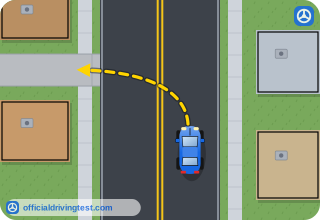
- Back to the left into the street, then drive forward out
- Turn around inside the driveway and drive forward out of it
- Back to the right into the street, then drive forward out
- Continue forward through the alley to the next street
Show answer
Correct answer: Back to the right into the street, then drive forward out
After pulling forward you back the vehicle to the right into the street and drive forward out of the exercise area.
Source: Kansas Driving Handbook (Revised February 2022), page 101
-
In the reverse two-point turnabout, how do you begin the exercise?
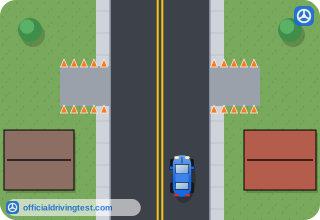
- Pull forward into the entrance, then back out to the right
- Drive past the entrance, then back to the right into it
- Drive past the entrance, then back to the left into it
- Stop at the entrance and make three moves to turn around
Show answer
Correct answer: Drive past the entrance, then back to the right into it
You drive past the entrance to a driveway or alley and back to the right into the street or alley until the front of your vehicle clears the cones.
Source: Kansas Driving Handbook (Revised February 2022), page 101
-
The turnabout exercises show your ability to do what on a two-lane road?
- Pass a slower vehicle on a two-lane road
- Merge into fast-moving expressway traffic
- Park within a marked space between cones
- Reverse the direction you are traveling
Show answer
Correct answer: Reverse the direction you are traveling
The three-point turnabout shows your ability to use a street to reverse the direction you are traveling on a two-lane road.
Source: Kansas Driving Handbook (Revised February 2022), page 102
-
How should you use the brakes during the road test?
- With quick, hard pressure to stop sooner
- Smoothly, using steady pressure
- By pumping the pedal at each stop
- Only with the parking brake at signals
Show answer
Correct answer: Smoothly, using steady pressure
The handbook says not to brake harshly but to brake smoothly using steady pressure and to stop completely at traffic signs or signals.
Source: Kansas Driving Handbook (Revised February 2022), page 106
-
Which steering methods are acceptable during the road test?
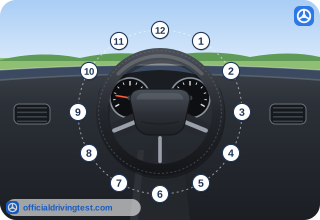
- Only hand-over-hand steering with both hands outside the wheel
- Only hand-to-hand steering with both hands outside the wheel
- Any method, as long as one hand stays at the center of the wheel
- Any method, as long as both hands are on the outside of the wheel
Show answer
Correct answer: Any method, as long as both hands are on the outside of the wheel
All methods of steering are acceptable, such as hand-over-hand and hand-to-hand, as long as both hands are on the outside of the wheel.
Source: Kansas Driving Handbook (Revised February 2022), page 106
-
When should you cancel your turn signal on the road test?
- Upon completion of a turn or lane change
- As soon as you begin the turn
- Only after you have reached the next intersection
- Never, because it cancels itself on all vehicles
Show answer
Correct answer: Upon completion of a turn or lane change
The handbook says to cancel turn signals upon completion of a turn or lane change.
Source: Kansas Driving Handbook (Revised February 2022), page 106
-
Where should you scan and check traffic during the road test?
- Only in areas marked by warning signs on the route
- Only when the examiner tells you to check traffic
- High volume areas and where pedestrians are expected
- Only at intersections that have traffic signals
Show answer
Correct answer: High volume areas and where pedestrians are expected
You scan and check traffic in high volume areas and areas where pedestrians are expected to be present.
Source: Kansas Driving Handbook (Revised February 2022), page 106
-
On the road test, how do you check your blind spots?
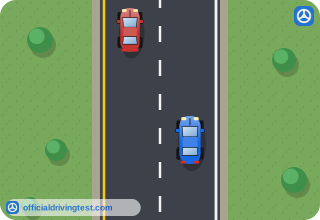
- By checking only your rearview mirror
- By looking over your shoulder (a head check)
- By glancing at the side mirrors only
- By turning on your hazard lights
Show answer
Correct answer: By looking over your shoulder (a head check)
You check your blind spots by looking over your shoulder, which the handbook calls a head check.
Source: Kansas Driving Handbook (Revised February 2022), page 104
-
Which of these should you check to prepare a vehicle for any trip?
- Seat fabric and floor mats
- Belts and hoses
- Paint and body trim
- Radio and clock settings
Show answer
Correct answer: Belts and hoses
To prepare a vehicle for a trip, check windshields and windows, lights, tires, all fluid levels, belts, hoses and brakes.
Source: Kansas Driving Handbook (Revised February 2022), page 108
-
In hot weather, how often should you inspect your tires?
- Every two hours or every 100 miles
- Every four hours or every 300 miles
- Once each day
- Every 500 miles or once each week
Show answer
Correct answer: Every two hours or every 100 miles
The manual says to inspect the tires every two hours or every 100 miles when driving in hot weather.
Source: Kansas Driving Handbook (Revised February 2022), page 110
-
Why should you not let air out of your tires when the air pressure rises in hot weather?
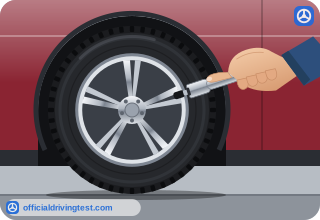
- The tires may lose their shape once they are hot
- The valve stems may be damaged by the escaping hot air
- The pressure will be too low when the tires cool off
- The engine may overheat from the lowered tire pressure
Show answer
Correct answer: The pressure will be too low when the tires cool off
Air pressure increases with temperature, and if you let air out, the pressure will be too low when the tires cool off.
Source: Kansas Driving Handbook (Revised February 2022), page 110
-
What does engine oil help do in very hot weather?
- Keep the tire pressure steady
- Keep the engine cool
- Reduce glare from the pavement
- Clean the radiator
Show answer
Correct answer: Keep the engine cool
The engine oil helps keep the engine cool, so make sure there is enough oil.
Source: Kansas Driving Handbook (Revised February 2022), page 110
-
Before driving in very hot weather, what should the engine cooling system have enough of?
- Oil and washer fluid
- Brake fluid and power steering fluid
- Fuel and oil
- Water and antifreeze
Show answer
Correct answer: Water and antifreeze
Before driving, make sure the engine cooling system has enough water and antifreeze.
Source: Kansas Driving Handbook (Revised February 2022), page 110
-
What should you do if the engine temperature gauge goes above the highest safe temperature?
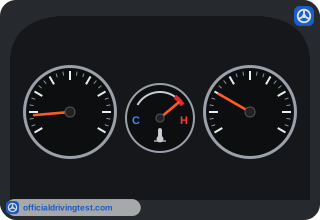
- Keep driving slowly until you reach your destination
- Turn off the air conditioner and keep on driving slowly
- Open the radiator cap right away to let the steam out
- Stop driving as soon as safely possible to find the problem
Show answer
Correct answer: Stop driving as soon as safely possible to find the problem
A reading above the highest safe temperature may lead to engine failure and possibly fire, so stop driving as soon as safely possible.
Source: Kansas Driving Handbook (Revised February 2022), page 110
-
In very hot weather, tar in the road pavement frequently rises to the surface. What hazard does this create?
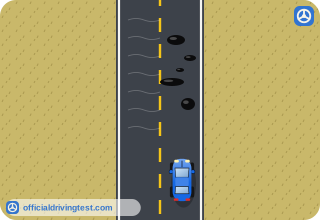
- The pavement becomes sticky enough to pull the vehicle sideways
- The spots where tar bleeds to the surface can be very slippery
- The tar makes the lane lines hard to see
- The tar causes tires to overheat quickly
Show answer
Correct answer: The spots where tar bleeds to the surface can be very slippery
Spots where tar bleeds to the surface can be very slippery, so use caution when you see it.
Source: Kansas Driving Handbook (Revised February 2022), page 110
-
Why should you go slow enough in very hot weather to prevent overheating?
- Slow driving keeps the tire pressure from rising
- Slow driving lets the engine oil circulate faster
- High speeds create more heat for tires and the engine
- High speeds make the air conditioner overheat
Show answer
Correct answer: High speeds create more heat for tires and the engine
High speeds create more heat for tires and the engine, which increases chances of tire failure or even fire and engine failure.
Source: Kansas Driving Handbook (Revised February 2022), page 110