Kansas: Signals and vehicle controls — Part 4 Practice Test
Seat and mirror adjustment, starting, accelerating, stopping, steering methods, backing, turn signals, headlights, the horn and the pre-trip vehicle safety inspection. — Part 4
Independent educational site · not affiliated with any government agency or DMV
Ready? Test yourself
- Instant feedback with an explanation
- Every answer cites its source in the manual
- Your best score is saved on this device
Questions are original and based on the official manual "Kansas Driving Handbook" (Revised February 2022), Kansas Department of Revenue, Division of Vehicles.
All 33 questions in this practice test
Take the test above first, then use this list to study. Tap “Show answer” to see the correct answer and explanation.
Show the questions and answersHide the questions
-
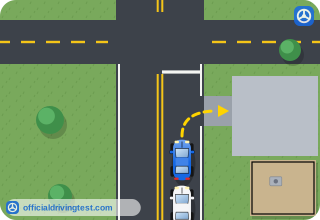
Why should you signal before reducing speed when parking or turning before an intersection?
- Pedestrians at the intersection will cross sooner if they see the signal
- Drivers behind you will stop automatically if they see the signal
- Other drivers cannot see brake lights near an intersection
- Following traffic expects your vehicle to travel through the intersection
Show answer
Correct answer: Following traffic expects your vehicle to travel through the intersection
Following traffic expects you to continue through the intersection, so a signal warns the drivers behind you that you will slow or turn first.
Source: Kansas Driving Handbook (Revised February 2022), page 70
-
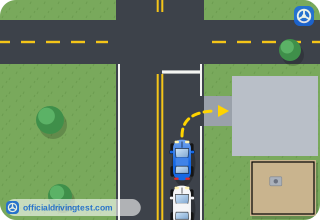
When should you signal prior to reducing speed?
- Only when another vehicle is driving directly beside you in the next lane
- When turning off a roadway with no separate turning or exiting lanes
- Only when you are driving faster than 40 mph on an open road
- Only when you are turning into a parking space on the right side
Show answer
Correct answer: When turning off a roadway with no separate turning or exiting lanes
Turning off a roadway with no separate turning or exiting lane is one of the times the manual lists for signaling before you reduce speed.
Source: Kansas Driving Handbook (Revised February 2022), page 70
-
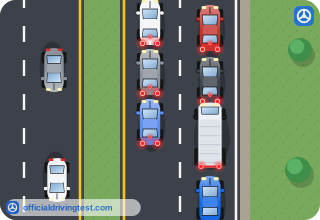
Before stopping for slowing traffic that a driver close behind your vehicle cannot see, what should you do?
- Keep your speed until the traffic ahead stops
- Signal prior to reducing speed
- Pull onto the shoulder without signaling
- Switch on your high beams
Show answer
Correct answer: Signal prior to reducing speed
Avoiding a hazard or stopping for slowing traffic that a driver close behind cannot see is a time to signal before reducing speed.
Source: Kansas Driving Handbook (Revised February 2022), page 70
-
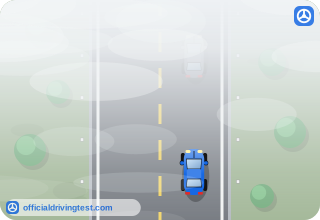
Which headlights should you use for best visibility when driving in fog, snow, or heavy rain, even during the day?
- High beams and parking lights
- High beams only
- Parking lights only
- Low beams and fog lights
Show answer
Correct answer: Low beams and fog lights
In fog, snow, or heavy rain you use your low beams and fog lights for best visibility, even during the day.
Source: Kansas Driving Handbook (Revised February 2022), page 77
-
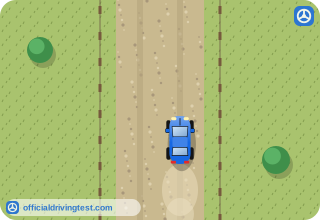
Gravel roads can become extremely dusty in dry periods. Which lights does the manual recommend using so others can see your vehicle better?
- High beam headlights
- Low beam headlights
- Hazard warning lights
- Parking lights only
Show answer
Correct answer: Low beam headlights
In dust, the manual recommends low beam headlights to make your vehicle more visible, along with slowing down and following farther back.
Source: Kansas Driving Handbook (Revised February 2022), page 90
-
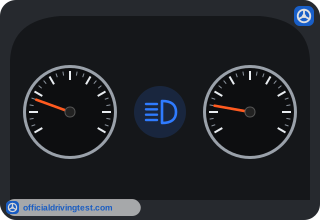
When should you use your high beams at night?
- Whenever you are following another vehicle
- Whenever it is foggy or raining hard
- Whenever there are no oncoming vehicles
- Whenever you are driving in heavy traffic
Show answer
Correct answer: Whenever there are no oncoming vehicles
High beams are for use whenever there are no oncoming vehicles; low beams are for following, heavy traffic, fog and hard rain or snow.
Source: Kansas Driving Handbook (Revised February 2022), page 90
-
According to Section 10, how far can you see with your high beams compared with low beams?
- One and a half times as far
- Three times as far
- Twice as far
- Four times as far
Show answer
Correct answer: Twice as far
High beams let you see twice as far as low beams.
Source: Kansas Driving Handbook (Revised February 2022), page 90
-
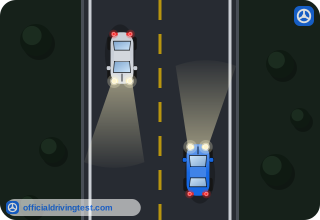
At night, how close to an oncoming vehicle should you come before you dim your high beams?
- Within about one block
- Within about two blocks
- Within about half a mile
- Within about 100 feet
Show answer
Correct answer: Within about one block
The manual says to dim your high beams whenever you come within about a one-block distance of an oncoming vehicle.
Source: Kansas Driving Handbook (Revised February 2022), page 91
-
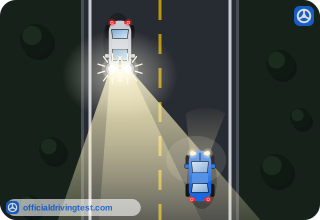
At night, a vehicle comes toward you with its high beams on. What should you do first?
- Switch on your hazard warning lights
- Sound your horn until the driver dims the lights
- Keep your high beams on so the driver sees you
- Flash your headlights once quickly
Show answer
Correct answer: Flash your headlights once quickly
Flashing your headlights once quickly signals the other driver to dim; keeping your own high beams on could blind you both.
Source: Kansas Driving Handbook (Revised February 2022), page 91
-
An oncoming driver fails to dim bright lights at night. Where should you look to keep from being blinded?
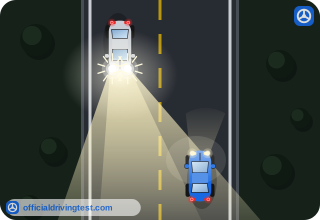
- Straight at the oncoming headlights
- Toward the right side of the road
- Toward the center of the road
- At the rearview mirror
Show answer
Correct answer: Toward the right side of the road
Looking toward the right side of the road keeps you from being blinded by the other driver's headlights.
Source: Kansas Driving Handbook (Revised February 2022), page 91
-
Why should you not keep your bright lights on to "get back" at a driver who will not dim theirs?
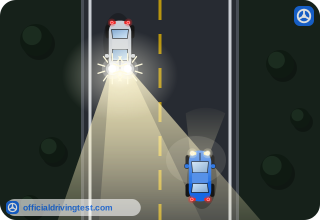
- Both of you may be blinded, possibly causing a crash
- Your high beams could burn out from the extra use
- It is the only way to tell the driver you are upset
- Your headlights could overheat and shut off
Show answer
Correct answer: Both of you may be blinded, possibly causing a crash
If both drivers keep bright lights on, both may be blinded, possibly causing a crash.
Source: Kansas Driving Handbook (Revised February 2022), page 91
-
In which of these situations should you use your low beams?
- When driving on a dark road with no other traffic
- When you want to see twice as far ahead
- When driving in fog
- When driving at night on an empty rural road
Show answer
Correct answer: When driving in fog
Low beams are for following another vehicle, heavy traffic, fog, and when it is snowing or raining hard.
Source: Kansas Driving Handbook (Revised February 2022), page 91
-
In which conditions does the manual say you can use fog lights, if your vehicle has them?
- Dust, smoke or darkness
- Fog, snow or rain
- Bright sunlight or glare
- Clear weather at dusk
Show answer
Correct answer: Fog, snow or rain
Some vehicles have fog lights that you can use in fog, snow or rain.
Source: Kansas Driving Handbook (Revised February 2022), page 91
-
The handbook says to practice inspecting vehicles with a parent, guardian or friend who is properly licensed and over what age?
- 18
- 25
- 30
- 21
Show answer
Correct answer: 21
It advises practicing with a properly licensed parent, guardian or friend who is over the age of 21.
Source: Kansas Driving Handbook (Revised February 2022), page 96
-
Where can you find the recommended tire pressure (psi) for your vehicle?
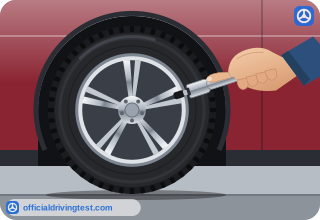
- In the owner's manual or on the driver's door jamb
- Stamped on the valve cap and valve stem
- Printed on the inside of the glove box door
- Written on the windshield next to the mirror
Show answer
Correct answer: In the owner's manual or on the driver's door jamb
The recommended psi is located in the vehicle owner's manual or on the driver's side door jamb.
Source: Kansas Driving Handbook (Revised February 2022), page 96
-
If your tire pressure is above the number listed on your door jamb, what should you do?
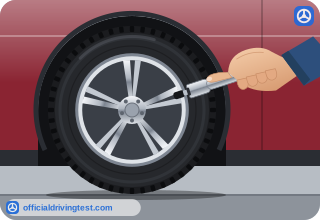
- Leave it, since extra pressure improves grip
- Drive until the tires warm up and then recheck
- Let air out until it matches
- Add a little more air to balance the tires
Show answer
Correct answer: Let air out until it matches
The handbook says that if the psi is above the number on the door jamb you let air out until it matches.
Source: Kansas Driving Handbook (Revised February 2022), page 96
-
In the penny test, what shows that your tire has a safe amount of tread?
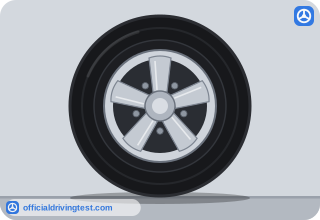
- All of Lincoln's head stays visible above the tread
- Any part of Lincoln's head is covered by the tread
- The penny cannot be placed into any groove
- Lincoln's body disappears into the groove
Show answer
Correct answer: Any part of Lincoln's head is covered by the tread
If any part of Lincoln's head is covered by the tread, you are driving with the safe amount of tread.
Source: Kansas Driving Handbook (Revised February 2022), page 96
-
According to the handbook, how often should you check your tires for wear and damage?
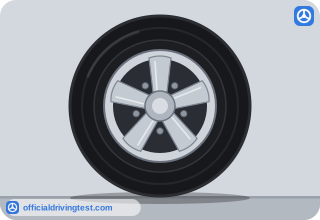
- Once a year, when the vehicle is inspected
- Every six months, on a date you choose
- Only when a tire looks flat or low on air
- Once every month, or before a long road trip
Show answer
Correct answer: Once every month, or before a long road trip
The handbook says to check tires for wear and damage once every month, or before a long road trip.
Source: Kansas Driving Handbook (Revised February 2022), page 96
-
According to the pre-trip inspection section, what does low tire inflation or lack of tread do?
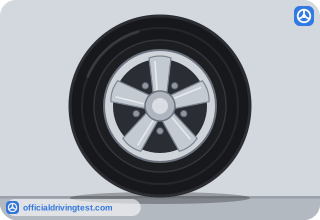
- Increases the effect of hydroplaning
- Shortens your stopping distance
- Improves your cornering ability
- Reduces the chance of a blowout
Show answer
Correct answer: Increases the effect of hydroplaning
Low inflation or lack of tread increases the effect of hydroplaning, reduces cornering ability and increases the chance of blowout.
Source: Kansas Driving Handbook (Revised February 2022), page 96
-
What does over inflation of a tire increase the chance of?
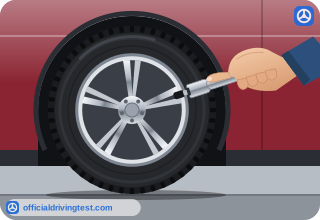
- Valve caps coming off the stems
- Brake lines leaking under the car
- Tread separation and tire failure
- Headlight lenses cracking in heat
Show answer
Correct answer: Tread separation and tire failure
The handbook says over inflation increases the chance of tread separation and tire failure.
Source: Kansas Driving Handbook (Revised February 2022), page 96
-
According to the handbook, fluid loss from a leak could indicate what?
- That the brake lights are not operating properly at the rear
- Component failure in areas such as the transmission or fuel systems
- That the engine oil was changed too recently
- That the coolant needs to be replaced with water
Show answer
Correct answer: Component failure in areas such as the transmission or fuel systems
Fluid loss could indicate component failure where levels may not be readily checked, such as the transmission or fuel systems.
Source: Kansas Driving Handbook (Revised February 2022), page 96
-
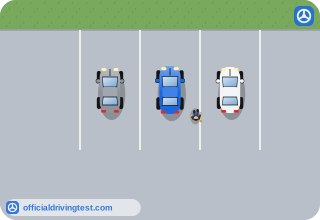
What should you look for around the vehicle during the walk-around before entering it?
- Scratches that need paint repair
- Missing parking permit stickers
- Loose items left in the trunk
- Children, animals and other debris
Show answer
Correct answer: Children, animals and other debris
During the walk-around you look at the general condition of the vehicle and for children, animals and other debris around it.
Source: Kansas Driving Handbook (Revised February 2022), page 96
-
What should you check about the headlights during the pre-trip inspection?
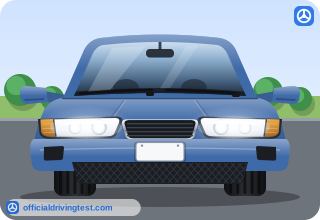
- That low and high beams work and the lenses are intact
- That only the low beams work, since high beams are optional
- That the bulbs are the brightest type available
- That the lenses are tinted for night driving
Show answer
Correct answer: That low and high beams work and the lenses are intact
Low and high beam headlights must be operational and the lenses must not be cracked, broken or missing.
Source: Kansas Driving Handbook (Revised February 2022), page 96
-
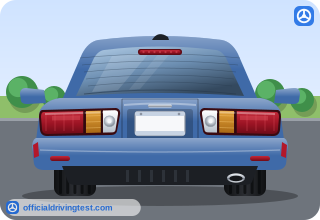
What do brake lights communicate to other drivers?
- That you are about to turn
- That your headlights are on
- That you are slowing or stopping
- That you are parked
Show answer
Correct answer: That you are slowing or stopping
Brake lights also communicate to other drivers that you are slowing or stopping.
Source: Kansas Driving Handbook (Revised February 2022), page 97
-
Which turn signals should you check during the pre-trip inspection?
- Only the front ones
- All of them, both front and back
- Only the ones at the back
- Only the one on the driver's side
Show answer
Correct answer: All of them, both front and back
The inspection checks that all turn signals, both front and back, are operational and have intact lenses.
Source: Kansas Driving Handbook (Revised February 2022), page 97
-
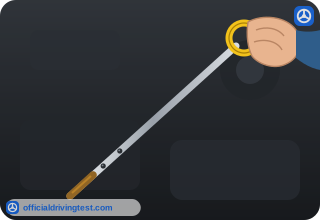
When checking the oil dipstick, what should you do if the film of oil does not reach the markings?
- Replace the dipstick
- Wait for the engine to cool, then drive
- Remove some oil
- Add more oil
Show answer
Correct answer: Add more oil
If the film of oil does not reach the markings, the handbook says to add more oil.
Source: Kansas Driving Handbook (Revised February 2022), page 97
-
When is it safe to open the radiator cap?
- Only after the car has cooled down
- Right after you turn the engine off
- While the engine is running, to see the level
- Only after you have added coolant
Show answer
Correct answer: Only after the car has cooled down
The handbook warns never to open the radiator cap on a hot car and to wait until the car has cooled down first.
Source: Kansas Driving Handbook (Revised February 2022), page 97
-
If the coolant does not reach the "minimum" fill line, what should you fill it with?
- Plain water only
- Clean engine oil
- A coolant/water solution
- Windshield washer fluid
Show answer
Correct answer: A coolant/water solution
The handbook says to fill the coolant tank with a coolant/water solution if it does not reach the minimum line.
Source: Kansas Driving Handbook (Revised February 2022), page 97
-
If the outside temperature is over 85°F, what must work properly in the vehicle used for the driving exam?
- The heater
- The air conditioner
- The windshield washers
- The rear defroster
Show answer
Correct answer: The air conditioner
For the driving exam vehicle, the air conditioner must work properly when the outside temperature is over 85°F.
Source: Kansas Driving Handbook (Revised February 2022), page 97
-
If the outside temperature is between 75°F and 85°F, what is acceptable for the vehicle used in the driving exam?
- A working heater only
- A working air conditioner only; the windows must stay closed
- A working heater, or a passenger window that rolls down
- A working air conditioner, or a passenger window that rolls down
Show answer
Correct answer: A working air conditioner, or a passenger window that rolls down
Between 75°F and 85°F the air conditioner must work properly, or the passenger window must roll down.
Source: Kansas Driving Handbook (Revised February 2022), page 97
-
If the outside temperature is under 45°F, what must work properly in the vehicle used for the driving exam?
- The heater
- The air conditioner
- The passenger window
- The rear window defroster
Show answer
Correct answer: The heater
For the driving exam vehicle, the heater must work properly when the outside temperature is under 45°F.
Source: Kansas Driving Handbook (Revised February 2022), page 97
-
How should you adjust the driver seat before the driving exam?
- As far back as possible to get the most room
- So the top of your head touches the roof
- So you can reach the pedals and turn the steering wheel
- As low as it will go for the best view over the hood
Show answer
Correct answer: So you can reach the pedals and turn the steering wheel
The inspection says to adjust the driver seat so you can reach the pedals and turn the steering wheel.
Source: Kansas Driving Handbook (Revised February 2022), page 97
-
What should you check about the doors during the pre-trip inspection?
- That they lock automatically when the vehicle moves
- That the windows are tinted to reduce glare
- That the handles are free of fingerprints
- That they are undamaged and open, close and latch properly
Show answer
Correct answer: That they are undamaged and open, close and latch properly
Doors should not be damaged and must open, close and latch properly to keep you safe while driving.
Source: Kansas Driving Handbook (Revised February 2022), page 97