Kansas: Signals and vehicle controls — Part 2 Practice Test
Seat and mirror adjustment, starting, accelerating, stopping, steering methods, backing, turn signals, headlights, the horn and the pre-trip vehicle safety inspection. — Part 2
Independent educational site · not affiliated with any government agency or DMV
Ready? Test yourself
- Instant feedback with an explanation
- Every answer cites its source in the manual
- Your best score is saved on this device
Questions are original and based on the official manual "Kansas Driving Handbook" (Revised February 2022), Kansas Department of Revenue, Division of Vehicles.
All 33 questions in this practice test
Take the test above first, then use this list to study. Tap “Show answer” to see the correct answer and explanation.
Show the questions and answersHide the questions
-
With a manual transmission, what do you do when the vehicle has stopped?
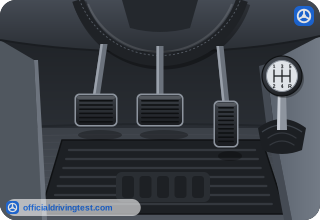
- Release the clutch pedal and shift the gearshift into neutral
- Press the clutch pedal down and shift into first gear
- Shift into reverse and set the parking brake
- Shift into second gear and release the brake
Show answer
Correct answer: Press the clutch pedal down and shift into first gear
When stopped, you press the clutch pedal down and shift into first gear, if applicable to the vehicle.
Source: Kansas Driving Handbook (Revised February 2022), page 30
-
In which direction should the steering wheel always be turned, whether moving forward or in reverse?
- The direction opposite to where you want the vehicle to move
- The direction opposite to where you want the rear to go when backing
- Toward the side of the road with the most clearance
- The direction you want the vehicle to move
Show answer
Correct answer: The direction you want the vehicle to move
The steering wheel is always turned in the direction you want the vehicle to move, whether moving forward or in reverse.
Source: Kansas Driving Handbook (Revised February 2022), page 30
-
Where should both hands be placed on the steering wheel?
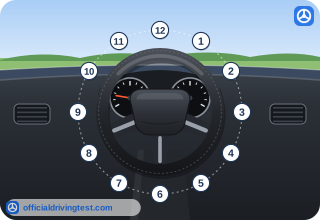
- On the outside of the wheel on opposite sides
- On the inside of the rim on opposite sides
- On the outside of the wheel, both at the top
- On the same side of the wheel at the bottom
Show answer
Correct answer: On the outside of the wheel on opposite sides
Both hands should be placed on the outside of the steering wheel on opposite sides.
Source: Kansas Driving Handbook (Revised February 2022), page 30
-
How should your grip on the steering wheel be?
- As tight as you can hold it
- Relaxed, with the wheel free to slip
- Firm but gentle
- Light, using only one hand
Show answer
Correct answer: Firm but gentle
Your grip on the steering wheel should be firm but gentle.
Source: Kansas Driving Handbook (Revised February 2022), page 30
-
How should you use your fingers and thumbs on the steering wheel?
- Use your palms instead of your fingers and hook your thumbs inside the wheel rim
- Use your fingers instead of your palms and keep your thumbs up along the wheel face
- Use your fingers and wrap your thumbs around the rim
- Use your palms and keep your thumbs behind the wheel
Show answer
Correct answer: Use your fingers instead of your palms and keep your thumbs up along the wheel face
You use your fingers instead of the palms of your hands and keep your thumbs up along the face of the steering wheel.
Source: Kansas Driving Handbook (Revised February 2022), page 30
-
What should you never do when turning the steering wheel?
- Hold it with both hands on the outside
- Use your fingers instead of your palms
- Keep your thumbs up along the face of the wheel
- Grip it from the inside of the rim
Show answer
Correct answer: Grip it from the inside of the rim
Never turn the wheel while gripping it from the inside of the rim.
Source: Kansas Driving Handbook (Revised February 2022), page 30
-
How many methods of steering does the manual describe?
- Four
- Two
- Three
- Five
Show answer
Correct answer: Four
The manual describes four methods of steering: hand-to-hand, hand-over-hand, evasive action and one hand steering.
Source: Kansas Driving Handbook (Revised February 2022), page 31
-
What is hand-to-hand steering commonly called?
- Over-and-under steering
- Shuffle steering
- Push/pull steering
- Palm-to-palm steering
Show answer
Correct answer: Push/pull steering
Hand-to-hand steering is commonly called push/pull steering.
Source: Kansas Driving Handbook (Revised February 2022), page 31
-
When should you use hand-to-hand steering?
- Only when turning at low speeds, such as when parking
- When turning the wheel during normal forward driving above 10-15 mph
- Only when backing or when reaching for a control such as the wipers
- Only when evading a hazard with anti-lock brakes engaged
Show answer
Correct answer: When turning the wheel during normal forward driving above 10-15 mph
Hand-to-hand steering is used when turning the wheel during normal driving going forward above 10-15 mph.
Source: Kansas Driving Handbook (Revised February 2022), page 31
-
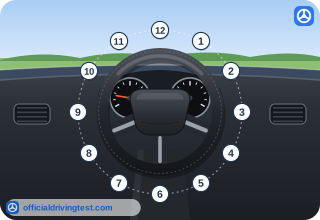
With hand-to-hand steering, where do your hands grasp the wheel?
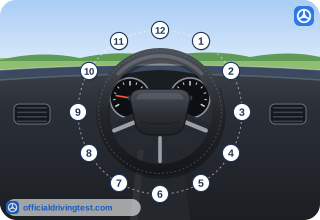
- Left hand between 8 and 9 o'clock and right hand between 3 and 4 o'clock
- Left hand between 6 and 7 o'clock and right hand between 5 and 6 o'clock
- Both hands between 11 and 1 o'clock at the top of the wheel
- Left hand between 7 and 8 o'clock and right hand between 4 and 5 o'clock
Show answer
Correct answer: Left hand between 7 and 8 o'clock and right hand between 4 and 5 o'clock
For hand-to-hand steering the left hand grasps the wheel between 7 and 8 o'clock and the right hand between 4 and 5 o'clock.
Source: Kansas Driving Handbook (Revised February 2022), page 31
-
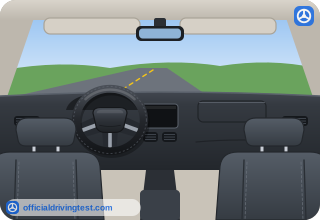
Why does hand-to-hand steering lower the chance of injury in a frontal crash when the vehicle has a driver side air bag?
- Your hands and arms never cross over the steering wheel
- Your hands stay at the 2 and 10 o'clock positions
- Your arms are held rigid against the steering wheel
- Your hands rest low on the rim near your lap
Show answer
Correct answer: Your hands and arms never cross over the steering wheel
Because the hands and arms never cross over the steering wheel, there is less chance of injury to the face, hands and arms in a frontal crash.
Source: Kansas Driving Handbook (Revised February 2022), page 31
-
Which steering method does the manual call the preferred method of steering?
- Hand-over-hand steering
- Evasive action steering
- Hand-to-hand steering
- One hand steering
Show answer
Correct answer: Hand-to-hand steering
The manual calls hand-to-hand steering the preferred method of steering.
Source: Kansas Driving Handbook (Revised February 2022), page 31
-
Why is the 2 and 10 o'clock hand position not recommended?
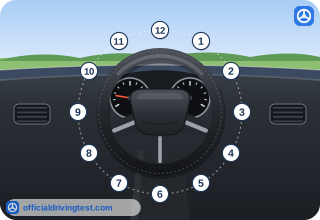
- It makes it harder to see the mirrors and the gauges clearly
- It can be dangerous in vehicles equipped with air bags
- It tires the arms on long trips
- It does not allow you to use the horn
Show answer
Correct answer: It can be dangerous in vehicles equipped with air bags
The 2 and 10 o'clock position is not recommended because it can be dangerous in vehicles equipped with air bags.
Source: Kansas Driving Handbook (Revised February 2022), page 31
-
When should you use hand-over-hand steering?
- During normal forward driving on an open straight road above 10-15 mph
- Only when backing to the left or right
- Only when you are forced off the roadway at speed
- When turning the wheel at low speeds, such as at an intersection or when parking
Show answer
Correct answer: When turning the wheel at low speeds, such as at an intersection or when parking
Hand-over-hand steering is used when turning the wheel at low speeds, such as at an intersection or when parking the vehicle.
Source: Kansas Driving Handbook (Revised February 2022), page 31
-
With hand-over-hand steering, where do your hands grasp the wheel?
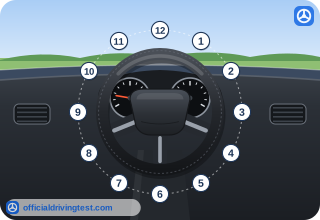
- Left hand between 8 and 9 o'clock and right hand between 3 and 4 o'clock
- Left hand between 7 and 8 o'clock and right hand between 4 and 5 o'clock
- Left hand between 9 and 10 o'clock and right hand between 2 and 3 o'clock
- Left hand between 10 and 11 o'clock and right hand between 1 and 2 o'clock
Show answer
Correct answer: Left hand between 8 and 9 o'clock and right hand between 3 and 4 o'clock
For hand-over-hand steering the left hand grasps the wheel between 8 and 9 o'clock and the right hand between 3 and 4 o'clock.
Source: Kansas Driving Handbook (Revised February 2022), page 31
-
When steering to avoid a problem on the roadway, steering should be limited to not more than how many degrees?
- 120 degrees
- 270 degrees
- 180 degrees
- 360 degrees
Show answer
Correct answer: 180 degrees
It is critical to limit steering to not more than 180 degrees when trying to evade a problem on the roadway.
Source: Kansas Driving Handbook (Revised February 2022), page 31
-
How many degrees of steering do modern vehicles take to move back on the road after an off-road encounter?
- 10 to 20 degrees
- 45 to 90 degrees
- 120 to 150 degrees
- 180 to 270 degrees
Show answer
Correct answer: 45 to 90 degrees
Modern vehicles only take 45 to 90 degrees of steering to move a vehicle back on the road after an off-road encounter.
Source: Kansas Driving Handbook (Revised February 2022), page 31
-
What happens when more than 180 degrees of steering input is used to evade a problem?
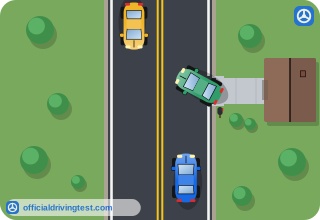
- The vehicle returns to its own lane faster and keeps more traction than before
- The air bag deploys and the steering wheel locks in place
- The anti-lock brakes release so the vehicle can turn sharply
- Traction is lost and the vehicle often crosses the roadway toward oncoming vehicles
Show answer
Correct answer: Traction is lost and the vehicle often crosses the roadway toward oncoming vehicles
With more than 180 degrees of input, traction loss occurs and the vehicle often moves across the roadway in the approach of oncoming vehicles.
Source: Kansas Driving Handbook (Revised February 2022), page 31
-
As speed increases, how much steering input is needed to move the vehicle one lane space to the left or right?
- Much less steering input
- Much more steering input
- About the same steering input
- No steering input at all
Show answer
Correct answer: Much less steering input
As speeds increase much less steering input is needed to move the vehicle one lane space to the left or right.
Source: Kansas Driving Handbook (Revised February 2022), page 31
-
When should you use one hand steering?
- Whenever driving on straight roads where both hands are not needed
- Whenever turning at an intersection at low speed
- Only when backing or operating vehicle controls that require a temporary reach
- Whenever changing lanes on a freeway at normal speed
Show answer
Correct answer: Only when backing or operating vehicle controls that require a temporary reach
One hand steering is used only when backing or operating vehicle controls such as wipers, flashers or lights that require a temporary reach from the wheel.
Source: Kansas Driving Handbook (Revised February 2022), page 31
-
When you reach for an operating control such as the wipers, where should your other hand be?
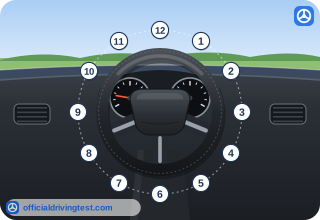
- At 12 o'clock, at the top of the steering wheel, with the thumb up
- At 8-9 o'clock or 3-4 o'clock, depending on the steering wheel design
- At 10 o'clock, near the top of the steering wheel
- At 6 o'clock, at the bottom of the steering wheel
Show answer
Correct answer: At 8-9 o'clock or 3-4 o'clock, depending on the steering wheel design
The other hand stays in the normal operating position of 8-9 o'clock or 3-4 o'clock, depending on the steering wheel design.
Source: Kansas Driving Handbook (Revised February 2022), page 31
-
When is the 12 o'clock hand position recommended?
- When turning the wheel at an intersection or when parking the vehicle at low speed
- When driving forward above 10-15 mph
- When reaching for the wipers while driving forward
- When backing left or right and you must turn in your seat to see the path to the rear
Show answer
Correct answer: When backing left or right and you must turn in your seat to see the path to the rear
The only time 12 o'clock is recommended is when backing a vehicle to the left or right and the driver must turn in the seat to see the path of travel to the rear.
Source: Kansas Driving Handbook (Revised February 2022), page 31
-
Why should you try to do as little backing as possible?
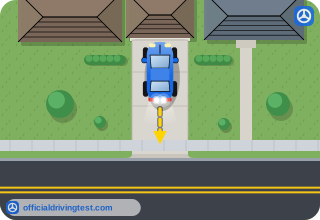
- It is hard for you to see behind your vehicle
- It uses much more fuel than driving forward
- Backing is against the law on most roads
- The mirrors stop working when you back up
Show answer
Correct answer: It is hard for you to see behind your vehicle
It is hard to see behind your vehicle, so you should try to do as little backing as possible.
Source: Kansas Driving Handbook (Revised February 2022), page 32
-
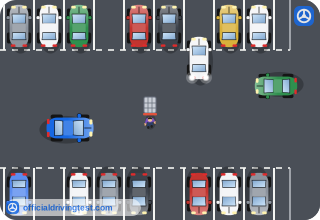
In a shopping center, what kind of parking space should you try to find?
- One close to the store entrance so you have a shorter walk inside
- One at the end of a row next to a curb
- One you can drive through, so you can drive forward when you leave
- One between two other parked vehicles
Show answer
Correct answer: One you can drive through, so you can drive forward when you leave
In a shopping center you should try to find a space you can drive through so you can drive forward when you leave and avoid backing.
Source: Kansas Driving Handbook (Revised February 2022), page 32
-
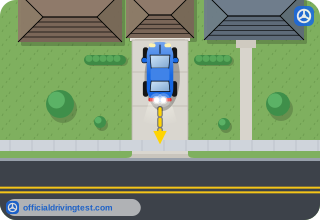
Why should you check behind your vehicle before you get in to back up?
- The rear lights may be dirty and not working properly at night
- Children or small objects cannot be seen from the driver's seat
- The mirrors do not show anything behind the vehicle
- The parking brake may be set behind the wheels
Show answer
Correct answer: Children or small objects cannot be seen from the driver's seat
Children or small objects behind the vehicle cannot be seen from the driver's seat, so check behind it before you get in.
Source: Kansas Driving Handbook (Revised February 2022), page 32
-
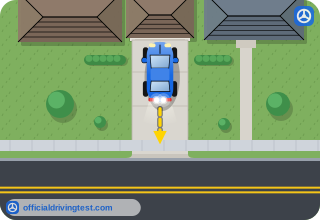
When backing, what should your foot be doing as you shift to reverse?
- Pressing the accelerator
- Holding the clutch halfway
- Resting on the floor
- Pressing the brake pedal
Show answer
Correct answer: Pressing the brake pedal
To back up you place your foot on the brake and shift to reverse.
Source: Kansas Driving Handbook (Revised February 2022), page 32
-
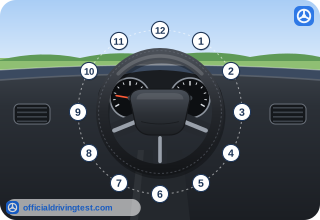
When you start backing, where do you grasp the steering wheel with your left hand?
- At 12 o'clock
- At 3 o'clock
- At 6 o'clock
- At 9 o'clock
Show answer
Correct answer: At 12 o'clock
When backing, you grasp the steering wheel at 12 o'clock with your left hand.
Source: Kansas Driving Handbook (Revised February 2022), page 32
-
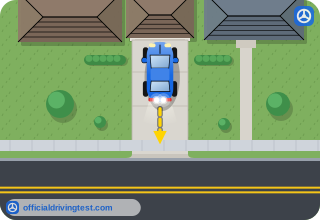
When backing, how should you look to the rear?
- Only in the rearview mirror with both hands kept on the steering wheel rim
- Only in the side mirrors with your left arm out the window
- Directly through the rear window with your right arm on the back of the seat
- Through the driver's window with your left arm on the door
Show answer
Correct answer: Directly through the rear window with your right arm on the back of the seat
You place your right arm on the back of the seat and look directly through the rear window.
Source: Kansas Driving Handbook (Revised February 2022), page 32
-
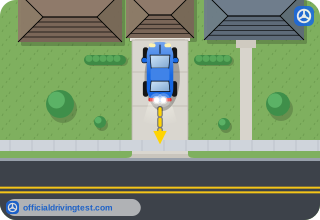
What should you keep in mind about your rearview and side mirrors when backing?
- They show the whole area directly behind the vehicle
- They do not show directly behind your vehicle
- They should not be used at all when backing
- They are more accurate than looking through the rear window
Show answer
Correct answer: They do not show directly behind your vehicle
You may use your rearview and side mirrors for backing, but these mirrors do not show directly behind your vehicle.
Source: Kansas Driving Handbook (Revised February 2022), page 32
-
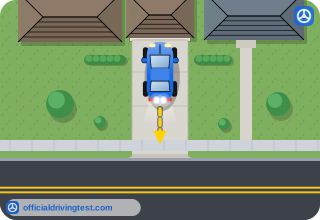
How should you accelerate when backing?
- Quickly, to clear the area as soon as possible
- At a steady medium speed
- Briskly at first and then slowly
- Gently and smoothly, keeping speed slow
Show answer
Correct answer: Gently and smoothly, keeping speed slow
When backing you accelerate gently and smoothly, keeping speed slow.
Source: Kansas Driving Handbook (Revised February 2022), page 32
-
How does steering a vehicle while backing compare with steering forward?
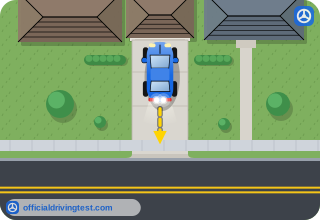
- The vehicle is much harder to steer while backing
- The vehicle is easier to steer while backing
- The vehicle steers the same way in both directions
- The vehicle steers more easily at higher speeds in reverse
Show answer
Correct answer: The vehicle is much harder to steer while backing
Your vehicle is much harder to steer while you are backing.
Source: Kansas Driving Handbook (Revised February 2022), page 32
-
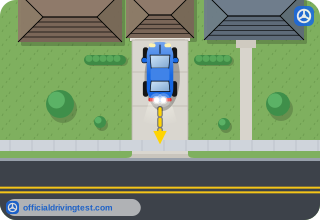
When backing, in which direction should you steer?
- Slightly in the direction the front of the vehicle should move
- Sharply away from the direction the rear should move
- Slightly in the direction the rear of the vehicle should move
- Straight ahead until the vehicle has stopped
Show answer
Correct answer: Slightly in the direction the rear of the vehicle should move
When backing you steer slightly in the direction the rear of the vehicle should move.
Source: Kansas Driving Handbook (Revised February 2022), page 32
-
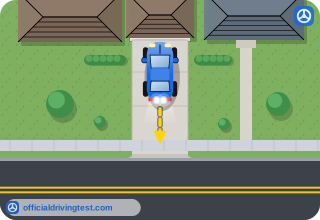
If you are backing while turning, what should you do?
- Look only at the rear window until you stop
- Make quick checks to the front and sides
- Look only in the rearview mirror
- Stop and check the front after every turn
Show answer
Correct answer: Make quick checks to the front and sides
If backing while turning, you make quick checks to the front and sides.
Source: Kansas Driving Handbook (Revised February 2022), page 32