Kansas: Signals and vehicle controls — Part 1 Practice Test
Seat and mirror adjustment, starting, accelerating, stopping, steering methods, backing, turn signals, headlights, the horn and the pre-trip vehicle safety inspection. — Part 1
Independent educational site · not affiliated with any government agency or DMV
Ready? Test yourself
- Instant feedback with an explanation
- Every answer cites its source in the manual
- Your best score is saved on this device
Questions are original and based on the official manual "Kansas Driving Handbook" (Revised February 2022), Kansas Department of Revenue, Division of Vehicles.
All 33 questions in this practice test
Take the test above first, then use this list to study. Tap “Show answer” to see the correct answer and explanation.
Show the questions and answersHide the questions
-
How far before making a turn or move must all signals be given in Kansas?
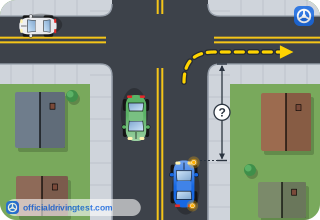
- At least 25 feet
- At least 50 feet
- At least 75 feet
- At least 100 feet
Show answer
Correct answer: At least 100 feet
Kansas requires that all signals be given at least 100 feet before making the actual move or turn.
Source: Kansas Driving Handbook (Revised February 2022), page 17
-
How long should a turn signal be held?
- Until you have slowed to 10 mph
- Until you can see the cross street
- Until you are ready to make the turn
- For exactly three seconds
Show answer
Correct answer: Until you are ready to make the turn
Signals should be held until you are ready to make the actual turn.
Source: Kansas Driving Handbook (Revised February 2022), page 17
-
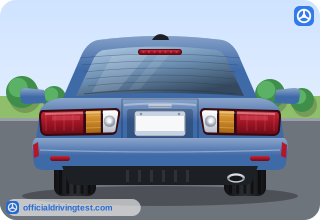
If your vehicle is required to have turn signals, how must you signal your intention to turn?
- With a hand signal only
- With your electric turn signals
- With a hand signal or the horn
- With your hazard lights
Show answer
Correct answer: With your electric turn signals
A driver of a vehicle required to have turn signals must signal turns with the electric turn signals.
Source: Kansas Driving Handbook (Revised February 2022), page 17
-
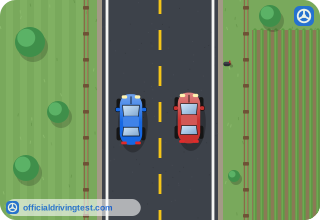
After passing, which signal do you use before returning to the right lane?
- Your left-turn signal
- Your hazard lights
- Your right-turn signal
- No signal is needed
Show answer
Correct answer: Your right-turn signal
Use the right-turn signal after passing and before returning to the right lane.
Source: Kansas Driving Handbook (Revised February 2022), page 17
-
When should you adjust your seat and mirrors?
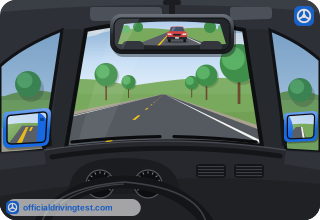
- Before you start to drive
- After you reach highway speed
- Only at the start of a long trip
- Once the vehicle is moving in traffic
Show answer
Correct answer: Before you start to drive
The manual says to always adjust the seat and mirrors before you start to drive, so you can see clearly and have full control of the pedals and steering wheel.
Source: Kansas Driving Handbook (Revised February 2022), page 26
-
When your seat is adjusted properly, what should your foot be able to do?
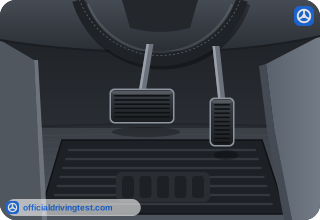
- Reach the brake and accelerator only by lifting your heel off the floor
- Press the brake and the accelerator at the same time with your toes
- Pivot smoothly from the brake to the accelerator while the heel stays on the floor
- Rest flat on the floor beside both pedals until you need them
Show answer
Correct answer: Pivot smoothly from the brake to the accelerator while the heel stays on the floor
Your foot should pivot smoothly from brake to accelerator with the heel kept on the floor.
Source: Kansas Driving Handbook (Revised February 2022), page 26
-
If the steering wheel can be adjusted, how high should its top be?
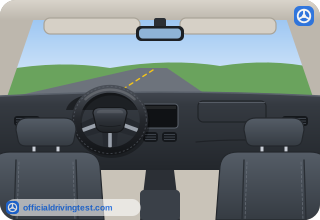
- Level with the top of your head and above your eyes
- No higher than the top of your shoulders and below chin level
- At eye level so the dashboard gauges stay in view
- Above your shoulders but no higher than your ears
Show answer
Correct answer: No higher than the top of your shoulders and below chin level
The top of the steering wheel should be no higher than the top of your shoulders and below the chin level.
Source: Kansas Driving Handbook (Revised February 2022), page 26
-
How much space should there be between your body and the bottom of the steering wheel?
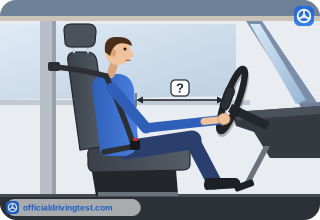
- 4 inches
- 16 inches
- 24 inches
- 10 inches
Show answer
Correct answer: 10 inches
There should be 10 inches between your body and the bottom of the steering wheel.
Source: Kansas Driving Handbook (Revised February 2022), page 26
-
What are head restraints designed to prevent?
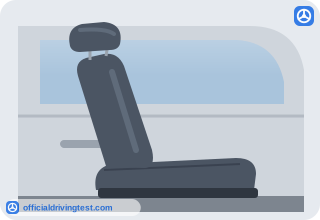
- Whiplash if you are hit from behind
- Injury to the chest in a head-on crash
- Your head striking the windshield in a stop
- Glare from the headlights of cars behind you
Show answer
Correct answer: Whiplash if you are hit from behind
Head restraints are designed to prevent whiplash, a neck pain caused by movement beyond the neck's normal range, if you are hit from behind.
Source: Kansas Driving Handbook (Revised February 2022), page 26
-
How should a head restraint be adjusted to help prevent whiplash?
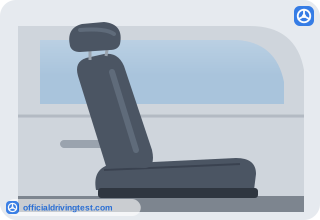
- So it rests against your upper back, well below the level of your ears
- So it sits several inches behind your head, above your ears
- So it contacts the back of your head and is not below the level of your ears
- So it is as low as it goes to keep the rear window clear
Show answer
Correct answer: So it contacts the back of your head and is not below the level of your ears
To help prevent whiplash the head restraint should contact the back of your head and not be below the level of your ears.
Source: Kansas Driving Handbook (Revised February 2022), page 26
-
How should you adjust the rearview mirror?
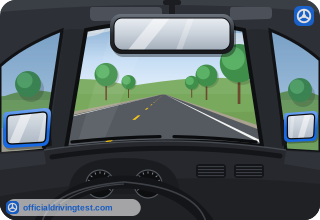
- So it shows mostly the inside of the vehicle
- So that it frames the rear window
- So it points at the left rear corner of the car
- So it shows only the road just behind the bumper
Show answer
Correct answer: So that it frames the rear window
The rearview mirror should frame the rear window so you can see traffic flow to the rear of the vehicle.
Source: Kansas Driving Handbook (Revised February 2022), page 26
-
If your vehicle has a day/night mirror, what should you make sure of?
- That it is always left in the night position
- That it is set to the day position all year
- That it is switched each time you stop the vehicle
- That it is set for the time of day you are driving
Show answer
Correct answer: That it is set for the time of day you are driving
A day/night mirror must be set for the time of day you are driving.
Source: Kansas Driving Handbook (Revised February 2022), page 26
-
With the traditional mirror setting, what should the left side view mirror let you see?
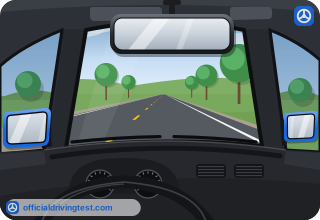
- The left edge of the vehicle
- Only the road far behind the vehicle
- The rear window of your own vehicle
- The top of the vehicle's roof
Show answer
Correct answer: The left edge of the vehicle
In the traditional setting, the left side view mirror is adjusted to see the left edge of the vehicle and the right mirror the right edge.
Source: Kansas Driving Handbook (Revised February 2022), page 26
-
For which vehicles may the traditional mirror setting be more appropriate when towing or backing in tight areas?
- Motorcycles and mopeds only
- Small passenger cars only
- Trucks, vans and SUV type vehicles
- Any vehicle that has a head restraint
Show answer
Correct answer: Trucks, vans and SUV type vehicles
The traditional setting may be more appropriate for trucks, vans and SUV type vehicles when towing or backing in tight areas.
Source: Kansas Driving Handbook (Revised February 2022), page 26
-
What does the manual say about side view mirrors on passenger vehicles?
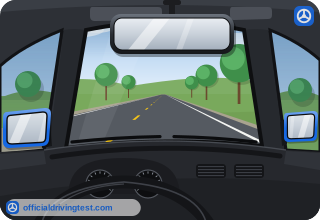
- They show the area directly behind the vehicle
- They are not designed for backing the vehicle
- They are designed mainly for backing in tight areas
- They should be folded in whenever you back up
Show answer
Correct answer: They are not designed for backing the vehicle
Passenger vehicle side view mirrors are not designed for backing the vehicle.
Source: Kansas Driving Handbook (Revised February 2022), page 26
-
In the enhanced mirror setting, how do you adjust the left side view mirror?
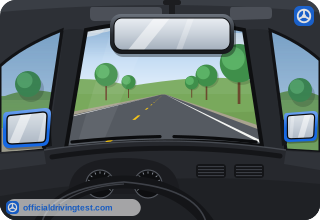
- Sit upright and aim it to show the left edge of the vehicle
- Lean your head back and aim it at the lane behind you
- Tilt it down until only the road beside the vehicle shows
- Lean your head to the left until it touches the driver side window
Show answer
Correct answer: Lean your head to the left until it touches the driver side window
For the enhanced setting you lean your head to the left until it touches the driver side window, then adjust the mirror so the rear fender is just visible at its edge.
Source: Kansas Driving Handbook (Revised February 2022), page 26
-
How much additional viewing area does the enhanced mirror setting add to each side of the vehicle?
- 12 to 16 degrees
- 2 to 5 degrees
- 20 to 25 degrees
- 30 to 45 degrees
Show answer
Correct answer: 12 to 16 degrees
The enhanced mirror setting adds 12 to 16 degrees of additional viewing area to each side of the vehicle.
Source: Kansas Driving Handbook (Revised February 2022), page 26
-
Why might the traditional mirror setting be appropriate instead of the enhanced setting?
- The enhanced setting is allowed only on trucks
- The enhanced setting cannot be used at night
- The enhanced setting may not work on all vehicles
- The enhanced setting shows too much of the vehicle's sides
Show answer
Correct answer: The enhanced setting may not work on all vehicles
The enhanced mirror setting may not work on all vehicles, so the traditional mirror setting may be appropriate.
Source: Kansas Driving Handbook (Revised February 2022), page 26
-
What should you make sure of before you start the vehicle?
- That the gear selector is in drive
- That the parking brake is set
- That the clutch pedal is released
- That the doors are unlocked
Show answer
Correct answer: That the parking brake is set
The manual says to make sure the parking brake is set before you start the vehicle.
Source: Kansas Driving Handbook (Revised February 2022), page 30
-
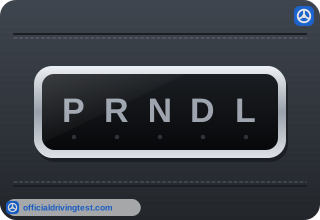
Before starting a vehicle with automatic transmission, what do you do?
- Place your left foot on the clutch and move the selector to neutral
- Place your right foot on the accelerator and move the selector to drive
- Release the parking brake and move the selector to reverse
- Place your right foot on the brake pedal and check that the gear selector is in park
Show answer
Correct answer: Place your right foot on the brake pedal and check that the gear selector is in park
With an automatic transmission you place your right foot on the brake pedal and check that the gear selector lever is in park.
Source: Kansas Driving Handbook (Revised February 2022), page 30
-
Before starting a vehicle with manual transmission, what do you do?
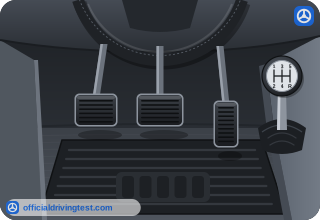
- Press the clutch to the floor with your left foot and put the gearshift lever in neutral
- Press the clutch halfway with your right foot and put the gearshift lever in first
- Press the brake with your left foot and put the gearshift lever in first gear
- Keep both feet off the pedals and put the gearshift lever in reverse
Show answer
Correct answer: Press the clutch to the floor with your left foot and put the gearshift lever in neutral
With a manual transmission you press the clutch to the floor with your left foot and put the gearshift lever in neutral.
Source: Kansas Driving Handbook (Revised February 2022), page 30
-
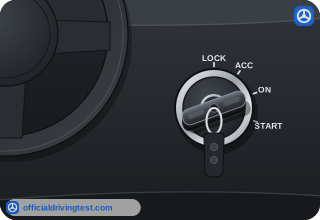
After you turn the ignition switch to the on position, what should you check?
- Only the fuel level, the outside temperature and the radio display
- Only the rearview mirror and the head restraint
- Indicator lights and gauges, such as fuel level, ABS and air bags
- Only the tire pressure and the oil pressure
Show answer
Correct answer: Indicator lights and gauges, such as fuel level, ABS and air bags
After turning the ignition switch to on, check the indicator lights and gauges (fuel level, ABS, air bags, etc.) before turning the switch to start.
Source: Kansas Driving Handbook (Revised February 2022), page 30
-
Which headlights does the manual say to turn on after you turn the ignition switch to start?
- High beam headlights
- Low beam headlights
- Fog lights only
- Parking lights only
Show answer
Correct answer: Low beam headlights
After turning the ignition switch to start, the manual says to turn on the low beam headlights and lock the doors.
Source: Kansas Driving Handbook (Revised February 2022), page 30
-
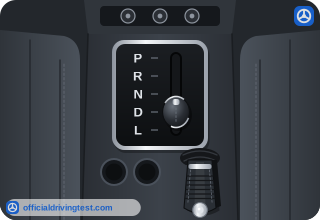
In a vehicle with automatic transmission, what do you do before moving the gear selector lever to D (drive)?
- Set the parking brake and press the accelerator
- Press the clutch to the floor and turn on the flashers
- Turn on the high beams and press the accelerator
- Release the parking brake and press the brake pedal
Show answer
Correct answer: Release the parking brake and press the brake pedal
With automatic transmission you release the parking brake, press the brake pedal and then move the gear selector lever to D (drive).
Source: Kansas Driving Handbook (Revised February 2022), page 30
-
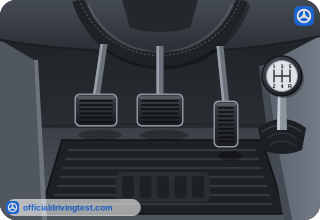
In a vehicle with manual transmission, which gear do you shift into from neutral to start moving?
- First
- Second
- Reverse
- Drive
Show answer
Correct answer: First
With manual transmission you keep the clutch to the floor, move the gearshift from neutral to first, press the brake pedal and release the parking brake.
Source: Kansas Driving Handbook (Revised February 2022), page 30
-
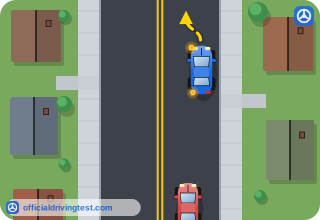
Before you move your foot to the accelerator to pull away, what should you check?
- Only the traffic in front of you and the lane beside you
- Only the rearview mirror for traffic behind you
- Forward for a safe path and for traffic to the sides and behind
- Only the gauges and warning lights
Show answer
Correct answer: Forward for a safe path and for traffic to the sides and behind
You check forward for a safe path and check for traffic to the sides and behind, then signal and, if safe, press the accelerator gently.
Source: Kansas Driving Handbook (Revised February 2022), page 30
-
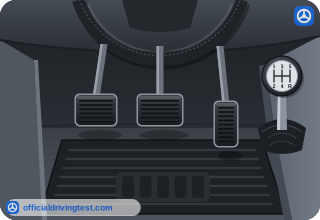
What happens if you release the clutch suddenly?
- The vehicle will roll backward without stalling
- The vehicle will jerk forward and the engine may stall
- The drive wheels will lock and the vehicle will skid
- The vehicle will shift itself into neutral
Show answer
Correct answer: The vehicle will jerk forward and the engine may stall
Releasing the clutch suddenly makes the vehicle jerk forward and the engine may stall.
Source: Kansas Driving Handbook (Revised February 2022), page 30
-
How should your foot rest on the accelerator when you accelerate?
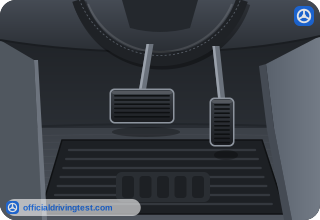
- With the heel of your foot on the pedal and your toes on the floor
- With your whole foot flat on the pedal and your heel off the floor
- With your foot raised just above the pedal until you press
- With the top of your foot on the pedal and your heel on the floor
Show answer
Correct answer: With the top of your foot on the pedal and your heel on the floor
You accelerate gradually and smoothly with the top of your foot on the pedal and the heel of your foot on the floor.
Source: Kansas Driving Handbook (Revised February 2022), page 30
-
What can trying to accelerate too fast cause, particularly on slippery surfaces?

- The drive wheels to spin and the vehicle to slide
- The brakes to lock and the engine to stall
- The tires to wear evenly and the vehicle to slow
- The steering wheel to lock and the lights to dim
Show answer
Correct answer: The drive wheels to spin and the vehicle to slide
Accelerating too fast can make the drive wheels spin, especially on slippery surfaces, and could make the vehicle slide.
Source: Kansas Driving Handbook (Revised February 2022), page 30
-
How should you increase speed when traction is poor, as in rain, snow, or sandy/gravel areas?

- As quickly as possible
- In short bursts of full power
- Gradually
- Only while braking lightly
Show answer
Correct answer: Gradually
Speed should be increased gradually when traction is poor, because too much power can make the drive wheels spin and you could lose control.
Source: Kansas Driving Handbook (Revised February 2022), page 30
-
What should you do if the drive wheels begin to spin?

- Press the accelerator harder to regain grip
- Take your foot off the accelerator
- Brake as hard as you can
- Shift into neutral and coast
Show answer
Correct answer: Take your foot off the accelerator
If the drive wheels begin to spin, take your foot off the accelerator.
Source: Kansas Driving Handbook (Revised February 2022), page 30
-
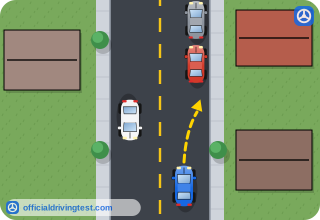
If you are moving to the curb to stop in a vehicle with automatic transmission, what should you do?
- Signal only after you have stopped at the curb
- Check only your rearview mirror and then slow down
- Turn on your hazard flashers and brake hard
- Check over your shoulder and signal your intentions
Show answer
Correct answer: Check over your shoulder and signal your intentions
If moving to the curb, you check over your shoulder and signal your intentions.
Source: Kansas Driving Handbook (Revised February 2022), page 30
-
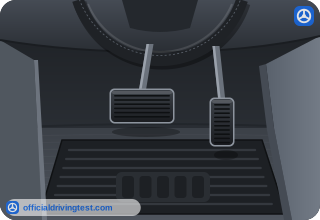
How should you press the brake pedal for a smooth stop?
- In quick, repeated pumps
- As hard as possible at first
- With steady pressure
- Lightly at first, then hard at the end
Show answer
Correct answer: With steady pressure
After releasing the accelerator, you move your foot to the brake pedal and press with steady pressure for a smooth stop.
Source: Kansas Driving Handbook (Revised February 2022), page 30