Kansas: Sharing the road — Part 4 Practice Test
Bicyclists, motorcycles, large trucks and their No-Zones, buses, school buses, slow-moving vehicles and aggressive drivers. — Part 4
Independent educational site · not affiliated with any government agency or DMV
Ready? Test yourself
- Instant feedback with an explanation
- Every answer cites its source in the manual
- Your best score is saved on this device
Questions are original and based on the official manual "Kansas Driving Handbook" (Revised February 2022), Kansas Department of Revenue, Division of Vehicles.
All 35 questions in this practice test
Take the test above first, then use this list to study. Tap “Show answer” to see the correct answer and explanation.
Show the questions and answersHide the questions
-
When following a large vehicle, how should you position your vehicle?
- Directly behind it, in the middle of its rear blind spot
- As close behind it as you can to stay out of the wind
- So that the driver can see it in the side mirrors
- Close enough that you can read its license plate
Show answer
Correct answer: So that the driver can see it in the side mirrors
Avoid following a large vehicle too closely and position your vehicle so the driver can see it in the side mirrors.
Source: Kansas Driving Handbook (Revised February 2022), page 86
-
On steep hills, large vehicles must drive slowly. At about what speed?
- Approximately 15 mph
- Approximately 35 mph
- Approximately 25 mph
- Approximately 45 mph
Show answer
Correct answer: Approximately 35 mph
When traveling up or down steep hills, large vehicles must drive slowly, approximately 35 mph, and therefore use the right lane.
Source: Kansas Driving Handbook (Revised February 2022), page 86
-
Where should you avoid driving in the right lane, if possible, to reduce the chance of a crash with a large vehicle?
- On any road with more than two lanes
- In construction zones only
- On roads with a speed limit above 55 mph
- On hills and near truck weigh stations
Show answer
Correct answer: On hills and near truck weigh stations
Large vehicles use the right lane when going slowly up or down hills and when reentering faster-moving traffic near weigh stations, so avoiding the right lane there reduces the chance of a crash.
Source: Kansas Driving Handbook (Revised February 2022), page 86
-
A truck or bus ahead of you is making a right turn. What is the safest action?
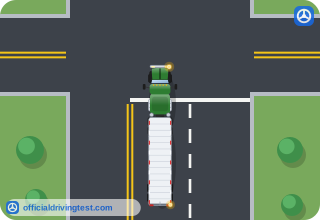
- Wait until it has completed its turn before you turn
- Pass it quickly on the right as it begins to turn
- Turn right just before it does
- Move up between it and the curb
Show answer
Correct answer: Wait until it has completed its turn before you turn
To avoid a crash, do not turn until the truck or bus has completed its turn.
Source: Kansas Driving Handbook (Revised February 2022), page 87
-
Why might a truck or bus swing wide to the left before turning right?
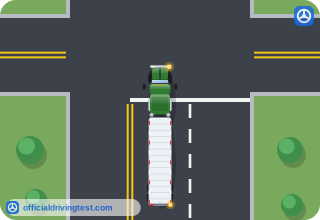
- To let faster traffic pass on its right side first
- To warn drivers behind it that it is about to stop
- To safely clear the corner of a curb or other obstruction
- To keep its right turn signal visible to drivers behind
Show answer
Correct answer: To safely clear the corner of a curb or other obstruction
When making a right turn, trucks and buses sometimes swing wide to the left in order to safely turn right and clear the corner of a curb or other obstruction.
Source: Kansas Driving Handbook (Revised February 2022), page 87
-
What can happen if you try to get in between a turning truck or bus and the curb?
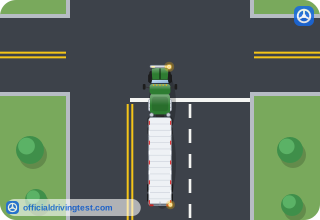
- The driver will see you more easily and let you through
- You can be squeezed between them and suffer a serious crash
- You will clear the corner safely ahead of the vehicle
- The truck will stop to allow you to pass
Show answer
Correct answer: You can be squeezed between them and suffer a serious crash
If you try to get in between the truck or bus and the curb, you will be squeezed between them and could suffer a serious crash.
Source: Kansas Driving Handbook (Revised February 2022), page 87
-
When you meet a truck coming from the opposite direction, where should you keep your vehicle?
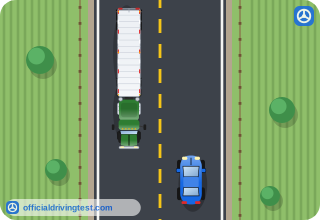
- Close to the center line to give it room
- Near the center line so you can see around it
- On the left shoulder, if there is one
- As far to the right side of the roadway as possible
Show answer
Correct answer: As far to the right side of the roadway as possible
Keep as far as possible to the right side of the roadway to avoid a side swept crash and to reduce the wind turbulence that pushes the vehicles apart.
Source: Kansas Driving Handbook (Revised February 2022), page 87
-
You are unsure of the speed of an oncoming truck or bus and want to turn left. What should you do?
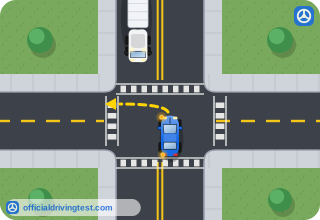
- Not turn left in its path
- Turn quickly before it gets closer
- Flash your headlights and turn
- Turn left slowly so it can slow down
Show answer
Correct answer: Not turn left in its path
When in doubt about the speed of an oncoming truck or bus, do not turn left in its path. It may be going faster than you think and takes longer to stop than a car.
Source: Kansas Driving Handbook (Revised February 2022), page 87
-
How do stop lines at intersections help large vehicles?
- They show trucks where to stop so they do not block you
- They give trucks the right of way over cars
- They keep you farther back, giving larger vehicles more turning space
- They mark the lane that trucks must use when turning right
Show answer
Correct answer: They keep you farther back, giving larger vehicles more turning space
Stop lines help set you farther back at an intersection to give larger vehicles more turning space, so you should always stop behind stop lines.
Source: Kansas Driving Handbook (Revised February 2022), page 87
-
Which of these should you NOT do to reach an exit or turn, or to beat a truck into a single-lane construction zone?
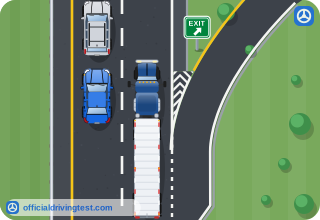
- Signal your lane change early
- Cut off the large vehicle
- Wait for the large vehicle to pass first
- Slow down and increase your space
Show answer
Correct answer: Cut off the large vehicle
Do not cut off a large vehicle in traffic or on the highway to reach an exit or turn or to beat a truck into a single-lane construction zone; the few seconds saved are not worth a life.
Source: Kansas Driving Handbook (Revised February 2022), page 87
-
Who may use the special escape or runaway ramps on long downgrades?
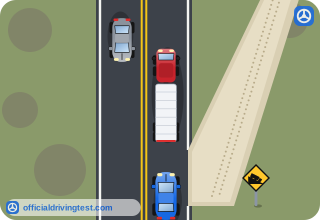
- Any vehicle that needs to cool its brakes on the long downgrade
- Any driver who wants to pass slow traffic on the long downgrade
- Only trucks that are carrying hazardous materials down the grade
- Only large vehicles that are out of control or have brake failure
Show answer
Correct answer: Only large vehicles that are out of control or have brake failure
Runaway ramps are to be used only by large vehicles that are out of control or cannot stop because of brake failure.
Source: Kansas Driving Handbook (Revised February 2022), page 87
-
What must you never do in the area of runaway ramps?
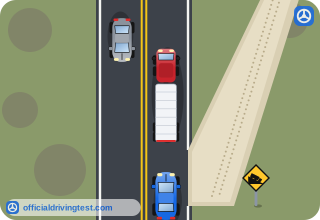
- Stop or park
- Drive past the ramp
- Slow down below the speed limit
- Signal before changing lanes
Show answer
Correct answer: Stop or park
Never stop or park in the area of runaway ramps.
Source: Kansas Driving Handbook (Revised February 2022), page 87
-
Why should you watch for transit buses that have stopped?
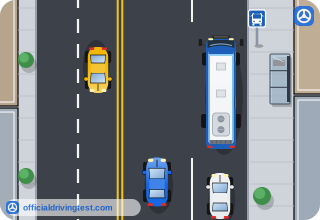
- They may be stopped to let you pass in front of them
- Their drivers must wait for you to go first at each stop
- They may block your view of pedestrians about to cross the street
- They may be about to back up into your lane
Show answer
Correct answer: They may block your view of pedestrians about to cross the street
Stopped buses may block your view of pedestrians about to cross the street, or they may be about to pull into traffic.
Source: Kansas Driving Handbook (Revised February 2022), page 87
-
Unlike a school bus, when must you stop for a transit bus that is dropping off or picking up people?
- Always, from every direction
- Only when you are behind it
- Only when it has its hazard lights on
- Only when the bus driver signals you
Show answer
Correct answer: Only when you are behind it
Unlike a school bus, you do not have to stop for a transit bus that is dropping off or picking up people unless you are behind it.
Source: Kansas Driving Handbook (Revised February 2022), page 87
-
What is a safety zone?
- A lane set aside for trolleys to pass slower traffic ahead
- An area where drivers may stop to pick up or drop off passengers
- A section of track where light rail vehicles may wait to load
- A space set aside for pedestrians boarding or waiting for trolleys
Show answer
Correct answer: A space set aside for pedestrians boarding or waiting for trolleys
A safety zone is a space set aside for pedestrians boarding, entering and waiting for trolleys and light rail vehicles.
Source: Kansas Driving Handbook (Revised February 2022), page 87
-
What are you never allowed to do in a trolley safety zone?
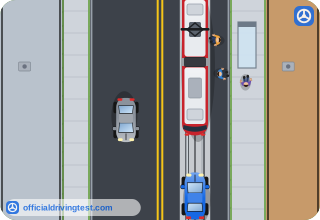
- Drive through or park, for any reason
- Drive through, but you may park briefly
- Park, but only to drop off passengers
- Drive through at any speed if no one is waiting
Show answer
Correct answer: Drive through or park, for any reason
Do not drive through or park on tracks or in a safety zone for any reason.
Source: Kansas Driving Handbook (Revised February 2022), page 87
-
At what speed may you pass a trolley safety zone, once it is safe to do so?
- No faster than 5 mph
- No faster than 15 mph
- No faster than 10 mph
- No faster than 25 mph
Show answer
Correct answer: No faster than 10 mph
You may pass the safety zone as soon as it is safe to do so and at no faster than 10 mph.
Source: Kansas Driving Handbook (Revised February 2022), page 87
-
People are boarding or leaving a trolley or light rail vehicle where there is no safety zone. What must you do?
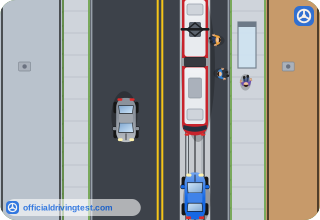
- Slow down and pass on the right at a walking pace past the doors
- Stop behind the nearest door or platform and wait until they are safe
- Stop beside the nearest door and wait for the trolley to move on
- Pass on the left once the trolley has started to move again
Show answer
Correct answer: Stop behind the nearest door or platform and wait until they are safe
Where there is no safety zone, stop behind the nearest door or vehicle platform and wait until the people have reached a safe place.
Source: Kansas Driving Handbook (Revised February 2022), page 87
-
Which of these is a time when you may pass a trolley or light rail vehicle on its left?
- When it is standing still at a stop
- When it is moving slowly and the road ahead is clear
- When you are running late and no one is boarding
- When a traffic officer directs you to
Show answer
Correct answer: When a traffic officer directs you to
You may not overtake a trolley or light rail vehicle on the left, moving or standing, except on a one-way street, when the tracks are too close to the right side to pass on the right, or when a traffic officer directs you.
Source: Kansas Driving Handbook (Revised February 2022), page 87
-
A light rail vehicle or trolley is approaching and you want to turn. What should you do?
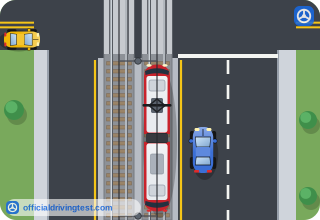
- Let it pass before making your turn
- Turn ahead of it if you have enough time
- Turn quickly while it is still far away
- Flash your headlights so it slows down
Show answer
Correct answer: Let it pass before making your turn
Never turn in front of an approaching light rail vehicle or trolley. Let it pass before making your turn.
Source: Kansas Driving Handbook (Revised February 2022), page 87
-
What can cause blind spots for the operator of a rail vehicle or trolley?
- The tracks running ahead of the vehicle
- Only the passengers standing in the doorway
- Buildings, trees and other objects
- Only heavy rain or fog
Show answer
Correct answer: Buildings, trees and other objects
Buildings, trees and other objects can cause blind spots for the rail vehicle or trolley operator.
Source: Kansas Driving Handbook (Revised February 2022), page 87
-
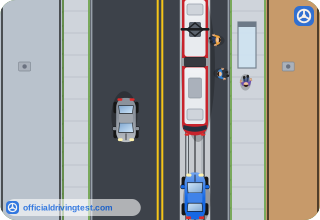
What should you maintain if a trolley or light rail vehicle shares the roadway with other users?
- A position beside it in the next lane
- A safe following distance
- A speed faster than the vehicle's
- A distance of one car length
Show answer
Correct answer: A safe following distance
Maintain a safe following distance from the rail vehicle or trolley if it shares the roadway with other users.
Source: Kansas Driving Handbook (Revised February 2022), page 88
-
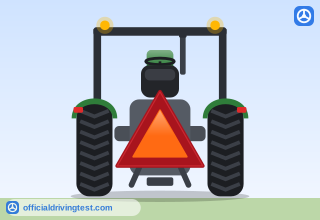
A fluorescent or reflective orange and red triangle is displayed on the rear of a vehicle. What does it mean?
- The vehicle is traveling less than 45 mph
- The vehicle is carrying a wide or oversize load
- The vehicle is stopped and may not move for some time
- The vehicle is traveling less than 25 mph
Show answer
Correct answer: The vehicle is traveling less than 25 mph
An orange and red triangle on the rear of vehicles drawn by animals, farm equipment or construction equipment means the vehicle is traveling less than 25 mph.
Source: Kansas Driving Handbook (Revised February 2022), page 88
-
How may the operator of farm machinery make a right turn?
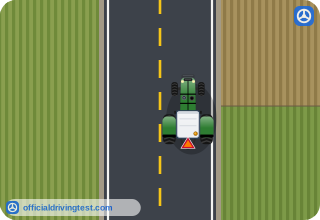
- Pull wide to the left and then turn to the right
- Pull onto the right shoulder and then turn left
- Stop and signal with the hazard flashers first
- Turn right from the center of the roadway
Show answer
Correct answer: Pull wide to the left and then turn to the right
Farm machinery usually does not have turn signals, and to make a right turn, operators may pull wide to the left and then turn to the right.
Source: Kansas Driving Handbook (Revised February 2022), page 88
-
How wide can farm machinery be?
- No wider than a single traffic lane
- Wide enough to fill about half a lane
- Wide enough to take up more than one traffic lane
- No wider than the shoulder of a state highway
Show answer
Correct answer: Wide enough to take up more than one traffic lane
Farm machinery can be very large and wide enough to take up more than one traffic lane.
Source: Kansas Driving Handbook (Revised February 2022), page 88
-
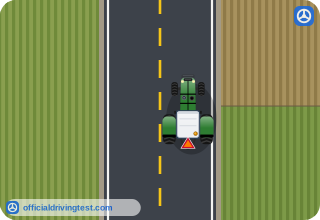
What should you remember about the operator of farm machinery when you pass?
- The operator can hear a horn from a long way off
- The operator cannot hear approaching vehicles
- The operator always signals before moving over
- The operator can see you in the mirrors at all times
Show answer
Correct answer: The operator cannot hear approaching vehicles
Pass farm machinery with caution and remember the operator cannot hear approaching vehicles.
Source: Kansas Driving Handbook (Revised February 2022), page 88
-
What road rights do animal drawn vehicles have?
- The right of way over all other vehicles on the road at all times
- Fewer rights than motor vehicles, but they follow the same rules
- The right to use only the shoulder of the road, never a lane
- The same rights as a motor vehicle, and they follow the same rules
Show answer
Correct answer: The same rights as a motor vehicle, and they follow the same rules
Animal drawn vehicles have the same rights to use the road as a motor vehicle and must follow the same rules of the road.
Source: Kansas Driving Handbook (Revised February 2022), page 88
-
What are the normal speeds of animal drawn vehicles?
- Between 5 and 8 miles per hour
- Between 10 and 15 miles per hour
- Between 15 and 20 miles per hour
- Between 2 and 4 miles per hour
Show answer
Correct answer: Between 5 and 8 miles per hour
Normal speeds for animal drawn vehicles range between 5 and 8 miles per hour, and may be even slower.
Source: Kansas Driving Handbook (Revised February 2022), page 88
-
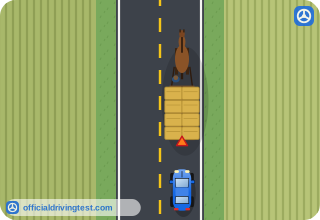
Why must you be extra cautious when passing an animal drawn vehicle that is pulling a large load of hay?
- Its driver may not be able to hear the load shifting
- Its horse may not follow the same rules of the road
- Its driver may not be able to see vehicles behind
- Its driver may be required to stop for every vehicle
Show answer
Correct answer: Its driver may not be able to see vehicles behind
When pulling large loads of hay or other equipment, drivers of animal drawn vehicles may not be able to see vehicles behind them.
Source: Kansas Driving Handbook (Revised February 2022), page 88
-
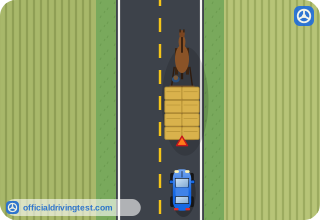
Why should you not use your horn or rev your engine when passing an animal drawn vehicle?
- It may make the driver stop in the traffic lane
- It may scare the horse and cause a crash
- It may make the driver turn into a driveway
- It may warn oncoming traffic too late
Show answer
Correct answer: It may scare the horse and cause a crash
Do not use your horn or rev the engine near an animal drawn vehicle because this may scare the horse and cause a crash.
Source: Kansas Driving Handbook (Revised February 2022), page 88
-
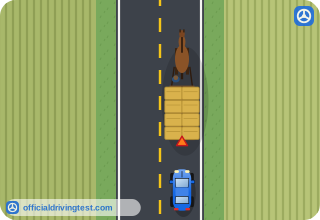
Which turns should you anticipate from animal drawn vehicles?
- U-turns on the highway
- Right turns made from the left lane
- Sudden stops in the middle of the road
- Left turns into fields and driveways
Show answer
Correct answer: Left turns into fields and driveways
To avoid collisions, you should anticipate left turns made by animal drawn vehicles into fields and driveways.
Source: Kansas Driving Handbook (Revised February 2022), page 88
-
How must horseback riders ride on a road?
- Single file near the right curb or road edge
- Two abreast in the center of the lane
- Single file near the left edge, facing traffic
- Side by side on the right shoulder only
Show answer
Correct answer: Single file near the right curb or road edge
Horseback riders must ride single file near the right curb or road edge, or on a usable right shoulder, lane or path.
Source: Kansas Driving Handbook (Revised February 2022), page 88
-
How will areas where horseback riding is common usually be marked?
- With a solid white line
- With colored pavement
- With an advisory sign
- With reflective posts
Show answer
Correct answer: With an advisory sign
Areas where horseback riding is common will usually be marked with an advisory sign.
Source: Kansas Driving Handbook (Revised February 2022), page 88
-
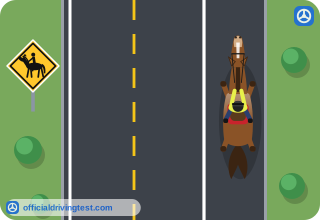
When you approach a horse being ridden or led along a road, how must you drive?
- At your normal speed, sounding your horn to warn the rider
- At a reasonable speed and a reasonable distance away from the horse
- As close to the horse as you can, to stay out of the lane
- At a walking speed, revving your engine to get it moving
Show answer
Correct answer: At a reasonable speed and a reasonable distance away from the horse
You must drive at a reasonable speed and at a reasonable distance away from the horse, without sounding your horn or revving your engine loudly.
Source: Kansas Driving Handbook (Revised February 2022), page 88
-
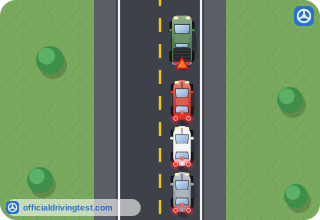
You are driving a slow-moving vehicle and other vehicles have to reduce speed behind you. What should you do?
- Stop in your lane and signal them to go around
- Turn on your hazard flashers and stay in your lane
- Speed up until you are able to reach the speed limit
- Pull to the side of the roadway when safe and let them pass
Show answer
Correct answer: Pull to the side of the roadway when safe and let them pass
If you are driving so slowly that other vehicles must reduce speed, pull to the side of the roadway when safe to do so and let the other vehicles pass.
Source: Kansas Driving Handbook (Revised February 2022), page 88