Kansas: Sharing the road — Part 2 Practice Test
Bicyclists, motorcycles, large trucks and their No-Zones, buses, school buses, slow-moving vehicles and aggressive drivers. — Part 2
Independent educational site · not affiliated with any government agency or DMV
Ready? Test yourself
- Instant feedback with an explanation
- Every answer cites its source in the manual
- Your best score is saved on this device
Questions are original and based on the official manual "Kansas Driving Handbook" (Revised February 2022), Kansas Department of Revenue, Division of Vehicles.
All 35 questions in this practice test
Take the test above first, then use this list to study. Tap “Show answer” to see the correct answer and explanation.
Show the questions and answersHide the questions
-
What does the manual say about smaller vehicles as a source of risk?
- They are less stable than every other vehicle
- They are harder for other drivers to see
- They have reduced visibility around the vehicle
- They need more room to stop than larger vehicles
Show answer
Correct answer: They are harder for other drivers to see
Smaller vehicles are harder for other drivers to see, which is one way the vehicle you drive creates risk.
Source: Kansas Driving Handbook (Revised February 2022), page 71
-
According to the manual, why does urban or city driving have increased risks?
- Speed limits there are always much higher
- Roads there do not have any marked lanes
- Drivers there seldom use their turn signals
- Many other people are using the roadway as well
Show answer
Correct answer: Many other people are using the roadway as well
Urban or city driving has increased risks because many other people are using the roadway as well.
Source: Kansas Driving Handbook (Revised February 2022), page 71
-
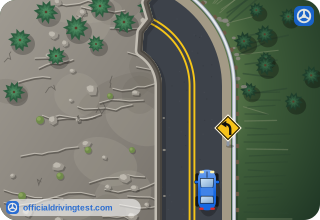
What does the manual say driving in areas with hills and mountains requires?
- A larger vehicle
- Headlights on at all times
- Special skills
- A passenger to help watch
Show answer
Correct answer: Special skills
The environment creates risk, and driving where there are hills and mountains requires special skills.
Source: Kansas Driving Handbook (Revised February 2022), page 71
-
What does the manual say about eliminating the risks of driving?
- It is impossible to eliminate them, so you must learn to minimize them
- Careful drivers can eliminate most of them after enough practice
- Newer vehicles with safety technology remove all of them
- Good weather and light traffic eliminate all of them
Show answer
Correct answer: It is impossible to eliminate them, so you must learn to minimize them
The manual says it is impossible to eliminate the risks, so you must learn how to best minimize them.
Source: Kansas Driving Handbook (Revised February 2022), page 71
-
How does the manual say to manage the risks of driving?
- Avoid thinking about them so that you can stay calm and focused
- Leave the task of managing them to the other drivers
- Drive at a steady speed and never change your lane position
- First identify them, then adjust your driving techniques to minimize them
Show answer
Correct answer: First identify them, then adjust your driving techniques to minimize them
Manage the risks by first identifying them and then adjusting your driving techniques to minimize those risks.
Source: Kansas Driving Handbook (Revised February 2022), page 71
-
Which two things does the manual say you adjust to manage risk, for example to increase your time to respond to threats?
- Your lights and/or horn
- Your position and/or speed
- Your route and/or time of day
- Your seat and/or mirrors
Show answer
Correct answer: Your position and/or speed
The risk-management steps, such as increasing time to respond and vehicle control, are done through position and/or speed adjustments.
Source: Kansas Driving Handbook (Revised February 2022), page 71
-
Why do new drivers have trouble making appropriate decisions when driving?
- They are not allowed to search the area around the vehicle for hazards
- They lack the experience for making appropriate decisions in many situations
- They are unable to use the horn or the turn signals correctly
- They are not responsible for the risks that they create
Show answer
Correct answer: They lack the experience for making appropriate decisions in many situations
Making appropriate decisions takes a lot of practice and experience, which new drivers lack.
Source: Kansas Driving Handbook (Revised February 2022), page 71
-
What does good decision making start with?
- A fast reaction time
- A powerful vehicle
- A quiet passenger
- Good visual search
Show answer
Correct answer: Good visual search
To decide how to lessen risk you must first identify other roadway users, so good decision making starts with good visual search.
Source: Kansas Driving Handbook (Revised February 2022), page 71
-
Once you have identified other roadway users, what should you do next?
- Determine the risks they may pose
- Sound your horn to alert them
- Brake to a stop immediately
- Move to the edge of your lane
Show answer
Correct answer: Determine the risks they may pose
After identifying the other roadway users, you determine the risks they may pose, and then decide the course of action.
Source: Kansas Driving Handbook (Revised February 2022), page 71
-
Generally, which choices can a driver make to lessen a risk?
- Change lanes, change routes, or call for help
- Change speed, change vehicles, or change seating
- Change direction, change speed, or communicate
- Stop, park, or turn off the engine
Show answer
Correct answer: Change direction, change speed, or communicate
You are generally limited to changing your direction, changing your speed, or communicating by signaling or sounding your horn.
Source: Kansas Driving Handbook (Revised February 2022), page 71
-
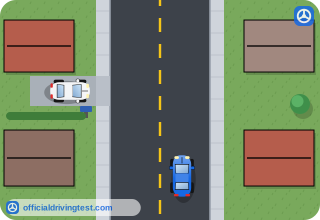
Which practice does the manual suggest to help you identify a potential hazard such as a vehicle pulling out of a driveway?
- Driving only in light traffic whenever it is possible
- Following other vehicles closely to keep pace with them
- Memorizing every one of the traffic laws by heart
- Asking yourself “What If” this driver pulls in front of you
Show answer
Correct answer: Asking yourself “What If” this driver pulls in front of you
Practicing asking yourself “What If” helps you decide how to minimize the risk by changing direction, changing speed and/or communicating.
Source: Kansas Driving Handbook (Revised February 2022), page 71
-
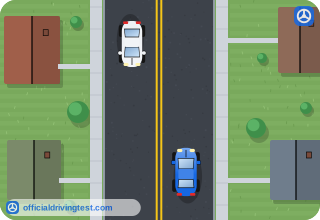
How much room should you give vehicles parked along the side of the road?
- One foot at most
- Enough room to straddle the lane line
- As much room as the lane allows
- No extra room if the lane is clear
Show answer
Correct answer: As much room as the lane allows
Parked vehicles may block your view and people may step out from between them, so give them as much room as the lane allows.
Source: Kansas Driving Handbook (Revised February 2022), page 77
-
How does the manual treat bicyclists on roadways?
- As pedestrians who must follow only the pedestrian rules
- As vehicles that are exempt from stopping at stop signs
- As vehicles that follow the same rules of the road as motorized vehicles
- As road users who may ignore traffic signals when no cars are near
Show answer
Correct answer: As vehicles that follow the same rules of the road as motorized vehicles
Bicyclists are considered vehicles when used on roadways and are expected to follow the same rules of the road as motorized vehicles.
Source: Kansas Driving Handbook (Revised February 2022), page 80
-
How does the manual describe a skillful bicyclist?
- Rides predictably and holds a steady line
- Swerves unpredictably into traffic
- Ignores traffic signs and signals at times
- Rides without a light at night
Show answer
Correct answer: Rides predictably and holds a steady line
A skillful bicyclist rides predictably and holds a steady line.
Source: Kansas Driving Handbook (Revised February 2022), page 80
-
If you see an unskillful bicyclist, what should you be ready for?
- A steady, predictable path
- A steady speed in the same lane
- Any sudden movements
- The bicyclist stopping at every signal
Show answer
Correct answer: Any sudden movements
An unskillful bicyclist may swerve unpredictably or ignore signs and signals, so be ready for any sudden movements.
Source: Kansas Driving Handbook (Revised February 2022), page 80
-
On which side of the roadway is a bicyclist required to ride?
- The left side, facing traffic
- The right side
- The center of the roadway
- Whichever side has less traffic
Show answer
Correct answer: The right side
A bicyclist is required to ride on the right side of the roadway.
Source: Kansas Driving Handbook (Revised February 2022), page 80
-
What must a bicyclist use to let others know what they plan to do?
- A horn
- A rear flashing light only
- Eye contact only
- Hand signals
Show answer
Correct answer: Hand signals
Bicyclists must obey all traffic signs and signals and use hand signals to let others know what they plan to do.
Source: Kansas Driving Handbook (Revised February 2022), page 80
-
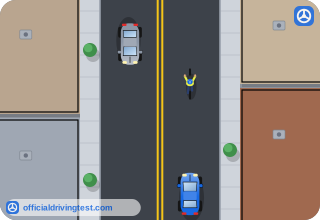
When is a bicyclist allowed to use the complete lane?
- Whenever the bicyclist is riding alone on the road
- Only on roads that have a marked bike lane
- When an obstacle or hazard exists, such as road debris or parked vehicles
- Only when the bicyclist is riding slower than the other traffic nearby
Show answer
Correct answer: When an obstacle or hazard exists, such as road debris or parked vehicles
A bicyclist may use the complete lane if an obstacle or hazard exists, such as road debris, cracks, parked vehicles, or something that may impede the riding path.
Source: Kansas Driving Handbook (Revised February 2022), page 80
-
When may a bicyclist use the middle and left side of the roadway?
- When going straight through an intersection or turning left
- Whenever the right side of the road is crowded
- When riding at night with a headlight on
- When all of the traffic around is stopped at a light
Show answer
Correct answer: When going straight through an intersection or turning left
A bicyclist may use the middle and left side of the roadway when going straight through an intersection or making a left-hand turn.
Source: Kansas Driving Handbook (Revised February 2022), page 80
-
Which riding arrangement is a bicyclist allowed to use in a lane?
- Three abreast
- Single file only, never two wide
- Two abreast only on roads with a bike lane
- Two abreast, or two wide
Show answer
Correct answer: Two abreast, or two wide
A bicyclist is allowed to ride two abreast or two wide in a lane.
Source: Kansas Driving Handbook (Revised February 2022), page 81
-
Under the Dead Red Law, what may a bicyclist do if the traffic signal will not respond to the bicycle?
- Never cross until a motor vehicle arrives and triggers it
- Cross the intersection after waiting a reasonable amount of time
- Cross at once without waiting at all
- Walk the bicycle around the intersection on the sidewalk
Show answer
Correct answer: Cross the intersection after waiting a reasonable amount of time
If the signal will not respond to the bicycle, the bicyclist may cross after waiting what they judge to be a reasonable time, without impeding cross-traffic or causing an accident.
Source: Kansas Driving Handbook (Revised February 2022), page 81
-
Which light is a bicyclist required to use at dusk?
- A taillight
- A headlight
- A spotlight
- A flashing red beacon
Show answer
Correct answer: A headlight
Use of a headlight at dusk is required for a bicyclist, while a taillight is highly recommended.
Source: Kansas Driving Handbook (Revised February 2022), page 81
-
What should a bicyclist wear to be more visible?
- Dark clothing and a reflective helmet cover
- A single reflective band only
- Loose clothing in muted colors
- Brightly colored clothing and reflectors
Show answer
Correct answer: Brightly colored clothing and reflectors
Bicyclists should wear brightly colored clothing and reflectors.
Source: Kansas Driving Handbook (Revised February 2022), page 81
-
When may a driver stop, park, or drive on a designated bicycle path or lane?
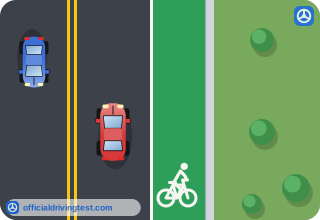
- When entering or leaving an alley or driveway
- When the bicycle lane is empty
- When traffic ahead of you is moving slowly
- When looking for a parking space
Show answer
Correct answer: When entering or leaving an alley or driveway
The exceptions are entering or leaving an alley or driveway, performing official duties, being directed by a police officer, or an emergency.
Source: Kansas Driving Handbook (Revised February 2022), page 81
-
What should you do when approaching or passing a bicyclist?
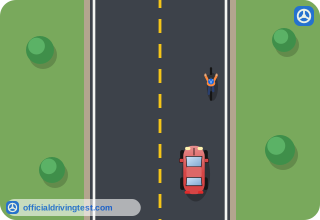
- Pass closely so you finish passing quickly
- Slow down and allow as much space as possible
- Sound your horn as you pass
- Keep your speed the same
Show answer
Correct answer: Slow down and allow as much space as possible
When approaching or passing a bicyclist you slow down, allow as much space as possible, and consider the bicyclist's speed.
Source: Kansas Driving Handbook (Revised February 2022), page 81
-
After you have passed a bicyclist, what should you not do?
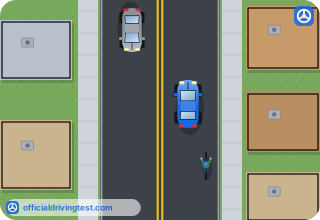
- Check your mirrors
- Hold a steady speed
- Move back gradually into your lane
- Slow down or stop quickly
Show answer
Correct answer: Slow down or stop quickly
A motor vehicle's brakes are more powerful than a bicycle's, so slowing or stopping quickly after passing could cause a crash.
Source: Kansas Driving Handbook (Revised February 2022), page 81
-
When should you sound your horn close to bicyclists?
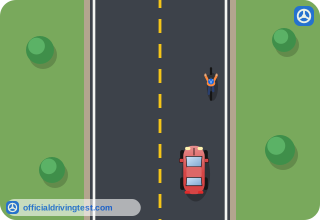
- Whenever you approach them from behind
- Whenever you want to alert them to your presence
- Only when there is a chance of a collision
- Before every turn
Show answer
Correct answer: Only when there is a chance of a collision
Sounding your horn to alert your presence may startle bicyclists and cause them to steer into your path, so use it only if a collision is possible.
Source: Kansas Driving Handbook (Revised February 2022), page 81
-
When making turns, what should you be especially careful about?
- Children riding bikes on the sidewalk who may come onto the road
- Bicyclists who have parked their bicycles at the curb ahead
- Pedestrians waiting at a bus stop
- Slow-moving vehicles ahead of you
Show answer
Correct answer: Children riding bikes on the sidewalk who may come onto the road
When turning, watch for bicyclists entering your lane, and be especially careful with children riding bikes on the sidewalk, who may come onto the road.
Source: Kansas Driving Handbook (Revised February 2022), page 81
-
What must a driver never do around a bicyclist?
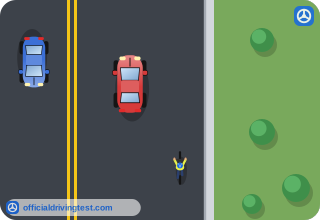
- Slow down well before you pass a bicyclist on the road
- Give the bicyclist extra space when passing
- Wait behind the bicyclist at an intersection
- Turn sharply in front of a bicyclist or force one off the road
Show answer
Correct answer: Turn sharply in front of a bicyclist or force one off the road
Never turn sharply in front of a bicyclist, and do not force a bicyclist off the road.
Source: Kansas Driving Handbook (Revised February 2022), page 81
-
Bicyclists are required to ride in the direction of traffic. Where should you look for them?
- Only on the right edge of the roadway
- Anywhere on the roadway
- Only in bike lanes
- Only on the shoulder
Show answer
Correct answer: Anywhere on the roadway
Although bicyclists are required to ride in the direction of traffic, you should look for them riding anywhere on the roadway.
Source: Kansas Driving Handbook (Revised February 2022), page 81
-
When should you be particularly careful around bicyclists?
- When the roadway is dry and the weather is clear
- When the roadway is wet or covered with sand or gravel
- When there is no traffic
- When the sun is behind you
Show answer
Correct answer: When the roadway is wet or covered with sand or gravel
On a wet road or one covered with sand or gravel, bicycles cannot brake as quickly or turn as sharply, and these conditions affect bicycles much more than vehicles.
Source: Kansas Driving Handbook (Revised February 2022), page 81
-
What clue can show a bicyclist's intent when the bicyclist cannot signal because both hands must stay on the handlebars?
- Ringing a bell to let other road users know
- Slowing down gradually
- Moving to the center of the lane
- Turning their head or looking over their shoulder
Show answer
Correct answer: Turning their head or looking over their shoulder
Look for clues such as the bicyclist turning their head or looking over their shoulder before changing lane position.
Source: Kansas Driving Handbook (Revised February 2022), page 81
-
A bicyclist extends the left arm straight out to the side. What does this hand signal mean?
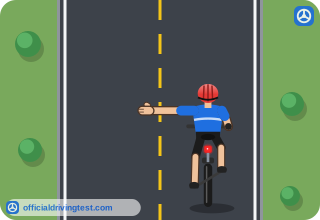
- A left turn
- A right turn
- A stop
- Passing another vehicle
Show answer
Correct answer: A left turn
A bicyclist signals a left turn by extending the left arm straight out to the side.
Source: Kansas Driving Handbook (Revised February 2022), page 82
-
A bicyclist holds the left arm bent upward at the elbow with the hand raised. What does this hand signal mean?
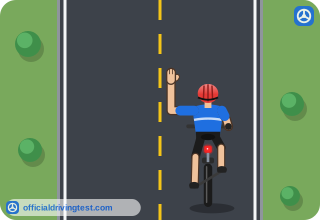
- A left turn
- A stop
- A right turn
- Slowing to park
Show answer
Correct answer: A right turn
A bicyclist can signal a right turn by holding the left arm bent upward at the elbow.
Source: Kansas Driving Handbook (Revised February 2022), page 82
-
A bicyclist holds the left arm bent downward with the hand pointing toward the ground. What does this hand signal mean?
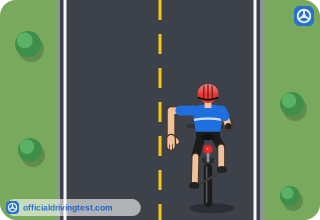
- A stop
- A left turn
- A right turn
- Speeding up
Show answer
Correct answer: A stop
A bicyclist signals a stop by holding the left arm bent downward.
Source: Kansas Driving Handbook (Revised February 2022), page 82