Kansas: Sharing the road — Part 1 Practice Test
Bicyclists, motorcycles, large trucks and their No-Zones, buses, school buses, slow-moving vehicles and aggressive drivers. — Part 1
Independent educational site · not affiliated with any government agency or DMV
Ready? Test yourself
- Instant feedback with an explanation
- Every answer cites its source in the manual
- Your best score is saved on this device
Questions are original and based on the official manual "Kansas Driving Handbook" (Revised February 2022), Kansas Department of Revenue, Division of Vehicles.
All 35 questions in this practice test
Take the test above first, then use this list to study. Tap “Show answer” to see the correct answer and explanation.
Show the questions and answersHide the questions
-
In addition to school buses, which buses must you stop for when they are stopped to pick up or let off children?
- City transit buses
- Charter tour buses
- Church buses and day care buses
- Only buses with a yellow body
Show answer
Correct answer: Church buses and day care buses
You must stop when meeting or overtaking a school bus, church bus or day care bus that is stopped to pick up or let off children.
Source: Kansas Driving Handbook (Revised February 2022), page 18
-
How long must you remain stopped for a school bus that has stopped to pick up or let off children?
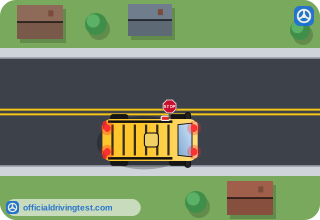
- Until the first child who got off is clear of the roadway
- Until the STOP signal is retracted and the red lights are off
- Until you have counted ten seconds since it stopped
- Until the bus driver waves you on past the bus
Show answer
Correct answer: Until the STOP signal is retracted and the red lights are off
You must remain stopped until the STOP signal is retracted and the red lights are turned off.
Source: Kansas Driving Handbook (Revised February 2022), page 18
-
What can happen if you respond to another driver's negative behavior on the road?
- It teaches the other driver a lesson
- It makes the other driver slow down
- It lowers your risk of a crash
- It can lead to a dangerous situation
Show answer
Correct answer: It can lead to a dangerous situation
You should realize that responding to another driver's negative behavior can lead to a dangerous situation.
Source: Kansas Driving Handbook (Revised February 2022), page 19
-
What should you do when confronted with an aggressive driver?
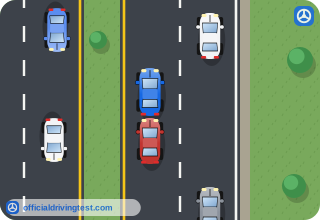
- Get out of their way
- Speed up to keep them behind you
- Hold your own in your path of travel
- Stop in the roadway and wait
Show answer
Correct answer: Get out of their way
Getting out of an aggressive driver's way is one of the actions the manual lists.
Source: Kansas Driving Handbook (Revised February 2022), page 19
-
How should you treat eye contact with an aggressive driver?
- Make it, to show the other driver that you mean no harm
- Make it, to show you are not afraid
- Avoid it, since it can sometimes anger the driver
- Make it only when stopped at a red light
Show answer
Correct answer: Avoid it, since it can sometimes anger the driver
The manual says to avoid eye contact because eye contact can sometimes anger an aggressive driver.
Source: Kansas Driving Handbook (Revised February 2022), page 19
-
How should you react to gestures and name calling from an aggressive driver?
- Return them to show you are not afraid
- Ignore them and refuse to return them
- Answer with your horn
- Follow the driver and report the license plate
Show answer
Correct answer: Ignore them and refuse to return them
The manual advises ignoring gestures and name calling from aggressive drivers and refusing to return them.
Source: Kansas Driving Handbook (Revised February 2022), page 19
-
Which action does the manual say NOT to take when confronted with an aggressive driver?
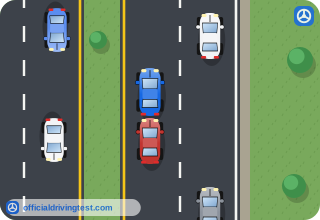
- Challenging them by speeding up
- Getting out of their way
- Avoiding eye contact
- Ignoring their gestures and name calling
Show answer
Correct answer: Challenging them by speeding up
The manual says not to challenge aggressive drivers by speeding up or attempting to hold your own in your path of travel.
Source: Kansas Driving Handbook (Revised February 2022), page 19
-
How does the handbook define aggressive driving?
- Intentionally committing a moving traffic offense that endangers others
- Driving more slowly than the flow of traffic on a crowded road
- Making an honest mistake that leads to a minor crash on the road
- Driving a vehicle that has not passed a safety inspection
Show answer
Correct answer: Intentionally committing a moving traffic offense that endangers others
Aggressive driving occurs when an individual intentionally commits an action or a moving traffic offense that endangers other persons or property.
Source: Kansas Driving Handbook (Revised February 2022), page 22
-
Which of these is a behavior typically associated with aggressive driving?
- Driving the posted speed limit
- Being courteous and forgiving
- Following too closely
- Being realistic about travel time
Show answer
Correct answer: Following too closely
Exceeding the posted speed limit, following too closely and erratic or unsafe lane changes are typical aggressive-driving behaviors.
Source: Kansas Driving Handbook (Revised February 2022), page 22
-
What does the handbook say to do to prevent yourself from becoming an aggressive driver?
- Match the speed of the aggressive drivers around you
- Relax and concentrate, and drive the posted speed limit
- Make up lost time by driving a little faster
- Block drivers who follow too closely
Show answer
Correct answer: Relax and concentrate, and drive the posted speed limit
To avoid becoming an aggressive driver, relax and concentrate on driving, drive the posted speed limit, be realistic about travel time and be courteous.
Source: Kansas Driving Handbook (Revised February 2022), page 22
-
What does the handbook say to do about serious aggressive driving by another driver?
- Follow the driver to get the license plate number
- Return the rude gestures so the driver backs off
- Speed up and stay close behind until the driver stops
- Drive away from the area, if possible, and report it
Show answer
Correct answer: Drive away from the area, if possible, and report it
Drive away from the area if possible and report serious aggressive driving.
Source: Kansas Driving Handbook (Revised February 2022), page 22
-
How should you position yourself in relation to trucks and buses inside a traffic circle or roundabout?
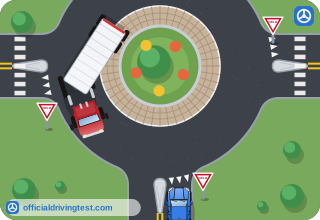
- Drive alongside them so their drivers can see you
- Pass them on the inside of the circle
- Stay close behind their rear bumper
- Do not drive alongside them
Show answer
Correct answer: Do not drive alongside them
The manual says not to drive alongside large vehicles, such as trucks and buses, in a traffic circle or roundabout.
Source: Kansas Driving Handbook (Revised February 2022), page 50
-
What must you do when a school bus is stopped with its red lights flashing and/or its stop arm extended?
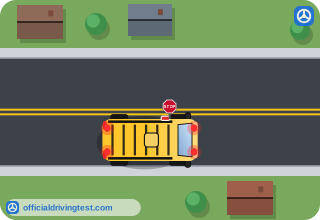
- Stop for the bus
- Slow down and pass with caution
- Pass only if no children are in sight
- Honk and keep moving
Show answer
Correct answer: Stop for the bus
You must stop for a school bus that is stopped with its red lights flashing and/or stop arm extended.
Source: Kansas Driving Handbook (Revised February 2022), page 50
-
A school bus has stopped and its red lights have stopped flashing and its stop arm is no longer visible. When may you proceed?
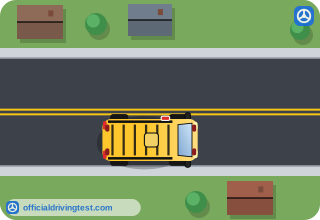
- Right away, because the bus is no longer signaling to traffic
- As soon as the bus begins to pull away from the stop
- When it is safe, after the children have completely left the roadway
- After the bus has driven completely out of your sight
Show answer
Correct answer: When it is safe, after the children have completely left the roadway
Once the bus lights stop flashing you must still watch for children and not proceed until it is safe and they have completely left the roadway.
Source: Kansas Driving Handbook (Revised February 2022), page 50
-
There are two solid yellow lines between lanes of traffic, and a school bus on the other side of the road is stopped with its red lights flashing. What must you do?
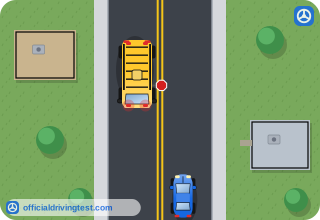
- Keep driving, because the double line separates the two directions
- Stop, whether the bus is on your side or the other side
- Slow down and pass the bus at a low speed
- Stop only if the bus is on your side of the road
Show answer
Correct answer: Stop, whether the bus is on your side or the other side
Two solid yellow lines between lanes do not excuse you from stopping: you must stop for the school bus on either side of the road.
Source: Kansas Driving Handbook (Revised February 2022), page 50
-
A road has a center turning lane between the roadways, and a school bus coming from the opposite direction is stopped with its red lights flashing. What must you do?
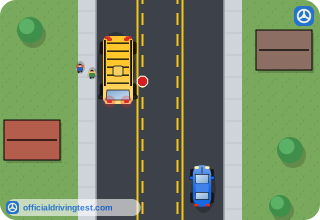
- Keep driving, because the turning lane separates the roadways
- Slow down and drive past the bus carefully
- Stop only if the bus is traveling in your direction
- Stop for the bus even though it is on the opposite side
Show answer
Correct answer: Stop for the bus even though it is on the opposite side
A center turning lane between the roadways does not remove the duty to stop; you stop whichever side of the road the bus is on.
Source: Kansas Driving Handbook (Revised February 2022), page 51
-
You are on a multi-lane highway with no median or barrier, and a school bus stops on the opposite side of the road with its red lights flashing. What must you do?
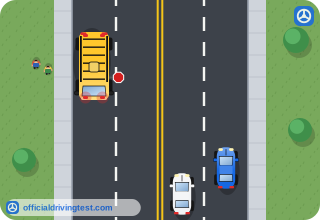
- Stop, because the bus can be on either side of the road
- Continue at the posted speed in your lane
- Change to the far lane and pass
- Stop only when you are in the lane next to the bus
Show answer
Correct answer: Stop, because the bus can be on either side of the road
On a multi-lane highway you must stop for a school bus whether it is on your side of the road or the opposite side.
Source: Kansas Driving Handbook (Revised February 2022), page 51
-
You are at an intersection and a school bus stopped on the opposite side of the road has its red lights flashing. What must you do?
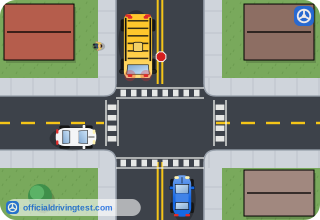
- Go through the intersection if it is clear
- Turn off the road and let the bus pass
- Stop, whichever side of the road the bus is on
- Stop only if you are facing the front of the bus
Show answer
Correct answer: Stop, whichever side of the road the bus is on
At an intersection you must stop for a school bus whether it is on your side of the road or the opposite side.
Source: Kansas Driving Handbook (Revised February 2022), page 51
-
When are you not required to stop for a stopped school bus?
- When the road has two solid yellow lines between lanes of traffic
- When a median or other barrier separates you from an oncoming bus
- When there is a center turning lane between the roadways
- When no children are visible near the bus
Show answer
Correct answer: When a median or other barrier separates you from an oncoming bus
The manual says you need not stop if the bus is traveling toward you and the roadway is separated by a median or other physical barrier.
Source: Kansas Driving Handbook (Revised February 2022), page 52
-
What should you avoid on multi-lane roads to keep space to the side of your vehicle?
- Driving in the center of your lane
- Driving next to other vehicles
- Driving at the posted speed limit
- Signaling before a lane change
Show answer
Correct answer: Driving next to other vehicles
Someone driving beside you may crowd your lane position or pull into your lane space, so avoid driving next to other vehicles on multi-lane roads.
Source: Kansas Driving Handbook (Revised February 2022), page 64
-
In general, where in your lane is it safest to drive?
- Near the right edge of your lane
- Close to the center line marking
- Close to the shoulder or curb
- In the center of your lane
Show answer
Correct answer: In the center of your lane
It is generally safest to drive in the center of your lane so your vehicle can move left or right to avoid a potential problem.
Source: Kansas Driving Handbook (Revised February 2022), page 64
-
What should you do to make space for vehicles entering a multiple-lane, limited access roadway from the side?
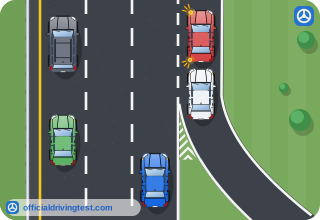
- Stay in your lane and speed up to pass the merging traffic
- Slow down and stop before the entrance to let them in
- Move over a lane if there is no vehicle in the next lane
- Move to the lane closest to the entrance ramp
Show answer
Correct answer: Move over a lane if there is no vehicle in the next lane
If there is not a vehicle in the next lane, move over a lane to avoid vehicles entering from the sides.
Source: Kansas Driving Handbook (Revised February 2022), page 64
-
How can you keep extra space between your vehicle and parked cars?
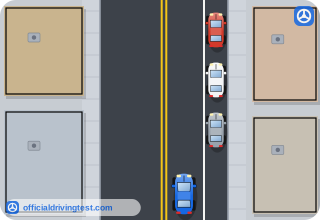
- Move to the left portion of your lane without crossing the centerline
- Cross the center line briefly while you pass the parked cars
- Move to the right portion of your lane, near the parked cars
- Sound your horn as you pass each parked vehicle
Show answer
Correct answer: Move to the left portion of your lane without crossing the centerline
Other roadway users could step out from or pull away from parked cars, so move to the left portion of your lane without crossing the centerline.
Source: Kansas Driving Handbook (Revised February 2022), page 64
-
Why should you give extra space to pedestrians and bicyclists, especially children?
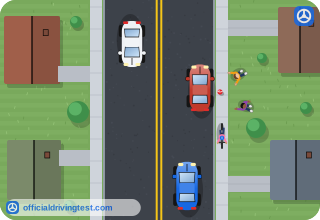
- They always travel at the same speed as the traffic around them
- They cannot see or hear any vehicles approaching from behind
- They are required by law to stay on the shoulder of the road
- They can move into the lane space quickly and without warning
Show answer
Correct answer: They can move into the lane space quickly and without warning
Pedestrians and bicyclists, especially children, can move into the lane space quickly and without warning.
Source: Kansas Driving Handbook (Revised February 2022), page 64
-
When a tractor-trailer is passing you, how can you leave a little more space?
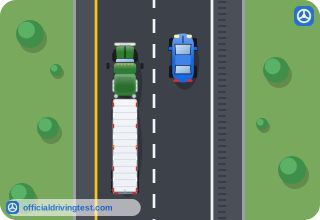
- Move toward the center portion of your lane so it can pass
- Move to the outside portion of your lane away from it
- Keep to the middle of your lane and increase your speed
- Slow down and brake firmly while it passes you
Show answer
Correct answer: Move to the outside portion of your lane away from it
When a passing vehicle is a tractor-trailer, leave a little more space by moving to the outside portion of your lane away from it.
Source: Kansas Driving Handbook (Revised February 2022), page 64
-
Which of these roadway users could have trouble seeing your vehicle?
- Drivers who have just turned on their daytime running lights
- Drivers whose windows are covered with snow or ice or steamed up
- Drivers who are following you with their headlights on
- Drivers stopped at a red light with a clear view ahead
Show answer
Correct answer: Drivers whose windows are covered with snow or ice or steamed up
Drivers whose windows are covered with snow or ice or are steamed-up may enter your path without knowing your vehicle is there, so give them extra space.
Source: Kansas Driving Handbook (Revised February 2022), page 67
-
Why should you give extra space to pedestrians with umbrellas in front of their faces or with their hats pulled down?
- They always walk faster than other pedestrians
- They are more likely to cross against a red light
- They are prohibited from using the crosswalk
- They could have trouble seeing your vehicle
Show answer
Correct answer: They could have trouble seeing your vehicle
Pedestrians with umbrellas in front of their faces or hats pulled down could have trouble seeing your vehicle.
Source: Kansas Driving Handbook (Revised February 2022), page 67
-
Why should you give extra space to drivers backing into the roadway or pulling out of parking spaces?
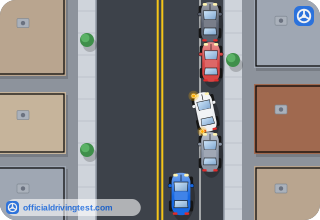
- Their vehicles cannot stop or turn fast enough to avoid other cars
- They always wait until traffic has cleared before they move
- They may enter your path without knowing your vehicle is there
- Their vehicles are required to stop when traffic comes by
Show answer
Correct answer: They may enter your path without knowing your vehicle is there
Drivers backing into the roadway or into or out of parking spaces may enter your travel path without knowing your vehicle is there.
Source: Kansas Driving Handbook (Revised February 2022), page 67
-
Which of these roadway users does the manual list as possibly distracted?
- Delivery persons
- Police officers directing traffic
- Drivers stopped at a red light
- Drivers stopped at a stop sign
Show answer
Correct answer: Delivery persons
Delivery persons, construction workers, and children or pedestrians who are not paying attention may be distracted, so allow extra space.
Source: Kansas Driving Handbook (Revised February 2022), page 67
-
Which of these roadway users does the manual list as possibly confused?
- Drivers using a turn signal for a lane change
- Drivers stopped at a red signal waiting to go
- Drivers who hold a steady speed in the right lane
- Tourists who do not seem to know where they are going
Show answer
Correct answer: Tourists who do not seem to know where they are going
People who may be confused include tourists or others who do not seem to know where they are going, drivers who slow for no reason, and drivers looking for street signs.
Source: Kansas Driving Handbook (Revised February 2022), page 67
-
If another driver passes you without enough space, what should you do?
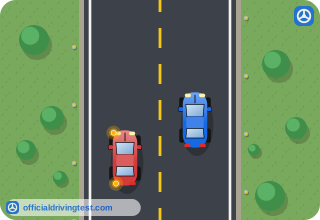
- Speed up so that the other driver cannot return to the lane
- Reduce your speed and let the driver return to the lane safely
- Move toward the center line to discourage the other driver
- Brake hard and sound your horn to warn the other driver
Show answer
Correct answer: Reduce your speed and let the driver return to the lane safely
If another driver makes a mistake, do not make the situation worse: reduce your speed and let the driver return to the lane safely.
Source: Kansas Driving Handbook (Revised February 2022), page 67
-
When overtaking a pedestrian walking along the roadway while an oncoming vehicle approaches, what should you do?
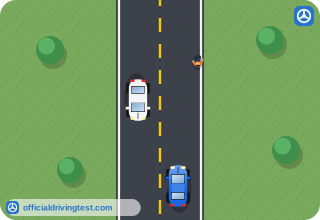
- Speed up and pass the pedestrian before the vehicle arrives
- Slow down and let the oncoming vehicle pass first
- Move into the oncoming lane to pass both at once
- Stop in the road and wave the pedestrian across
Show answer
Correct answer: Slow down and let the oncoming vehicle pass first
Take hazards one at a time: slow down and let the oncoming vehicle pass first so you pass only one roadway user at a time.
Source: Kansas Driving Handbook (Revised February 2022), page 67
-
What is the golden rule of driving?
- Always yield to the larger vehicle on the road
- Never drive faster than the other traffic
- Treat others the way you would want to be treated
- Stay in the right lane whenever it is possible
Show answer
Correct answer: Treat others the way you would want to be treated
The golden rule of driving is to treat others the way you would want to be treated, which means obeying traffic laws, driving responsibly and avoiding unnecessary risks.
Source: Kansas Driving Handbook (Revised February 2022), page 70
-
The traffic laws and rules of the road cannot address all possible driving situations. What helps avoid crashes and keep traffic moving in an orderly fashion?
- Being courteous
- Driving faster than traffic
- Honking at slower drivers
- Staying close to the car ahead
Show answer
Correct answer: Being courteous
If you remember to be courteous, you can help avoid crashes and keep traffic moving in an orderly fashion.
Source: Kansas Driving Handbook (Revised February 2022), page 70
-
Which statement about larger vehicles does the manual make as a source of driving risk?
- They are always more stable and have better visibility around the vehicle
- They are easier to stop than smaller vehicles
- They can be less stable and have reduced visibility around the vehicle
- They are less visible to other drivers than smaller vehicles
Show answer
Correct answer: They can be less stable and have reduced visibility around the vehicle
The manual says larger vehicles can be less stable and have reduced visibility around the vehicle.
Source: Kansas Driving Handbook (Revised February 2022), page 71