Kansas: Road signs — Part 2 Practice Test
Questions in this part include: “What are passing areas based on?” · “Which type of guide sign shows the direction and distance to places such as cities, airports and county lines?”
Independent educational site · not affiliated with any government agency or DMV
Ready? Test yourself
- Instant feedback with an explanation
- Every answer cites its source in the manual
- Your best score is saved on this device
Questions are original and based on the official manual "Kansas Driving Handbook" (Revised February 2022), Kansas Department of Revenue, Division of Vehicles.
All 16 questions in this practice test
Take the test above first, then use this list to study. Tap “Show answer” to see the correct answer and explanation.
Show the questions and answersHide the questions
-
A yellow pennant-shaped sign reads NO PASSING ZONE. What does it tell you?
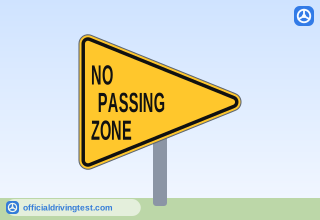
- Where passing is allowed with care
- Where a lane is reserved for slow vehicles
- Where you cannot pass another vehicle
- That the road ahead is closed to traffic
Show answer
Correct answer: Where you cannot pass another vehicle
A Do Not Pass sign tells you where you cannot pass another vehicle.
Source: Kansas Driving Handbook (Revised February 2022), page 41
-
What are passing areas based on?
- The speed of traffic that is behind you
- How far you can see ahead
- The number of vehicles on the road
- The posted speed limit of the road
Show answer
Correct answer: How far you can see ahead
Passing areas are based on how far you can see ahead, considering unseen hazards such as hills, curves, intersections and driveways.
Source: Kansas Driving Handbook (Revised February 2022), page 41
-
A sign reads PASS WITH CARE. What does it tell you?
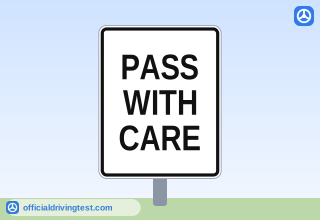
- You are at the start of a no passing zone
- You must pass the vehicle ahead
- Passing is allowed at any time
- You are at the end of a no passing zone
Show answer
Correct answer: You are at the end of a no passing zone
The sign marks the end of a no passing zone, and you may pass only when it is safe to do so.
Source: Kansas Driving Handbook (Revised February 2022), page 41
-
KEEP RIGHT signs indicate what?
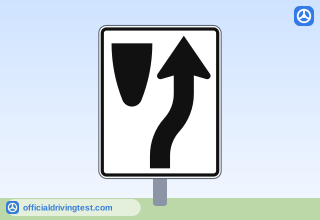
- Traffic must stay right of a feature or obstruction
- All traffic must use the lane on the far right
- Only right turns may be made at the next corner
- The lane on the right ends in a short distance
Show answer
Correct answer: Traffic must stay right of a feature or obstruction
Keep Right signs show that traffic must stay to the right of a feature such as an upcoming median, island or lane divider.
Source: Kansas Driving Handbook (Revised February 2022), page 41
-
At which of these places is a DO NOT ENTER sign visible?
- Entrance ramps that lead onto a highway lane
- Exit ramps where you would drive the wrong way
- Intersections where all traffic has a stop sign
- Railroad crossings that have no crossing gates
Show answer
Correct answer: Exit ramps where you would drive the wrong way
A Do Not Enter sign appears at roadway openings you may not enter, such as exit ramps where you would be going the wrong way, crossovers on divided roadways and many locations on one-way streets.
Source: Kansas Driving Handbook (Revised February 2022), page 41
-
A red rectangular sign reads WRONG WAY. What does it tell you?
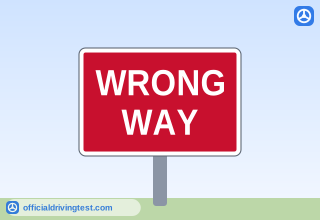
- Traffic ahead is moving in the wrong direction
- You are about to cross a one-way street
- The road ahead is closed to all traffic
- Your vehicle is moving in the wrong direction
Show answer
Correct answer: Your vehicle is moving in the wrong direction
A Wrong Way sign tells you that your vehicle is moving in the wrong direction.
Source: Kansas Driving Handbook (Revised February 2022), page 41
-
Where will you see a WRONG WAY sign on an expressway ramp?
- A short distance past the DO NOT ENTER sign
- Before the DO NOT ENTER sign
- At the end of the ramp
- Beside the first lane of the highway
Show answer
Correct answer: A short distance past the DO NOT ENTER sign
The Wrong Way sign is posted on expressway ramps a short distance past the DO NOT ENTER sign.
Source: Kansas Driving Handbook (Revised February 2022), page 41
-
What kind of information do guide signs give?
- Laws that apply to a particular stretch of road
- Intersecting roads, routes to towns and points of interest
- Hazards on the road ahead and how to avoid them
- Temporary closures and detours for unplanned events
Show answer
Correct answer: Intersecting roads, routes to towns and points of interest
Guide signs give information on intersecting roads, help direct you to cities and towns and show points of interest along the highway.
Source: Kansas Driving Handbook (Revised February 2022), page 42
-
Which type of guide sign shows the direction and distance to places such as cities, airports and county lines?
- Service signs
- Route number signs
- Incident signs
- Destination signs
Show answer
Correct answer: Destination signs
Destination signs show direction and distance to locations such as cities, airports, state and county lines, or special areas such as national parks.
Source: Kansas Driving Handbook (Revised February 2022), page 42
-
On an exit sign, the word "Exit" is written on the left side. What does this tell you?
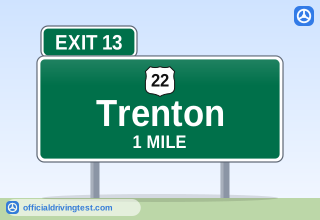
- The exit lane or ramp is to the left
- The exit lane or ramp is to the right
- The exit is closed
- The exit leads to a rest area
Show answer
Correct answer: The exit lane or ramp is to the left
If the word "Exit" is on the left side of an exit sign, the exit lane or ramp is to the left; if it is on the right side, the exit is to the right.
Source: Kansas Driving Handbook (Revised February 2022), page 42
-
A blue square sign shows a white bed symbol. What does it show the location of?
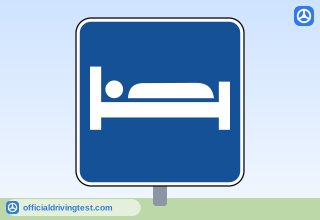
- A rest area
- Lodging
- A hospital
- Fuel
Show answer
Correct answer: Lodging
A blue service sign with a bed symbol marks lodging.
Source: Kansas Driving Handbook (Revised February 2022), page 42
-
What do the shape and color of a route number sign tell you?
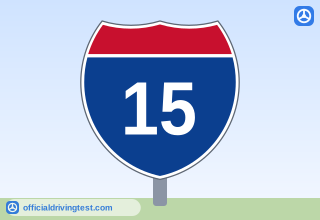
- The speed limit that applies on that roadway
- The distance to the next town along the route
- Whether the roadway has a paved shoulder
- The type of roadway, such as interstate or state
Show answer
Correct answer: The type of roadway, such as interstate or state
The shape and color of route number signs indicate the type of roadway: interstate, U.S., state, city, county, or local road.
Source: Kansas Driving Handbook (Revised February 2022), page 42
-
A shield-shaped route sign has a red top band, a blue lower part and the number 70. What type of roadway does it mark?
- An interstate route
- A U.S. route
- A state route
- A county road
Show answer
Correct answer: An interstate route
The red and blue shield route sign marks an interstate route.
Source: Kansas Driving Handbook (Revised February 2022), page 42
-
What does the manual say to do during a trip to keep from getting lost in an unfamiliar area?
- Follow the signs of the busiest road
- Stay in the left lane
- Follow the route signs
- Drive only on interstate routes
Show answer
Correct answer: Follow the route signs
The manual says to follow the route signs during the trip to prevent getting lost in an unfamiliar area.
Source: Kansas Driving Handbook (Revised February 2022), page 42
-
Incident signs are temporary. When are they used?
- When a road is closed for planned resurfacing work
- When a new posted speed limit takes effect on a road
- When a school zone is active on school days
- When a road is closed or detoured by an unplanned event
Show answer
Correct answer: When a road is closed or detoured by an unplanned event
Incident signs tell you when to be prepared to stop or when roadways are closed or detoured due to an unplanned incident such as a natural disaster or hazardous material spill.
Source: Kansas Driving Handbook (Revised February 2022), page 43
-
What does a yellow diamond sign with curved arrows forming a circle warn of?
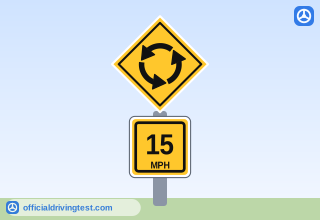
- A merging lane
- A roundabout or traffic circle
- A four-way stop ahead
- A road that ends in a dead end
Show answer
Correct answer: A roundabout or traffic circle
A diamond-shaped warning sign with arrows curving in a circle warns of a roundabout or traffic circle ahead.
Source: Kansas Driving Handbook (Revised February 2022), page 49