Pavement markings in Kansas
The Kansas Driving Handbook shows or names everything on this page: 19 in all, on pages 43–45, 55, 82.
Independent educational site · not affiliated with any government agency or DMV
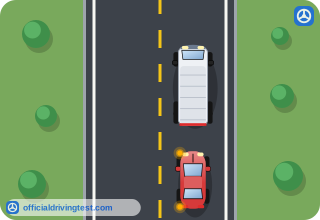
Two-Direction Roadway, Passing Permitted
Lines separating traffic moving in opposite directions are yellow. Dashed yellow lines between opposing lanes of traffic mean that you may pass if a safe gap in traffic is available.
Manual page 43
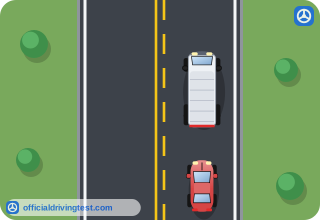
Two-Direction Roadway, Passing Permitted When Dashed Line Is on Your Side
Where there is both a solid and a dashed yellow line between opposing lanes of traffic you should not pass if the solid yellow line is on your side. If the dashed line is on your side, you may pass if a safe gap in traffic is available.
Manual page 43

Two-Direction Roadway, Passing Prohibited in Both Directions
Two solid yellow lines between lanes of traffic means neither side may pass. You may cross a solid yellow line to turn when gaps in traffic flow exist.
Manual page 43
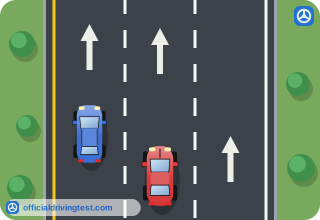
One-Direction Roadway, Passing Permitted
Multiple lanes of travel in the same direction are separated by white lane markings. A dashed white line between lanes of traffic means that you may cross it to change lanes if a safe gap in traffic is available.
Manual page 43
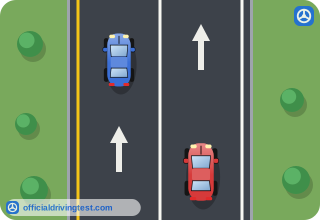
Solid White Line
A solid white line between lanes of traffic means that you must stay within the lane unless a special situation requires a lane change. They also mark the right edge of the roadway and parking spaces. Solid white lines designate turn lanes and prevent lane changes near intersections.
Manual page 43
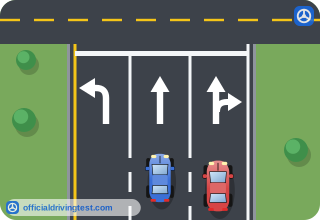
Directional Arrow Markings
White arrows on the roadway indicate which way traffic is flowing and can also indicate which turns may be made from which lanes.
Manual page 43
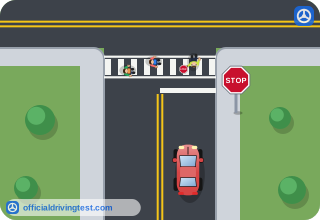
Stop Line
When required to stop because of a sign or signal, you must stop behind the stop line, crosswalk, or behind the stop sign or signal. ... If there is a stop line before the crosswalk, the stop line must be obeyed first.
Manual page 44
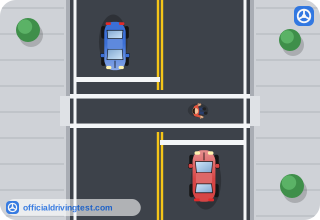
Crosswalk (Two Parallel Lines)
Crosswalks define the area where pedestrians may cross the roadway. You must yield to pedestrians entering or in a crosswalk.
Manual page 44
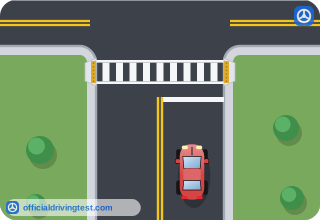
Crosswalk (Ladder / Continental Style)
Crosswalks define the area where pedestrians may cross the roadway. You must yield to pedestrians entering or in a crosswalk.
Manual page 44

Unmarked Crosswalk
Not all crosswalks are marked. Be alert for pedestrians when crossing intersections. If crosswalks are not apparent, then you must stop prior to entering the intersection.
Manual page 44
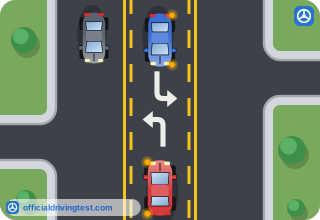
Shared Center Left-Turn Lane
On many streets where it is difficult to make a left turn safely, there is a shared left turn lane located in the middle of the roadway. The solid yellow centerline means you cannot use the center lane for passing. The broken yellow centerlines show that vehicles traveling in either direction may use the center lane only to make left turns.
Manual page 44
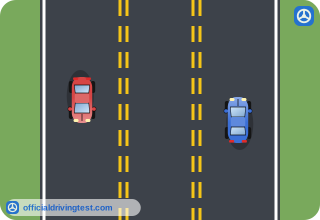
Reversible Lane (Double Dashed Yellow Lines)
In some areas, a shared center lane becomes a "reversible lane" during rush hours. The lanes may have double dashed yellow lines to either side.
Manual page 45
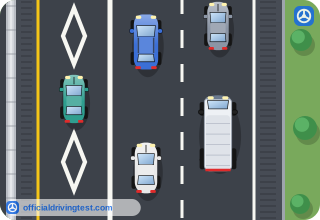
Reserved Lane Diamond Marking
Reserved lanes are marked by special lane marking signs stating that the lane is reserved for special use and often have a white diamond posted at the side of the road or painted on the road surface.
Manual page 45
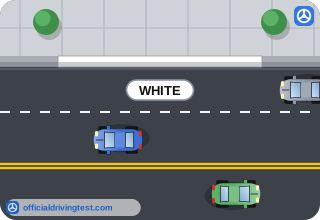
White Curb
White – indicates that only short stops are permitted
Manual page 55
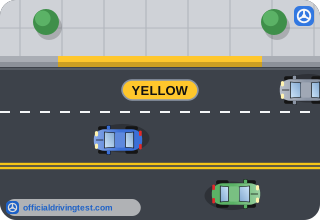
Yellow Curb
Yellow – indicates a loading zone or some other restriction
Manual page 55
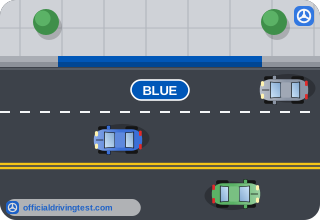
Blue Curb
Blue – indicates a handicap restriction
Manual page 55
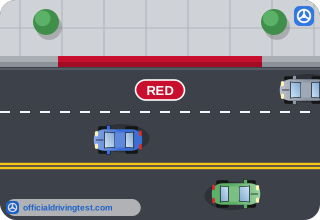
Red Curb
Red – indicates fire zone restrictions
Manual page 55
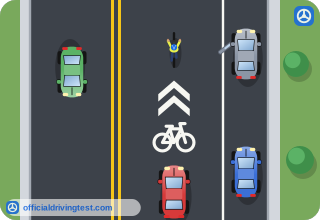
Shared Lane Marking (Sharrow)
Sharrows - are road markers on the pavement that provide a recommendation of where in a lane a bicyclist should ride to flow easiest with other traffic. Designated by a bicycle with two chevrons (arrows) pointing above it, you will find sharrows on roads with higher volumes of traffic.
Manual page 82
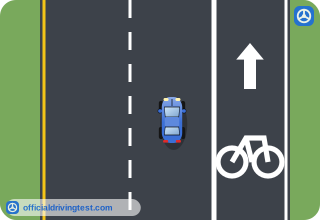
Bike Lane Marking
Bike Lanes – are road markers on the pavement that provide a designated part of the roadway for bicycle traffic to use. ... Bike lanes can be designated using solid white lines and are commonly found towards the right side of the roadway.
Manual page 82