Kansas: Right-of-way and turning — Part 3 Practice Test
Who yields at intersections and four-way stops, turning lanes, turnabouts, U-turns, roundabouts, passing and merging. — Part 3
Independent educational site · not affiliated with any government agency or DMV
Ready? Test yourself
- Instant feedback with an explanation
- Every answer cites its source in the manual
- Your best score is saved on this device
Questions are original and based on the official manual "Kansas Driving Handbook" (Revised February 2022), Kansas Department of Revenue, Division of Vehicles.
All 36 questions in this practice test
Take the test above first, then use this list to study. Tap “Show answer” to see the correct answer and explanation.
Show the questions and answersHide the questions
-
Which kind of turnabout does the manual call the most difficult and dangerous?
- The three-point turnabout
- The forward two-point turnabout
- The reverse two-point turnabout
- The U-turn
Show answer
Correct answer: The three-point turnabout
The manual calls the three-point turnabout the most difficult and dangerous way to perform a turnabout.
Source: Kansas Driving Handbook (Revised February 2022), page 48
-
When should you use a three-point turnabout?
- Whenever a driveway or alley is not available for a two-point turnabout
- Whenever the road is wider than two lanes and traffic is light
- Only when the road is too narrow to make a U-turn and you cannot go around the block
- When you miss a turn on the interstate and no exit is nearby
Show answer
Correct answer: Only when the road is too narrow to make a U-turn and you cannot go around the block
Use a three-point turnabout only when the road or street is too narrow to make a U-turn and you cannot go around the block.
Source: Kansas Driving Handbook (Revised February 2022), page 48
-
At the start of a three-point turnabout, after you signal right, where do you stop?
- In the center of the road
- On the right side of the road
- On the left side of the road
- Across both lanes of the road
Show answer
Correct answer: On the right side of the road
You signal right and stop on the right side of the road to begin a three-point turnabout.
Source: Kansas Driving Handbook (Revised February 2022), page 48
-
In a three-point turnabout, when traffic is clear after you signal left and check over your left shoulder, what do you do?
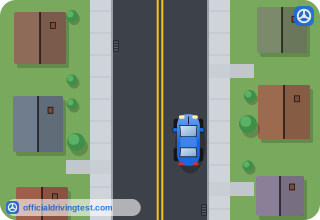
- Turn gradually left and merge into traffic in the new direction
- Turn hard right and stop at the edge of the road behind you
- Shift to reverse and back straight across the road
- Turn hard left to the other side of the road and stop
Show answer
Correct answer: Turn hard left to the other side of the road and stop
After signaling left and checking your blind spot, you turn hard left to the other side of the road and stop once you reach it.
Source: Kansas Driving Handbook (Revised February 2022), page 48
-
In a three-point turnabout, after you shift to reverse and check traffic and both blind spots, what do you do?
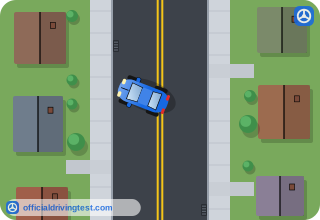
- Turn hard right to the other side of the road and stop
- Turn hard left to the other side of the road and stop
- Back straight along the right edge of the road
- Back slowly while steering gently to the left
Show answer
Correct answer: Turn hard right to the other side of the road and stop
In reverse, when traffic is clear, you turn hard right to the other side of the road and stop.
Source: Kansas Driving Handbook (Revised February 2022), page 48
-
At the end of a three-point turnabout, which lane do you drive into?
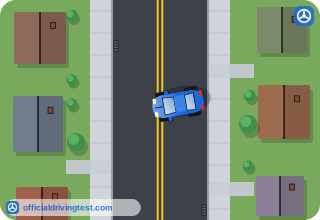
- The left lane of traffic heading in the new direction
- The center of the road, until traffic clears
- The right lane of traffic heading in the new direction
- Whichever lane is empty
Show answer
Correct answer: The right lane of traffic heading in the new direction
You turn hard left and drive forward into the right lane of traffic heading in the new direction.
Source: Kansas Driving Handbook (Revised February 2022), page 48
-
What do U-turns require?
- A traffic signal and a marked crosswalk
- Wide streets or vehicles that can turn in a very small area
- A divided highway with a raised median
- A road with at least three lanes in each direction
Show answer
Correct answer: Wide streets or vehicles that can turn in a very small area
U-turns require wide streets or vehicles that can turn in a very small area.
Source: Kansas Driving Handbook (Revised February 2022), page 49
-
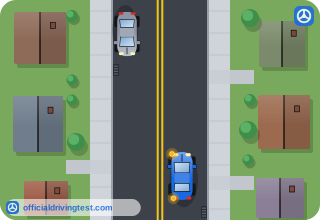
What should you watch for before making a U-turn, because U-turns are not legal in all places?
- Signs that require U-turns at intersections
- Signs showing the speed limit of the cross street
- Signs that mark school bus stops
- Signs that prohibit U-turns
Show answer
Correct answer: Signs that prohibit U-turns
U-turns are not legal in all places, so you must watch out for signs that prohibit them.
Source: Kansas Driving Handbook (Revised February 2022), page 49
-
If you must make a U-turn, where should you move before turning?
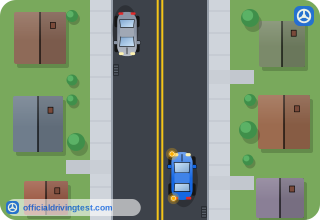
- As far to the right as you can
- To the center of the road
- To the left edge of the road
- To the shoulder, past the lane line
Show answer
Correct answer: As far to the right as you can
For a U-turn, move as far to the right as you can, then wait for a large gap in traffic.
Source: Kansas Driving Handbook (Revised February 2022), page 49
-
Before turning the wheel left sharply for a U-turn, what should you wait for?
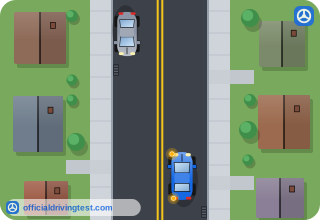
- A gap in the traffic coming from the front only
- The vehicle behind you to pass
- A large gap in the traffic in both directions
- A red light in both directions
Show answer
Correct answer: A large gap in the traffic in both directions
Wait for a large gap in the traffic in both directions, then turn the wheel left sharply and adjust your speed to match the traffic flow.
Source: Kansas Driving Handbook (Revised February 2022), page 49
-
What should you watch for during a U-turn?
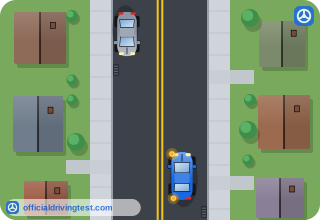
- Vehicles passing you on the left shoulder
- Other vehicles turning right into your intended path
- Pedestrians stepping out of parked cars behind you
- Vehicles backing out of the nearest driveway
Show answer
Correct answer: Other vehicles turning right into your intended path
During a U-turn, watch for other vehicles turning right into your intended path.
Source: Kansas Driving Handbook (Revised February 2022), page 49
-
What is a roundabout or traffic circle?
- A circular intersection where all traffic must come to a full stop first
- A long curve on a highway where passing is permitted on the inside
- A round parking area with a raised island for loading buses
- A circular intersection designed to promote safe and efficient traffic flow
Show answer
Correct answer: A circular intersection designed to promote safe and efficient traffic flow
A roundabout or traffic circle is a circular intersection with design features that promote safe and efficient traffic flow.
Source: Kansas Driving Handbook (Revised February 2022), page 49
-
In which direction do vehicles travel around the raised center island of a roundabout?
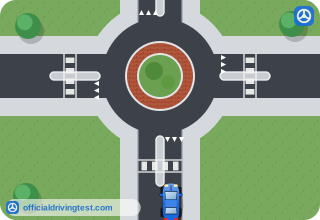
- Counterclockwise
- Clockwise
- Straight through
- Whichever way is shorter
Show answer
Correct answer: Counterclockwise
Vehicles travel counterclockwise around a raised center island.
Source: Kansas Driving Handbook (Revised February 2022), page 49
-
In a roundabout or traffic circle, who must yield the right-of-way?
- Circulating traffic yields to entering traffic
- The larger vehicle yields to the smaller vehicle
- Entering traffic yields to circulating traffic
- The vehicle on the right yields to the vehicle on the left
Show answer
Correct answer: Entering traffic yields to circulating traffic
Entering traffic yields the right-of-way to circulating traffic.
Source: Kansas Driving Handbook (Revised February 2022), page 49
-
To about what speed should you slow when entering a roundabout or traffic circle?
- About 5 to 10 mph
- About 15 to 20 mph
- About 25 to 30 mph
- About 35 to 40 mph
Show answer
Correct answer: About 15 to 20 mph
Entering a roundabout means negotiating a sharp curve, so you slow your speed to about 15 to 20 mph.
Source: Kansas Driving Handbook (Revised February 2022), page 49
-
Once you are in a roundabout, how do you find the exit you need?
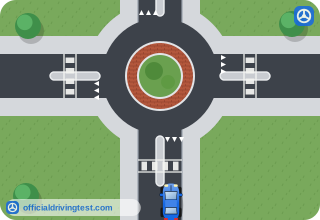
- Stay beside the vehicle in front of you until it exits
- Count the entrances you pass on the circle
- Follow the vehicle in the inside lane
- Follow the guidance of traffic signs and pavement markings
Show answer
Correct answer: Follow the guidance of traffic signs and pavement markings
Once in the roundabout, proceed to the appropriate exit, following the guidance provided by traffic signs and pavement markings.
Source: Kansas Driving Handbook (Revised February 2022), page 49
-
What must you be sure of before entering a roundabout that has more than one lane going in the same direction?
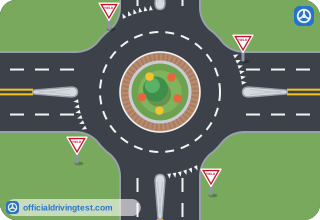
- You know where you want to go and are in the proper lane
- You are in the left-most lane so you can pass slower vehicles
- The exit you need is no more than one block away
- Other drivers have stopped to let you in
Show answer
Correct answer: You know where you want to go and are in the proper lane
With more than one lane going the same direction, make sure you know where you want to go and are in the proper lane before entering.
Source: Kansas Driving Handbook (Revised February 2022), page 49
-
Once inside a multi-lane roundabout, what must you not do?
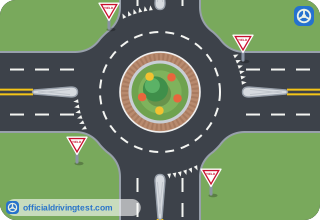
- Follow signs and pavement markings to your exit
- Know where you want to go before you enter
- Change lanes or pass any vehicles
- Proceed to the appropriate exit
Show answer
Correct answer: Change lanes or pass any vehicles
In a roundabout with more than one lane in the same direction, you should not change lanes or pass any vehicles.
Source: Kansas Driving Handbook (Revised February 2022), page 49
-
What should you do as you approach a roundabout or traffic circle?
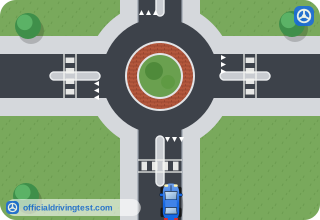
- Speed up to merge with traffic in the circle
- Stop completely before every entrance
- Sound your horn to warn drivers in the circle
- Slow down
Show answer
Correct answer: Slow down
The manual says to slow down as you approach the circle.
Source: Kansas Driving Handbook (Revised February 2022), page 49
-
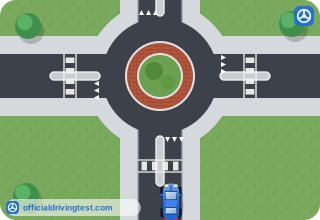
If another vehicle arrives at a traffic circle at the same time as you do, which should you yield to?
- The vehicle on your right
- The vehicle on your left
- The larger vehicle
- The faster vehicle
Show answer
Correct answer: The vehicle on your right
If another vehicle arrives at the same time as you do, yield to the vehicle if it is on your right.
Source: Kansas Driving Handbook (Revised February 2022), page 49
-
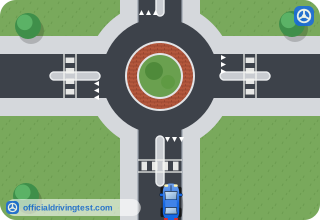
Besides vehicles, who else must you yield to in a traffic circle or roundabout?
- Only pedestrians in a marked crosswalk
- Only buses and emergency vehicles
- Pedestrians and bicyclists
- Only vehicles entering from your left
Show answer
Correct answer: Pedestrians and bicyclists
You must also yield to pedestrians and bicyclists in the traffic circle or roundabout.
Source: Kansas Driving Handbook (Revised February 2022), page 49
-
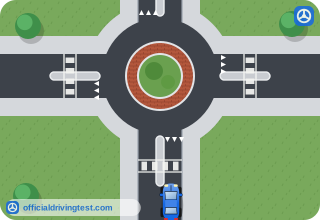
How do you enter a traffic circle and travel around it?
- Enter to the left, but steer to the right (clockwise)
- Enter to the right, but steer to the left (counterclockwise)
- Enter straight across the center island
- Enter to the right and keep steering right around the island
Show answer
Correct answer: Enter to the right, but steer to the left (counterclockwise)
The manual says to enter a traffic circle to the right, but steer to the left, in a counterclockwise direction.
Source: Kansas Driving Handbook (Revised February 2022), page 49
-
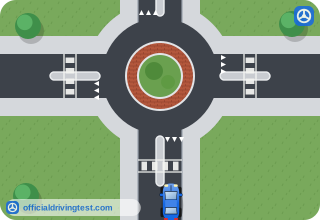
You intend to turn right at a traffic circle or roundabout. When should you signal?
- While approaching and until you exit
- Only after you have entered the circle
- Only when you reach the exit you want
- No signal is needed for a right turn
Show answer
Correct answer: While approaching and until you exit
A driver turning right signals right while approaching and keeps the signal on until exiting the traffic circle or roundabout.
Source: Kansas Driving Handbook (Revised February 2022), page 50
-
You are going straight through a traffic circle or roundabout. When do you signal right?
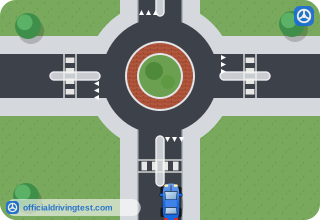
- Continuously from the approach until you leave
- Never, because going straight needs no signal at all
- Before the exit you want to take
- Only after you are already on the exit road
Show answer
Correct answer: Before the exit you want to take
When going straight through, no signal is needed on the approach, but you signal right before the exit you want to take.
Source: Kansas Driving Handbook (Revised February 2022), page 50
-
You intend to turn left at a traffic circle or roundabout. When do you signal right to take the exit?
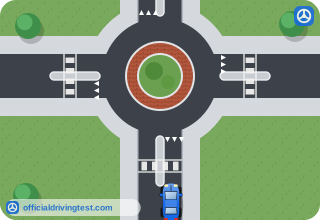
- As soon as you enter the circle
- Once you have traveled three quarters of the way around
- Once you have traveled one quarter of the way around
- Once you have traveled half of the way around
Show answer
Correct answer: Once you have traveled three quarters of the way around
A driver turning left signals right to take the exit only after traveling three quarters of the way around the circle.
Source: Kansas Driving Handbook (Revised February 2022), page 50
-
You are stopped at an intersection. How should you look before entering it?
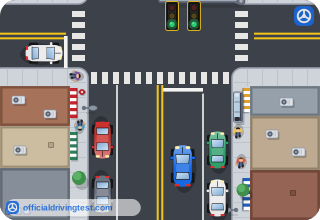
- Left, right and left again
- Right, left and right again
- Straight ahead, then right only
- Left only, because that traffic arrives first
Show answer
Correct answer: Left, right and left again
If stopped, you should look left, right and left again before entering the intersection.
Source: Kansas Driving Handbook (Revised February 2022), page 57
-
According to the manual, what is an intersection?
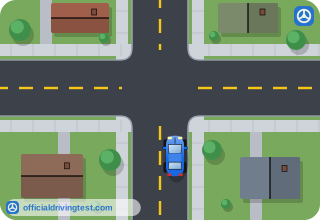
- Only a place where two named streets meet
- Only a place with traffic signals or stop signs
- Any place where traffic flow merges or crosses
- Any straight stretch of road with two or more lanes
Show answer
Correct answer: Any place where traffic flow merges or crosses
The manual says intersections are any place where traffic flow merges or crosses, including driveways, shopping center lanes and parking lot entrances.
Source: Kansas Driving Handbook (Revised February 2022), page 57
-
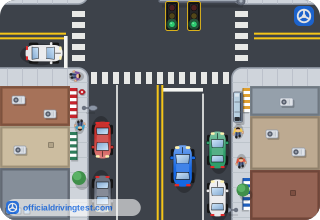
Why should you look to the front, left and right at an intersection even when cross traffic has a red light or a stop sign?
- Red lights and stop signs only apply to the lane next to you
- Some drivers may not obey signals or signs, or may not see them
- Cross traffic is always allowed to go first
- Signals at intersections are usually switched off
Show answer
Correct answer: Some drivers may not obey signals or signs, or may not see them
You should not rely on signals or signs to tell you that no one will cross in front of you, because some drivers may not obey them or may not see them.
Source: Kansas Driving Handbook (Revised February 2022), page 57
-
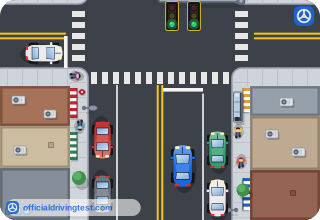
Why is searching at an intersection especially important just after a light has turned green?
- Drivers behind you accelerate more slowly when they start from a green light
- Pedestrians never cross the street while the signal is green for traffic
- Cross traffic is required to stop for ten seconds after the light turns green
- People on the cross street are most likely to hurry through before the light turns red
Show answer
Correct answer: People on the cross street are most likely to hurry through before the light turns red
People on the cross street are most likely to hurry through the intersection before the light changes to red, so look before you go.
Source: Kansas Driving Handbook (Revised February 2022), page 57
-
What should you make sure of before entering an intersection so that you will not block it if you must stop?
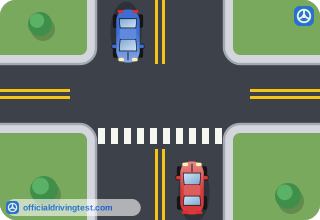
- The travel path is clear all the way through and you can see crossing traffic
- The vehicle behind you has also come to a stop at the intersection
- Your turn signal has been flashing for at least several seconds
- The light has just turned green and other drivers are moving
Show answer
Correct answer: The travel path is clear all the way through and you can see crossing traffic
You must make sure the travel path is clear all the way through the intersection and that you can clearly see crossing traffic, so you will not block the intersection if you must stop.
Source: Kansas Driving Handbook (Revised February 2022), page 57
-
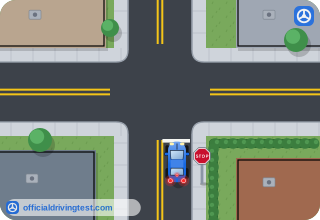
You are stopped and your view of traffic on a cross street is blocked. What should you do?
- Honk your horn and then pull out
- Wait for the vehicle behind you to go first
- Edge forward slowly until you can see
- Pull out quickly to get a better view
Show answer
Correct answer: Edge forward slowly until you can see
Edge forward slowly until you can see. Crossing drivers can then see the front of your vehicle before you can see them, giving them a chance to slow down and warn you.
Source: Kansas Driving Handbook (Revised February 2022), page 57
-
When turning left at an intersection, what should you do to be ready for the turn?
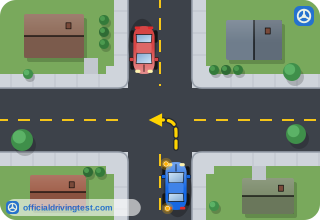
- Stop well back of the intersection and wait
- Move to the far right of your lane
- Stop in the crosswalk
- Pull into the intersection
Show answer
Correct answer: Pull into the intersection
When turning left at an intersection, you pull into the intersection to be ready to turn left, then look for a safe gap in the oncoming traffic.
Source: Kansas Driving Handbook (Revised February 2022), page 57
-
Before turning left, you should search to be sure there are no vehicles or pedestrians in your path that could do what?
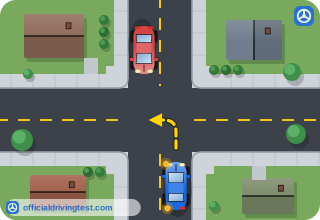
- Leave your vehicle stranded in the path of oncoming traffic
- Force you to sound your horn to warn the other drivers
- Make you cross the center line before you are ready to turn
- Cause you to miss the green signal for the next cycle
Show answer
Correct answer: Leave your vehicle stranded in the path of oncoming traffic
Before turning left you search for vehicles or pedestrians that could leave your vehicle stranded in the path of oncoming traffic.
Source: Kansas Driving Handbook (Revised February 2022), page 57
-
Before turning right, what must you make sure of regarding oncoming traffic?
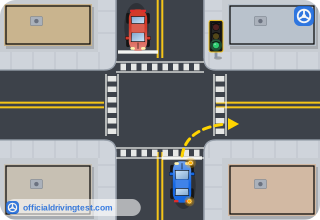
- That none of it is stopped at a red light
- That none of it is using its turn signal
- That none of it is turning left into your path
- That none of it is parked at the curb
Show answer
Correct answer: That none of it is turning left into your path
Before turning right you must make sure no traffic is approaching from your left and no oncoming traffic is turning left into your path.
Source: Kansas Driving Handbook (Revised February 2022), page 57
-
When merging with other traffic, where in the gap should you move?
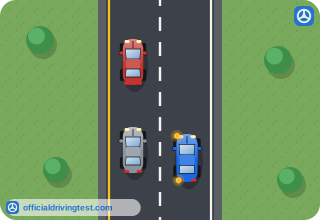
- Right behind the vehicle ahead of the gap
- Right in front of the vehicle behind the gap
- At the very end of the gap
- Into the middle of the gap
Show answer
Correct answer: Into the middle of the gap
Move into the middle of the gap so both vehicles can adjust their following interval.
Source: Kansas Driving Handbook (Revised February 2022), page 64
-
Why should you try not to merge into a small gap in traffic?
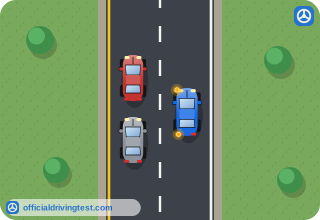
- A small gap can quickly become even smaller
- A small gap is illegal to enter on a limited access roadway
- Other drivers cannot see a vehicle in a small gap
- A small gap makes your turn signal harder to see
Show answer
Correct answer: A small gap can quickly become even smaller
The manual warns that a small gap can quickly become even smaller, so enter a gap that gives you time to adjust.
Source: Kansas Driving Handbook (Revised February 2022), page 64