Kansas: Right-of-way and turning — Part 2 Practice Test
Who yields at intersections and four-way stops, turning lanes, turnabouts, U-turns, roundabouts, passing and merging. — Part 2
Independent educational site · not affiliated with any government agency or DMV
Ready? Test yourself
- Instant feedback with an explanation
- Every answer cites its source in the manual
- Your best score is saved on this device
Questions are original and based on the official manual "Kansas Driving Handbook" (Revised February 2022), Kansas Department of Revenue, Division of Vehicles.
All 36 questions in this practice test
Take the test above first, then use this list to study. Tap “Show answer” to see the correct answer and explanation.
Show the questions and answersHide the questions
-
What must you do when leaving a driveway, alley or building area such as a gas station, store, or restaurant?
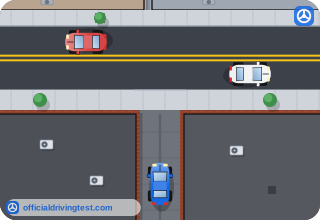
- Stop just as you would at a stop sign
- Slow down and merge if the road looks clear
- Yield to vehicles only, since pedestrians use sidewalks
- Stop only if a sign requires it
Show answer
Correct answer: Stop just as you would at a stop sign
Leaving a driveway, alley or building area requires a stop just as if there were a stop sign.
Source: Kansas Driving Handbook (Revised February 2022), page 44
-
Where should you stop when leaving a driveway, alley or building area?
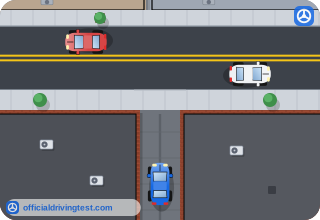
- On the sidewalk, if it gives a better view
- In the travel lane of the roadway
- Behind the sidewalk
- Beside the building entrance
Show answer
Correct answer: Behind the sidewalk
You should stop behind the sidewalk and yield the right-of-way to all pedestrians and traffic.
Source: Kansas Driving Handbook (Revised February 2022), page 44
-
When you leave a driveway or alley, to whom must you yield the right-of-way?
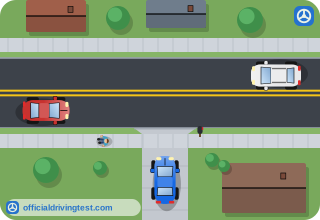
- Only vehicles already in the street
- All pedestrians and traffic
- Only pedestrians in a marked crosswalk
- Only vehicles approaching from your left
Show answer
Correct answer: All pedestrians and traffic
A driver leaving a driveway, alley or building area must yield the right-of-way to all pedestrians and traffic.
Source: Kansas Driving Handbook (Revised February 2022), page 44
-
When is it legal to back a vehicle in a travel lane?
- When you have missed a turn or exit
- When no other vehicles are in sight
- When you are letting out a passenger
- Only when you are parallel parking
Show answer
Correct answer: Only when you are parallel parking
It is illegal and unsafe to back a vehicle in any travel lane except to parallel park.
Source: Kansas Driving Handbook (Revised February 2022), page 45
-
What should you do if you miss a turn or exit?
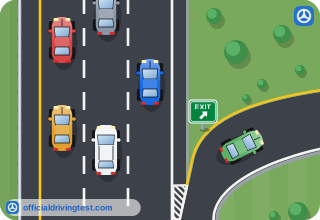
- Go on to where it is safe to turn around
- Back up slowly with your hazard lights on
- Stop on the shoulder until traffic clears
- Turn around across the median strip
Show answer
Correct answer: Go on to where it is safe to turn around
If you miss a turn or exit, do not back up; go on to where it is safe to turn around.
Source: Kansas Driving Handbook (Revised February 2022), page 45
-
On a road with two or more lanes traveling in the same direction, which lane should you stay in except to pass?
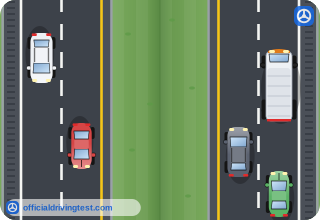
- The left lane
- The right lane
- The center lane
- The lane with the fastest traffic
Show answer
Correct answer: The right lane
On a road with two or more lanes in the same direction, you stay in the right lane except to pass.
Source: Kansas Driving Handbook (Revised February 2022), page 46
-
On a road with three or more lanes traveling in the same direction, which lane should you use, especially when a lot of traffic is entering or exiting the flow?
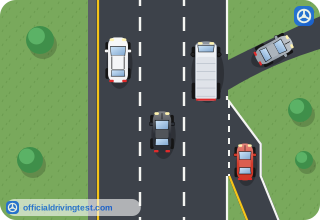
- The right-most travel lane
- The left-most travel lane
- Whichever lane has the fastest traffic
- The center travel lane
Show answer
Correct answer: The center travel lane
On a road with three or more lanes in the same direction, use the center travel lane, especially when a lot of traffic is entering or exiting.
Source: Kansas Driving Handbook (Revised February 2022), page 46
-
On multi-lane roads, which lane is intended to be used for passing slower vehicles?
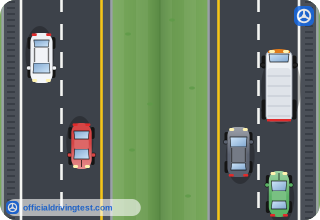
- The right-most lane
- The center lane
- The left-most lane
- The shoulder
Show answer
Correct answer: The left-most lane
On multi-lane roads, the left-most lane is intended for passing slower vehicles.
Source: Kansas Driving Handbook (Revised February 2022), page 46
-
Why is passing on the right risky?
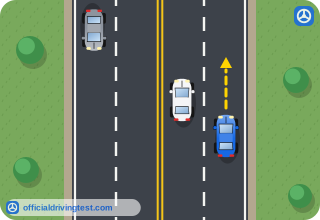
- Drivers ahead are likely to signal a left turn without any warning
- The other driver may have difficulty seeing you and might suddenly change lanes
- Vehicles in the right lane are required to speed up when passed
- Pedestrians commonly cross from the right side of the road
Show answer
Correct answer: The other driver may have difficulty seeing you and might suddenly change lanes
When passing on the right, the other driver may have difficulty seeing you and might suddenly change lanes.
Source: Kansas Driving Handbook (Revised February 2022), page 46
-
According to the manual, why is passing on the shoulder dangerous?
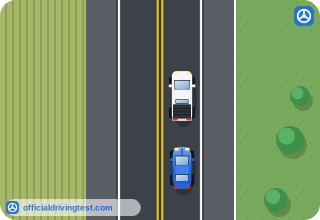
- The shoulder surface may be too soft for your tires to grip
- Other drivers may stop on the shoulder to read road signs
- The shoulder is reserved for bicyclists and pedestrians only
- Other drivers may pull off the road without looking for your vehicle
Show answer
Correct answer: Other drivers may pull off the road without looking for your vehicle
Other drivers may pull off the road without looking for your vehicle, so you should never pass on the shoulder.
Source: Kansas Driving Handbook (Revised February 2022), page 46
-
What should you search all corners of an intersection for as you approach it?
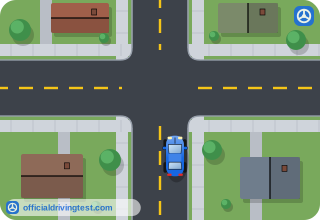
- Traffic controls, pedestrians, and other vehicles
- Parking spaces, bicycle racks, and driveways
- Open lanes, police vehicles, and school zones
- Pavement cracks, potholes, and loose gravel
Show answer
Correct answer: Traffic controls, pedestrians, and other vehicles
When approaching an intersection, search all corners for traffic controls, pedestrians and other vehicles, and signal your intentions.
Source: Kansas Driving Handbook (Revised February 2022), page 46
-
Where there are no signs or lane markings to control turning, which lane should you enter and stay in?
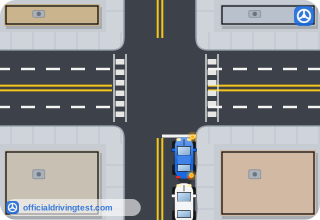
- The lane with the fewest vehicles waiting
- The center lane, so you can change either way
- The lane closest to the direction you want to go
- The lane farthest from the direction you want to go
Show answer
Correct answer: The lane closest to the direction you want to go
Where nothing controls turning, you enter and maintain position in the lane closest to the direction you want to go.
Source: Kansas Driving Handbook (Revised February 2022), page 46
-
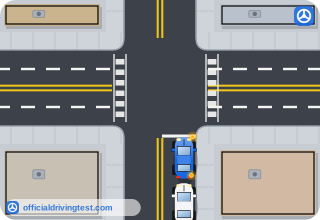
As a safety precaution, which lane should you turn into?
- The farthest lane going your way, so you have more room to speed up
- The closest lane to you that is going in the direction you want to go
- The lane that has the fewest vehicles in it at the time
- The lane that lets you cross the most lanes of traffic quickly
Show answer
Correct answer: The closest lane to you that is going in the direction you want to go
Turning into the closest lane going your way means you cross the fewest lanes of traffic.
Source: Kansas Driving Handbook (Revised February 2022), page 46
-
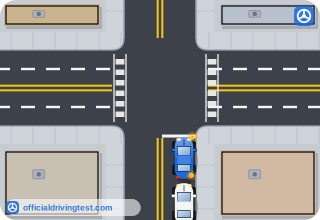
What is the best way to use your eyes while making a turn?
- Keep your eyes on the pavement just ahead of your front bumper
- Watch the vehicle in the lane next to you through the turn
- Look at the curb on the inside of the turn
- Look through the turn to the farthest point possible along your path
Show answer
Correct answer: Look through the turn to the farthest point possible along your path
The manual says to look through the turn to the farthest point possible along the intended path.
Source: Kansas Driving Handbook (Revised February 2022), page 46
-
If you are not already in the right lane after turning, what should you do?
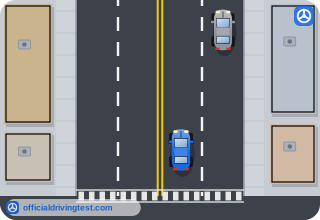
- Change lanes to the right when it is safe and maintain lane position
- Stay where you are and keep your turn signal on until the next turn
- Move to the left lane to leave room for vehicles entering behind you
- Pull onto the shoulder and wait until traffic behind you clears
Show answer
Correct answer: Change lanes to the right when it is safe and maintain lane position
If you are not in the right lane after a turn, change lanes to the right when it is safe to do so and maintain lane position.
Source: Kansas Driving Handbook (Revised February 2022), page 46
-
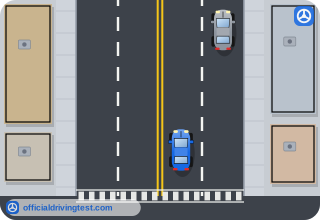
After you complete a turn and accelerate smoothly, what else should you do?
- Switch on your hazard lights until you reach full speed
- Stop briefly to let following drivers pass
- Make sure your turn signal is cancelled and check traffic to the rear
- Flash your headlights to thank the drivers you turned past
Show answer
Correct answer: Make sure your turn signal is cancelled and check traffic to the rear
After a turn, accelerate smoothly, make sure the turn signal is cancelled and check traffic to the rear.
Source: Kansas Driving Handbook (Revised February 2022), page 46
-
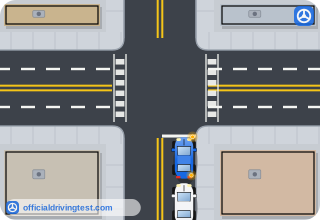
Which action does the manual tell you to avoid on a right turn?
- Turning from the right-most lane
- Swinging wide to the left before making the turn
- Checking traffic in all directions
- Turning into the closest lane going your way
Show answer
Correct answer: Swinging wide to the left before making the turn
On right turns, avoid swinging wide to the left before making the turn.
Source: Kansas Driving Handbook (Revised February 2022), page 46
-
Why should you avoid swinging wide to the left before a right turn?
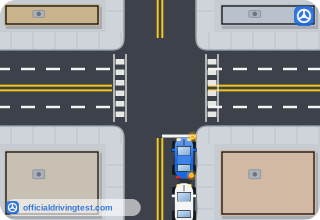
- Oncoming drivers may think you are turning left and enter the intersection
- Pedestrians in the crosswalk may not see your turn signal flashing
- The vehicle behind you will not be able to see your brake lights
- The driver behind you may think you are changing lanes or turning left and try to pass
Show answer
Correct answer: The driver behind you may think you are changing lanes or turning left and try to pass
The driver behind you may think you are changing lanes or going to turn left and may try to pass you on the right.
Source: Kansas Driving Handbook (Revised February 2022), page 46
-
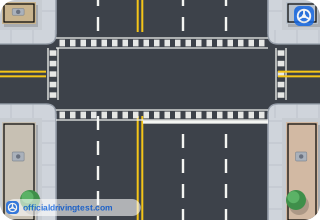
Unless lane markings allow multiple lanes to be used, from which lane should you always turn right?
- The right-most lane
- The center lane
- The left-most lane
- The lane with the least traffic
Show answer
Correct answer: The right-most lane
Always turn right from the right-most lane or when lane markings indicate multiple lanes can be used for a right turn at the same time.
Source: Kansas Driving Handbook (Revised February 2022), page 46
-
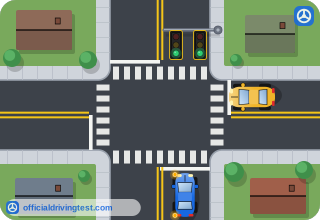
When you are making a left turn and the light turns green, what should you do?
- Wait behind the stop line until oncoming traffic has cleared
- Turn before oncoming vehicles enter the intersection
- Pull into the intersection to be ready to turn
- Stay at the stop line and signal until no vehicles are approaching
Show answer
Correct answer: Pull into the intersection to be ready to turn
When the light turns green for a left turn, pull into the intersection to be ready to turn.
Source: Kansas Driving Handbook (Revised February 2022), page 47
-
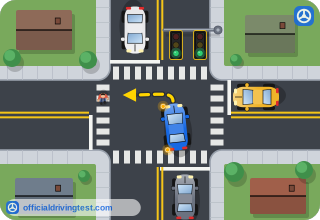
Which action does the manual tell you to avoid when making a left turn?
- Leaving room for oncoming vehicles to turn left in front of your vehicle
- Cutting the corner so sharply that you are in front of someone coming from the left
- Pulling into the intersection to be ready when the light turns green
- Starting the turn from the left-most lane of the roadway
Show answer
Correct answer: Cutting the corner so sharply that you are in front of someone coming from the left
On a left turn, avoid cutting the corner so sharply that your vehicle is in front of someone approaching from the left.
Source: Kansas Driving Handbook (Revised February 2022), page 47
-
When making a left turn, what should you leave for oncoming vehicles?
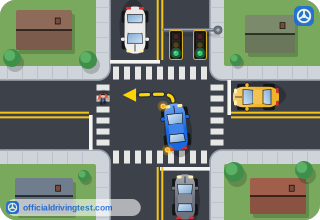
- Room to pass you on your right side
- A full lane width on your left
- Room to cross the center line ahead of you
- Room to turn left in front of your vehicle
Show answer
Correct answer: Room to turn left in front of your vehicle
On a left turn, be sure to leave room for oncoming vehicles to turn left in front of your vehicle.
Source: Kansas Driving Handbook (Revised February 2022), page 47
-
Unless lane markings allow multiple lanes to be used, from which lane should you always turn left?
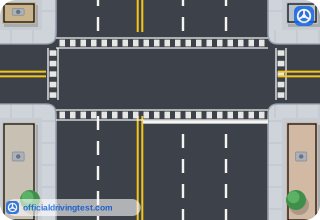
- The left-most lane
- The right-most lane
- The center lane
- The lane with the fewest cars
Show answer
Correct answer: The left-most lane
Always turn left from the left-most lane or when lane markings indicate multiple lanes can be used for a left turn at the same time.
Source: Kansas Driving Handbook (Revised February 2022), page 47
-
How far before turning should you identify and enter the lane from which you will turn on a multiple-lane turn?
- Half a block
- Only after the light turns green
- At least one block
- Just as you reach the intersection
Show answer
Correct answer: At least one block
For multiple lane turns you identify and enter the lane from which you will turn at least one block before turning.
Source: Kansas Driving Handbook (Revised February 2022), page 47
-
Before entering the lane for a multiple-lane turn, how do you check for traffic?
- Check only the mirrors, because the turn signal covers the blind spots
- Check mirrors for following traffic and blind spots by looking over your shoulder
- Look ahead at the traffic light and the vehicle in front of you only
- Check the traffic signal for oncoming vehicles and the lane markings
Show answer
Correct answer: Check mirrors for following traffic and blind spots by looking over your shoulder
Before entering the turning lane, check mirrors for following traffic and check blind spots by looking over your shoulder.
Source: Kansas Driving Handbook (Revised February 2022), page 47
-
When the green signal appears for a multiple-lane turn, which lane do you steer into?
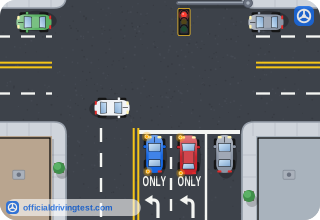
- The left-most lane of the new road, to speed up
- Any open lane, as soon as you clear the intersection
- The lane closest to the center line of the new road
- The lane corresponding to the one from which the turn was made
Show answer
Correct answer: The lane corresponding to the one from which the turn was made
When the green signal appears and it is safe, steer into the lane corresponding to the one from which the turn was made.
Source: Kansas Driving Handbook (Revised February 2022), page 47
-
What is the safest way to change direction when you find yourself headed the wrong way?
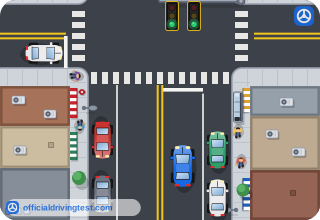
- Turn right and go around the block
- Make a left turn across traffic
- Back into the nearest intersection
- Turn around in the middle of the block
Show answer
Correct answer: Turn right and go around the block
The safest way to change direction is to turn right and go around the block, which avoids most left turns across traffic.
Source: Kansas Driving Handbook (Revised February 2022), page 47
-
When is a two-point turnabout used?
- When you have missed an exit on the interstate
- When you need to turn left across several lanes of traffic
- When the street is wide enough for a U-turn
- When driving around a block is not practical or possible
Show answer
Correct answer: When driving around a block is not practical or possible
A two-point turnabout uses a street, alley or driveway to reverse direction when it is not practical or possible to drive around a block.
Source: Kansas Driving Handbook (Revised February 2022), page 48
-
Why is backing into a driveway the safer way to do a two-point turnabout?
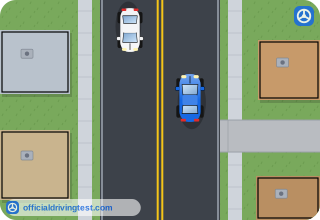
- It allows you to see traffic better when leaving the driveway
- It keeps your headlights on the traffic behind you
- It lets you use the turn signal for a shorter time
- It lets you turn around without checking for traffic
Show answer
Correct answer: It allows you to see traffic better when leaving the driveway
Backing into the driveway allows you to see traffic better when leaving the driveway.
Source: Kansas Driving Handbook (Revised February 2022), page 48
-
On what kind of roadway should a two-point turnabout only be used?
- A multi-lane roadway with a center turn lane
- A one-way street
- A two-lane roadway
- An interstate ramp
Show answer
Correct answer: A two-lane roadway
A two-point turnabout should only be used on a two-lane roadway.
Source: Kansas Driving Handbook (Revised February 2022), page 48
-
While backing slowly in a reverse two-point turnabout, how do you steer?
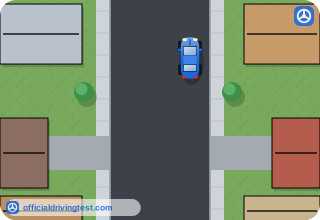
- Steer slowly toward the left side
- Steer rapidly all the way to the right
- Keep the wheels straight until the rear reaches the lane
- Steer all the way to the left as fast as possible
Show answer
Correct answer: Steer rapidly all the way to the right
While backing slowly in a reverse two-point turnabout, you steer rapidly all the way to the right.
Source: Kansas Driving Handbook (Revised February 2022), page 48
-
In a reverse two-point turnabout, how far do you move back before you steer into the driveway?
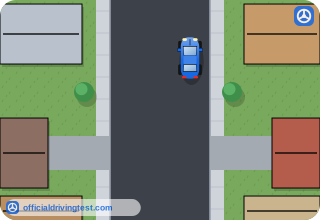
- Until the rear bumper passes the far edge of the driveway
- Until the front bumper is even with the driveway
- Until you are fully inside the driveway before turning the wheel
- Until the rear bumper reaches the near edge of the driveway
Show answer
Correct answer: Until the rear bumper reaches the near edge of the driveway
You move back until the rear bumper of the vehicle reaches the near edge of the driveway.
Source: Kansas Driving Handbook (Revised February 2022), page 48
-
At the end of a reverse two-point turnabout, what do you do after shifting to drive?
- Check both ways, then signal and turn left into the proper lane
- Turn right immediately into the nearest lane
- Sound the horn and pull out ahead of traffic
- Leave the signal off and drive straight across the road
Show answer
Correct answer: Check both ways, then signal and turn left into the proper lane
After shifting to drive, check in both directions and, if clear, signal and turn left into the proper lane.
Source: Kansas Driving Handbook (Revised February 2022), page 48
-
At the start of a forward two-point turnabout, where do you position your vehicle before turning into the driveway or alley?
- Close to the right-hand curb
- Wide on the right shoulder
- Close to the center of the road
- At the far edge of the opposite lane
Show answer
Correct answer: Close to the center of the road
For a forward two-point turnabout you move close to the center of the road and turn into the driveway or alley as near as possible to the right side.
Source: Kansas Driving Handbook (Revised February 2022), page 48
-
When do you stop in the driveway during a forward two-point turnabout?
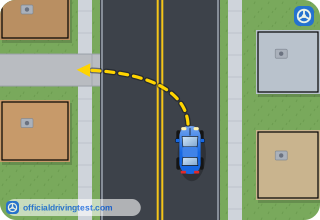
- As the front bumper reaches the far side of the driveway
- As the rear of the vehicle clears the curb or edge of the driveway
- When the vehicle is parallel to the road
- As soon as the front wheels cross the curb
Show answer
Correct answer: As the rear of the vehicle clears the curb or edge of the driveway
In a forward two-point turnabout you stop as the rear of the vehicle clears the curb or edge of the driveway.
Source: Kansas Driving Handbook (Revised February 2022), page 48
-
Which signal do you give just before shifting to reverse in a forward two-point turnabout?
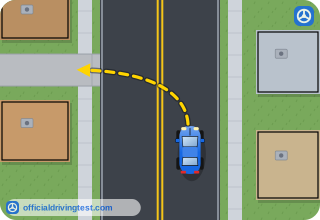
- A left turn signal
- The hazard flashers
- No signal until moving forward again
- A right turn signal
Show answer
Correct answer: A right turn signal
Before shifting to reverse in a forward two-point turnabout, you check in all directions, signal a right turn and shift to reverse.
Source: Kansas Driving Handbook (Revised February 2022), page 48