Kansas: Right-of-way and turning — Part 1 Practice Test
Who yields at intersections and four-way stops, turning lanes, turnabouts, U-turns, roundabouts, passing and merging. — Part 1
Independent educational site · not affiliated with any government agency or DMV
Ready? Test yourself
- Instant feedback with an explanation
- Every answer cites its source in the manual
- Your best score is saved on this device
Questions are original and based on the official manual "Kansas Driving Handbook" (Revised February 2022), Kansas Department of Revenue, Division of Vehicles.
All 36 questions in this practice test
Take the test above first, then use this list to study. Tap “Show answer” to see the correct answer and explanation.
Show the questions and answersHide the questions
-
How should you make a right turn from a four-lane divided highway?
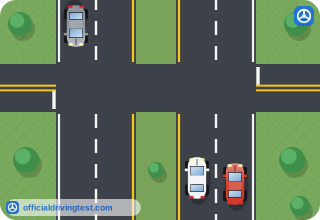
- Enter the right lane well in advance, then turn tightly into the right lane
- Start from the center lane and swing wide into the cross street
- Turn from the left lane after slowing to a crawl
- Stay in the left lane until you reach the cross street, then turn right
Show answer
Correct answer: Enter the right lane well in advance, then turn tightly into the right lane
For a right turn from a four-lane divided highway, enter the right lane well in advance and turn tightly into the right lane of the cross street.
Source: Kansas Driving Handbook (Revised February 2022), page 17
-
How should you make a left turn on a multi-lane road?
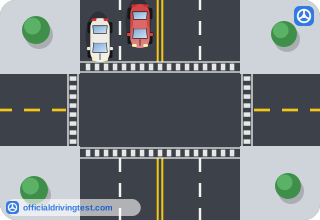
- Stay in the right lane and swing wide before turning into the cross street
- Turn from the outside lane and enter the cross street's far lane
- Stop in the center of the intersection until traffic clears
- From the inside lane near the center line, entering just right of the center line
Show answer
Correct answer: From the inside lane near the center line, entering just right of the center line
For left turns, move near the center line or traffic divider, turn from the inside lane without swinging wide, and enter just to the right of the center line.
Source: Kansas Driving Handbook (Revised February 2022), page 17
-
At an intersection that is marked to permit turns from more than one lane, what may you do?
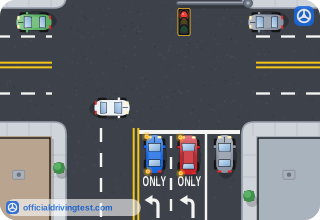
- Turn only from the lane next to the curb
- Turn only from the lane next to the center line
- Make turns as indicated by signs or pavement markings
- Turn from any lane, whatever the markings say
Show answer
Correct answer: Make turns as indicated by signs or pavement markings
At intersections marked to permit turns from more than one lane, you may make turns as indicated by signs or pavement markings.
Source: Kansas Driving Handbook (Revised February 2022), page 17
-
In Kansas, you should not make a "U" turn anywhere you cannot be seen by other drivers for at least how far?
- 100 feet
- 500 feet
- 200 feet
- 300 feet
Show answer
Correct answer: 500 feet
Do not make a U-turn on a curve, near the top of a hill or anywhere other drivers cannot see you for at least 500 feet.
Source: Kansas Driving Handbook (Revised February 2022), page 17
-
When may you pass another vehicle on the left on a two-lane road with traffic moving in both directions?
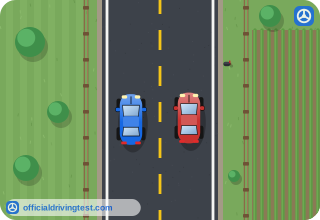
- Whenever the vehicle ahead is driving below the posted limit
- If you speed up enough to finish the pass quickly
- Whenever you can see a gap of one car length ahead
- If it can be done safely without exceeding the speed limit
Show answer
Correct answer: If it can be done safely without exceeding the speed limit
On such roads you may pass on the left if the pass can be completed safely and without exceeding the speed limit.
Source: Kansas Driving Handbook (Revised February 2022), page 17
-
In preparing to pass, what should you check behind you?
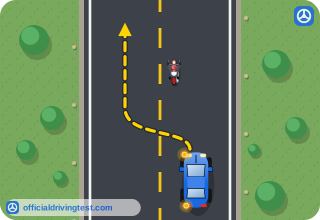
- For other traffic that may be preparing to pass you
- For stopped vehicles along the shoulder
- For the license plate of the vehicle you are passing
- For any vehicle driving at a lower speed
Show answer
Correct answer: For other traffic that may be preparing to pass you
In preparing to pass, check the road ahead for sufficient distance and the road behind for other traffic that may be preparing to pass you.
Source: Kansas Driving Handbook (Revised February 2022), page 17
-
When may you return to the right lane after passing a vehicle?
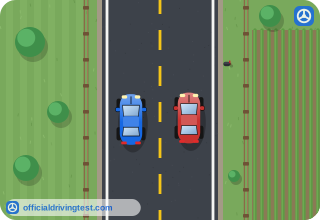
- As soon as your rear bumper is level with the front bumper of that vehicle
- When you see the entire front of the passed vehicle in your rearview mirror
- As soon as you have gone 10 mph faster than that vehicle was driving
- As soon as you have counted two full seconds since you passed its front
Show answer
Correct answer: When you see the entire front of the passed vehicle in your rearview mirror
Do not return to the right lane too soon; wait until you can see the entire front of the vehicle you have just passed in your rearview mirror.
Source: Kansas Driving Handbook (Revised February 2022), page 17
-
When may you pass another vehicle on the right in Kansas?
- On any two-lane road whenever the driver ahead is driving slowly
- On any road at all, as long as you use your right-turn signal
- On one-way streets and roads marked for two or more same-direction lanes
- On any road with a paved shoulder wide enough for your vehicle
Show answer
Correct answer: On one-way streets and roads marked for two or more same-direction lanes
You may pass on the right on one-way streets and on highways marked for two or more lanes of traffic moving in the same direction.
Source: Kansas Driving Handbook (Revised February 2022), page 17
-
When may you drive on the shoulder to pass another vehicle?
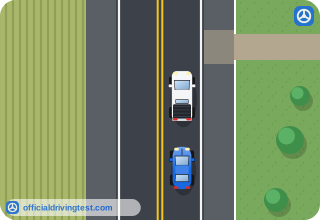
- Whenever the vehicle ahead is turning left
- Only during an emergency or when directed by traffic authorities
- When the road is wet or icy
- When the vehicle ahead is driving under the speed limit
Show answer
Correct answer: Only during an emergency or when directed by traffic authorities
Do not drive on the shoulder to pass except during an emergency or when directed by traffic authorities.
Source: Kansas Driving Handbook (Revised February 2022), page 17
-
At a stop sign with no clearly marked stop line, where must you stop?
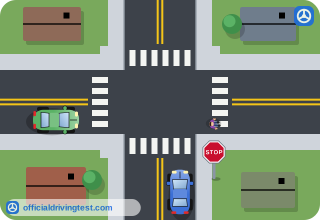
- Just past the crosswalk, before the intersection
- In the middle of the intersection
- Before entering the crosswalk on the near side of the intersection
- Beside the stop sign, even if that is past the crosswalk
Show answer
Correct answer: Before entering the crosswalk on the near side of the intersection
Stop at a marked stop line; if none, before entering the near-side crosswalk; if none, at the point nearest the intersecting roadway.
Source: Kansas Driving Handbook (Revised February 2022), page 18
-
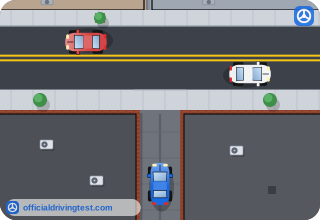
What must you do when coming from an alley, private drive or building within a business or residential district?
- Slow down and yield only if a car is coming
- Come to a complete stop
- Stop only if you see a pedestrian
- Honk and proceed
Show answer
Correct answer: Come to a complete stop
A complete stop is required when coming from an alley, private drive or building within a business or residential district.
Source: Kansas Driving Handbook (Revised February 2022), page 18
-
What must you do when a school crossing guard is displaying a flag in a STOP position?
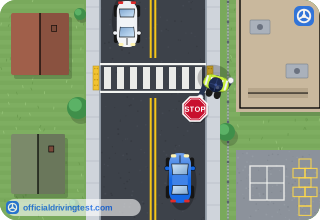
- Come to a complete stop
- Slow down and proceed if no child is in the road
- Slow down and sound your horn
- Stop only if a child is in front of your vehicle
Show answer
Correct answer: Come to a complete stop
A complete stop is required when a school crossing guard displays a flag in a STOP position.
Source: Kansas Driving Handbook (Revised February 2022), page 18
-
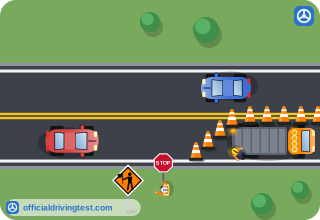
What must you do when a flag person at a construction site or a police officer directs you to stop?
- Slow down and proceed when clear
- Stop only if other traffic is present
- Come to a complete stop
- Stop only when the officer is in a marked patrol car
Show answer
Correct answer: Come to a complete stop
A complete stop is required when directed by a flag person at a construction site, or anytime when directed by a police officer.
Source: Kansas Driving Handbook (Revised February 2022), page 18
-
If you are approaching an intersection and a vehicle from a different highway has already entered it, what must you do?
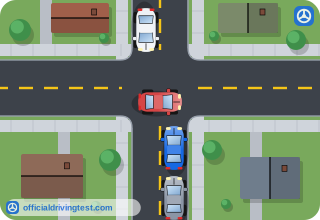
- Yield the right-of-way to that vehicle
- Enter first if you are going straight
- Enter first if you are on the wider road
- Sound your horn and proceed
Show answer
Correct answer: Yield the right-of-way to that vehicle
The driver approaching an intersection must yield to a vehicle that has already entered the intersection from a different highway.
Source: Kansas Driving Handbook (Revised February 2022), page 18
-
When two vehicles enter an intersection from different roadways at approximately the same time, who must yield?
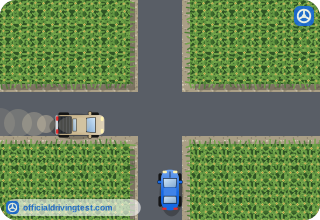
- The driver on the right yields to the driver on the left
- The driver on the narrower road yields
- The driver in the newer vehicle yields
- The driver on the left yields to the driver on the right
Show answer
Correct answer: The driver on the left yields to the driver on the right
When two vehicles enter an intersection from different roadways at about the same time, the driver on the left yields to the vehicle on the right.
Source: Kansas Driving Handbook (Revised February 2022), page 18
-
When you enter a through street or highway at which there are stop signs, what must you do?
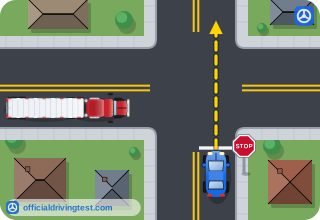
- Slow down and enter the through street ahead of the other traffic
- Stop completely, then go when you can do so without interfering with traffic
- Stop only if you see a vehicle on the through street
- Stop and then enter ahead of traffic already on that street
Show answer
Correct answer: Stop completely, then go when you can do so without interfering with traffic
You must stop completely and proceed only when you can do so without interfering with other traffic.
Source: Kansas Driving Handbook (Revised February 2022), page 18
-
A driver turning left and a driver going straight through enter an intersection from opposite directions at the same time. Who has the right-of-way?
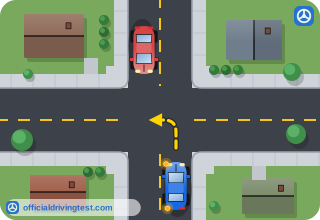
- The car going straight through
- The car turning left
- The car on the wider road
- The car that is moving faster
Show answer
Correct answer: The car going straight through
A left-turning driver yields to oncoming vehicles, and if both cars enter at the same time the car going straight through has the right-of-way.
Source: Kansas Driving Handbook (Revised February 2022), page 18
-
Who has the right-of-way when a vehicle on a public street or highway meets a vehicle entering from a private drive or side road?
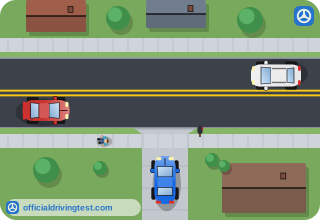
- The vehicle entering from the private drive
- Whichever driver arrives first
- The vehicle with the most passengers
- The vehicle on the public street or highway
Show answer
Correct answer: The vehicle on the public street or highway
Vehicles on a public street or highway have the right-of-way over vehicles entering from a private drive or side road.
Source: Kansas Driving Handbook (Revised February 2022), page 18
-
A driver in a business or residential district is emerging from an alley, driveway or building. What must the driver do before yielding?
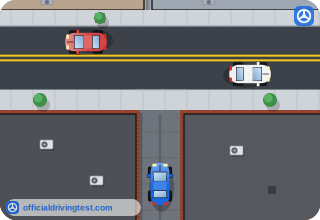
- Stop with the front of your vehicle in the middle of the sidewalk
- Stop just before the sidewalk or the sidewalk area
- Drive across onto the sidewalk and stop there to look
- Slow to a crawl and keep moving, yielding only if needed
Show answer
Correct answer: Stop just before the sidewalk or the sidewalk area
The driver must stop immediately prior to driving onto a sidewalk or the sidewalk area across the alley or driveway, and then yield the right-of-way.
Source: Kansas Driving Handbook (Revised February 2022), page 18
-
When must a car controlled by a yield sign stop?
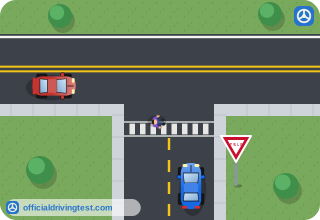
- Always, in the same way as at a stop sign, even if no one is near
- Never, no matter whether pedestrians or vehicles are crossing
- Only when needed to avoid interfering with other traffic or pedestrians
- Only when another vehicle is within 100 feet of the intersection
Show answer
Correct answer: Only when needed to avoid interfering with other traffic or pedestrians
Cars controlled by a yield sign need stop only when necessary to avoid interfering with traffic that has the right-of-way, including pedestrians.
Source: Kansas Driving Handbook (Revised February 2022), page 18
-
You have a green light, but there is not enough room on the other side of the intersection for your vehicle. What should you do?
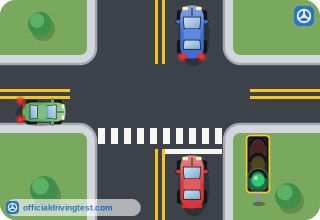
- Enter and stop in the middle of the intersection
- Enter and block the crosswalk
- Enter and use your horn
- Not enter the intersection
Show answer
Correct answer: Not enter the intersection
Even with a green light, you may not enter an intersection, crosswalk or railroad crossing unless there is room on the other side for your vehicle.
Source: Kansas Driving Handbook (Revised February 2022), page 18
-
What does the law do about right-of-way, according to the manual?
- It says who must yield; it does not give anyone the right-of-way
- It gives the right-of-way to the driver who signals first
- It gives the right-of-way to the driver of the larger vehicle
- It gives the right-of-way to the driver who is traveling faster
Show answer
Correct answer: It says who must yield; it does not give anyone the right-of-way
The law only says who must yield the right-of-way to another roadway user. It does not give the right-of-way to anyone.
Source: Kansas Driving Handbook (Revised February 2022), page 33
-
When do you gain the right-of-way?
- Whenever you are driving the larger vehicle
- Whenever you honk your horn to warn other drivers
- Only when another roadway user gives it to you
- Whenever you drive on the road with the higher speed limit
Show answer
Correct answer: Only when another roadway user gives it to you
You gain the right-of-way only when another roadway user gives you the right-of-way, so you must do everything possible to avoid striking anyone or anything.
Source: Kansas Driving Handbook (Revised February 2022), page 33
-
When turning left, which vehicles must you yield to?
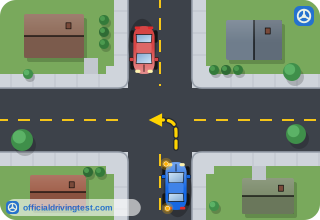
- Oncoming vehicles going straight ahead or turning right
- Only oncoming vehicles that are going straight ahead
- Oncoming vehicles that are also turning left
- Only vehicles that are stopped behind you
Show answer
Correct answer: Oncoming vehicles going straight ahead or turning right
A driver turning left must yield to oncoming vehicles that are going straight ahead or turning right.
Source: Kansas Driving Handbook (Revised February 2022), page 33
-
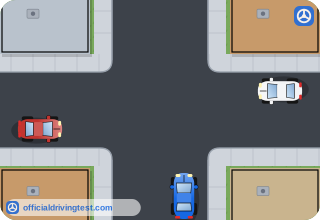
At an uncontrolled intersection with no stop sign, yield sign or traffic signal, who must you yield to?
- Vehicles in the intersection and those coming from the left
- Vehicles in the intersection and those coming from the right
- Only vehicles that are already in the intersection
- Only vehicles that are traveling faster than you
Show answer
Correct answer: Vehicles in the intersection and those coming from the right
At an uncontrolled intersection you must yield to vehicles already in the intersection and to those coming from the right.
Source: Kansas Driving Handbook (Revised February 2022), page 33
-
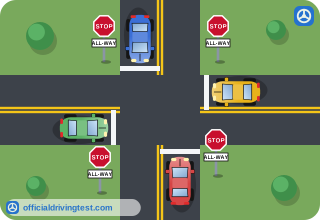
At a 4-way stop, who should be given the right-of-way by the other drivers?
- The driver who is turning right
- The driver of the largest vehicle
- The driver who is going straight ahead
- The driver who reaches the intersection first
Show answer
Correct answer: The driver who reaches the intersection first
At a 4-way stop, the driver who reaches the intersection first should be given the right-of-way.
Source: Kansas Driving Handbook (Revised February 2022), page 33
-
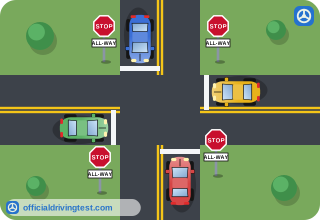
At a 4-way stop, more than one vehicle arrives at the same time. Which vehicle goes first?
- The vehicle on the right
- The vehicle on the left
- The vehicle going straight ahead
- The largest vehicle
Show answer
Correct answer: The vehicle on the right
If more than one vehicle arrives at a 4-way stop at the same time, the vehicle on the right goes first.
Source: Kansas Driving Handbook (Revised February 2022), page 33
-
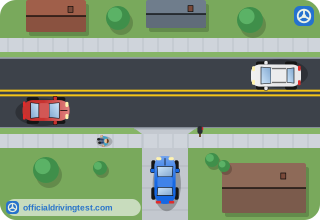
What must you do when entering a road from a driveway, alley or roadside?
- Enter quickly so that traffic on the road must slow for you
- Sound your horn and then pull out ahead of traffic
- Yield to vehicles already on the main road
- Yield only if the main road has a stop sign
Show answer
Correct answer: Yield to vehicles already on the main road
When entering a road from a driveway, alley or roadside, you must yield to vehicles already on the main road.
Source: Kansas Driving Handbook (Revised February 2022), page 34
-
When may you enter an intersection?
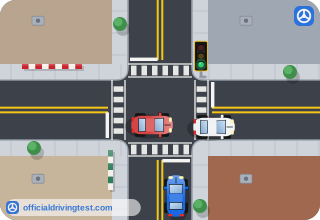
- Whenever the light is green, even if traffic ahead has not cleared
- Whenever you have started to move and cannot stop
- Only when you can get through it without blocking traffic flow
- Whenever no pedestrians are in the crosswalk
Show answer
Correct answer: Only when you can get through it without blocking traffic flow
You may not enter an intersection unless you can get through it without blocking traffic flow, so wait until traffic ahead clears.
Source: Kansas Driving Handbook (Revised February 2022), page 34
-
A small 4-WAY sign is added to a stop sign. What does it tell you?
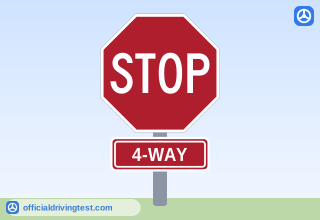
- All approaching traffic has a stop sign
- Four lanes of traffic come together here
- Only four vehicles may enter at once
- Cross traffic does not have to stop
Show answer
Correct answer: All approaching traffic has a stop sign
A 4-WAY sign may be added to the stop sign at intersections where all approaching traffic has a stop sign.
Source: Kansas Driving Handbook (Revised February 2022), page 40
-
A red and white triangle pointing downward with the word YIELD on it means that you must do what?
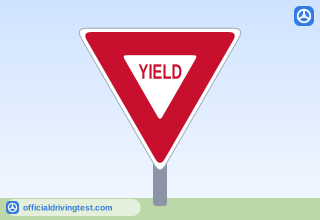
- Stop completely every time, then proceed when ready
- Stop only if another vehicle is already in the intersection
- Slow down and let traffic with the right-of-way cross first
- Speed up and merge ahead of the cross traffic to clear it
Show answer
Correct answer: Slow down and let traffic with the right-of-way cross first
A yield sign means you must slow down and allow traffic that has the right-of-way to cross before entering.
Source: Kansas Driving Handbook (Revised February 2022), page 40
-
A sign with the words CENTER LANE ONLY and left-turn arrows is posted. What does it tell you about that lane?
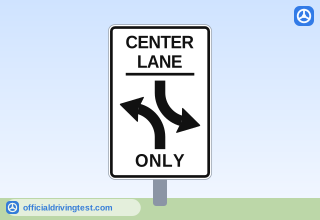
- It is a lane for through traffic in both directions
- It is reserved for left turns from either direction
- It is a lane for passing slower vehicles ahead
- It is reserved for left turns from one direction only
Show answer
Correct answer: It is reserved for left turns from either direction
A shared center lane left turn only sign marks a lane reserved for left-turning vehicles from either direction, not for through traffic or passing.
Source: Kansas Driving Handbook (Revised February 2022), page 40
-
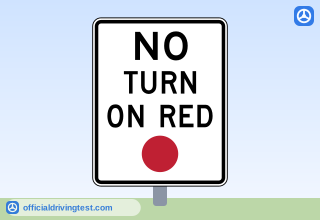
What does a NO TURN ON RED sign mean?
- You may not turn left, but you may turn right
- You may turn only after a full stop with no traffic
- You may turn only if pedestrians are not present
- You may not turn right or left during the red light
Show answer
Correct answer: You may not turn right or left during the red light
With this sign posted you may not turn right or left on red and must wait for the green signal.
Source: Kansas Driving Handbook (Revised February 2022), page 40
-
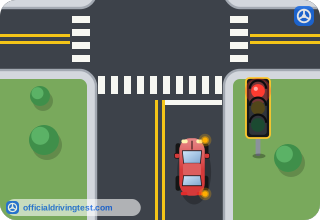
There is no NO TURN ON RED sign at a traffic light and the light is red. What may you do?
- Turn right without stopping if no traffic is in sight
- Wait for the light to turn green before turning right
- Stop, check for traffic and pedestrians, then turn right
- Go straight through the red if no traffic is coming
Show answer
Correct answer: Stop, check for traffic and pedestrians, then turn right
Without a No Turn on Red sign, after stopping at the stop line and checking for traffic and pedestrians, you may turn right on red.
Source: Kansas Driving Handbook (Revised February 2022), page 40
-
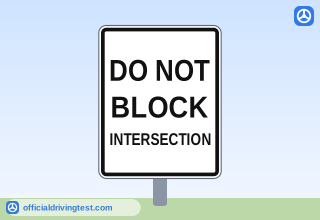
A DO NOT BLOCK INTERSECTION sign is posted. When must you not enter the intersection?
- If the traffic light has just turned yellow
- If traffic would stop you from clearing it
- If a vehicle ahead is waiting to turn left
- If you plan to turn right at the intersection
Show answer
Correct answer: If traffic would stop you from clearing it
You must not enter an intersection if traffic conditions do not permit you to clear the intersection completely.
Source: Kansas Driving Handbook (Revised February 2022), page 41
-
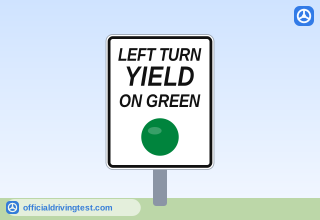
A sign reads LEFT TURN YIELD ON GREEN with a green circle. What does it tell you?
- A left turn is allowed only when a green arrow shows
- Oncoming traffic must yield to you when you turn left
- You must come to a stop before turning left on green
- You may turn left but must yield to oncoming traffic
Show answer
Correct answer: You may turn left but must yield to oncoming traffic
This sign tells you that a left turn is permitted, but you must yield to oncoming traffic.
Source: Kansas Driving Handbook (Revised February 2022), page 41