Kansas: Railroad crossings Practice Test
Railroad signs and signals, where to stop, crossing the tracks and what to do if your vehicle stalls on them.
Independent educational site · not affiliated with any government agency or DMV
Ready? Test yourself
- Instant feedback with an explanation
- Every answer cites its source in the manual
- Your best score is saved on this device
Questions are original and based on the official manual "Kansas Driving Handbook" (Revised February 2022), Kansas Department of Revenue, Division of Vehicles.
All 31 questions in this practice test
Take the test above first, then use this list to study. Tap “Show answer” to see the correct answer and explanation.
Show the questions and answersHide the questions
-
What must you do at a railroad crossing when a flag person or a traffic control device directs you to stop?
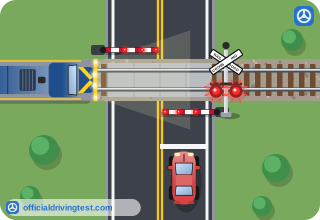
- Slow down and look both ways
- Come to a complete stop
- Stop only if you see a train
- Change lanes and proceed
Show answer
Correct answer: Come to a complete stop
A complete stop is required when directed by a flag person or any traffic control device at a railroad crossing.
Source: Kansas Driving Handbook (Revised February 2022), page 18
-
What does a round yellow sign with an X and black RR letters tell you?
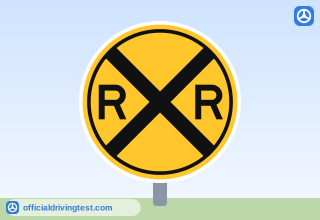
- A railroad crossing is closed and you must take a detour
- You must stop at the sign every time before you go on
- Slow down, look and listen for a train and be ready to stop
- The crossing ahead has no train traffic and you may drive normally
Show answer
Correct answer: Slow down, look and listen for a train and be ready to stop
The round yellow sign cautions you to slow down, look and listen for a train or railroad vehicle and be prepared to stop if a train is approaching.
Source: Kansas Driving Handbook (Revised February 2022), page 36
-
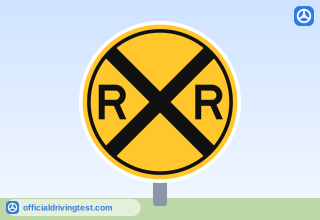
Where is the round yellow railroad warning sign placed?
- At the crossing itself, right beside the railroad tracks
- Along the road before the highway-railroad grade crossing
- Only at crossings that have crossing gates
- Only at crossings that have more than one track
Show answer
Correct answer: Along the road before the highway-railroad grade crossing
The round yellow warning sign is placed along the road prior to a highway-railroad grade crossing.
Source: Kansas Driving Handbook (Revised February 2022), page 36
-
A train is approaching and you reach a white X-shaped Railroad Crossing sign. What must you do?
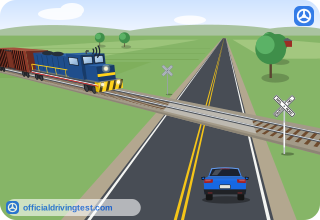
- Cross quickly before the train arrives
- Stop on the tracks and wait for the train to pass
- Cross if the train is still far away
- Wait behind the stop line until the crossing is clear
Show answer
Correct answer: Wait behind the stop line until the crossing is clear
At the white X-shaped sign you must wait for the approaching train, and your vehicle must remain behind the stop line or prior to the intersection until it is clear.
Source: Kansas Driving Handbook (Revised February 2022), page 36
-
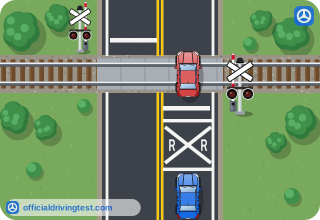
What should you do about the possibility of more than one track at a highway-railroad grade crossing?
- Check only when the number of tracks is posted on a sign
- Check only at crossings that have gates or flashing red lights
- Assume there is only one track unless a sign says otherwise
- Check for more than one track, train or railroad vehicle at each crossing
Show answer
Correct answer: Check for more than one track, train or railroad vehicle at each crossing
Not all crossings with more than one track have a sign, so it is important to check for more than one track, train or railroad vehicle at each crossing.
Source: Kansas Driving Handbook (Revised February 2022), page 37
-
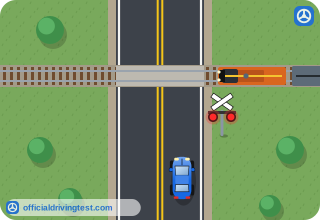
A train is approaching and the lights at a crossing are flashing. What must you do?
- Slow down and cross if you see no train
- Stop before the stop line or gate crossing area
- Stop only if the gate has started to lower
- Cross quickly before the gate lowers
Show answer
Correct answer: Stop before the stop line or gate crossing area
When a train is approaching and the lights are flashing you must stop prior to the stop line or gate crossing area.
Source: Kansas Driving Handbook (Revised February 2022), page 37
-
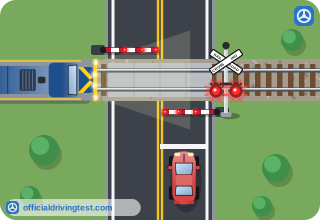
What does the manual say about a crossing gate that has lowered?
- You may go around it if you can see that no train is coming
- You may go around it if you cross the tracks very quickly
- You may not move around it until it is lifted or the lights have stopped
- You may go around it if you drive in the lane for oncoming cars
Show answer
Correct answer: You may not move around it until it is lifted or the lights have stopped
You may not move around the crossing gate until the gate is lifted or the lights have stopped.
Source: Kansas Driving Handbook (Revised February 2022), page 37
-
A crossing has a bell or horn that is sounding. When may you cross?
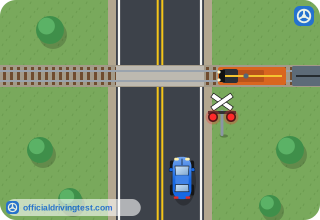
- Not until the bell or horn has stopped
- Once you have slowed down and looked both ways
- As soon as the gate starts to rise
- If the sound seems far away
Show answer
Correct answer: Not until the bell or horn has stopped
You should not cross until the bell or horn has stopped.
Source: Kansas Driving Handbook (Revised February 2022), page 37
-
At which highway-railroad grade crossings should you expect a train?
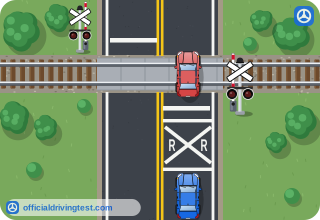
- Only at crossings that have flashing lights
- At every crossing, even if you have never seen one there
- Only at crossings where a train schedule is posted
- Only at crossings where you have seen trains before
Show answer
Correct answer: At every crossing, even if you have never seen one there
Trains do not always have a set schedule, so you should always expect a train at every crossing, even if you have never seen one at that crossing before.
Source: Kansas Driving Handbook (Revised February 2022), page 37
-
How far does a 100-car freight train traveling at 55 mph need to stop once it is in emergency braking?
- About a half mile
- About 1,500 feet
- Less than 1,000 feet
- More than a mile
Show answer
Correct answer: More than a mile
A 100-car freight train traveling at 55 mph needs more than a mile to stop once it is set into emergency braking.
Source: Kansas Driving Handbook (Revised February 2022), page 37
-
When you need to cross railroad tracks, what should you do?
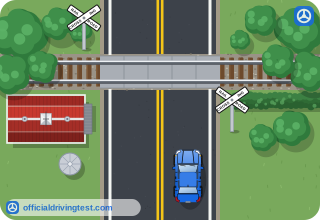
- Look both ways and cross quickly without stopping
- Stop on the tracks and look both ways
- Shift into a lower gear while on the tracks
- Follow the car ahead closely across the tracks
Show answer
Correct answer: Look both ways and cross quickly without stopping
When you need to cross railroad tracks you should look both ways and cross the tracks quickly, without stopping.
Source: Kansas Driving Handbook (Revised February 2022), page 37
-
A train is crossing the highway. When may you cross the highway-railroad grade crossing?
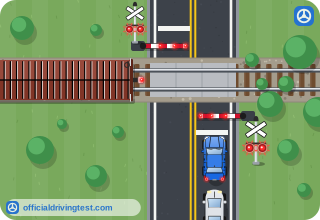
- As soon as the last train car has cleared the road in front of you
- When the train's horn has stopped sounding in the distance
- Once the train is well down the track or the devices show it is safe
- As soon as you can see that the tracks ahead look clear
Show answer
Correct answer: Once the train is well down the track or the devices show it is safe
You must wait until the train is well down the track or railroad devices such as lights and gates indicate it is safe to cross.
Source: Kansas Driving Handbook (Revised February 2022), page 37
-
You are approaching railroad tracks and need to stop for traffic or a signal. Where should you stop?
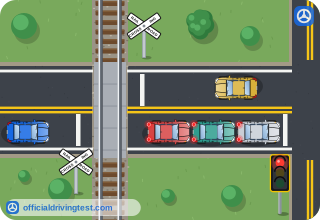
- On the tracks, if the signal ahead is red
- Beside the tracks, close enough to see both ways
- At the stop line, before the railroad tracks
- Beyond the tracks, as soon as the road is clear
Show answer
Correct answer: At the stop line, before the railroad tracks
If you need to stop for traffic or a signal as you approach railroad tracks, you stop at the stop line, prior to the tracks.
Source: Kansas Driving Handbook (Revised February 2022), page 37
-
When may you proceed through a highway-railroad grade crossing?
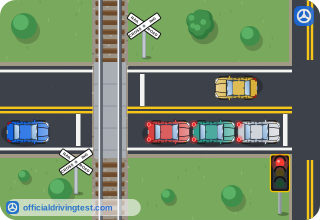
- Only if you can completely clear it without stopping on the tracks
- Whenever no train is visible, even if traffic ahead is stopped
- Whenever the gate is up, even if traffic is backed up beyond it
- Whenever you have slowed to a crawl and looked both ways
Show answer
Correct answer: Only if you can completely clear it without stopping on the tracks
You should only proceed through a crossing if you are sure you can completely clear it without stopping on the tracks, and never let traffic conditions trap you on them.
Source: Kansas Driving Handbook (Revised February 2022), page 37
-
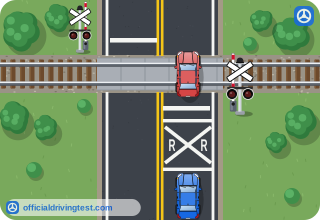
At highway-railroad grade crossings, who must you always yield the right-of-way to?
- Only passenger trains
- Only trains approaching from the right
- Only trains that are traveling at high speed
- Trains and railroad vehicles
Show answer
Correct answer: Trains and railroad vehicles
You must always yield the right-of-way to trains and railroad vehicles at highway-railroad grade crossings.
Source: Kansas Driving Handbook (Revised February 2022), page 37
-
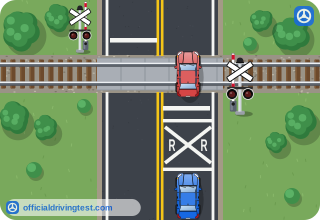
Why is it wise not to shift gears while crossing railroad tracks?
- The tracks could damage the gears
- You might stall on the tracks
- You might not see an approaching train
- You could lose control of the steering
Show answer
Correct answer: You might stall on the tracks
It is wise not to shift gears when crossing railroad tracks just in case you might stall.
Source: Kansas Driving Handbook (Revised February 2022), page 37
-
If your vehicle stalls on railroad tracks, what should you do first?
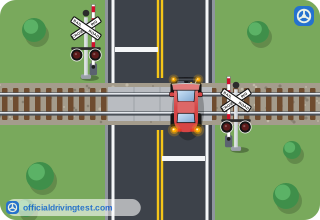
- Get everyone out and far away from the tracks
- Stay inside and restart the engine
- Stay inside with your seat belts fastened until help comes
- Push the vehicle off the tracks by yourself
Show answer
Correct answer: Get everyone out and far away from the tracks
If you stall on railroad tracks, get everyone out of the vehicle and far away from the tracks.
Source: Kansas Driving Handbook (Revised February 2022), page 37
-
After you get everyone out of a vehicle stalled on the tracks, which way should you run?
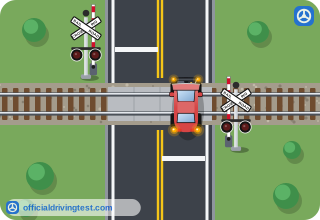
- In the same direction the train is traveling
- Directly across the tracks and away from the road
- In the direction from which the train is approaching
- Straight back toward the vehicle
Show answer
Correct answer: In the direction from which the train is approaching
You should run in the direction from which the train is approaching, because running in the same direction the train is traveling could injure you with flying debris when it hits your vehicle.
Source: Kansas Driving Handbook (Revised February 2022), page 37
-
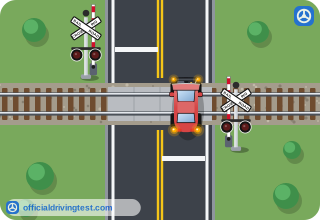
Whom does the manual say to call for assistance when your vehicle has stalled on railroad tracks?
- Your insurance company
- Your local law enforcement agency
- A towing company
- A friend or relative who can drive out to you
Show answer
Correct answer: Your local law enforcement agency
After you get everyone away from the stalled vehicle, you should call your local law enforcement agency for assistance.
Source: Kansas Driving Handbook (Revised February 2022), page 37
-
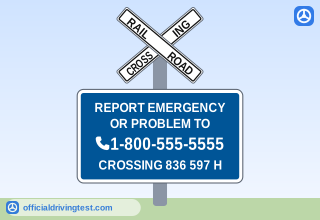
What does the blue Emergency Notification System (ENS) sign at a crossing provide?
- The speed limit for trains passing through that crossing
- The number of trains that are scheduled to pass each day
- A map showing the nearest detour around the crossing
- A 24/7/365 telephone number to report problems or emergencies
Show answer
Correct answer: A 24/7/365 telephone number to report problems or emergencies
The blue ENS sign gives the public a 24/7/365 telephone number to report problems or emergencies at the railroad location.
Source: Kansas Driving Handbook (Revised February 2022), page 37
-
Who answers the emergency contact number on an ENS sign?
- County 911 operators
- Highway patrol troopers
- Local fire department staff
- Railroad dispatchers
Show answer
Correct answer: Railroad dispatchers
When the emergency contact number on an ENS sign is called, it is answered by railroad dispatchers.
Source: Kansas Driving Handbook (Revised February 2022), page 37
-
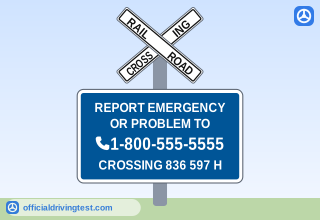
What does the Department of Transportation number printed below the dispatch number on an ENS sign identify?
- The railroad company that owns the tracks
- The exact location of the crossing
- The number of tracks at the crossing
- The date of the last crossing inspection
Show answer
Correct answer: The exact location of the crossing
The Department of Transportation number directly below the dispatch number identifies the exact location of the crossing in question.
Source: Kansas Driving Handbook (Revised February 2022), page 37
-
Where may an ENS sign be located at a crossing?
- Only on a post at the stop line before the crossing
- Only on the crossing gate arm, never near the crossing
- On the black and white crossbuck or near the actual crossing
- Only about a mile before the crossing, beside the road
Show answer
Correct answer: On the black and white crossbuck or near the actual crossing
ENS signs may be located either on the black and white crossbuck or near the actual crossing.
Source: Kansas Driving Handbook (Revised February 2022), page 37
-
Which of these can be reported using the information on an ENS sign?
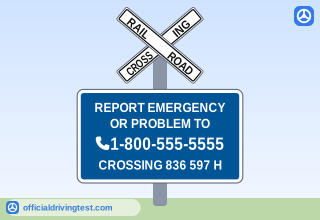
- A disabled vehicle blocking the tracks
- A train running behind schedule
- Noise from a train horn at night
- A request for directions to the nearest town
Show answer
Correct answer: A disabled vehicle blocking the tracks
The public can report unsafe conditions such as disabled cars, trucks or other vehicles blocking the railroad tracks at the crossings.
Source: Kansas Driving Handbook (Revised February 2022), page 38
-
Where should you slow down and begin looking each direction for a train when approaching a highway-railroad grade crossing?
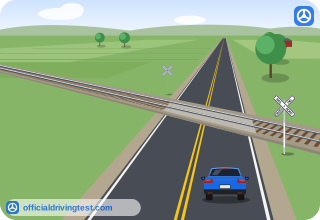
- When your front bumper reaches the tracks
- At the round warning sign
- Only after the gates begin to lower
- When you hear a train horn
Show answer
Correct answer: At the round warning sign
You approach any highway-railroad grade crossing by slowing down at the round warning sign and looking each direction before the tracks for a train or railroad maintenance equipment.
Source: Kansas Driving Handbook (Revised February 2022), page 57
-
Besides making sure that no trains are coming, what must you make sure of before crossing a highway-railroad grade crossing?
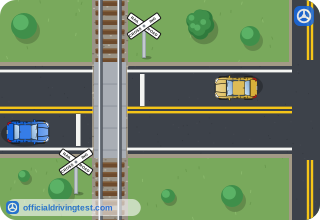
- That your gas tank is full
- That your hazard lights are on
- That your vehicle has room to cross
- That your windows are closed
Show answer
Correct answer: That your vehicle has room to cross
You need to make sure that there are no trains coming and that your vehicle has room to cross.
Source: Kansas Driving Handbook (Revised February 2022), page 61
-
What should you do at highway-railroad grade crossings that have different levels of rail crossings?
- Speed up to clear the tracks quickly
- Reduce speed to cross safely
- Change gears while on the tracks
- Stop on the tracks to look
Show answer
Correct answer: Reduce speed to cross safely
Some crossings have different levels of rail crossings, so you need to reduce speed to cross safely.
Source: Kansas Driving Handbook (Revised February 2022), page 61
-
What must you make sure of when you cross railroad tracks?
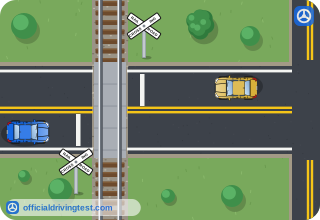
- That you follow the vehicle ahead closely so you clear the crossing
- That you slow to a crawl as you cross to avoid damage
- That you shift into low gear before you reach the tracks
- That you can cross without having to stop on the tracks
Show answer
Correct answer: That you can cross without having to stop on the tracks
Before crossing railroad tracks, make sure you can cross the highway-railroad grade crossing without having to stop on the tracks.
Source: Kansas Driving Handbook (Revised February 2022), page 65
-
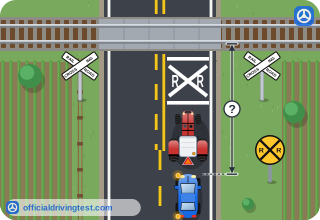
When should you not pass in relation to a highway-railroad grade crossing?
- Only when the crossing gates are down and the lights flash
- If a crossing is more than one mile ahead of your vehicle
- If a crossing is within the 20 to 25 second area ahead
- Only if a train horn is heard before you start to pass
Show answer
Correct answer: If a crossing is within the 20 to 25 second area ahead
You should not pass if there is a railroad grade crossing within the 20 to 25 second area ahead.
Source: Kansas Driving Handbook (Revised February 2022), page 66
-
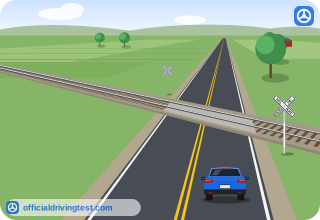
With what are many highway-railroad grade crossings on rural roads marked?
- Only a warning sign and a white X-shaped crossing sign
- Flashing red lights and a lowered crossing gate on both sides
- A red stop sign and a flagger who waves each driver across
- A painted white line and a yellow warning flag at each side
Show answer
Correct answer: Only a warning sign and a white X-shaped crossing sign
Many rural crossings have only a warning sign and a white X-shaped railroad crossing sign and typically no lights or gates.
Source: Kansas Driving Handbook (Revised February 2022), page 90
-
Because many rural railroad crossings have no lights or gates, what should you always do before crossing the tracks?
- Maintain your speed and listen for a train horn
- Slow down, look both ways and be prepared to stop for a train
- Speed up to clear the tracks before a train can arrive
- Stop only if you can see a train approaching
Show answer
Correct answer: Slow down, look both ways and be prepared to stop for a train
Crossings without lights or gates give no signal, so you must slow down, look both ways and be ready to stop for a train.
Source: Kansas Driving Handbook (Revised February 2022), page 90