Kansas: Pedestrians Practice Test
Yielding to pedestrians at crosswalks and intersections, blind pedestrians, and school zones.
Independent educational site · not affiliated with any government agency or DMV
Ready? Test yourself
- Instant feedback with an explanation
- Every answer cites its source in the manual
- Your best score is saved on this device
Questions are original and based on the official manual "Kansas Driving Handbook" (Revised February 2022), Kansas Department of Revenue, Division of Vehicles.
All 26 questions in this practice test
Take the test above first, then use this list to study. Tap “Show answer” to see the correct answer and explanation.
Show the questions and answersHide the questions
-
A pedestrian is jaywalking across the street where they should not be. What must you do?
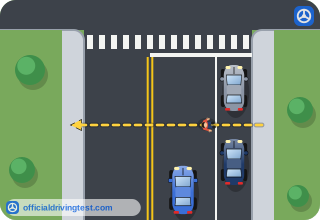
- Keep going, because the pedestrian is breaking the law
- Stop for the pedestrian even though they are in the wrong
- Honk to warn the pedestrian and then pass in front of them
- Slow down but keep going if the pedestrian is far enough away
Show answer
Correct answer: Stop for the pedestrian even though they are in the wrong
You must yield to pedestrians always. Even a jaywalking pedestrian must be stopped for.
Source: Kansas Driving Handbook (Revised February 2022), page 33
-
When is it legal to drive on a sidewalk?
- When traffic ahead is stopped and no pedestrians are near
- When you need to pass a slow vehicle on a narrow street
- When you are looking for a parking space on the block
- Only to cross it, such as at a driveway
Show answer
Correct answer: Only to cross it, such as at a driveway
Driving on a sidewalk is illegal except to cross it, such as at a driveway.
Source: Kansas Driving Handbook (Revised February 2022), page 33
-
When you cross a sidewalk to enter or exit a driveway, alley or parking lot, who must you yield to?
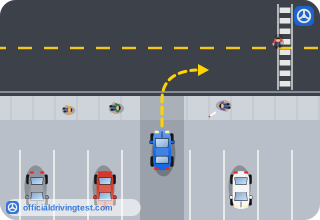
- Only pedestrians who are in a marked crosswalk
- Only children and visually impaired pedestrians
- Only pedestrians who have a walk signal
- Pedestrians using the sidewalk
Show answer
Correct answer: Pedestrians using the sidewalk
When crossing a sidewalk to enter or exit a driveway, alley or parking lot, you must yield to pedestrians.
Source: Kansas Driving Handbook (Revised February 2022), page 33
-
How must you treat a pedestrian who is using a guide dog or carrying a white cane?
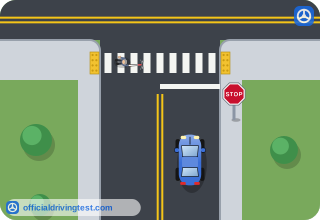
- Give them the right-of-way only at marked crosswalks
- Give them the right-of-way at all times
- Give them the right-of-way only when traffic is light
- Give them the right-of-way only if they signal that they wish to cross
Show answer
Correct answer: Give them the right-of-way at all times
Pedestrians using a guide dog or carrying a white cane must always be given the right-of-way.
Source: Kansas Driving Handbook (Revised February 2022), page 33
-
What should you not use when a pedestrian with a guide dog or a white cane is near?
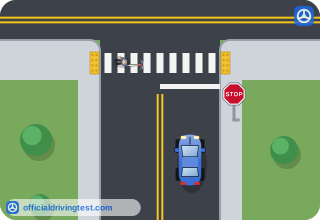
- Your high beams
- Your turn signal
- Your horn
- Your hazard lights
Show answer
Correct answer: Your horn
Do not use your horn, because it could confuse or frighten a visually impaired pedestrian or a guide dog.
Source: Kansas Driving Handbook (Revised February 2022), page 33
-
When you turn at an intersection, where should you watch for pedestrians who are crossing?
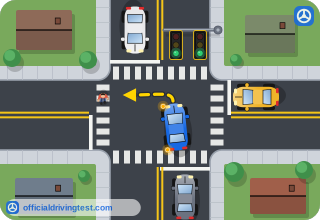
- Only in front of your vehicle
- Only behind your vehicle
- In front of and from the side of your vehicle
- Only in the crosswalk of the street you are leaving
Show answer
Correct answer: In front of and from the side of your vehicle
When turning at intersections you should always watch for pedestrians crossing in front or from the side of your vehicle.
Source: Kansas Driving Handbook (Revised February 2022), page 34
-
What must you do for pedestrians who are entering or already in a crosswalk?
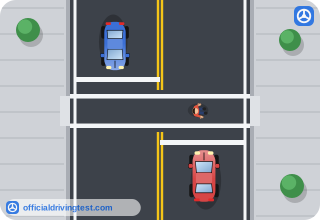
- Speed up and pass before they reach your lane
- Yield only if the crosswalk has painted lines
- Yield to them so they can cross the roadway
- Yield only if they are at least halfway across
Show answer
Correct answer: Yield to them so they can cross the roadway
Drivers must yield to pedestrians entering or in a crosswalk, and not every crosswalk is marked.
Source: Kansas Driving Handbook (Revised February 2022), page 44
-
Near which of these places is it very important to look to the sides because someone is likely to cross or enter the road?
- A long, empty stretch of rural highway
- Shopping centers and schoolyards
- A limited-access roadway with no exits for miles
- An empty field beside a fence
Show answer
Correct answer: Shopping centers and schoolyards
Whenever there is a lot of activity along the side of the road, someone is likely to cross or enter it, so look to the sides near shopping centers, parking lots, construction areas, busy sidewalks, playgrounds and schoolyards.
Source: Kansas Driving Handbook (Revised February 2022), page 57
-
What should you always be alert for near schools, playgrounds and residential streets?
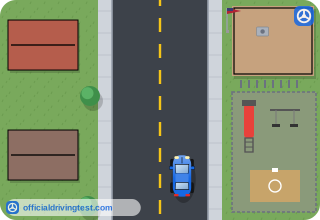
- Children crossing, running or riding into the street without looking
- Large trucks that are parking or loading along the curb there
- Drivers who pass on the right side of vehicles that are stopped
- Bicycles that are riding only in the left lane of the road
Show answer
Correct answer: Children crossing, running or riding into the street without looking
These areas often have children present, so always be alert for children crossing the street, running into the street or riding into the street without looking.
Source: Kansas Driving Handbook (Revised February 2022), page 61
-
When do you become a pedestrian?
- Only once you reach a sidewalk
- As soon as you step out of your vehicle
- Only when you cross a street
- After you have walked a full block
Show answer
Correct answer: As soon as you step out of your vehicle
As soon as you step out of your vehicle, you become a pedestrian with the rights and responsibilities of one.
Source: Kansas Driving Handbook (Revised February 2022), page 79
-
Pedestrians are subject to pedestrian traffic laws. What responsibility do they have compared with motorists?
- Fewer responsibilities, because they are on foot
- Responsibilities only at night
- No responsibilities when a driver is stopped
- The same responsibilities to obey traffic laws
Show answer
Correct answer: The same responsibilities to obey traffic laws
A pedestrian is subject to pedestrian traffic laws and has the same responsibilities to obey traffic laws as motorists.
Source: Kansas Driving Handbook (Revised February 2022), page 79
-
Where must a pedestrian walk when there is a sidewalk?
- On the edge of the street facing traffic
- On the shoulder with traffic
- On the sidewalk
- In the lane nearest the curb
Show answer
Correct answer: On the sidewalk
The manual says a pedestrian must walk where there is a sidewalk.
Source: Kansas Driving Handbook (Revised February 2022), page 79
-
Where should a pedestrian walk when there is no sidewalk?
- On the left side of the street, facing the oncoming traffic
- On the right side of the street, with the traffic
- In the middle of the street
- On the right side of the street, facing the oncoming traffic
Show answer
Correct answer: On the left side of the street, facing the oncoming traffic
Without a sidewalk, a pedestrian should walk on the left side of the street facing the oncoming traffic.
Source: Kansas Driving Handbook (Revised February 2022), page 79
-
What should a pedestrian do at night so that motorists can see them easily?
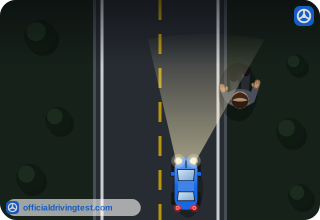
- Wear dark clothing and walk as close to the moving traffic as you can
- Walk in the center of the road where lights are brightest
- Carry no light so you do not blind the oncoming drivers
- Carry a flashlight and wear light colored clothing and reflective material
Show answer
Correct answer: Carry a flashlight and wear light colored clothing and reflective material
At night a pedestrian should carry a flashlight and wear light colored clothing and reflective material so motorists can see them easily.
Source: Kansas Driving Handbook (Revised February 2022), page 79
-
What should a pedestrian who is facing a "WALK" signal or a green light do before crossing the road?
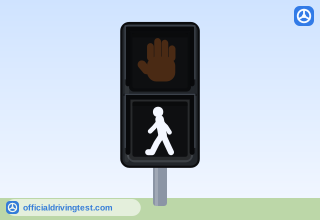
- Run across before the signal changes
- Make sure all drivers see them and stop for them
- Assume the drivers have already seen them
- Wait for the vehicles to honk
Show answer
Correct answer: Make sure all drivers see them and stop for them
Even with the right-of-way, a pedestrian should make sure all drivers see them and stop before crossing the road.
Source: Kansas Driving Handbook (Revised February 2022), page 79
-
A pedestrian is facing a yellow light. What should the pedestrian do?
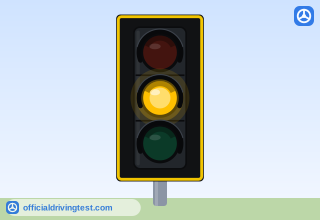
- Cross quickly before it turns red
- Not cross the street
- Cross if no vehicle is close
- Cross only in a marked crosswalk
Show answer
Correct answer: Not cross the street
A pedestrian must not cross the street when facing a "DON'T WALK" signal or a red or yellow light.
Source: Kansas Driving Handbook (Revised February 2022), page 79
-
The flashing "DON'T WALK" signal appears while a pedestrian is already crossing the street. What may the pedestrian do?
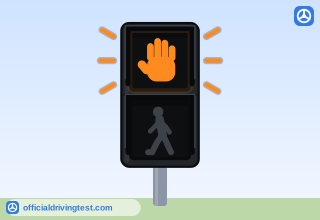
- Turn back to the starting curb
- Stop and wait in the middle of the street
- Cross only if no vehicle is moving
- Finish crossing the street
Show answer
Correct answer: Finish crossing the street
If the flashing "DON'T WALK" signal appears while you are crossing, you may finish crossing the street.
Source: Kansas Driving Handbook (Revised February 2022), page 79
-
What should a pedestrian do when a driver slows down or stops?
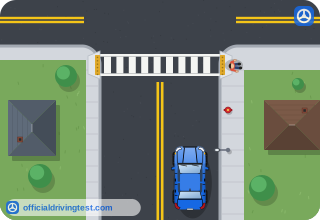
- Establish eye contact to be sure the driver is yielding
- Assume the driver will stop for them without checking
- Wave the driver on and cross behind the vehicle
- Start crossing without looking at the driver again
Show answer
Correct answer: Establish eye contact to be sure the driver is yielding
A pedestrian should establish eye contact with drivers who slow down or stop and should not assume the driver will stop.
Source: Kansas Driving Handbook (Revised February 2022), page 79
-
A pedestrian is crossing the street where they should not be, outside a crosswalk. What must a driver do?
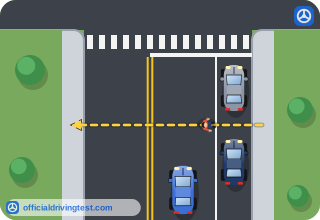
- Sound the horn and keep driving
- Continue, since the pedestrian is jaywalking
- Stop for the pedestrian
- Pass quickly behind the pedestrian
Show answer
Correct answer: Stop for the pedestrian
You must yield to pedestrians always; even when they are not in a crosswalk and are jaywalking, you must stop for them.
Source: Kansas Driving Handbook (Revised February 2022), page 80
-
Where do crosswalks exist?
- At all intersections where a sidewalk meets the street
- Only where there are painted lines on the pavement
- Only at intersections that have traffic signals
- Only in front of schools and playgrounds
Show answer
Correct answer: At all intersections where a sidewalk meets the street
Crosswalks exist at all intersections where a sidewalk meets the street, and not all crosswalks have markings.
Source: Kansas Driving Handbook (Revised February 2022), page 80
-
How must you treat a mid-block crosswalk?
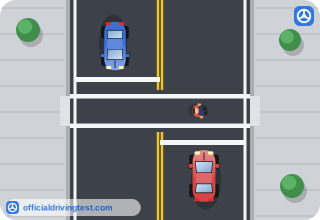
- Slow down but keep moving
- Yield only if signs are posted
- Yield as you would at a corner
- Yield only when a signal is flashing
Show answer
Correct answer: Yield as you would at a corner
Mid-block crosswalks require you to yield as you would at a corner, and they have warning signs and pavement markings.
Source: Kansas Driving Handbook (Revised February 2022), page 80
-
A pedestrian is crossing a street guided by a dog or carrying a white cane. What must you do?
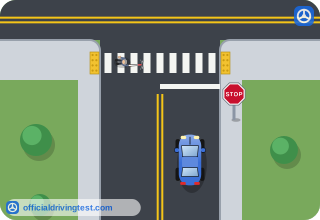
- Slow down and pass behind
- Come to a complete stop
- Sound your horn to alert them
- Stop only if they step in front of you
Show answer
Correct answer: Come to a complete stop
You must always yield the right-of-way to persons who are visually impaired and come to a complete stop for a pedestrian with a guide dog or white cane.
Source: Kansas Driving Handbook (Revised February 2022), page 80
-
You are approaching a vehicle that is stopped in your lane on a multi-lane road. What should you do before passing?
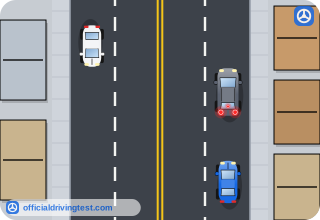
- Pass at once, since the other lane is open
- Sound your horn and pass
- Pass only if the stopped vehicle has its hazard lights off
- Slow down and be sure no pedestrians are crossing in front of it
Show answer
Correct answer: Slow down and be sure no pedestrians are crossing in front of it
Slow down and do not pass until you are sure there are no pedestrians crossing in front of the stopped vehicle, even on multi-lane roads.
Source: Kansas Driving Handbook (Revised February 2022), page 80
-
Where should you especially check for pedestrians in your path before backing?
- On freeways and other high-speed roads
- In shopping centers or places with many pedestrians
- On rural roads that have no sidewalks
- Only at intersections that have traffic signals
Show answer
Correct answer: In shopping centers or places with many pedestrians
Always check for pedestrians in your path before backing, especially in shopping centers or places where there are many pedestrians.
Source: Kansas Driving Handbook (Revised February 2022), page 80
-
In school, playground, and residential areas where children could run out from between parked vehicles, what is a good idea?
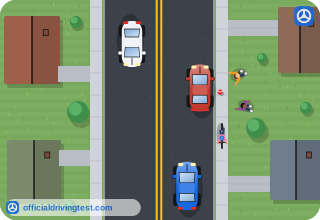
- Drive at the speed limit and keep to the center of the road
- Drive slower than the speed limit and be prepared to stop quickly
- Sound your horn continuously while you drive through
- Stay close to the parked vehicles to keep out of the way
Show answer
Correct answer: Drive slower than the speed limit and be prepared to stop quickly
It is a good idea to drive slower than the speed limit in these areas and be prepared to stop quickly.
Source: Kansas Driving Handbook (Revised February 2022), page 80
-
At a school crossing with traffic patrol, what must you do if you are signaled to do so?
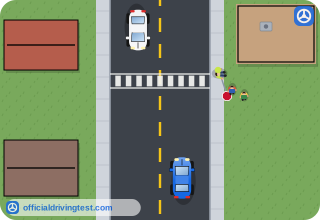
- Stop and yield
- Slow down and proceed
- Stop only if children are in the road
- Continue if the crossing is clear
Show answer
Correct answer: Stop and yield
At a school crossing where there is traffic patrol, you stop and yield if you are signaled to do so.
Source: Kansas Driving Handbook (Revised February 2022), page 80