Kansas: Pavement markings — Part 2 Practice Test
Questions in this part include: “While using a shared left turn lane, what should you watch for?” · “What are sharrows?”
Independent educational site · not affiliated with any government agency or DMV
Ready? Test yourself
- Instant feedback with an explanation
- Every answer cites its source in the manual
- Your best score is saved on this device
Questions are original and based on the official manual "Kansas Driving Handbook" (Revised February 2022), Kansas Department of Revenue, Division of Vehicles.
All 16 questions in this practice test
Take the test above first, then use this list to study. Tap “Show answer” to see the correct answer and explanation.
Show the questions and answersHide the questions
-
What do the broken yellow centerlines along a shared center left turn lane show?
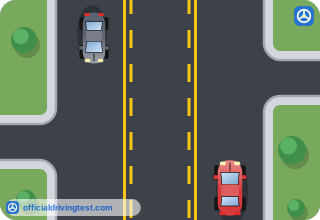
- Vehicles in either direction may use the lane only to make left turns
- Vehicles in either direction may use the lane to pass slow traffic
- Only vehicles traveling in one direction may use the lane
- The lane may be used to wait for a gap to merge
Show answer
Correct answer: Vehicles in either direction may use the lane only to make left turns
Broken yellow centerlines show that vehicles traveling in either direction may use the center lane only to make left turns.
Source: Kansas Driving Handbook (Revised February 2022), page 44
-
Why should you not move into a shared left turn lane too soon?
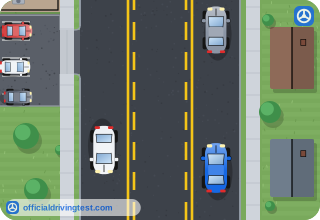
- Entering early gives other drivers a chance to pass you on the left
- Drivers behind you may mistake the lane for a passing lane and follow
- You are more likely to meet oncoming traffic the longer you stay in it
- Signals above the lane may change before you can complete the turn
Show answer
Correct answer: You are more likely to meet oncoming traffic the longer you stay in it
The longer you stay in the lane, the more likely you will meet someone coming in the opposite direction.
Source: Kansas Driving Handbook (Revised February 2022), page 44
-
While using a shared left turn lane, what should you watch for?
- Oncoming vehicles using the lane to pass
- Vehicles pulling out of entrances and side streets
- Bicyclists riding along the center line
- Drivers stopped on the shoulder waiting to merge
Show answer
Correct answer: Vehicles pulling out of entrances and side streets
Drivers in a shared left turn lane should watch for vehicles pulling out of entrances and side streets.
Source: Kansas Driving Handbook (Revised February 2022), page 44
-
Before steering into a shared center left turn lane, which step must you take?
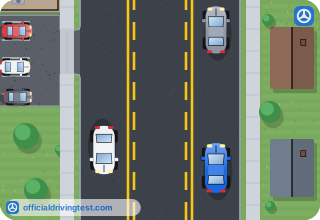
- Signal right and check your right blind spot in the mirror
- Stop in the travel lane and wait for oncoming traffic to clear
- Check only your mirrors and enter without signaling
- Signal left and check your left blind spot by looking over your shoulder
Show answer
Correct answer: Signal left and check your left blind spot by looking over your shoulder
You must check for vehicles ahead, check mirrors, signal left and check your left blind spot by looking over your shoulder.
Source: Kansas Driving Handbook (Revised February 2022), page 44
-
Once you have steered smoothly into a shared center left turn lane, how do you make the left turn?
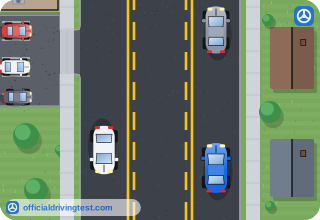
- Choose an appropriate gap in oncoming traffic
- Stop and wait for oncoming drivers to wave you through
- Move across quickly ahead of the nearest oncoming vehicle
- Wait in the lane until oncoming traffic has stopped
Show answer
Correct answer: Choose an appropriate gap in oncoming traffic
After entering the lane you choose an appropriate gap in oncoming traffic to make the left turn.
Source: Kansas Driving Handbook (Revised February 2022), page 44
-
What often marks a lane that is reserved for special vehicles?
- A solid red line along both edges of the lane
- A yellow triangle on a sign beside the lane
- A white diamond at the roadside or on the pavement
- Blinking blue lights above the lane
Show answer
Correct answer: A white diamond at the roadside or on the pavement
Reserved lanes often have a white diamond posted at the side of the road or painted on the road surface.
Source: Kansas Driving Handbook (Revised February 2022), page 45
-
What does a lane marked "Transit" or "bus" mean?
- The lane is for buses and carpools
- The lane is for bus use only
- The lane is for bus stops and loading zones only
- The lane is for any vehicle carrying passengers
Show answer
Correct answer: The lane is for bus use only
A "Transit" or "bus" lane is for bus use only.
Source: Kansas Driving Handbook (Revised February 2022), page 45
-
What does a lane marked "Bicycle" mean?
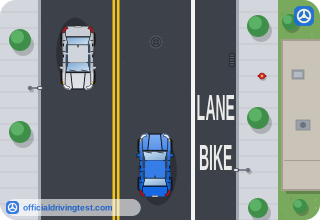
- The lane is shared by bicyclists and buses
- The lane is a parking area for bicycles
- The lane is for bicyclists and pedestrians
- The lane is reserved for bicyclists
Show answer
Correct answer: The lane is reserved for bicyclists
A "Bicycle" lane is reserved for bicyclists.
Source: Kansas Driving Handbook (Revised February 2022), page 45
-
What does HOV mean on a lane sign or marking?
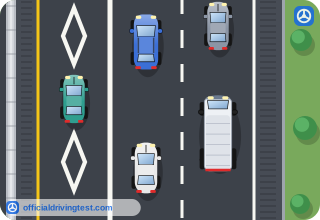
- High Occupancy Vehicles, lanes for vehicles with two or more people
- Highway Overtaking Vehicles, lanes for passing slower traffic
- High Overload Vehicles, lanes for trucks with heavy loads
- Hybrid-Only Vehicles, lanes for low-emission cars
Show answer
Correct answer: High Occupancy Vehicles, lanes for vehicles with two or more people
HOV means High Occupancy Vehicles and marks lanes reserved for vehicles with two or more people in them.
Source: Kansas Driving Handbook (Revised February 2022), page 45
-
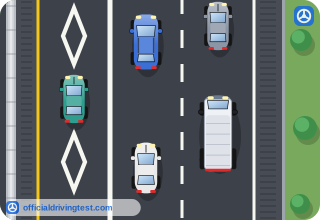
What does "HOV 3" mean?
- Only vehicles with three or fewer passengers may use that lane
- Three lanes of the road are reserved for HOV traffic
- There must be at least three people in the vehicle to use that lane
- The lane is open to all vehicles three days a week
Show answer
Correct answer: There must be at least three people in the vehicle to use that lane
"HOV 3" means there must be at least three people in the vehicle to use that lane.
Source: Kansas Driving Handbook (Revised February 2022), page 45
-
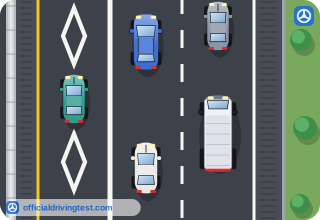
Besides how many people must be in the vehicle, what else may HOV signs indicate?
- The lowest speed allowed in the lane
- The days and hours that apply
- The distance to the next exit
- The type of vehicle that may follow
Show answer
Correct answer: The days and hours that apply
HOV signs may indicate the number of people required as well as the days and hours which apply to the lane use.
Source: Kansas Driving Handbook (Revised February 2022), page 45
-
What are sharrows?
- Lanes reserved only for the use of bicycles
- Signs that mark a recommended bicycle route
- Pavement marks recommending where in a lane a bicyclist should ride
- Barriers that physically separate bicycles from other traffic
Show answer
Correct answer: Pavement marks recommending where in a lane a bicyclist should ride
Sharrows are road markers on the pavement that recommend where in a lane a bicyclist should ride to flow easiest with other traffic.
Source: Kansas Driving Handbook (Revised February 2022), page 82
-
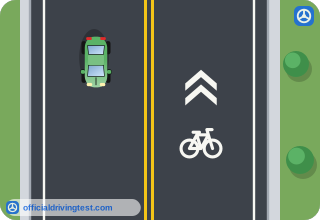
On which roads will you find sharrows?
- Roads with higher volumes of traffic
- Roads with the lowest traffic volumes
- Only roads inside parks
- Only freeway ramps
Show answer
Correct answer: Roads with higher volumes of traffic
Sharrows are designated by a bicycle with two chevrons pointing above it, and you will find them on roads with higher volumes of traffic.
Source: Kansas Driving Handbook (Revised February 2022), page 82
-
What is a bike lane?
- A road closed to motor vehicles
- A recommended route on quiet neighborhood side roads
- A lane on a sidewalk for pedestrians
- A designated part of the roadway for bicycle traffic to use
Show answer
Correct answer: A designated part of the roadway for bicycle traffic to use
Bike lanes are pavement markings that provide a designated part of the roadway for bicycle traffic to use.
Source: Kansas Driving Handbook (Revised February 2022), page 82
-
How can bike lanes be designated?
- Using solid yellow lines
- Using solid white lines
- Using broken white lines only
- Using raised red barriers
Show answer
Correct answer: Using solid white lines
Bike lanes can be designated using solid white lines.
Source: Kansas Driving Handbook (Revised February 2022), page 82
-
On which side of the roadway are bike lanes commonly found?
- Toward the left side
- Toward the right side
- In the center of the roadway
- Alternating sides every block
Show answer
Correct answer: Toward the right side
Bike lanes are commonly found towards the right side of the roadway.
Source: Kansas Driving Handbook (Revised February 2022), page 82