Kansas: Pavement markings — Part 1 Practice Test
Questions in this part include: “Which of these is something pavement markings are used for?” · “What color are the markings that separate multiple lanes of travel in the same direction?”
Independent educational site · not affiliated with any government agency or DMV
Ready? Test yourself
- Instant feedback with an explanation
- Every answer cites its source in the manual
- Your best score is saved on this device
Questions are original and based on the official manual "Kansas Driving Handbook" (Revised February 2022), Kansas Department of Revenue, Division of Vehicles.
All 16 questions in this practice test
Take the test above first, then use this list to study. Tap “Show answer” to see the correct answer and explanation.
Show the questions and answersHide the questions
-
Which of these is something pavement markings are used for?
- To show which lanes to use for turns
- To show the distance to the next town
- To show where gas stations are located
- To show the weather ahead
Show answer
Correct answer: To show which lanes to use for turns
Pavement markings are used to divide lanes, tell you when you may pass or change lanes, show which lanes to use for turns, define pedestrian walkways and show where you must stop.
Source: Kansas Driving Handbook (Revised February 2022), page 43
-
What color are the lines that separate traffic moving in opposite directions?
- White
- Red
- Yellow
- Blue
Show answer
Correct answer: Yellow
Lines separating traffic moving in opposite directions are yellow.
Source: Kansas Driving Handbook (Revised February 2022), page 43
-
What do dashed yellow lines between opposing lanes of traffic mean?
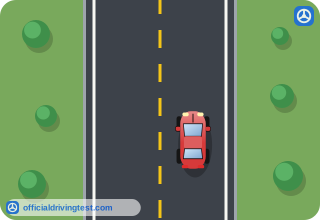
- You may never pass in that area at all
- You may pass if there is a safe gap
- You must stay within your own lane
- Only motorcycles may pass in that area
Show answer
Correct answer: You may pass if there is a safe gap
Dashed yellow lines between opposing lanes mean you may pass if a safe gap in traffic is available.
Source: Kansas Driving Handbook (Revised February 2022), page 43
-
Between opposing lanes there is a solid yellow line and a dashed yellow line, and the solid line is on your side. What should you do?
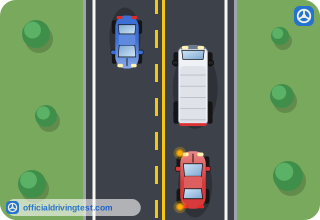
- Pass if the road ahead is clear
- Pass only if you are driving a large vehicle
- Pass only when the other lane is empty
- Not pass
Show answer
Correct answer: Not pass
Where the solid yellow line is on your side, you should not pass.
Source: Kansas Driving Handbook (Revised February 2022), page 43
-
When you are permitted to pass, under what condition may you do so?
- Only if the lane you enter is clear of traffic flow
- Only if the vehicle ahead is a truck
- Only if you are within the speed limit by 5 mph
- Only if no vehicle is behind you
Show answer
Correct answer: Only if the lane you enter is clear of traffic flow
When permitted to pass, you may do so only if the lane entered is clear of traffic flow.
Source: Kansas Driving Handbook (Revised February 2022), page 43
-
What do two solid yellow lines between lanes of traffic mean?
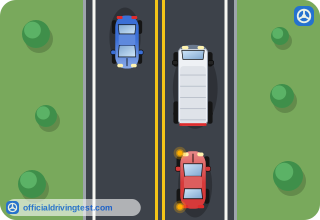
- Passing is allowed on either side
- Only the side with the wider line may pass
- Neither side may pass
- Passing is allowed when traffic is light
Show answer
Correct answer: Neither side may pass
Two solid yellow lines between lanes of traffic mean that neither side may pass.
Source: Kansas Driving Handbook (Revised February 2022), page 43
-
Under what condition may you cross a solid yellow line?
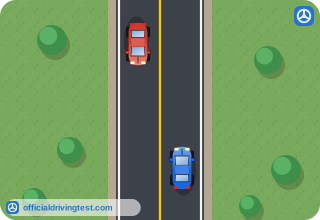
- To pass a slow vehicle when the road is clear
- To turn when gaps in traffic flow exist
- To avoid a bicycle near the edge of the road
- To change lanes when no one is behind you
Show answer
Correct answer: To turn when gaps in traffic flow exist
The manual says you may cross a solid yellow line to turn when gaps in traffic flow exist.
Source: Kansas Driving Handbook (Revised February 2022), page 43
-
What color are the markings that separate multiple lanes of travel in the same direction?
- Yellow
- Red
- Green
- White
Show answer
Correct answer: White
Multiple lanes of travel in the same direction are separated by white lane markings.
Source: Kansas Driving Handbook (Revised February 2022), page 43
-
A dashed white line is between lanes of traffic. What does it mean?
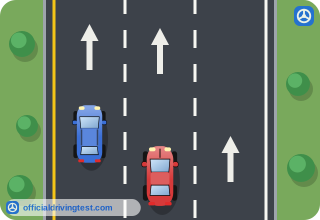
- You may change lanes if there is a safe gap
- You must stay within your lane at all times
- Passing is prohibited on this stretch of road
- The lane ahead is closed to all traffic
Show answer
Correct answer: You may change lanes if there is a safe gap
A dashed white line between lanes means you may cross it to change lanes if a safe gap in traffic is available.
Source: Kansas Driving Handbook (Revised February 2022), page 43
-
What does a solid white line between lanes of traffic mean?
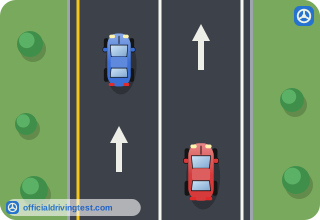
- You may change lanes whenever the lane next to you is empty
- You may pass vehicles ahead by using the left lane
- Stay in the lane unless a special situation requires a change
- You may cross it only when you are turning to the left
Show answer
Correct answer: Stay in the lane unless a special situation requires a change
A solid white line between lanes means you must stay within the lane unless a special situation requires a lane change.
Source: Kansas Driving Handbook (Revised February 2022), page 43
-
Solid white lines are used to do which of the following?
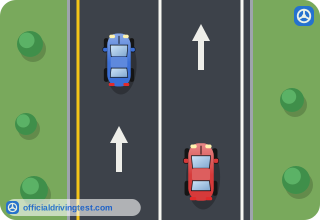
- Separate traffic that is moving in opposite directions
- Mark turn lanes and stop lane changes near intersections
- Mark the stretches where passing is permitted by law
- Mark the left edge of the roadway on two-way roads
Show answer
Correct answer: Mark turn lanes and stop lane changes near intersections
Solid white lines designate turn lanes and prevent lane changes near intersections.
Source: Kansas Driving Handbook (Revised February 2022), page 43
-
What can white arrows on the roadway indicate?
- Where passing is allowed on a two-way road
- Where pedestrians are allowed to cross the road
- Where vehicles are allowed to park at the curb
- Which way traffic flows and which turns are allowed
Show answer
Correct answer: Which way traffic flows and which turns are allowed
White arrows on the roadway show which way traffic is flowing and can also show which turns may be made from which lanes.
Source: Kansas Driving Handbook (Revised February 2022), page 43
-
When a sign or signal requires you to stop, where must you stop?
- Behind the stop line, crosswalk, stop sign or signal
- Just past the crosswalk so you can see cross traffic
- In the middle of the crosswalk, ready to go
- At the curb, wherever you can see best
Show answer
Correct answer: Behind the stop line, crosswalk, stop sign or signal
The manual says that when a sign or signal requires a stop, you must stop behind the stop line, the crosswalk, or the stop sign or signal.
Source: Kansas Driving Handbook (Revised February 2022), page 44
-
If crosswalks are not apparent at an intersection, where must you stop?
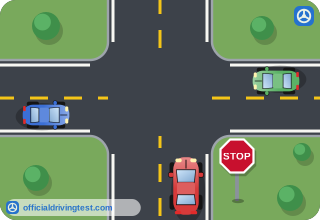
- After entering, so you can look both ways
- Before entering the intersection
- Only if a traffic signal is present
- Just past the corner, beside the curb
Show answer
Correct answer: Before entering the intersection
When crosswalks are not apparent, you must stop prior to entering the intersection.
Source: Kansas Driving Handbook (Revised February 2022), page 44
-
Where must you stop when a stop line is painted before a crosswalk?
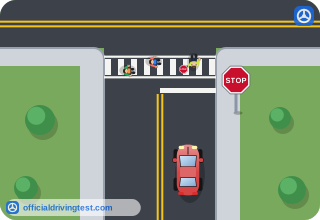
- At the crosswalk, ignoring the stop line
- At the far edge of the crosswalk
- Past the crosswalk, where you can see cross traffic
- At the stop line, which must be obeyed first
Show answer
Correct answer: At the stop line, which must be obeyed first
If there is a stop line before the crosswalk, the stop line must be obeyed first.
Source: Kansas Driving Handbook (Revised February 2022), page 44
-
What does the solid yellow centerline beside a shared center left turn lane mean?
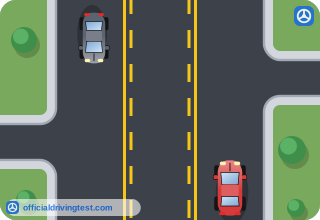
- The center lane may be used for passing when it is clear
- Only vehicles turning right may use the center lane
- The center lane is open to traffic in one direction only
- You cannot use the center lane for passing
Show answer
Correct answer: You cannot use the center lane for passing
The solid yellow centerline means the center lane may not be used for passing.
Source: Kansas Driving Handbook (Revised February 2022), page 44