Kansas: Exam Simulator
25 random questions from every topic, like a mini exam.
Independent educational site · not affiliated with any government agency or DMV
Ready? Test yourself
Like the real test: 25 questions; pass with 20 correct.
- Instant feedback with an explanation
- Every answer cites its source in the manual
- Your best score is saved on this device
Questions are original and based on the official manual "Kansas Driving Handbook" (Revised February 2022), Kansas Department of Revenue, Division of Vehicles.
Sample questions
The exam simulator picks 25 random questions from every topic each time you start. Here are a few examples.
Show the questions and answersHide the questions
-
What must the documents be that you bring to a Kansas driver’s license office to apply for a license, permit, or identification card?
- Original documents
- Photocopied documents
- Faxed copies of documents
- Electronic copies of documents
Show answer
Correct answer: Original documents
The Kansas checklist tells applicants to make sure their documents are originals. Faxed, photo-copied, laminated, or electronic copies are not accepted.
Source: Kansas Driving Handbook (Revised February 2022), page 6
-
How far before making a turn or move must all signals be given in Kansas?
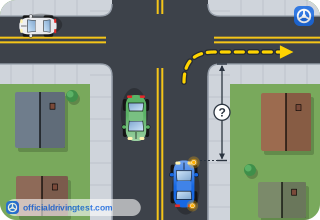
- At least 25 feet
- At least 50 feet
- At least 75 feet
- At least 100 feet
Show answer
Correct answer: At least 100 feet
Kansas requires that all signals be given at least 100 feet before making the actual move or turn.
Source: Kansas Driving Handbook (Revised February 2022), page 17
-
Which of these is something pavement markings are used for?
- To show which lanes to use for turns
- To show the distance to the next town
- To show where gas stations are located
- To show the weather ahead
Show answer
Correct answer: To show which lanes to use for turns
Pavement markings are used to divide lanes, tell you when you may pass or change lanes, show which lanes to use for turns, define pedestrian walkways and show where you must stop.
Source: Kansas Driving Handbook (Revised February 2022), page 43
-
Where is a SLOWER TRAFFIC KEEP RIGHT sign posted, and what does it tell slow drivers?
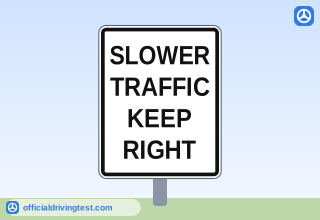
- On a two-lane road, to pull onto the shoulder
- On an exit ramp, to slow to the ramp speed
- On a multilane highway, to stay in the right lane
- On a one-way street, to stay in the left lane
Show answer
Correct answer: On a multilane highway, to stay in the right lane
This sign is posted on a multilane highway for those driving slower than the normal speed of traffic and tells them to stay in the right lane.
Source: Kansas Driving Handbook (Revised February 2022), page 41
-
How close to a fire hydrant is parking NOT allowed?
- Within 5 feet
- Within 15 feet
- Within 10 feet
- Within 25 feet
Show answer
Correct answer: Within 15 feet
Parking is not allowed within 15 feet of a fire hydrant.
Source: Kansas Driving Handbook (Revised February 2022), page 19
-
Which warning sign is described as the only pennant-shaped warning sign?
- The Yield Sign Ahead sign
- The Stop Sign Ahead sign
- The Traffic Signal Ahead sign
- The No Passing Zone sign
Show answer
Correct answer: The No Passing Zone sign
The No Passing Zone sign is the only pennant-shaped warning sign.
Source: Kansas Driving Handbook (Revised February 2022), page 17
-
What is the purpose of a warning sign?
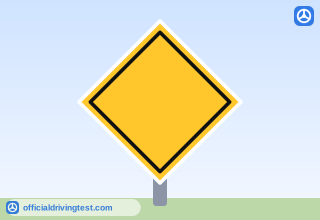
- To show where roadway services such as fuel are located
- To mark a lane that is reserved for special use
- To tell drivers the speed limit that is in effect
- To tell a driver of possible danger that might be ahead
Show answer
Correct answer: To tell a driver of possible danger that might be ahead
Warning signs tell a driver of possible danger that might be ahead, such as a hazard or special situation on the roadway.
Source: Kansas Driving Handbook (Revised February 2022), page 35
-
Besides signals, signs and pavement markings, who can provide traffic control that you must obey?
- Law enforcement, highway personnel and school crossing guards
- Only uniformed law enforcement officers
- Law enforcement officers and tow truck drivers
- Only police and crossing guards, not highway personnel
Show answer
Correct answer: Law enforcement, highway personnel and school crossing guards
Traffic control can also be provided by law enforcement, highway personnel or school crossing guards, and you must obey their directions.
Source: Kansas Driving Handbook (Revised February 2022), page 34
-
How should you make a right turn from a four-lane divided highway?
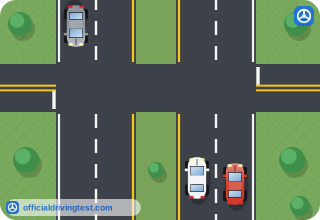
- Enter the right lane well in advance, then turn tightly into the right lane
- Start from the center lane and swing wide into the cross street
- Turn from the left lane after slowing to a crawl
- Stay in the left lane until you reach the cross street, then turn right
Show answer
Correct answer: Enter the right lane well in advance, then turn tightly into the right lane
For a right turn from a four-lane divided highway, enter the right lane well in advance and turn tightly into the right lane of the cross street.
Source: Kansas Driving Handbook (Revised February 2022), page 17
-
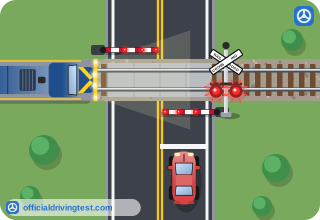
What must you do at a railroad crossing when a flag person or a traffic control device directs you to stop?
- Slow down and look both ways
- Come to a complete stop
- Stop only if you see a train
- Change lanes and proceed
Show answer
Correct answer: Come to a complete stop
A complete stop is required when directed by a flag person or any traffic control device at a railroad crossing.
Source: Kansas Driving Handbook (Revised February 2022), page 18