Iowa: Speed and following distance — Part 2 Practice Test
Questions in this part include: “Besides the vehicle itself, what does the manual call crucial in stopping?” · “What is the reaction distance for a vehicle traveling 60 mph, according to the manual’s stopping-distance chart?”
Independent educational site · not affiliated with any government agency or DMV
Ready? Test yourself
- Instant feedback with an explanation
- Every answer cites its source in the manual
- Your best score is saved on this device
Questions are original and based on the official manual "Iowa Driver’s License Manual" (July 2026), Iowa Department of Transportation.
All 16 questions in this practice test
Take the test above first, then use this list to study. Tap “Show answer” to see the correct answer and explanation.
Show the questions and answersHide the questions
-
Besides the vehicle itself, what does the manual call crucial in stopping?
- The time it takes to turn on the hazard lights
- The time it takes to roll down the window
- The reaction time in getting your foot on the brake pedal
- The number of seconds the engine has been running
Show answer
Correct answer: The reaction time in getting your foot on the brake pedal
The reaction time in getting your foot on the brake pedal is also crucial to how quickly you stop.
Source: Iowa Driver’s License Manual (July 2026), page 40
-
Applying the brakes too hard may cause your vehicle to skid on which kinds of surface?
- Only on snow and ice, never on dry pavement
- Loose gravel, snow and ice, or even dry pavement
- Only on loose gravel, never on paved roads
- Only on wet pavement, never on dry pavement
Show answer
Correct answer: Loose gravel, snow and ice, or even dry pavement
Loose gravel roads, snow and ice, or even dry pavement may cause your vehicle to skid if the brakes are applied too hard.
Source: Iowa Driver’s License Manual (July 2026), page 40
-
How does speed affect the distance it takes to stop?
- Speed has no effect when the road is dry
- At higher speeds, it takes less time to stop
- Speed affects only the reaction distance
- At higher speeds, it takes longer to stop
Show answer
Correct answer: At higher speeds, it takes longer to stop
At higher speeds it takes longer to stop; the stopping distance is the reaction distance plus the braking distance.
Source: Iowa Driver’s License Manual (July 2026), page 40
-
What is the total stopping distance for a vehicle traveling 20 mph, according to the manual’s stopping-distance chart?
- 44 feet
- 84 feet
- 69 feet
- 99 feet
Show answer
Correct answer: 69 feet
At 20 mph the reaction distance is 44 ft and the braking distance is 25 ft, for a stopping distance of 69 ft.
Source: Iowa Driver’s License Manual (July 2026), page 40
-
What is the total stopping distance for a vehicle traveling 30 mph, according to the manual’s stopping-distance chart?
- 123 feet
- 93 feet
- 153 feet
- 189 feet
Show answer
Correct answer: 123 feet
At 30 mph the reaction distance is 66 ft and the braking distance is 57 ft, for a stopping distance of 123 ft.
Source: Iowa Driver’s License Manual (July 2026), page 40
-
What is the braking distance for a vehicle traveling 40 mph, according to the manual’s stopping-distance chart?
- 88 feet
- 158 feet
- 189 feet
- 101 feet
Show answer
Correct answer: 101 feet
At 40 mph the reaction distance is 88 ft and the braking distance is 101 ft, for a stopping distance of 189 ft.
Source: Iowa Driver’s License Manual (July 2026), page 40
-
What is the total stopping distance for a vehicle traveling 50 mph, according to the manual’s stopping-distance chart?
- 210 feet
- 268 feet
- 310 feet
- 359 feet
Show answer
Correct answer: 268 feet
At 50 mph the reaction distance is 110 ft and the braking distance is 158 ft, for a stopping distance of 268 ft.
Source: Iowa Driver’s License Manual (July 2026), page 40
-
What is the reaction distance for a vehicle traveling 60 mph, according to the manual’s stopping-distance chart?
- 110 feet
- 132 feet
- 154 feet
- 227 feet
Show answer
Correct answer: 132 feet
At 60 mph the reaction distance is 132 ft and the braking distance is 227 ft, for a stopping distance of 359 ft.
Source: Iowa Driver’s License Manual (July 2026), page 40
-
What is the total stopping distance for a vehicle traveling 70 mph, according to the manual’s stopping-distance chart?
- 359 feet
- 410 feet
- 520 feet
- 464 feet
Show answer
Correct answer: 464 feet
At 70 mph the reaction distance is 154 ft and the braking distance is 310 ft, for a stopping distance of 464 ft.
Source: Iowa Driver’s License Manual (July 2026), page 40
-
According to the manual, where is the greatest chance of a collision?
- In front of you
- Behind you
- Beside you in the next lane
- In your blind spot
Show answer
Correct answer: In front of you
Because the greatest chance of a collision is in front of you, the 3- to 4-second rule helps you keep a safe following distance.
Source: Iowa Driver’s License Manual (July 2026), page 41
-
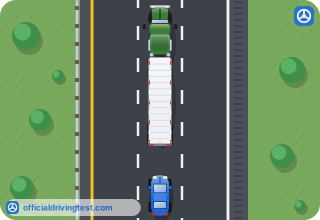
What following distance is recommended when the vehicle in front of you blocks your view?
- Six or more seconds
- Two seconds
- Three seconds
- Four seconds
Show answer
Correct answer: Six or more seconds
When the vehicle in front of you blocks your view, a following distance of six or more seconds is recommended.
Source: Iowa Driver’s License Manual (July 2026), page 41
-
The posted speed limit is the maximum speed you can legally drive under what conditions?
- Any weather conditions
- Ideal driving conditions
- Daytime conditions only
- Heavy traffic conditions
Show answer
Correct answer: Ideal driving conditions
The posted speed limit is the maximum speed you can legally drive under ideal driving conditions, so your speed also depends on road conditions and weather.
Source: Iowa Driver’s License Manual (July 2026), page 42
-
According to the manual, a vehicle traveling 60 mph will travel how much further than a vehicle traveling 30 mph before coming to a stop?
- 1.5 times further
- 2 times further
- 6 times further
- 3 times further
Show answer
Correct answer: 3 times further
The manual’s example says a vehicle going 60 mph will travel 3 times further than one going 30 mph before stopping.
Source: Iowa Driver’s License Manual (July 2026), page 42
-
When the speed limit is not posted, what general limit applies in any business district?
- 15 mph
- 30 mph
- 20 mph
- 35 mph
Show answer
Correct answer: 20 mph
Where no limit is posted, the general limit is 20 mph in any business district.
Source: Iowa Driver’s License Manual (July 2026), page 42
-
When the speed limit is not posted, what general limit applies in a residential district or school district?
- 25 mph
- 15 mph
- 30 mph
- 35 mph
Show answer
Correct answer: 25 mph
Where no limit is posted, the general limit is 25 mph in a residential district or school district.
Source: Iowa Driver’s License Manual (July 2026), page 42
-
When the speed limit is not posted, what general limit applies in any suburban district?
- 30 mph
- 35 mph
- 55 mph
- 45 mph
Show answer
Correct answer: 45 mph
Where no limit is posted, the general limit is 45 mph in any suburban district.
Source: Iowa Driver’s License Manual (July 2026), page 42