Iowa: Speed and following distance — Part 1 Practice Test
Questions in this part include: “What should you do about speed even if your vehicle has a curve speed warning?” · “Which of these is one way a high speed alert may warn you?”
Independent educational site · not affiliated with any government agency or DMV
Ready? Test yourself
- Instant feedback with an explanation
- Every answer cites its source in the manual
- Your best score is saved on this device
Questions are original and based on the official manual "Iowa Driver’s License Manual" (July 2026), Iowa Department of Transportation.
All 17 questions in this practice test
Take the test above first, then use this list to study. Tap “Show answer” to see the correct answer and explanation.
Show the questions and answersHide the questions
-
When the roadway is slippery from rain or snow, or it is hard to see far down the road because of fog, what may you need to do?
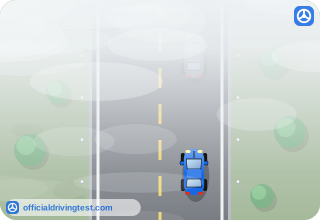
- Reduce your speed below the posted limit
- Keep to the posted maximum speed
- Drive at the posted minimum speed
- Follow the vehicle ahead more closely
Show answer
Correct answer: Reduce your speed below the posted limit
Sometimes you must reduce your speed when conditions require it, such as slippery roads or fog.
Source: Iowa Driver’s License Manual (July 2026), page 8
-
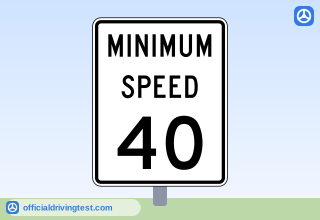
Which roads have minimum speed limits?
- All residential streets
- Some high-speed roads
- Only school zones
- Every road that has a speed limit sign
Show answer
Correct answer: Some high-speed roads
Some high-speed roads have minimum speed limits.
Source: Iowa Driver’s License Manual (July 2026), page 8
-
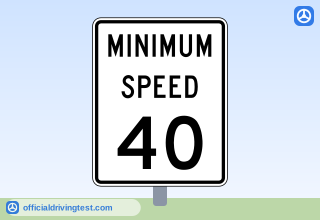
If the minimum speed limit on a high-speed road is too fast for you, what should you do?
- Use another route
- Drive in the left lane
- Drive slowly with your hazard lights on
- Follow a faster vehicle
Show answer
Correct answer: Use another route
If the minimum speed is too fast for you, you should use another route.
Source: Iowa Driver’s License Manual (July 2026), page 8
-
What should you do about speed even if your vehicle has a curve speed warning?
- Maintain a safe speed when approaching curves or exits
- Rely on the warning to tell you when to slow down
- Drive at the speed shown on the dashboard display
- Slow down only after the warning has sounded twice
Show answer
Correct answer: Maintain a safe speed when approaching curves or exits
You should not become dependent on curve speed warnings and should maintain a safe speed while driving and approaching curves or exits.
Source: Iowa Driver’s License Manual (July 2026), page 29
-
Even if your vehicle has a forward collision warning system, what should you always do?
- Rely on the warning to tell you when to slow down for traffic ahead
- Follow closely, because the system will notify you if you get too near
- Check traffic only after a warning has sounded
- Be cautious, check traffic regularly, and keep a safe following distance
Show answer
Correct answer: Be cautious, check traffic regularly, and keep a safe following distance
You should always be cautious, check traffic regularly, and keep a safe following distance; the system only notifies you if you unintentionally get too close.
Source: Iowa Driver’s License Manual (July 2026), page 30
-
What does a high speed alert do?
- It sounds an alert if you are speeding, to help you keep a safe speed
- It alerts you when you drift out of your lane using visual or sound warnings
- It warns you to slow down when you approach a curve or an exit too quickly
- It applies the brakes whenever you go over the posted speed limit
Show answer
Correct answer: It sounds an alert if you are speeding, to help you keep a safe speed
A high speed alert helps maintain a safe speed by sounding an alert if you are speeding.
Source: Iowa Driver’s License Manual (July 2026), page 30
-
For a high speed alert to know the posted speed, what must be up to date?
- The speedometer calibration settings
- The odometer and trip meter readings
- The GPS or the car's infotainment center
- The tire pressure monitor readings
Show answer
Correct answer: The GPS or the car's infotainment center
The GPS or the car's infotainment center must be up to date so that the posted speed is known and the high speed alert works.
Source: Iowa Driver’s License Manual (July 2026), page 30
-
A high speed alert sounds. How should you slow to the posted speed limit?
- Quickly, by braking hard until the alert stops
- By shifting into neutral and coasting down
- By waiting for the system to slow the car for you
- Carefully, by releasing the accelerator or lightly braking
Show answer
Correct answer: Carefully, by releasing the accelerator or lightly braking
When a high speed alert sounds, you should carefully slow the car by releasing the accelerator or lightly braking; do not slam the brakes.
Source: Iowa Driver’s License Manual (July 2026), page 30
-
Even with a high speed alert on your vehicle, what should you still do?
- Trust the alert to keep you at the posted speed limit
- Always monitor your speed and obey the speed limit
- Check your speed only when the alert sounds
- Drive at the speed that makes the alert stay silent
Show answer
Correct answer: Always monitor your speed and obey the speed limit
You should not rely on the high-speed alert; always monitor your speed, maintain a safe speed, and obey the speed limit on the roadway.
Source: Iowa Driver’s License Manual (July 2026), page 30
-
Which of these is one way a high speed alert may warn you?
- A steady horn blast
- Hazard lights turning on
- A flashing speed limit sign
- Gradual loss of engine power
Show answer
Correct answer: A flashing speed limit sign
A high speed alert may activate as beeps or visual warnings such as color changes on the display or a flashing speed limit sign.
Source: Iowa Driver’s License Manual (July 2026), page 30
-
What does adaptive cruise control do?
- It adjusts speed to keep a following distance set by the driver
- It holds one fixed speed no matter what traffic is ahead of you
- It steers the vehicle to keep it centered in its lane on the road
- It alerts you only when you go over the posted speed limit
Show answer
Correct answer: It adjusts speed to keep a following distance set by the driver
Adaptive cruise control can increase or decrease the vehicle's speed to maintain a following distance set by the driver.
Source: Iowa Driver’s License Manual (July 2026), page 33
-
What can advanced versions of adaptive cruise control do in traffic jams?
- Park the vehicle at the side of the road for you
- Steer around the stopped vehicles ahead of you
- Slow and stop the vehicle, then accelerate automatically
- Change lanes on its own to find faster traffic
Show answer
Correct answer: Slow and stop the vehicle, then accelerate automatically
Advanced versions of adaptive cruise control can even slow and stop the vehicle in traffic jams and then accelerate automatically.
Source: Iowa Driver’s License Manual (July 2026), page 33
-
To use adaptive cruise control, what do you do first?
- Turn on the system and let it choose a speed for you
- Accelerate to your set speed and then turn on the system
- Brake to a stop and then turn on the system
- Turn on the system while parked and then pull out
Show answer
Correct answer: Accelerate to your set speed and then turn on the system
With adaptive cruise control, you accelerate to your set speed and then turn on the system.
Source: Iowa Driver’s License Manual (July 2026), page 33
-
What choices does adaptive cruise control generally offer for the following distance gap?
- Short, medium, or long distances
- Two, three, or four seconds
- One fixed distance that cannot be changed
- Exact distances in feet typed in by the driver
Show answer
Correct answer: Short, medium, or long distances
With adaptive cruise control you can generally choose how close the following distance gap will be: short, medium, or long distances.
Source: Iowa Driver’s License Manual (July 2026), page 33
-
While adaptive cruise control maintains the distance to the vehicle ahead, what is the driver required to do?
- Watch the road only in heavy traffic
- Steer only when the system sends an alert
- Remain aware of their surroundings
- Keep the following gap set to long at all times
Show answer
Correct answer: Remain aware of their surroundings
Even though sensors read the road ahead and maintain distance, the driver is required to remain aware of their surroundings.
Source: Iowa Driver’s License Manual (July 2026), page 33
-
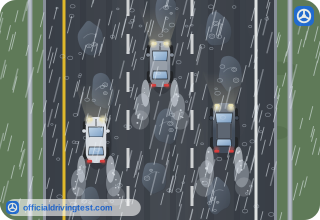
In bad weather and other unsafe driving conditions, what is advised about cruise control?
- Use adaptive cruise control but not regular cruise control
- Do not use any cruise control, including adaptive cruise control
- Use cruise control only at a low speed
- Use cruise control with the following gap set to long
Show answer
Correct answer: Do not use any cruise control, including adaptive cruise control
In bad weather and other unsafe driving conditions, it is advised not to use any cruise control, including adaptive cruise control.
Source: Iowa Driver’s License Manual (July 2026), page 33
-
Which of these affects the time it takes your wheels to stop?
- The vehicle’s weight, size, and load, and the condition of its tires
- Only the color of the vehicle and the year it was built in
- Only the width of the lane you are driving in at the time
- Only the number of passengers riding in the vehicle
Show answer
Correct answer: The vehicle’s weight, size, and load, and the condition of its tires
The time it takes your wheels to stop depends on the vehicle’s weight, size, and load, as well as the condition of its tires.
Source: Iowa Driver’s License Manual (July 2026), page 40