Iowa: Signals and vehicle controls — Part 5 Practice Test
Maintaining your vehicle, seats and mirrors, driver-assistance systems, starting, shifting, braking, steering, backing, turn signals, headlights and the horn. — Part 5
Independent educational site · not affiliated with any government agency or DMV
Ready? Test yourself
- Instant feedback with an explanation
- Every answer cites its source in the manual
- Your best score is saved on this device
Questions are original and based on the official manual "Iowa Driver’s License Manual" (July 2026), Iowa Department of Transportation.
All 36 questions in this practice test
Take the test above first, then use this list to study. Tap “Show answer” to see the correct answer and explanation.
Show the questions and answersHide the questions
-
When you complete a turn, how should you straighten out the steering wheel?
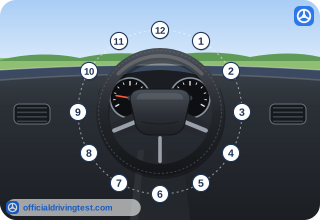
- By letting it slip through your fingers
- By hand, not by letting it slip through your fingers
- By releasing it and letting it center itself
- By pressing the accelerator to straighten it
Show answer
Correct answer: By hand, not by letting it slip through your fingers
You should straighten the wheel by hand because letting it slip through your fingers could be dangerous.
Source: Iowa Driver’s License Manual (July 2026), page 42
-
At what speed should backing up be done?
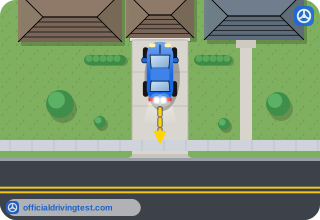
- At normal speed
- At the speed of traffic behind you
- At whatever speed is needed to finish quickly
- At slow speeds
Show answer
Correct answer: At slow speeds
It is harder to keep control in reverse, so backing up should be done at slow speeds.
Source: Iowa Driver’s License Manual (July 2026), page 43
-
What should you not depend on alone when backing up?
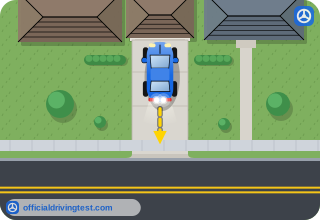
- Mirrors or backup cameras
- Turning your head to look
- Checking blind spots
- Looking over your shoulder
Show answer
Correct answer: Mirrors or backup cameras
Mirrors and backup cameras do not provide a full view and can be misleading in depth perception, so you should turn your head to see beyond the head restraint.
Source: Iowa Driver’s License Manual (July 2026), page 43
-
When you back up, what does the manual say to do with your right arm?
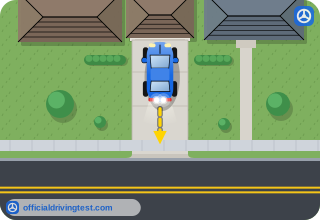
- Hold it on the steering wheel at 3 o’clock
- Rest it on the door
- Drape it over the back of the seat
- Hold it against the mirror control
Show answer
Correct answer: Drape it over the back of the seat
The manual says to drape your right arm over the back of the seat, grasp the top of the steering wheel with your left hand and look over your right shoulder through the rear window.
Source: Iowa Driver’s License Manual (July 2026), page 43
-
When backing, how should you use the accelerator?
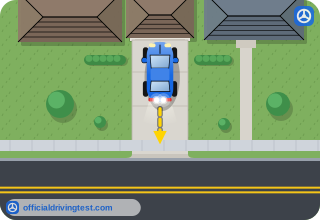
- Firmly, to back quickly out of the way
- Evenly, keeping it pressed all the time
- Quickly, then brake hard
- Gently, and only when necessary
Show answer
Correct answer: Gently, and only when necessary
After releasing the brake you use the accelerator gently, and only when necessary, to control speed, keeping it slow.
Source: Iowa Driver’s License Manual (July 2026), page 43
-
In which direction should you turn the steering wheel when backing?
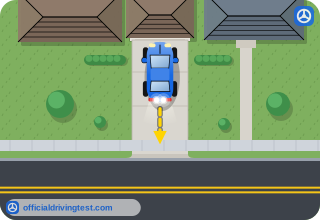
- Opposite to the direction you want the car to travel
- In the direction you want the car to travel
- Straight, then correct once moving
- Toward the nearest curb
Show answer
Correct answer: In the direction you want the car to travel
The manual says to turn your wheel in the direction you want the car to travel.
Source: Iowa Driver’s License Manual (July 2026), page 43
-
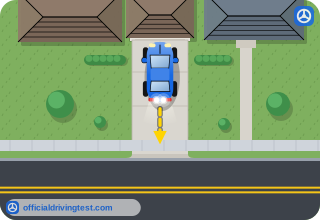
When should you check all areas behind the vehicle and in its blind spots?
- Only before you start backing up
- Only while the vehicle is moving
- Prior to and while backing up
- Only after you stop backing up
Show answer
Correct answer: Prior to and while backing up
You check all areas behind the vehicle and in the blind spots prior to and while backing up.
Source: Iowa Driver’s License Manual (July 2026), page 43
-
You should use your turn signals before you change lanes, turn right or left, merge into traffic, or do what?
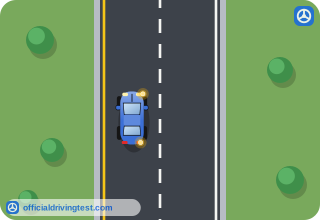
- Increase speed
- Turn off the engine
- Park
- Sound the horn
Show answer
Correct answer: Park
The manual says to use your turn signals before you change lanes, turn right or left, merge into traffic, or park.
Source: Iowa Driver’s License Manual (July 2026), page 43
-
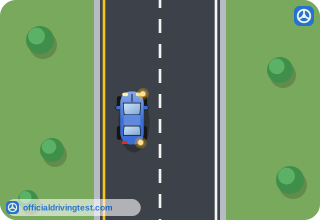
Why should you signal even when you do not see anyone else around?
- Signals are required when the engine is on
- Someone may be in your blind spot
- Signals warn animals near the road
- Other drivers may expect you to honk
Show answer
Correct answer: Someone may be in your blind spot
There may be vehicles, pedestrians or cyclists in your blind spot, and it is easy to miss someone who needs to know what you are doing.
Source: Iowa Driver’s License Manual (July 2026), page 43
-
How far before a turn does Iowa law require you to signal if the speed limit is 45 mph or less?
- At least 50 feet
- At least 200 feet
- At least 500 feet
- At least 100 feet
Show answer
Correct answer: At least 100 feet
Iowa law requires a signal at least 100 feet before a turn if the speed limit is 45 mph or less.
Source: Iowa Driver’s License Manual (July 2026), page 43
-
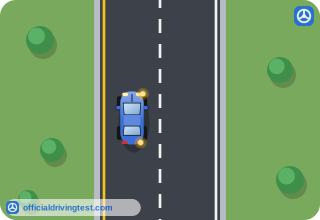
As a rule of thumb, when should you signal?
- Prior to slowing down
- After you begin braking
- Once you reach the intersection
- While you are turning the wheel
Show answer
Correct answer: Prior to slowing down
The manual’s rule of thumb is to signal prior to slowing down.
Source: Iowa Driver’s License Manual (July 2026), page 43
-
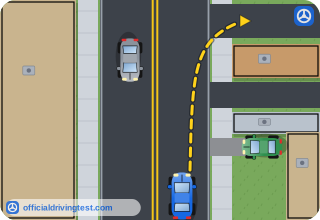
If there are streets, driveways or entrances between you and where you want to turn, when should you signal?
- Before you reach the first one
- As soon as you see them
- Only if a car is waiting there
- After you have passed them
Show answer
Correct answer: After you have passed them
You should be careful not to signal too early: wait until you have passed those streets, driveways or entrances to signal.
Source: Iowa Driver’s License Manual (July 2026), page 43
-
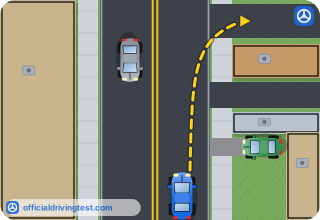
Why should you wait to signal your turn until you have passed a vehicle that is about to enter the street?
- The other driver may not see a signal in daylight
- The other driver may think you will turn there
- Signaling early would be against the law
- The other driver may sound the horn at you
Show answer
Correct answer: The other driver may think you will turn there
If you signal earlier, the other driver may think you plan to turn where that driver is and might pull into your path.
Source: Iowa Driver’s License Manual (July 2026), page 43
-
What should you ensure after you have completed a turn?
- That your hazard lights are on
- That the turn signal is off
- That your headlights are dimmed
- That your horn has been used
Show answer
Correct answer: That the turn signal is off
The manual says to ensure the turn signal is off after the turn.
Source: Iowa Driver’s License Manual (July 2026), page 43
-
Besides helping you see at night, what else do headlights do?
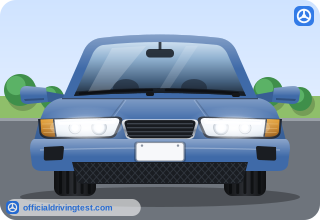
- Show other drivers where you will turn next
- Help other drivers see you
- Make hazard lights unnecessary
- Warn pedestrians that you will stop
Show answer
Correct answer: Help other drivers see you
Headlights also help other drivers see you.
Source: Iowa Driver’s License Manual (July 2026), page 49
-
Why should you turn on your headlights whenever you have trouble seeing other vehicles?
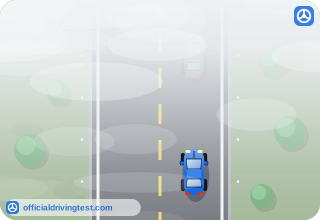
- It keeps your battery charged in cold weather
- It lets you use fewer mirror checks
- It shows other drivers your next turn
- Those drivers are likely having trouble seeing you
Show answer
Correct answer: Those drivers are likely having trouble seeing you
When you are having trouble seeing other vehicles, they are likely having trouble seeing you, so you turn on your headlights.
Source: Iowa Driver’s License Manual (July 2026), page 49
-
In which condition might your automatic headlights have to be turned on manually?
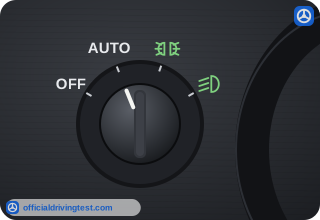
- Driving just after sunset
- A cloudless afternoon
- Driving on gravel at noon
- A daytime snowstorm
Show answer
Correct answer: A daytime snowstorm
In some conditions, such as daytime snowstorms, the ambient light is bright enough that automatic headlights must be turned on manually.
Source: Iowa Driver’s License Manual (July 2026), page 49
-
Iowa law requires both headlights from sunset to sunrise or whenever visibility is how many feet or less?
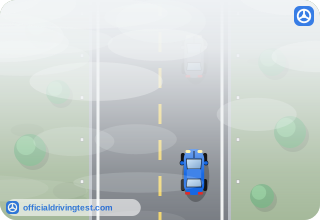
- 200 feet
- 500 feet
- 100 feet
- 1,000 feet
Show answer
Correct answer: 500 feet
Iowa law requires both headlights from sunset to sunrise or whenever visibility is 500 feet or less, such as in fog, heavy rain, or snow.
Source: Iowa Driver’s License Manual (July 2026), page 49
-
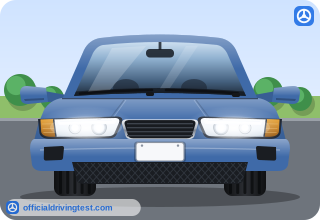
What is a good rule of thumb for when to turn your headlights on?
- Whenever you use your turn signal
- Whenever you drive faster than 45 mph
- Whenever you turn your windshield wipers on
- Whenever you drive on a two-lane road
Show answer
Correct answer: Whenever you turn your windshield wipers on
A good rule of thumb is to turn your headlights on whenever you turn your windshield wipers on.
Source: Iowa Driver’s License Manual (July 2026), page 49
-
Which of these is a reason to use your horn?
- A pedestrian or bicyclist appears to be moving into your lane of travel
- You want to tell a driver ahead of you to go faster than the traffic
- You are greeting a friend or neighbor who is walking along the road
- A driver ahead is stopped at a red light and you are in a hurry
Show answer
Correct answer: A pedestrian or bicyclist appears to be moving into your lane of travel
Use your horn when a pedestrian or bicyclist appears to be moving into your lane of travel.
Source: Iowa Driver’s License Manual (July 2026), page 49
-
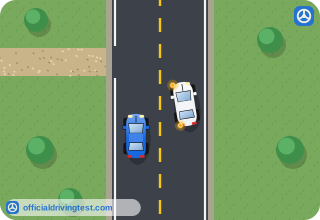
You are passing a driver who starts to turn into your lane. What should you use?
- Your horn
- Your hazard lights
- Your high beams
- Your brake lights
Show answer
Correct answer: Your horn
The manual lists passing a driver who starts to turn into your lane as a time to use your horn.
Source: Iowa Driver’s License Manual (July 2026), page 49
-
Which of these is a time to use your horn?
- You want a slow driver ahead of you to speed up or change lanes
- You want to say hello to a passing pedestrian
- You are exiting a narrow alley and cannot see what is ahead
- You are in a long line of stopped traffic
Show answer
Correct answer: You are exiting a narrow alley and cannot see what is ahead
Use your horn when you are coming to a place where you cannot see what is ahead, such as exiting a narrow alley.
Source: Iowa Driver’s License Manual (July 2026), page 49
-
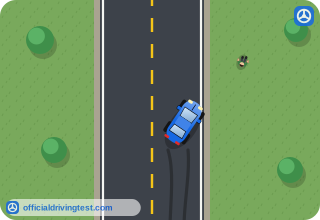
What should you use to warn someone when you have lost control of your vehicle and are moving toward that person?
- Your headlights
- Your horn
- Your hazard lights
- Your turn signal
Show answer
Correct answer: Your horn
The manual lists having lost control of your vehicle and moving toward someone as a time to use your horn.
Source: Iowa Driver’s License Manual (July 2026), page 49
-
Which driver should you alert with your horn?
- One who is signaling to turn at an upcoming intersection
- One who is stopped at a red light with the engine running
- One who is driving at the speed limit in the lane next to yours
- One who is not paying attention or who may have trouble seeing you
Show answer
Correct answer: One who is not paying attention or who may have trouble seeing you
Use your horn when a driver is not paying attention or may have trouble seeing you.
Source: Iowa Driver’s License Manual (July 2026), page 49
-
When is it right to sound your horn?
- The vehicle ahead is parked legally at the curb
- You want to thank a driver who let you merge
- You are waiting for a pedestrian in a crosswalk
- Another car is in danger of hitting you
Show answer
Correct answer: Another car is in danger of hitting you
Use your horn when another car is in danger of hitting you.
Source: Iowa Driver’s License Manual (July 2026), page 49
-
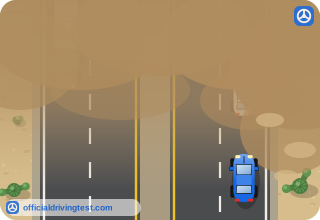
What should you use to make your vehicle more visible to others during extremely dusty conditions?
- High beam headlights
- Low beam headlights
- Hazard lights only
- Parking lights only
Show answer
Correct answer: Low beam headlights
The manual says to use low beam headlights to make your vehicle more visible in extremely dusty conditions.
Source: Iowa Driver’s License Manual (July 2026), page 55
-
What can help to reduce glare from oncoming headlights at night?
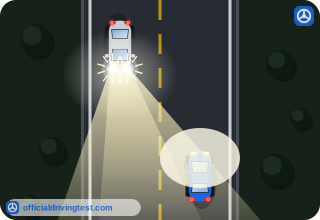
- Looking directly at the oncoming headlights to adjust your eyes
- Switching on your high beams to match the oncoming lights
- Looking toward the left side of the road and closing one eye
- Looking toward the right side of the road and adjusting the rearview mirror
Show answer
Correct answer: Looking toward the right side of the road and adjusting the rearview mirror
Looking toward the right side of the road and adjusting the rearview mirror can help to reduce headlight glare.
Source: Iowa Driver’s License Manual (July 2026), page 56
-
According to the night driving tips, when should headlights be turned on?
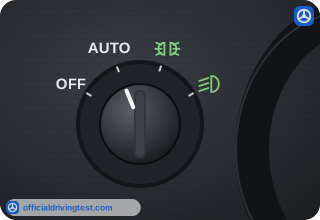
- Before the sun goes down
- Only after it is completely dark
- When you see another vehicle's headlights
- Only when the road has no streetlights
Show answer
Correct answer: Before the sun goes down
Headlights should be turned on before the sun goes down to make the car more visible.
Source: Iowa Driver’s License Manual (July 2026), page 56
-
When should high beams be used at night?
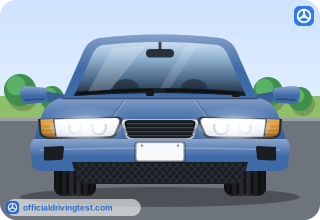
- In dense fog or heavy rain, so that you can see farther down the road ahead
- Whenever you are following another vehicle closely
- When other drivers won't see them, such as on isolated roadways with little traffic
- In heavy traffic, so that other drivers notice you
Show answer
Correct answer: When other drivers won't see them, such as on isolated roadways with little traffic
High beams should only be used when other drivers won't see them, such as on isolated roadways with little traffic.
Source: Iowa Driver’s License Manual (July 2026), page 56
-
Which feature should you not use during inclement weather?
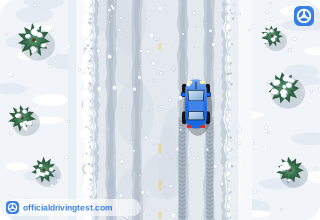
- Windshield wipers
- Cruise control
- Turn signals
- Low-beam headlights
Show answer
Correct answer: Cruise control
The manual says not to use cruise control during inclement weather.
Source: Iowa Driver’s License Manual (July 2026), page 59
-
What should you do with the windshield wipers when driving in precipitation?
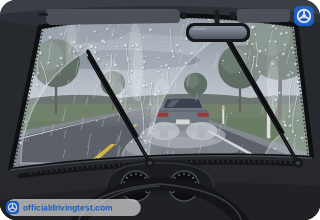
- Turn them on as soon as the windshield becomes wet
- Turn them on only when you can no longer see the road
- Turn them on only when driving faster than 35 mph
- Leave them off to avoid streaking the glass
Show answer
Correct answer: Turn them on as soon as the windshield becomes wet
The manual says to turn on the wipers as soon as the windshield becomes wet.
Source: Iowa Driver’s License Manual (July 2026), page 60
-
Which headlights should you use when driving in precipitation so others can see you?
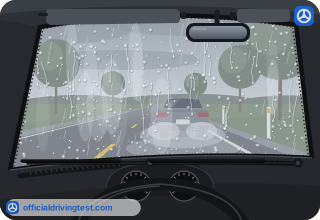
- High-beam headlights
- Parking lights only
- Low-beam headlights
- Fog lights only
Show answer
Correct answer: Low-beam headlights
Turning on the low-beam headlights helps others see you when it is raining or snowing.
Source: Iowa Driver’s License Manual (July 2026), page 60
-
What can you turn on to keep windows from fogging over when driving on wet roads?
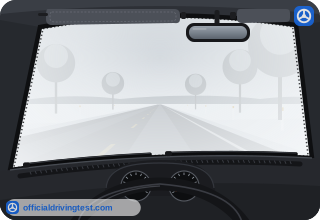
- The defroster
- The high beams
- The cruise control
- The emergency flashers
Show answer
Correct answer: The defroster
Turning the defroster on keeps the windows from fogging over.
Source: Iowa Driver’s License Manual (July 2026), page 60
-
Which feature should you not use on wet or slippery roads?
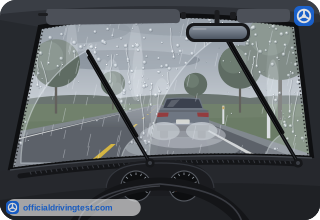
- Windshield wipers
- Low-beam headlights
- Cruise control
- The defroster
Show answer
Correct answer: Cruise control
The manual says not to use cruise control in wet or slippery conditions.
Source: Iowa Driver’s License Manual (July 2026), page 60
-
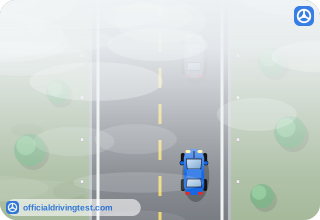
Which lights should you use in fog if your vehicle has them?
- High-beam lights
- Low-beam lights or fog lights
- Parking lights only
- Parking lights or flashers only
Show answer
Correct answer: Low-beam lights or fog lights
In fog, use low-beam lights or fog lights if your vehicle has them.
Source: Iowa Driver’s License Manual (July 2026), page 60
-
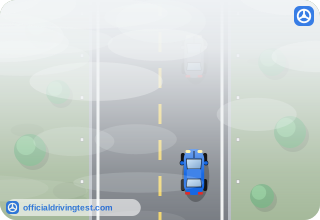
Why should you not use high beams in fog?
- They make the fog thicker around the vehicle
- They let other drivers think you are parked
- They shine too low to light the road far enough ahead of you
- They reflect off the fog, causing glare and reduced visibility
Show answer
Correct answer: They reflect off the fog, causing glare and reduced visibility
High beams reflect off the fog, causing glare and reduced visibility.
Source: Iowa Driver’s License Manual (July 2026), page 60