Iowa: Signals and vehicle controls — Part 2 Practice Test
Maintaining your vehicle, seats and mirrors, driver-assistance systems, starting, shifting, braking, steering, backing, turn signals, headlights and the horn. — Part 2
Independent educational site · not affiliated with any government agency or DMV
Ready? Test yourself
- Instant feedback with an explanation
- Every answer cites its source in the manual
- Your best score is saved on this device
Questions are original and based on the official manual "Iowa Driver’s License Manual" (July 2026), Iowa Department of Transportation.
All 37 questions in this practice test
Take the test above first, then use this list to study. Tap “Show answer” to see the correct answer and explanation.
Show the questions and answersHide the questions
-
What must you have if a load blocks your view in the rearview mirror?
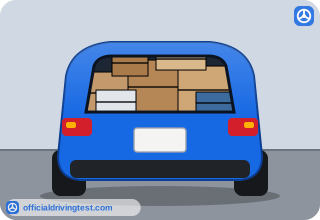
- A back-up camera
- A second person watching behind
- An outside mirror
- A rear window defroster
Show answer
Correct answer: An outside mirror
If your view is blocked by a load, you must have an outside mirror.
Source: Iowa Driver’s License Manual (July 2026), page 25
-
Which mirrors must vans or van-type vehicles have?
- A left outside mirror only
- Both left and right outside mirrors
- A right outside mirror only
- A rearview mirror and a back-up camera
Show answer
Correct answer: Both left and right outside mirrors
Vans or van-type vehicles must have both left and right outside mirrors.
Source: Iowa Driver’s License Manual (July 2026), page 25
-
What is the minimum distance that should be between the steering wheel and your chest, with the air bag pointing at your chest?
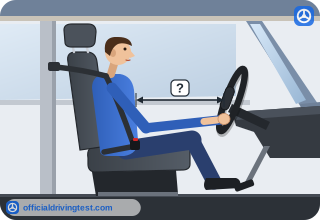
- 4 inches
- 6 inches
- 8 inches
- 10 inches
Show answer
Correct answer: 10 inches
There should be at least 10 inches between the steering wheel and your chest.
Source: Iowa Driver’s License Manual (July 2026), page 25
-
How high should the top of the steering wheel be?
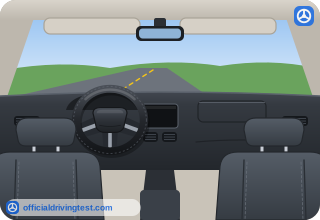
- No higher than your shoulders
- No higher than your eyes
- At the level of the top of your head
- No lower than your chin
Show answer
Correct answer: No higher than your shoulders
The top of the steering wheel should be no higher than your shoulders.
Source: Iowa Driver’s License Manual (July 2026), page 25
-
How should you move the driver’s seat forward or backward?
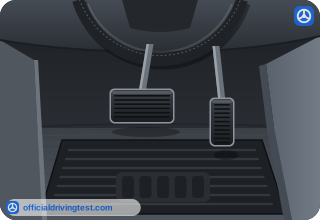
- So your knees stay locked straight while your foot rests on the brake pedal
- So the steering wheel rests against your chest when your hands are on it
- So your heel touches the floor and you can pivot quickly between the brake and accelerator
- So your toes can reach the pedals only when you slide down in the seat
Show answer
Correct answer: So your heel touches the floor and you can pivot quickly between the brake and accelerator
Move the seat so that your heel touches the floor and you can pivot quickly between the brake and accelerator.
Source: Iowa Driver’s License Manual (July 2026), page 25
-
What may shorter drivers need in order to sit safely 10 inches from the air bag?
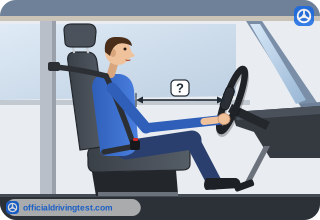
- A steering wheel cover or a longer seat belt
- A seat cushion or pedal extenders
- A higher steering wheel or a smaller air bag
- A tilted mirror and a shorter seat belt
Show answer
Correct answer: A seat cushion or pedal extenders
Shorter drivers may need a seat cushion or pedal extenders to sit safely 10 inches from the air bag.
Source: Iowa Driver’s License Manual (July 2026), page 25
-
Where should the head restraint be positioned?
- At the base of the driver’s neck
- At the top of the driver’s head
- At the level of the driver’s shoulders
- At the center of the driver’s head
Show answer
Correct answer: At the center of the driver’s head
The head restraint should be at the center of the driver’s head.
Source: Iowa Driver’s License Manual (July 2026), page 25
-
How should the inside mirror be adjusted when you sit up straight in the driver’s seat?
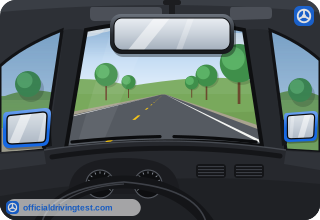
- So it frames the entire rear window
- So it shows mostly the left side of the road
- So it shows only the road directly behind the bumper
- So it frames the top half of the rear window
Show answer
Correct answer: So it frames the entire rear window
Adjust the inside mirror so that it frames the entire rear window.
Source: Iowa Driver’s License Manual (July 2026), page 25
-
Which mirror is the main mirror for viewing what is behind the vehicle?
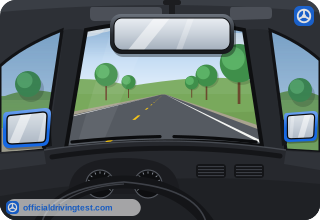
- The left-side mirror
- The right-side mirror
- The inside mirror
- The sun visor mirror
Show answer
Correct answer: The inside mirror
The inside mirror is the main mirror for viewing what is behind the vehicle.
Source: Iowa Driver’s License Manual (July 2026), page 25
-
How should you set the left-side mirror?
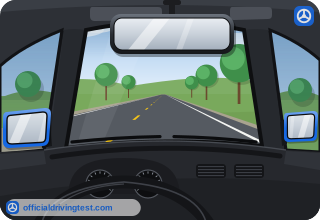
- Sit up straight and set it so you can see most of the side of the car
- Lean your head toward the left window and set it so you can barely see the side of the car
- Lean your head toward the left window and set it to frame the rear window
- Lean to the right over the center console and set it to show the side of the car
Show answer
Correct answer: Lean your head toward the left window and set it so you can barely see the side of the car
For the left-side mirror, lean your head toward the left-side window and set the mirror so you can barely see the side of the car.
Source: Iowa Driver’s License Manual (July 2026), page 25
-
After the left-side mirror is set, what should be true when you sit up straight?
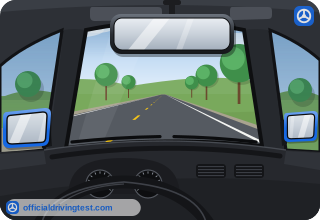
- The whole side of the car should be visible
- Only the rear bumper should be visible
- The door handle should fill the mirror
- The car should no longer be visible in the mirror
Show answer
Correct answer: The car should no longer be visible in the mirror
When sitting up straight, the car should no longer be visible in the left-side mirror.
Source: Iowa Driver’s License Manual (July 2026), page 25
-
To set the right-side mirror, where should you lean?
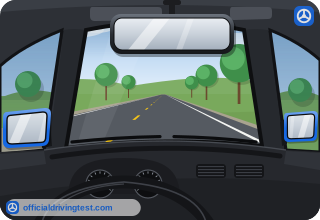
- To the right, over the car’s center console
- Toward the right-side window of the vehicle
- Forward over the steering wheel and the dash
- Back against the seat and head restraint
Show answer
Correct answer: To the right, over the car’s center console
For the right-side mirror, lean to the right over the car’s center console and set the mirror so you can barely see the right side of the car.
Source: Iowa Driver’s License Manual (July 2026), page 25
-
What does the manual’s method of adjusting the mirrors provide for maximum safety?
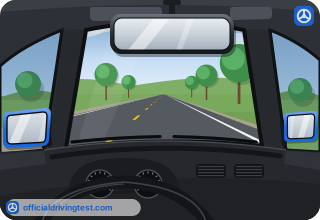
- The widest view of the road far ahead
- The best view of the dashboard instruments
- The best view of adjacent lanes
- The best view of the vehicle’s rear bumper
Show answer
Correct answer: The best view of adjacent lanes
The mirror method in the manual provides the best view of adjacent lanes, for maximum safety.
Source: Iowa Driver’s License Manual (July 2026), page 25
-
When should you adjust the driver’s seat and mirrors?
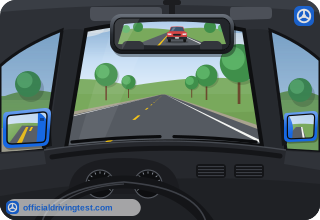
- After you reach 25 mph
- Before driving
- Only when you change lanes
- At the first red light
Show answer
Correct answer: Before driving
The driver’s seat and mirrors should be adjusted before driving so they are set correctly for you.
Source: Iowa Driver’s License Manual (July 2026), page 25
-
What are advanced driver-assistance systems (ADAS) designed to do?
- Let the driver stop paying attention to the road
- Replace the need for a driver’s license
- Make the vehicle drive faster on highways
- Increase the safety of driving a vehicle
Show answer
Correct answer: Increase the safety of driving a vehicle
ADAS are technological features designed to increase the safety of driving a vehicle.
Source: Iowa Driver’s License Manual (July 2026), page 26
-
The manual says ADAS features like automatic emergency braking keep us all safer, but only if what?
- They are used correctly
- They are installed by a dealer
- The driver is under 25
- The vehicle is driven only in daylight
Show answer
Correct answer: They are used correctly
ADAS features keep us safer only if they are used correctly, so drivers should understand how they work and their limitations.
Source: Iowa Driver’s License Manual (July 2026), page 26
-
What is the primary purpose of vehicle warning system technologies?
- To provide warnings to the driver in specific circumstances
- To steer the vehicle back into its lane automatically
- To brake the vehicle without any input from the driver
- To keep the vehicle at a set speed automatically
Show answer
Correct answer: To provide warnings to the driver in specific circumstances
The primary purpose of vehicle warning system technologies is to provide warnings to the driver in specific circumstances.
Source: Iowa Driver’s License Manual (July 2026), page 27
-
What does it mean that most vehicle warning technologies are passive?
- They activate only after the driver has switched them on manually
- They work only while the vehicle is parked or moving very slowly
- They warn the driver but do not automatically prevent a problem or crash
- They prevent a crash automatically so the driver need not react
Show answer
Correct answer: They warn the driver but do not automatically prevent a problem or crash
Most warning technologies are passive: they warn the driver of a potential issue but do not automatically prevent a problem or crash.
Source: Iowa Driver’s License Manual (July 2026), page 27
-
How do vehicle warning systems notify the driver?
- By turning the steering wheel for the driver
- By sound, light, or vibration
- By sending a text message to the driver
- By applying the parking brake
Show answer
Correct answer: By sound, light, or vibration
Vehicle warning systems notify the driver by sound, light, or vibration that a crash is about to occur or that there is a problem.
Source: Iowa Driver’s License Manual (July 2026), page 27
-
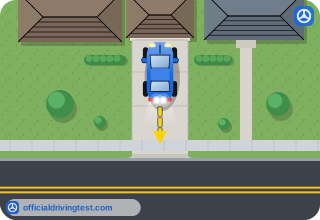
What does a back-up warning feature do?
- Shows a virtual bird’s-eye view of the vehicle on a dashboard screen
- Brakes the vehicle automatically before it touches an object behind
- Tracks the vehicle’s speed by GPS and warns you about sharp curves
- Scans behind the vehicle with rear sensors and alerts you to objects
Show answer
Correct answer: Scans behind the vehicle with rear sensors and alerts you to objects
A back-up warning uses rear sensors to scan for objects behind the vehicle and alerts you if an object is detected.
Source: Iowa Driver’s License Manual (July 2026), page 27
-
When does the back-up warning feature scan behind the vehicle?
- When the driver shifts into reverse
- As soon as the engine is started
- Whenever the vehicle is moving forward
- When the driver turns on the turn signal
Show answer
Correct answer: When the driver shifts into reverse
The back-up warning feature scans behind the vehicle when the driver shifts into reverse.
Source: Iowa Driver’s License Manual (July 2026), page 27
-
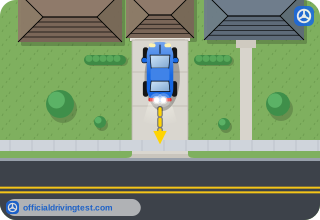
While backing, which checks should you still make even if the vehicle has a back-up warning?
- Only the back-up warning, because its sensors scan the whole area behind
- Only the rear-view mirror, because the side mirrors cannot see behind
- Side mirrors, the rear-view mirror, and over-the-shoulder head checks
- None, because head checks are not needed once the warning sounds
Show answer
Correct answer: Side mirrors, the rear-view mirror, and over-the-shoulder head checks
When backing you should demonstrate checking the side mirrors, the rear-view mirror, over the shoulders (head checks) and other cameras, if equipped.
Source: Iowa Driver’s License Manual (July 2026), page 27
-
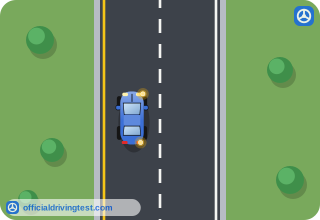
What does a blind spot monitor do?
- Shows a bird’s-eye view of the vehicle’s surroundings
- Warns you of other vehicles in your blind spots
- Applies the brakes when a vehicle ahead stops suddenly
- Keeps the vehicle centered in its lane
Show answer
Correct answer: Warns you of other vehicles in your blind spots
A blind spot monitor warns you of other vehicles driving in your blind spots through a symbol, sound, or vibration.
Source: Iowa Driver’s License Manual (July 2026), page 27
-
When may a blind spot monitor give an additional warning?
- When you shift the vehicle into reverse gear in a parking lot
- When you drive faster than the posted speed limit on a road
- When you open the driver’s door while the vehicle is parked
- When you use your turn signal and other vehicles are in the lane
Show answer
Correct answer: When you use your turn signal and other vehicles are in the lane
An additional blind spot warning may occur if the driver uses the turn signal when there are other vehicles in the lane.
Source: Iowa Driver’s License Manual (July 2026), page 27
-
When changing lanes with a blind spot monitor, what should the driver not do?
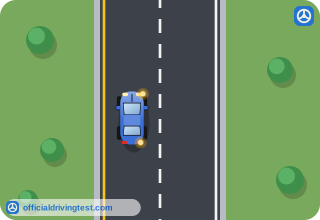
- Depend on the monitor alone
- Check the side mirrors
- Make a head check over the shoulder
- Scan the rear-view mirror frequently
Show answer
Correct answer: Depend on the monitor alone
The monitor’s warnings can help, but the driver should not become complacent and dependent on blind spot monitors alone for changing lanes.
Source: Iowa Driver’s License Manual (July 2026), page 27
-
What does a rear camera help you do?
- Check the lane beside the vehicle at highway speeds
- See the vehicle’s position from a bird’s-eye view
- See objects directly behind the vehicle while backing
- Measure how fast the traffic behind you is moving
Show answer
Correct answer: See objects directly behind the vehicle while backing
A rear camera helps you see objects directly behind the vehicle by showing a wide view behind it while backing.
Source: Iowa Driver’s License Manual (July 2026), page 28
-
What should you do when your vehicle has a rear camera?
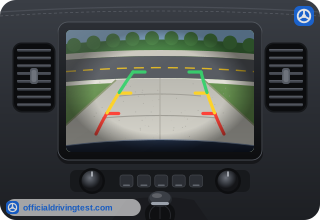
- Rely on the camera alone, because it shows a wide view behind
- Not depend on it and keep checking mirrors and over your shoulders
- Check only the side mirrors and skip the rear-view mirror and head checks
- Skip head checks, since the camera covers all the blind spots
Show answer
Correct answer: Not depend on it and keep checking mirrors and over your shoulders
You should not become dependent on rear cameras and should continue to check the side mirrors, rear-view mirror and over your shoulders (head checks).
Source: Iowa Driver’s License Manual (July 2026), page 28
-
When does a sideview camera show an expanded view of the lane beside the vehicle?
- Only when the driver shifts the vehicle into reverse gear to back up
- Only when the hazard flashers are on and the vehicle is stopped
- Only when the vehicle is traveling on a freeway at higher speeds
- When you use your turn signal or activate the feature manually
Show answer
Correct answer: When you use your turn signal or activate the feature manually
A sideview camera shows an expanded view of a lane beside the vehicle when you use your turn signal or activate the feature manually.
Source: Iowa Driver’s License Manual (July 2026), page 28
-
How should sideview cameras be used?
- In conjunction with traditional mirrors and head checks
- Only while the vehicle is parked with the engine off
- Only when backing up, never while changing lanes
- Only in place of the rear-view mirror
Show answer
Correct answer: In conjunction with traditional mirrors and head checks
Sideview cameras should be used together with traditional mirrors and head checks (checking over the shoulders).
Source: Iowa Driver’s License Manual (July 2026), page 28
-
Where is the button that activates a sideview camera usually located?
- On the gear shift lever
- On the rear-view mirror
- On the turn signal lever
- On the parking brake handle
Show answer
Correct answer: On the turn signal lever
A sideview camera can be activated through a button usually located on the turn signal lever.
Source: Iowa Driver’s License Manual (July 2026), page 28
-
What limitation of sideview cameras does the manual mention?
- The feature can be used only when the driver has no passengers in the vehicle
- The feature may not be available while backing up or may turn on only at low speeds
- The feature always replaces the mirrors and head checks on every vehicle
- The feature works only at highway speeds and never in parking lots
Show answer
Correct answer: The feature may not be available while backing up or may turn on only at low speeds
The manual says a sideview camera may not be available while backing up or may only turn on at low speeds.
Source: Iowa Driver’s License Manual (July 2026), page 28
-
What kind of view does a surround-view (around-view) monitor give you?
- A narrow view of the lane beside the vehicle
- A rear view that shows only objects behind the vehicle
- A forward view from the top of the windshield
- A virtual bird’s-eye view from above the vehicle
Show answer
Correct answer: A virtual bird’s-eye view from above the vehicle
A surround-view monitor assists parking through a virtual bird’s-eye view from above the vehicle.
Source: Iowa Driver’s License Manual (July 2026), page 28
-
How many cameras does an around-view monitor process video from?
- Four
- Two
- Three
- Six
Show answer
Correct answer: Four
The around-view monitor processes video from four cameras (front, back, left and right) into one bird’s-eye view.
Source: Iowa Driver’s License Manual (July 2026), page 28
-
What does the around-view monitor help you visually confirm?
- How quickly traffic is approaching from behind while you back out
- Whether the tires are inflated enough before you leave the parking space
- The vehicle’s position relative to parking space lines and adjacent objects
- The distance to the vehicle ahead when you are driving at highway speeds
Show answer
Correct answer: The vehicle’s position relative to parking space lines and adjacent objects
The around-view monitor helps you confirm the vehicle’s position relative to the lines around parking spaces and adjacent objects.
Source: Iowa Driver’s License Manual (July 2026), page 28
-
Bicycle, pedestrian, and obstacle detection generally alerts you when you drive at low speeds of about how fast?
- About 5 mph
- About 25 mph
- About 45 mph
- About 60 mph
Show answer
Correct answer: About 25 mph
These detection systems alert you when driving at low speeds, generally around 25 mph.
Source: Iowa Driver’s License Manual (July 2026), page 29
-
What limit does the manual give for some bicycle, pedestrian, and obstacle detection systems?
- They detect only objects that are directly behind the vehicle while it is parked
- They detect only objects that are beside the vehicle and moving in the opposite direction
- They detect only objects that are stationary and more than 100 feet away from the vehicle
- They detect only what is directly in front of the vehicle and moving in the same direction
Show answer
Correct answer: They detect only what is directly in front of the vehicle and moving in the same direction
Some systems can only detect bicyclists, pedestrians, or obstacles directly in front of the vehicle and moving in the same direction.
Source: Iowa Driver’s License Manual (July 2026), page 29
-
What do some versions of obstacle detection do?
- Apply the brakes automatically
- Turn the steering wheel automatically
- Shift the vehicle into park automatically
- Honk the horn automatically
Show answer
Correct answer: Apply the brakes automatically
Some versions of obstacle detection apply the brakes automatically.
Source: Iowa Driver’s License Manual (July 2026), page 29