Iowa: Railroad crossings — Part 2 Practice Test
Questions in this part include: “How does the width of a train compare with the width of the tracks?” · “While waiting for a train to pass at a crossing that has a white stop line, where should you stay?”
Independent educational site · not affiliated with any government agency or DMV
Ready? Test yourself
- Instant feedback with an explanation
- Every answer cites its source in the manual
- Your best score is saved on this device
Questions are original and based on the official manual "Iowa Driver’s License Manual" (July 2026), Iowa Department of Transportation.
All 23 questions in this practice test
Take the test above first, then use this list to study. Tap “Show answer” to see the correct answer and explanation.
Show the questions and answersHide the questions
-
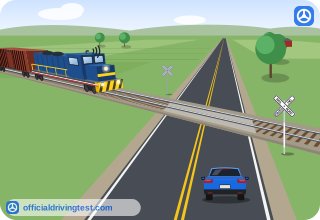
How does a train compare with how it looks from a distance?
- It is always farther away than it appears
- It is always traveling slower than it appears
- It travels at a constant speed that is easy to judge
- It may be closer and traveling faster than it appears
Show answer
Correct answer: It may be closer and traveling faster than it appears
The manual warns that trains may be closer and traveling faster than they appear and can run on any track at any time.
Source: Iowa Driver’s License Manual (July 2026), page 12
-
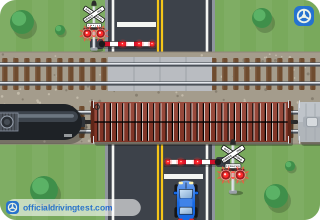
What must you be able to do before you proceed when a railroad crossing has multiple tracks?
- Hear the horn of each approaching train
- Identify which track the first train will use
- See clearly down the tracks in both directions
- Follow the vehicle ahead of you across
Show answer
Correct answer: See clearly down the tracks in both directions
Multiple tracks may mean multiple trains, so you must ensure you can clearly see down the tracks in both directions before proceeding.
Source: Iowa Driver’s License Manual (July 2026), page 12
-
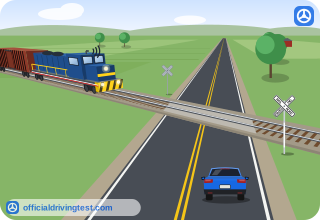
What should you never try to do when a train is approaching a railroad crossing?
- Beat the train
- Stop behind the white line
- Look both ways
- Wait for the lights to stop flashing
Show answer
Correct answer: Beat the train
The manual says to avoid crossing while lights are flashing or gates are down and never to try to beat a train.
Source: Iowa Driver’s License Manual (July 2026), page 12
-
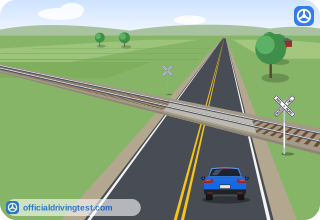
Before you cross railroad tracks, what must you be sure of?
- That the crossing has gates
- That the train's horn has sounded
- That your fuel tank is at least half full
- That you can completely clear the tracks
Show answer
Correct answer: That you can completely clear the tracks
Before crossing, you must be sure you can completely clear the tracks so you do not get stuck on them.
Source: Iowa Driver’s License Manual (July 2026), page 12
-
How does the width of a train compare with the width of the tracks?
- Trains are exactly as wide as the tracks
- Trains are wider than the tracks
- Trains are narrower than the tracks
- Trains are the same width only on curves
Show answer
Correct answer: Trains are wider than the tracks
The manual tells drivers to keep in mind that trains are wider than the tracks when deciding whether they can clear the crossing.
Source: Iowa Driver’s License Manual (July 2026), page 12
-
When you are stopped near a railroad crossing, how much space should you leave between your vehicle and the nearest rail?
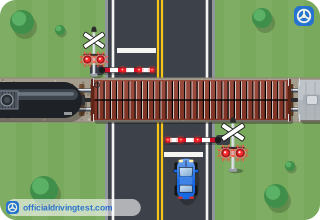
- At least 15 feet
- At least 5 feet
- At least 10 feet
- At least 25 feet
Show answer
Correct answer: At least 15 feet
When stopped, leave at least 15 feet between the front and rear of your vehicle and the nearest rail.
Source: Iowa Driver’s License Manual (July 2026), page 12
-
What does the manual say about shifting gears while crossing railroad tracks?
- Shift to a lower gear on the tracks
- Shift into neutral to coast across
- Avoid shifting gears while crossing
- Shift gears quickly to speed up the crossing
Show answer
Correct answer: Avoid shifting gears while crossing
Drivers should avoid shifting gears while crossing the tracks.
Source: Iowa Driver’s License Manual (July 2026), page 12
-
A white X-shaped sign reading RAILROAD CROSSING stands at a crossing and a train is approaching. What must you do?
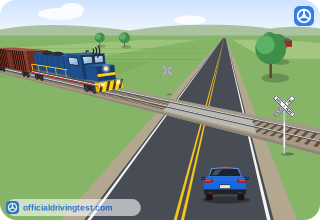
- Speed up and cross ahead of the train
- Yield to the train
- Proceed if the train is far away
- Honk your horn and cross before the train arrives
Show answer
Correct answer: Yield to the train
At a crossbuck you must yield if a train is approaching, because trains always have the right-of-way.
Source: Iowa Driver’s License Manual (July 2026), page 13
-
Who always has the right-of-way at a railroad crossing?
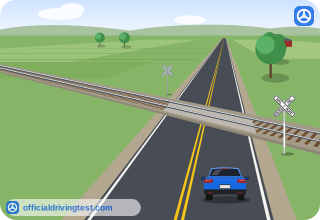
- Vehicles that arrive first at the crossing
- Vehicles that are already crossing
- Vehicles carrying the most passengers
- Trains
Show answer
Correct answer: Trains
Trains always have the right-of-way at a railroad crossing.
Source: Iowa Driver’s License Manual (July 2026), page 13
-
What should you do when the red lights at a railroad crossing are flashing?
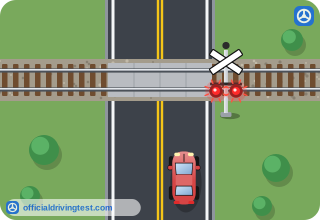
- Slow down and cross if you see no train coming
- Go around the gate arm if there is no train in sight
- Stop and wait until they stop flashing
- Stop only when the gate arms have come down
Show answer
Correct answer: Stop and wait until they stop flashing
You should stop when the lights are flashing and not proceed until the lights stop flashing.
Source: Iowa Driver’s License Manual (July 2026), page 13
-
You have already started across the tracks when the red lights begin flashing. What should you do?
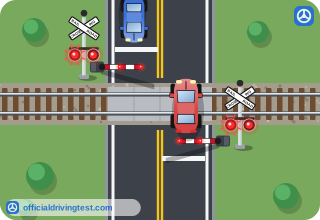
- Keep going
- Stop on the tracks and wait
- Back up to where you started
- Stop and wait for the gates to lower
Show answer
Correct answer: Keep going
If the lights begin flashing after you start across the tracks, you should keep going.
Source: Iowa Driver’s License Manual (July 2026), page 13
-
When may you proceed after the gates at a railroad crossing have lowered and the lights have started flashing?
- As soon as you can see no train coming
- After the train's horn stops sounding
- Once other drivers begin driving around the gates
- Only after the lights turn off and the gates go up
Show answer
Correct answer: Only after the lights turn off and the gates go up
With lowering gates and flashing red lights, you must not proceed until the lights turn off and the gates go up.
Source: Iowa Driver’s License Manual (July 2026), page 13
-
What does the manual say about driving around lowered railroad crossing gates?
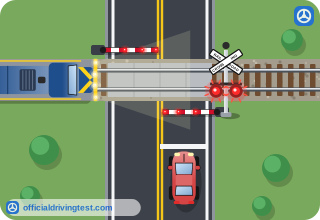
- It is allowed if no train is in sight
- It is illegal and dangerous
- It is allowed if you drive slowly
- It is allowed if you first stop and look
Show answer
Correct answer: It is illegal and dangerous
It is illegal and dangerous to go around lowered gates at a railroad crossing.
Source: Iowa Driver’s License Manual (July 2026), page 13
-
What is true of the phone number and location ID number on Emergency Notification System signs?
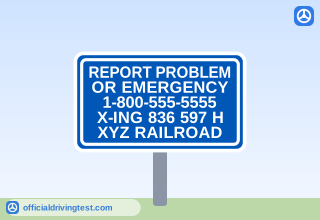
- Each sign has a different phone number and location ID number
- All signs show the same phone number and location ID number
- Only the location ID differs; the phone number is the same everywhere
- Neither number is printed on the sign itself
Show answer
Correct answer: Each sign has a different phone number and location ID number
Each Emergency Notification System sign has its own phone number and location ID number.
Source: Iowa Driver’s License Manual (July 2026), page 13
-
Which of these should you also report using the phone number on an Emergency Notification System sign?
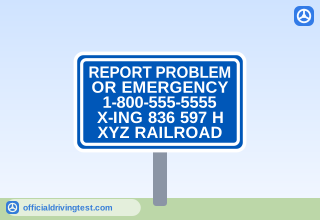
- A train running behind schedule
- Slow traffic on a nearby road
- Debris on the tracks
- Loud train horns at night
Show answer
Correct answer: Debris on the tracks
Besides a stuck or stalled vehicle, the number is also used to report people, vehicles or debris on the tracks, damaged signs or signals, and obstructed views.
Source: Iowa Driver’s License Manual (July 2026), page 13
-
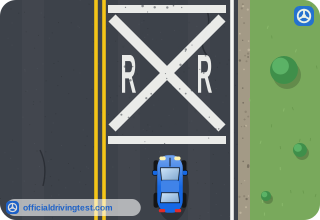
What do the letters RxR and a wide white line painted across the road mean?
- A school crossing is directly ahead
- You are approaching a railroad crossing
- A lane is reserved for buses only
- A bicycle lane begins at this point
Show answer
Correct answer: You are approaching a railroad crossing
RxR and a wide white line on the roadway mean you are approaching a railroad crossing.
Source: Iowa Driver’s License Manual (July 2026), page 13
-
While waiting for a train to pass at a crossing that has a white stop line, where should you stay?
- Just past the white line
- Beside the nearest rail
- On the shoulder next to the crossbuck
- Behind the white line
Show answer
Correct answer: Behind the white line
You should stay behind the white line while waiting for a train to pass.
Source: Iowa Driver’s License Manual (July 2026), page 13
-
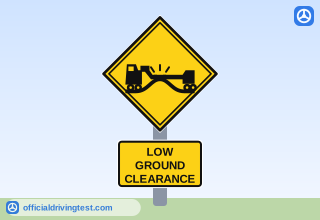
A yellow diamond sign shows a low vehicle on railroad tracks with the words LOW GROUND CLEARANCE. What does it warn of?
- A crossing that is closed
- A railroad crossing with two tracks
- A raised crossing ahead
- A low bridge ahead
Show answer
Correct answer: A raised crossing ahead
The low ground clearance sign warns of a raised crossing ahead where low vehicles risk getting hung up on the tracks.
Source: Iowa Driver’s License Manual (July 2026), page 13
-
At a low ground clearance railroad crossing, when may you proceed?
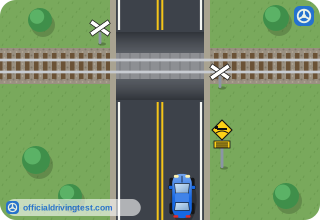
- Once you know your vehicle will clear the tracks
- As soon as the road ahead looks clear of cars
- After you slow to a crawl and look both ways
- Once a train has sounded its horn nearby
Show answer
Correct answer: Once you know your vehicle will clear the tracks
You must not proceed until you know your vehicle will clear the tracks, because low vehicles can get hung up.
Source: Iowa Driver’s License Manual (July 2026), page 13
-
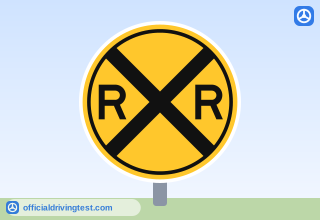
What should you do when you see a round yellow sign with a black X between two letter Rs?
- Stop completely and wait for a signal to go
- Yield to traffic on the cross street first
- Speed up to clear the tracks quickly
- Slow down, look, listen, and be prepared to stop
Show answer
Correct answer: Slow down, look, listen, and be prepared to stop
The railroad advance warning sign means to slow down, look, listen and be prepared to stop.
Source: Iowa Driver’s License Manual (July 2026), page 13
-
Typically, which railroad crossing sign is the first one you see when approaching a crossing?
- The crossbuck
- The advance warning sign
- The Emergency Notification System sign
- The low ground clearance sign
Show answer
Correct answer: The advance warning sign
The advance warning sign is typically the first sign you see when approaching a railroad crossing.
Source: Iowa Driver’s License Manual (July 2026), page 13
-
What does the manual say about warning devices at railroad crossings on rural roads?
- Flashing lights and bells are always installed, but gates are not
- They always have crossing gates that lower when a train comes
- There are typically no flashing lights, bells, gates or pavement markings
- They have the same warning devices as crossings on major roads
Show answer
Correct answer: There are typically no flashing lights, bells, gates or pavement markings
Unlike most railroad crossings on major roads, rural road crossings typically have no red flashing lights, warning bells, crossing gates or pavement markings.
Source: Iowa Driver’s License Manual (July 2026), page 56
-
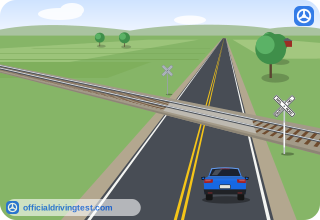
What should you always do before crossing railroad tracks on a rural road?
- Keep your speed and wait for warning bells to tell you a train is near
- Slow down, look both ways, and be prepared to stop for a train
- Look only in the direction of traffic and cross without slowing
- Cross quickly so that a train cannot reach the crossing first
Show answer
Correct answer: Slow down, look both ways, and be prepared to stop for a train
Rural crossings usually have no automatic warnings, so you must always slow down, look both ways and be prepared to stop for a train.
Source: Iowa Driver’s License Manual (July 2026), page 56