Iowa: Pedestrians Practice Test
Yielding at crosswalks, Iowa’s 2024 pedestrian conveyance law, sight-impaired pedestrians, sidewalks and pedestrians at roundabouts.
Independent educational site · not affiliated with any government agency or DMV
Ready? Test yourself
- Instant feedback with an explanation
- Every answer cites its source in the manual
- Your best score is saved on this device
Questions are original and based on the official manual "Iowa Driver’s License Manual" (July 2026), Iowa Department of Transportation.
All 22 questions in this practice test
Take the test above first, then use this list to study. Tap “Show answer” to see the correct answer and explanation.
Show the questions and answersHide the questions
-
The pedestrian crossing sign tells you to watch out for people walking, running, riding, or using what?
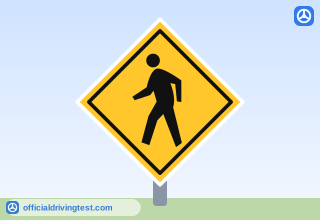
- Motorcycles or other motorized vehicles
- Farm equipment or horse-drawn wagons
- Handheld signals at school crossings
- Wheelchairs or low-speed micromobility devices
Show answer
Correct answer: Wheelchairs or low-speed micromobility devices
The pedestrian crossing sign warns you to watch out for people walking, running, riding, or using wheelchairs or low-speed micromobility devices.
Source: Iowa Driver’s License Manual (July 2026), page 9
-
Under the 2024 crosswalk update to Iowa’s traffic code, who must vehicles yield the right of way to?
- Only people who are walking on foot
- Pedestrians on foot and those using any human-powered device
- Only people who use motorized wheelchairs
- People on foot and people who are riding motorcycles
Show answer
Correct answer: Pedestrians on foot and those using any human-powered device
The new law says vehicles must yield the right of way to pedestrians on foot and those using any human-powered device, called a pedestrian conveyance.
Source: Iowa Driver’s License Manual (July 2026), page 10
-
What kind of device does the manual say a pedestrian conveyance is?
- Gasoline-powered
- Human-powered
- Animal-powered
- Wind-powered
Show answer
Correct answer: Human-powered
A pedestrian conveyance is defined as any human-powered device by which a pedestrian may move other than by walking or may move another person.
Source: Iowa Driver’s License Manual (July 2026), page 10
-
Which of these is listed in the manual as a pedestrian conveyance?
- Mopeds
- Motorcycles
- Farm tractors
- Skateboards
Show answer
Correct answer: Skateboards
The manual lists wheelchairs, strollers, skateboards, scooters and electric personal assistive mobility devices as pedestrian conveyances.
Source: Iowa Driver’s License Manual (July 2026), page 10
-
When the manual uses the word “pedestrian,” whom does it include?
- Pedestrians and pedestrian conveyances
- Only people who are on foot
- Pedestrians and motorcyclists
- Pedestrians and school crossing guards
Show answer
Correct answer: Pedestrians and pedestrian conveyances
The manual notes that any time it says pedestrian(s), it means pedestrians and pedestrian conveyances.
Source: Iowa Driver’s License Manual (July 2026), page 10
-
On what date did the update requiring drivers to yield to pedestrian conveyances take effect, according to the manual?
- January 1, 2024
- July 1, 2023
- July 1, 2024
- January 1, 2025
Show answer
Correct answer: July 1, 2024
The manual says the rule requiring drivers to yield to pedestrian conveyances applies as of July 1, 2024.
Source: Iowa Driver’s License Manual (July 2026), page 10
-
Before the July 1, 2024 change, how was a “pedestrian” defined?
- Any person using a human-powered device
- Any person who is crossing at a signal
- Any person in a wheelchair or on a scooter
- Any person on foot
Show answer
Correct answer: Any person on foot
Before the 2024 change a pedestrian was defined as any person on foot; the new rule adds pedestrian conveyances.
Source: Iowa Driver’s License Manual (July 2026), page 10
-
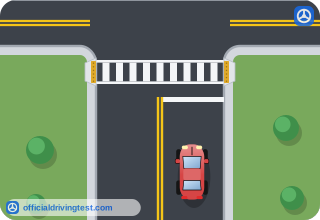
What do crosswalks define?
- The point where drivers must stop for cross traffic
- The area where pedestrians are to cross the roadway
- The area where vehicles may stop to let passengers out
- The lane where bicyclists are to ride
Show answer
Correct answer: The area where pedestrians are to cross the roadway
Crosswalks define the area where pedestrians are to cross the roadway.
Source: Iowa Driver’s License Manual (July 2026), page 15
-
At a crosswalk, whom must you yield to?
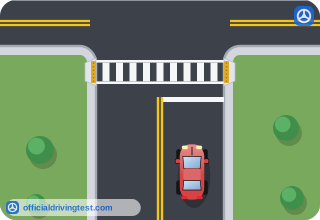
- Anyone in or about to enter the crosswalk
- Only pedestrians who are already in the crosswalk
- Only pedestrians who are crossing with a walk signal
- Only pedestrians in a marked crosswalk
Show answer
Correct answer: Anyone in or about to enter the crosswalk
You must yield to anyone in or about to enter a crosswalk.
Source: Iowa Driver’s License Manual (July 2026), page 15
-
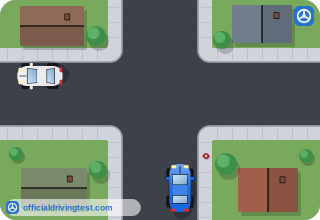
What should you do when crossing intersections that do not have defined crosswalks?
- Assume that pedestrians will not cross there
- Expect pedestrians only at the corners with traffic signals
- Be alert for pedestrians
- Drive faster to clear the intersection
Show answer
Correct answer: Be alert for pedestrians
Not all crosswalks are marked, so you should be alert for pedestrians when crossing intersections that do not have defined crosswalks.
Source: Iowa Driver’s License Manual (July 2026), page 15
-
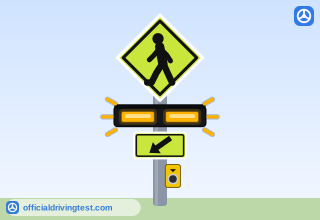
A Rectangular Rapid Flashing Beacon is flashing and someone is in the crosswalk. What must you do?
- Slow down and drive around the person
- Sound your horn and proceed with caution
- Stop only if the person is a child
- Stop for anyone within the crosswalk
Show answer
Correct answer: Stop for anyone within the crosswalk
Motorists must stop for anyone within the crosswalk and be alert for anyone about to enter it while the beacon is flashing.
Source: Iowa Driver’s License Manual (July 2026), page 18
-
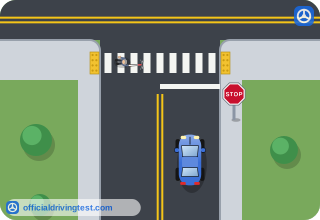
A person is being led by a harnessed service animal or is walking with a white cane, or a white cane with a red tip. What is the person likely to be?
- Hearing impaired
- Visually impaired
- Using a wheelchair
- Unfamiliar with the area
Show answer
Correct answer: Visually impaired
A person led by a harnessed service animal or using a white cane (or one with a red tip) is likely visually impaired, so drivers use extra caution.
Source: Iowa Driver’s License Manual (July 2026), page 18
-
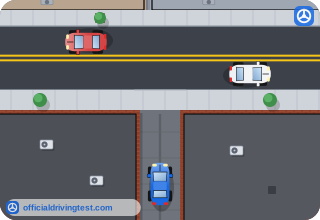
Who must drivers yield to when crossing a sidewalk, or when entering or exiting a driveway, alley, or parking lot?
- Bicyclists only
- Parked vehicles
- Pedestrians
- School buses only
Show answer
Correct answer: Pedestrians
Drivers crossing a sidewalk or entering or exiting a driveway, alley, or parking lot must yield to pedestrians.
Source: Iowa Driver’s License Manual (July 2026), page 19
-
It is illegal to drive on a sidewalk except to do what?
- Park beside it
- Cross it
- Make a U-turn
- Pass a stopped vehicle
Show answer
Correct answer: Cross it
Driving on a sidewalk is illegal except to cross it.
Source: Iowa Driver’s License Manual (July 2026), page 19
-
At which crosswalks must you yield or stop for pedestrians?
- Marked crosswalks only
- Only crosswalks with a traffic signal
- Only crosswalks near schools
- Marked and unmarked crosswalks
Show answer
Correct answer: Marked and unmarked crosswalks
You must yield or stop for pedestrians in marked or unmarked crosswalks.
Source: Iowa Driver’s License Manual (July 2026), page 19
-
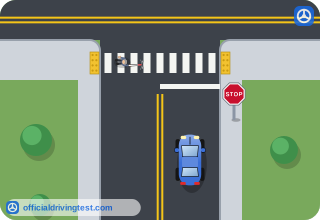
A visually impaired person with a cane or a guide dog is walking in front of you, or is close enough to be in danger. What must you do?
- Slow down and drive around the person
- Sound your horn to warn the person
- Stop
- Keep going if the person is not in your lane
Show answer
Correct answer: Stop
You must always stop when a visually impaired person with a cane (often white or red-tipped) or guide dog is walking in front of you or close enough to be in danger.
Source: Iowa Driver’s License Manual (July 2026), page 41
-
A pedestrian approaches a roundabout crosswalk. Which direction should the pedestrian look first?
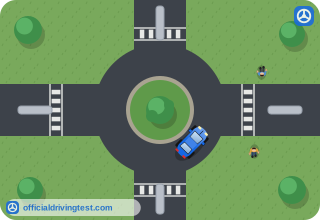
- Right
- Left
- Straight ahead only
- Up at the signs
Show answer
Correct answer: Left
Pedestrians look left on approach, cross to the raised splitter island, then look right.
Source: Iowa Driver’s License Manual (July 2026), page 54
-
A pedestrian crossing at a roundabout first crosses to which point?
- The yield line
- The truck apron
- The nearest edge of the circulating lane
- The raised splitter island
Show answer
Correct answer: The raised splitter island
Pedestrians cross to the raised splitter island, look right, and then finish crossing to the opposite sidewalk.
Source: Iowa Driver’s License Manual (July 2026), page 54
-
What must a pedestrian never do at a roundabout?
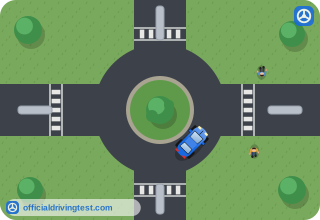
- Look left before starting to cross the crosswalk
- Walk across the circulating lanes to the center island
- Finish crossing to the opposite sidewalk
- Use the crosswalk at the entry to the roundabout
Show answer
Correct answer: Walk across the circulating lanes to the center island
Pedestrians must never walk across the circulating lane or lanes of a roundabout to the center island.
Source: Iowa Driver’s License Manual (July 2026), page 55
-
Where must you be especially careful to look for pedestrians, bicyclists, skaters and people using wheelchairs before turning?
- On freeway entrance ramps
- At intersections and driveways
- On rural gravel roads
- On interstate highways
Show answer
Correct answer: At intersections and driveways
Be especially careful to look for pedestrians, bicyclists, skaters and people using wheelchairs or low-speed micromobility devices before turning at intersections and driveways.
Source: Iowa Driver’s License Manual (July 2026), page 58
-
What should you pay attention to so that you can give the right-of-way to people walking, biking, skating or using a wheelchair?
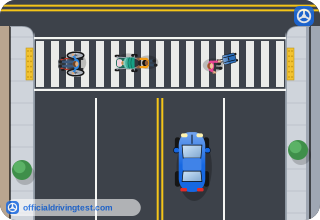
- The color of the crosswalk markings
- The speed limit sign near the crossing
- The hand signals of the vehicle ahead
- The pedestrian signal
Show answer
Correct answer: The pedestrian signal
Pay attention to the pedestrian signal and give the right-of-way to people walking, biking, skating, or on a wheelchair or low-speed micromobility device.
Source: Iowa Driver’s License Manual (July 2026), page 58
-
What should you never do when another vehicle has stopped or is slowing down for a pedestrian?
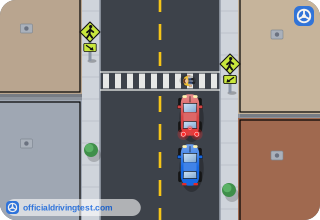
- Pass that vehicle
- Stop behind that vehicle
- Wait for the pedestrian to cross
- Slow down and look for pedestrians
Show answer
Correct answer: Pass that vehicle
You might not be able to see the pedestrian when you approach a stopped vehicle, so never pass a vehicle that has stopped or is slowing down for a pedestrian.
Source: Iowa Driver’s License Manual (July 2026), page 58