Iowa: Pavement markings Practice Test
Yellow and white lines, passing markings, yield lines, crosswalks and stop lines, reversible and shared left-turn lanes, and bicycle lane markings.
Independent educational site · not affiliated with any government agency or DMV
Ready? Test yourself
- Instant feedback with an explanation
- Every answer cites its source in the manual
- Your best score is saved on this device
Questions are original and based on the official manual "Iowa Driver’s License Manual" (July 2026), Iowa Department of Transportation.
All 24 questions in this practice test
Take the test above first, then use this list to study. Tap “Show answer” to see the correct answer and explanation.
Show the questions and answersHide the questions
-
In addition to lane control signs, what color of arrows may sometimes be painted on the road?
- Yellow
- Red
- Orange
- White
Show answer
Correct answer: White
Sometimes white arrows may also be painted on the road.
Source: Iowa Driver’s License Manual (July 2026), page 8
-
What do yellow lines on the pavement separate?
- Traffic moving in opposite directions
- Traffic moving in the same direction
- Bicycle lanes from the other lanes of the road
- Lanes reserved for special vehicles from regular lanes
Show answer
Correct answer: Traffic moving in opposite directions
Yellow lines separate traffic moving in opposite directions, while white lines separate traffic moving in the same direction.
Source: Iowa Driver’s License Manual (July 2026), page 15
-
How may pavement markings be used?
- Only together with a traffic signal at an intersection
- Only where no signs are posted along the road
- Alone or together with signs and traffic signals
- Only on roads that have two or more lanes in each direction
Show answer
Correct answer: Alone or together with signs and traffic signals
Pavement markings help direct and regulate traffic, just like highway signs, and are found alone or used with signs and traffic signals.
Source: Iowa Driver’s License Manual (July 2026), page 15
-
On a two-way road, a solid yellow line has a dashed yellow line beside it. On which side is passing not allowed?
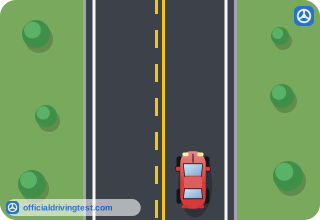
- The side with the dashed yellow line
- The side with the solid yellow line
- Both sides, unless the road ahead is clear
- Neither side, because the lines are the same color
Show answer
Correct answer: The side with the solid yellow line
Passing is not allowed on the side with the solid yellow line; vehicles on the dashed-line side may pass when it is safe.
Source: Iowa Driver’s License Manual (July 2026), page 15
-
What do yield lines look like?
- A row of solid yellow triangles pointing away from approaching vehicles
- A single solid white line across the travel lane
- A row of white triangles pointing in the direction of travel
- A row of solid white triangles pointing toward approaching vehicles
Show answer
Correct answer: A row of solid white triangles pointing toward approaching vehicles
Yield lines are a row of solid white triangles pointing toward approaching vehicles, extending across a travel lane.
Source: Iowa Driver’s License Manual (July 2026), page 15
-
What do yield lines across a travel lane show?
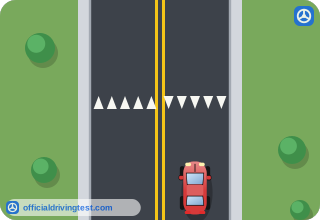
- The point where vehicles must come to a full stop
- The area where pedestrians are to cross the roadway
- The point where vehicles should yield
- The point where a lane is reserved for special vehicles
Show answer
Correct answer: The point where vehicles should yield
Yield lines extend across a travel lane to indicate the point where vehicles should yield.
Source: Iowa Driver’s License Manual (July 2026), page 15
-
Yield lines are used to show where to yield in compliance with which of these signs?
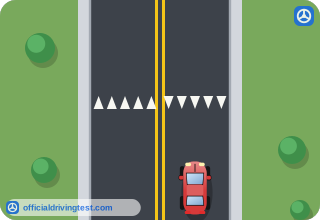
- "Yield Here To Pedestrians"
- "Do Not Enter" or "Wrong Way"
- "Stop Ahead" or "Signal Ahead"
- "No Passing Zone" or "Keep Right"
Show answer
Correct answer: "Yield Here To Pedestrians"
Yield lines indicate where vehicles should yield in compliance with "Yield," "Yield Here To Pedestrians," or "Yield Here to Pedestrians and Bicycles" signs.
Source: Iowa Driver’s License Manual (July 2026), page 15
-
A sign or signal requires you to stop. Where must you stop?
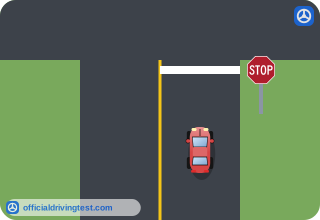
- Past the stop line, wherever you can best see the cross traffic
- Inside the intersection, just beyond the crosswalk, to see better
- In the middle of the crosswalk so pedestrians can see you
- Before your vehicle reaches the stop line, or the crosswalk if there is one
Show answer
Correct answer: Before your vehicle reaches the stop line, or the crosswalk if there is one
When required to stop by a sign or signal, you must stop before your vehicle reaches the stop line, or a crosswalk if there is one.
Source: Iowa Driver’s License Manual (July 2026), page 15
-
What do special arrow markings on the pavement show when they are used?
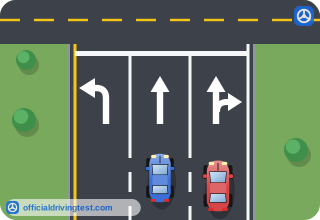
- The lanes that are open only at certain times of the day
- The movements that are allowed or required in that lane
- The lane that is reserved for high-occupancy vehicles
- The point where traffic must stop for pedestrians
Show answer
Correct answer: The movements that are allowed or required in that lane
Special arrow markings show the movements that are allowed or required when driving in that lane.
Source: Iowa Driver’s License Manual (July 2026), page 15
-
What is a reversible lane?
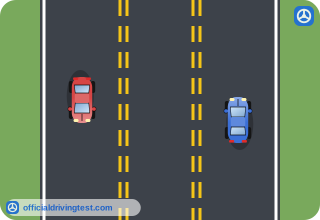
- A lane reserved for vehicles making left turns from either direction
- A lane for vehicles carrying two or more people
- A lane that bicyclists use when traveling against traffic
- A lane that carries traffic in opposite directions at different times
Show answer
Correct answer: A lane that carries traffic in opposite directions at different times
Reversible lanes are designed to carry traffic in one direction at certain times and in the opposite direction at other times.
Source: Iowa Driver’s License Manual (July 2026), page 15
-
How are reversible lanes usually marked?
- By a solid white line on each side
- By a row of white triangles
- By double-dashed yellow lines
- By a solid yellow line and a dashed white line
Show answer
Correct answer: By double-dashed yellow lines
Reversible lanes are usually marked by double-dashed yellow lines.
Source: Iowa Driver’s License Manual (July 2026), page 15
-
What should you do before you start driving in a reversible lane?
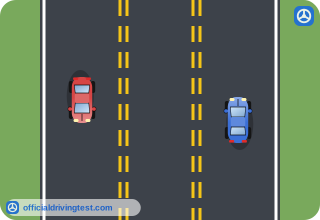
- Check to see which lanes you can use at that time
- Wait for traffic to clear in every lane
- Check that the lane is marked with a white diamond
- Slow down to half the posted speed limit
Show answer
Correct answer: Check to see which lanes you can use at that time
Before driving in a reversible lane, check to see which lanes you can use at that time, using the signs or special lights provided.
Source: Iowa Driver’s License Manual (July 2026), page 15
-
For which vehicles are shared left-turn lanes reserved?
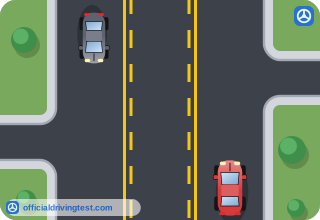
- Vehicles that are passing slower traffic
- Vehicles making left turns from either direction
- Vehicles going straight in either direction
- Vehicles carrying two or more people
Show answer
Correct answer: Vehicles making left turns from either direction
Shared left-turn lanes are reserved for vehicles making left turns from either direction.
Source: Iowa Driver’s License Manual (July 2026), page 16
-
How are the left-turn arrows on the pavement of a shared left-turn lane arranged?
- They all point toward the nearest intersection ahead
- They point only in the direction of the heavier traffic
- They appear only at the start of the lane, in one direction
- They alternate with arrows for traffic from the other direction
Show answer
Correct answer: They alternate with arrows for traffic from the other direction
On a shared left-turn lane, left-turn arrows for traffic in one direction alternate with left-hand arrows for traffic coming from the other direction.
Source: Iowa Driver’s License Manual (July 2026), page 16
-
How are shared left-turn lanes marked on each side?
- By a solid white line and a dashed white line
- By double solid yellow lines
- By a solid yellow line and a dashed yellow line
- By a dashed white line only
Show answer
Correct answer: By a solid yellow line and a dashed yellow line
Shared left-turn lanes are marked on each side by a solid yellow and a dashed yellow line.
Source: Iowa Driver’s License Manual (July 2026), page 16
-
What may a driver do in a shared left-turn lane before making a left turn?
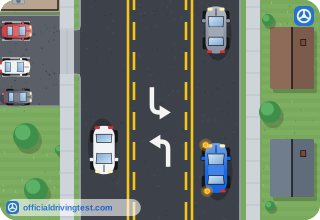
- Enter the lane and stop
- Pass slower traffic
- Drive in the lane for a long distance
- Make a U-turn from the lane
Show answer
Correct answer: Enter the lane and stop
Vehicles may enter and stop in a shared left-turn lane before making a left turn, but the lane cannot be used for passing.
Source: Iowa Driver’s License Manual (July 2026), page 16
-
Which statement about a shared left-turn lane is correct?
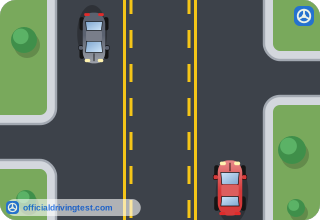
- It may be used for passing when the road is clear
- It may be used for passing on two-lane roads only
- It may be used for passing by emergency vehicles only
- It cannot be used for passing
Show answer
Correct answer: It cannot be used for passing
The manual says a shared left-turn lane cannot be used for passing.
Source: Iowa Driver’s License Manual (July 2026), page 16
-
What is often posted at the side of the road or painted on the road surface to mark a reserved lane?
- A yellow square
- A white diamond
- A red circle
- A green triangle
Show answer
Correct answer: A white diamond
Reserved lanes are marked by signs and often have a white diamond posted at the side of the road and/or painted on the road surface.
Source: Iowa Driver’s License Manual (July 2026), page 16
-
When may you travel in a reserved lane?
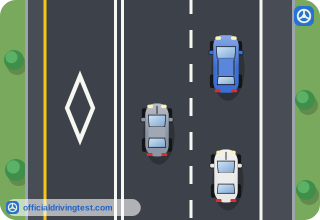
- Only when you are operating the type of vehicle the lane is reserved for
- Only when the other lanes of the road are closed to traffic
- Only when traffic in the other lanes is moving slower than the speed limit
- Only when you are making a turn from the lane at the next intersection
Show answer
Correct answer: Only when you are operating the type of vehicle the lane is reserved for
You must not travel in a reserved lane unless you are operating that type of vehicle.
Source: Iowa Driver’s License Manual (July 2026), page 16
-
A road has a double yellow center line, and broken white lines separate lanes traveling in the same direction. May you pass by crossing the center yellow lines?
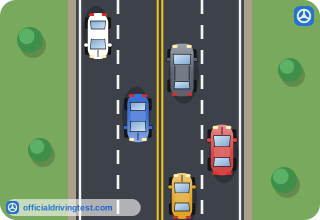
- No, not over the center yellow lines in either direction
- Yes, when no oncoming vehicle is in sight
- Yes, but only when you are passing a slow-moving vehicle
- Yes, but only on a straight stretch of road
Show answer
Correct answer: No, not over the center yellow lines in either direction
With a double yellow center line there is no passing either way over the center yellow lines.
Source: Iowa Driver’s License Manual (July 2026), page 45
-
A road has a double yellow center line and broken white lane lines. What do these markings allow?
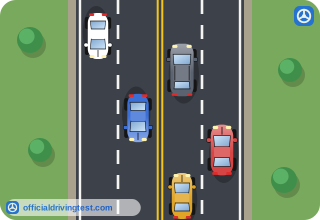
- Passing only across the broken white lines
- Passing across the center lines when it is clear
- No passing in any lane at all
- Passing only on the right shoulder
Show answer
Correct answer: Passing only across the broken white lines
There is no passing either way over the center yellow lines. Broken white lines separate traffic traveling in the same direction, and passing is allowed when a broken white line is in your lane.
Source: Iowa Driver’s License Manual (July 2026), page 45
-
The center of a two-way road has a solid yellow line next to a broken yellow line. Which traffic may pass?
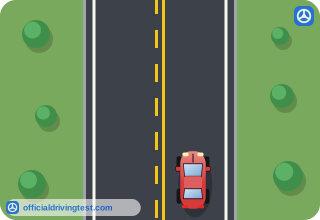
- Only traffic in the lane next to the solid line
- Traffic in both lanes
- Only traffic in the lane next to the broken line
- Traffic in neither lane
Show answer
Correct answer: Only traffic in the lane next to the broken line
A driver must not pass when the solid line is in their lane. Traffic in the lane next to the broken line can pass.
Source: Iowa Driver’s License Manual (July 2026), page 45
-
What do yellow lines on the road separate?
- Traffic traveling in the same direction
- Traffic traveling in different directions
- Parking spaces from travel lanes
- Bicycle lanes from travel lanes
Show answer
Correct answer: Traffic traveling in different directions
Yellow lines separate traffic traveling in different directions.
Source: Iowa Driver’s License Manual (July 2026), page 45
-
What do white lines on the road separate?
- Traffic traveling in different directions
- Vehicles that may pass from vehicles that may not
- Slow-moving vehicles from faster vehicles
- Traffic traveling in the same direction
Show answer
Correct answer: Traffic traveling in the same direction
White lines separate traffic traveling in the same direction.
Source: Iowa Driver’s License Manual (July 2026), page 45