Iowa: Parking rules Practice Test
Parking on hills, the places where parking is not allowed and how far to stay from them, and parking-assist technology.
Independent educational site · not affiliated with any government agency or DMV
Ready? Test yourself
- Instant feedback with an explanation
- Every answer cites its source in the manual
- Your best score is saved on this device
Questions are original and based on the official manual "Iowa Driver’s License Manual" (July 2026), Iowa Department of Transportation.
All 28 questions in this practice test
Take the test above first, then use this list to study. Tap “Show answer” to see the correct answer and explanation.
Show the questions and answersHide the questions
-
If you must park on a roadway, how should you park your vehicle?
- As far away from traffic as possible
- Partly in the lane so other drivers can see it
- Directly beside the nearest travel lane
- Wherever it is closest to your destination
Show answer
Correct answer: As far away from traffic as possible
The manual says that if you must park on a roadway you should park as far away from traffic as possible.
Source: Iowa Driver’s License Manual (July 2026), page 21
-
When you must park on a roadway that has a curb, how close to the curb must you park?
- Within 24 inches of the curb
- Within 30 inches of the curb
- Within 18 inches of the curb
- Within 36 inches of the curb
Show answer
Correct answer: Within 18 inches of the curb
When parking on a roadway with a curb, you park within 18 inches of the curb or closer.
Source: Iowa Driver’s License Manual (July 2026), page 21
-
Where should you park if it is possible?
- On the shoulder of the road
- In a designated area
- Beside a travel lane with hazard lights on
- On the sidewalk
Show answer
Correct answer: In a designated area
The manual advises parking in a designated area, if possible.
Source: Iowa Driver’s License Manual (July 2026), page 21
-
How far from any travel lane should you park?
- Close enough that other drivers can see the vehicle
- Close enough to leave again without checking traffic
- Close enough that its hazard lights stay visible
- Far enough to avoid interfering with traffic
Show answer
Correct answer: Far enough to avoid interfering with traffic
You should park far enough from any travel lane to avoid interfering with traffic.
Source: Iowa Driver’s License Manual (July 2026), page 21
-
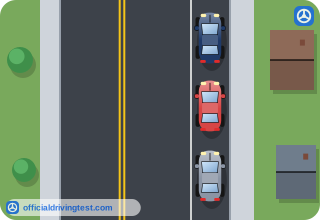
What should you do before you open the door of a parked vehicle?
- Check traffic
- Sound your horn
- Flash your headlights
- Roll down all the windows
Show answer
Correct answer: Check traffic
The manual says to check traffic before you open the door of a parked vehicle.
Source: Iowa Driver’s License Manual (July 2026), page 21
-
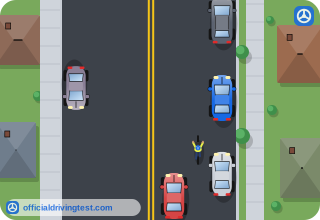
From which side should you get out of a parked vehicle if necessary?
- The traffic side
- The driver’s side only
- The curb side
- The side with the most room
Show answer
Correct answer: The curb side
If necessary, you should get out of the vehicle on the curb side.
Source: Iowa Driver’s License Manual (July 2026), page 21
-
After you park, what are you responsible for making sure of?
- That your vehicle stays locked at all times
- That your vehicle does not become a hazard
- That your vehicle faces the direction of traffic
- That your vehicle is visible from the nearest lane
Show answer
Correct answer: That your vehicle does not become a hazard
Drivers are responsible for making sure their parked vehicles do not become a hazard.
Source: Iowa Driver’s License Manual (July 2026), page 21
-
At which of these places is parking not allowed?
- 25 feet from a fire station entrance
- 15 feet from a stop sign
- 60 feet from a railroad crossing
- In an intersection
Show answer
Correct answer: In an intersection
The manual lists parking in an intersection as not allowed.
Source: Iowa Driver’s License Manual (July 2026), page 21
-
Which of these is a place where you may not park?
- On a sidewalk
- 25 feet from a fire station entrance
- 70 feet from a railroad crossing
- 12 feet from a stop sign
Show answer
Correct answer: On a sidewalk
Parking on a sidewalk is not allowed.
Source: Iowa Driver’s License Manual (July 2026), page 21
-
Which of these parking spots breaks the rules in the manual?
- 30 feet from a fire station entrance
- 75 feet from a railroad crossing
- On a crosswalk
- 20 feet from a stop sign
Show answer
Correct answer: On a crosswalk
The manual says not to park on a crosswalk.
Source: Iowa Driver’s License Manual (July 2026), page 21
-
Parking in front of what is not allowed?
- A street lamp on the roadside
- A public or private driveway
- A utility pole beside the road
- A tree beside the sidewalk
Show answer
Correct answer: A public or private driveway
You may not park in front of a public or private driveway.
Source: Iowa Driver’s License Manual (July 2026), page 21
-
On which bridges is parking not allowed?
- Only bridges over a river
- Only bridges longer than a city block
- Only bridges with a railroad underneath
- Any bridge outside city limits
Show answer
Correct answer: Any bridge outside city limits
The manual says not to park on any bridge outside city limits, or in highway tunnels.
Source: Iowa Driver’s License Manual (July 2026), page 21
-
What does the manual call parking alongside another stopped or parked car, which is not allowed?
- Double parking
- Parallel parking
- Angle parking
- Diagonal parking
Show answer
Correct answer: Double parking
Parking alongside another stopped or parked car is called double parking and is not allowed.
Source: Iowa Driver’s License Manual (July 2026), page 21
-
You may not park closer than how far from a fire hydrant?
- Three feet
- Eight feet
- Five feet
- Fifteen feet
Show answer
Correct answer: Five feet
You may not park closer than five feet from a fire hydrant, or in a designated hydrant red zone.
Source: Iowa Driver’s License Manual (July 2026), page 21
-
You may not park closer than how far from a stop sign?
- 5 feet
- 10 feet
- 15 feet
- 25 feet
Show answer
Correct answer: 10 feet
Parking closer than 10 feet from a stop sign is not allowed.
Source: Iowa Driver’s License Manual (July 2026), page 21
-
You may not park closer than how far from a fire station entrance?
- 10 feet
- 30 feet
- 40 feet
- 20 feet
Show answer
Correct answer: 20 feet
Parking closer than 20 feet from a fire station entrance is not allowed.
Source: Iowa Driver’s License Manual (July 2026), page 21
-
You may not park closer than how far from a railroad crossing?
- 50 feet
- 25 feet
- 30 feet
- 75 feet
Show answer
Correct answer: 50 feet
Parking closer than 50 feet from a railroad crossing is not allowed.
Source: Iowa Driver’s License Manual (July 2026), page 21
-
Which of these usually marks a “NO PARKING ZONE”?
- Green painted curbs
- White painted curbs
- Yellow painted curbs
- Purple painted curbs
Show answer
Correct answer: Yellow painted curbs
No parking zones are usually marked with signs, yellow painted curbs, or pavement markings or lines.
Source: Iowa Driver’s License Manual (July 2026), page 21
-
Who may park in a space reserved for persons with disabilities?
- Any driver stopping briefly while someone waits in the car
- Only a driver who has a Persons with Disabilities Parking Permit
- Any driver who holds a valid Iowa driver’s license
- Any driver when all of the other spaces are full
Show answer
Correct answer: Only a driver who has a Persons with Disabilities Parking Permit
You may park in a reserved space only if you have a Persons with Disabilities Parking Permit.
Source: Iowa Driver’s License Manual (July 2026), page 21
-
What do parking sensors do?
- They park the vehicle for you without any input from the driver
- They alert you to the position of objects around your vehicle as you park
- They warn you of vehicles approaching from the left and right as you back out
- They show a camera view of the area behind your vehicle as you park
Show answer
Correct answer: They alert you to the position of objects around your vehicle as you park
Parking sensors alert you to the position of objects around your vehicle as you park.
Source: Iowa Driver’s License Manual (July 2026), page 31
-
As a vehicle with parking sensors gets closer to an object, what may happen to the beeps?
- The beeps may become quieter
- The intervals between beeps may become longer
- The beeps may stop before the vehicle reaches the object
- The intervals between beeps may become shorter
Show answer
Correct answer: The intervals between beeps may become shorter
With parking sensors, the intervals between beeps may become shorter the closer the vehicle is to an object.
Source: Iowa Driver’s License Manual (July 2026), page 31
-
With parking sensors, what does a constant tone mean?
- The vehicle is close to an object
- The vehicle is parked correctly
- It is safe to keep backing up
- The sensors have been turned off
Show answer
Correct answer: The vehicle is close to an object
A constant tone from parking sensors means the vehicle is close to an object.
Source: Iowa Driver’s License Manual (July 2026), page 31
-
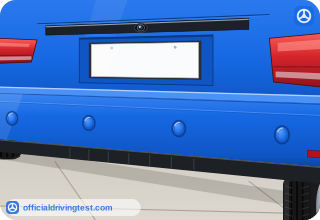
Which kind of object might parking sensors fail to detect?
- An object directly behind the vehicle
- An object that is brightly colored
- An object that is larger than a car
- An object that is flat on the ground
Show answer
Correct answer: An object that is flat on the ground
Parking sensors may not detect objects that are flat on the ground, below the bumper, too close to the vehicle, or too far from it.
Source: Iowa Driver’s License Manual (July 2026), page 31
-
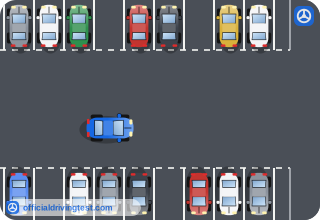
While parking with parking sensors, what should you use to stay aware of your surroundings?
- Only the beeps and tones from the sensors
- Mirrors, head checks, and rear cameras
- The horn and the hazard lights
- The headlights and the turn signal
Show answer
Correct answer: Mirrors, head checks, and rear cameras
Do not rely solely on parking sensors; stay aware of your surroundings through mirrors, head checks, and rear cameras while parking.
Source: Iowa Driver’s License Manual (July 2026), page 31
-
With automatic parallel parking, what are you still responsible for?
- Finding the space and checking its size
- Adjusting the sensors for the vehicle's size
- Reporting the parked position to the dealership
- Braking and monitoring the environment
Show answer
Correct answer: Braking and monitoring the environment
Automatic parallel parking helps guide you into a parallel parking spot, but you are still responsible for braking and monitoring the environment.
Source: Iowa Driver’s License Manual (July 2026), page 33
-
How do you find out that automatic parallel parking has found a spot?
- A horn sounds whenever you pass any open space
- The vehicle stops by itself beside the open space
- The system informs you when it finds a spot
- You find the spot yourself and then press a pedal
Show answer
Correct answer: The system informs you when it finds a spot
The automatic parallel parking system will inform you when it has found an appropriate spot to park.
Source: Iowa Driver’s License Manual (July 2026), page 33
-
Which of these may automatic parallel parking prompt you to do?
- Take your foot off the brake pedal
- Take your hands off the steering wheel
- Turn off the engine
- Open the driver's door
Show answer
Correct answer: Take your hands off the steering wheel
The prompts from automatic parallel parking may include pulling in front of the space, shifting into reverse, and taking hands off the steering wheel.
Source: Iowa Driver’s License Manual (July 2026), page 33
-
After a vehicle has parked itself with automatic parallel parking, what may you need to do?
- Restart the vehicle to confirm that it is parked
- Reset the parking sensors at the dealership
- Drive out of the space and start the process again
- Make slight adjustments to reach an optimal position
Show answer
Correct answer: Make slight adjustments to reach an optimal position
After the vehicle is parked, you may need to do some slight adjustments to ensure it is in an optimal position.
Source: Iowa Driver’s License Manual (July 2026), page 33