Iowa: Emergency vehicles and work zones Practice Test
Yielding to emergency vehicles, Iowa’s Move Over or Slow Down law, work zones and flaggers, and traffic stops by law enforcement.
Independent educational site · not affiliated with any government agency or DMV
Ready? Test yourself
- Instant feedback with an explanation
- Every answer cites its source in the manual
- Your best score is saved on this device
Questions are original and based on the official manual "Iowa Driver’s License Manual" (July 2026), Iowa Department of Transportation.
All 29 questions in this practice test
Take the test above first, then use this list to study. Tap “Show answer” to see the correct answer and explanation.
Show the questions and answersHide the questions
-
What is the basic color of signs and warning devices in work zones?
- Orange
- Yellow
- Red
- Green
Show answer
Correct answer: Orange
Orange is the basic color of work zone signs and warning devices.
Source: Iowa Driver’s License Manual (July 2026), page 14
-
What shape are most signs in work areas?
- Octagonal
- Triangular
- Diamond-shaped
- Round
Show answer
Correct answer: Diamond-shaped
Most signs in work areas are diamond-shaped, although a few signs are rectangular.
Source: Iowa Driver’s License Manual (July 2026), page 14
-
What may happen to fines in work area zones?
- They may be waived
- They may double
- They may be cut in half
- They may triple
Show answer
Correct answer: They may double
The manual says to stay alert and drive cautiously because fines may double in work area zones.
Source: Iowa Driver’s License Manual (July 2026), page 14
-
When are large flashing arrow panels typically used?
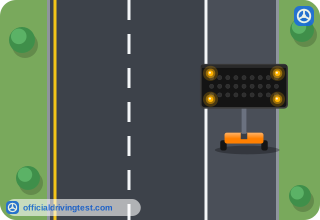
- When a flagger is not present
- When the speed limit has been reduced
- When a road has just been repainted
- When a lane or shoulder is closed
Show answer
Correct answer: When a lane or shoulder is closed
Large flashing arrow panels are typically used when a lane or shoulder is closed.
Source: Iowa Driver’s License Manual (July 2026), page 14
-
What color vests, shirts, or jackets should flaggers be wearing?
- White or light gray
- Red or dark blue
- Fluorescent yellow green or orange
- Black with reflective stripes
Show answer
Correct answer: Fluorescent yellow green or orange
Flaggers should be wearing fluorescent yellow green or orange vests, shirts or jackets.
Source: Iowa Driver’s License Manual (July 2026), page 14
-
What do flaggers normally use to control traffic in a work zone?
- Stop/slow signs
- Green and red lanterns
- Whistles and hand signals only
- Flashing arrow panels
Show answer
Correct answer: Stop/slow signs
Flaggers will normally use stop/slow signs, and drivers must follow their instructions.
Source: Iowa Driver’s License Manual (July 2026), page 14
-
Which item may flaggers occasionally use?
- Yellow flags
- Green flags
- Blue flags
- Red flags
Show answer
Correct answer: Red flags
Flaggers normally use stop/slow signs, but red flags may be used occasionally.
Source: Iowa Driver’s License Manual (July 2026), page 14
-
How should you adjust your following distance in a work zone?
- Decrease it
- Increase it
- Keep it the same as on open road
- Match the distance of the vehicle ahead
Show answer
Correct answer: Increase it
One of the manual's rules for work zones is to increase your following distance.
Source: Iowa Driver’s License Manual (July 2026), page 14
-
How should you set your speed in a work zone?
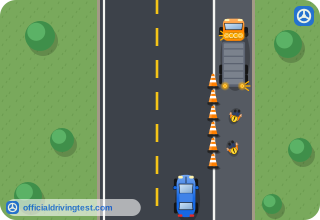
- Adjust it to the traffic conditions
- Keep it at the speed limit of the road before the zone
- Drive as fast as the flow of traffic allows, regardless of signs
- Slow to a crawl whether or not traffic is moving
Show answer
Correct answer: Adjust it to the traffic conditions
Drivers should adjust their speed to the traffic conditions in a work zone.
Source: Iowa Driver’s License Manual (July 2026), page 14
-
Whose instructions must you obey in a work zone?
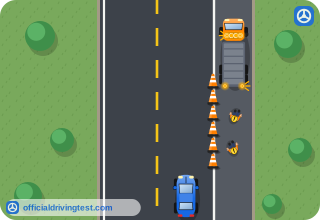
- Flaggers and police officers, but not traffic signals
- Posted signs and cones, but not flaggers
- All signs, traffic signals, and flaggers
- Temporary traffic signals only, not signs or flaggers
Show answer
Correct answer: All signs, traffic signals, and flaggers
Drivers must obey all instructions provided by signs, traffic signals, and flaggers in a work zone.
Source: Iowa Driver’s License Manual (July 2026), page 14
-
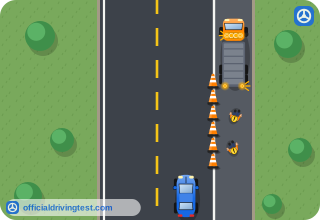
What should you give to driving when you go through a work zone?
- A quick glance at the signs only
- Your full attention
- Attention only while workers are visible
- Attention only when traffic is heavy
Show answer
Correct answer: Your full attention
One of the manual's work zone rules is to give your full attention to driving.
Source: Iowa Driver’s License Manual (July 2026), page 14
-
Which of these is a channelizing device used in work zones?
- An arrow board
- A flagger
- A temporary traffic signal
- Drums
Show answer
Correct answer: Drums
Barricades, vertical panels, drums, cones, and tubular markers are the most common channelizing devices in work zones.
Source: Iowa Driver’s License Manual (July 2026), page 14
-
What are channelizing devices used for in work zones?
- To show drivers where the next rest area or exit is located
- To measure how fast vehicles are traveling in the zone
- To alert drivers to dangerous conditions and guide them safely
- To block all traffic until the workers have finished the job
Show answer
Correct answer: To alert drivers to dangerous conditions and guide them safely
Channelizing devices alert drivers of unusual and potentially dangerous conditions and guide them safely through the work zone.
Source: Iowa Driver’s License Manual (July 2026), page 14
-
What should you do when you see or hear an emergency vehicle approaching from any direction?
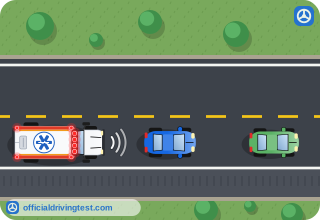
- Pull over to the left edge of the road, or as near to the left as possible
- Pull over to the right edge of the road, or as near to the right as possible
- Slow down and keep driving in your lane until the vehicle has passed
- Stop in the middle of your lane and wait until the vehicle has passed
Show answer
Correct answer: Pull over to the right edge of the road, or as near to the right as possible
Drivers must pull over to the right edge of the road, or as near to the right as possible, when an emergency vehicle approaches.
Source: Iowa Driver’s License Manual (July 2026), page 19
-
You are in an intersection when an emergency vehicle approaches. What should you do?
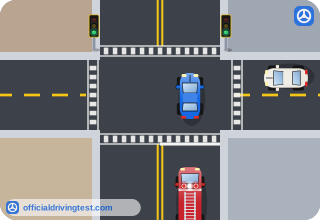
- Stop where you are and wait for the vehicle to pass
- Pull over to the right inside the intersection at once
- Back up out of the intersection to clear the way
- Drive through the intersection before you pull over
Show answer
Correct answer: Drive through the intersection before you pull over
In an intersection, including a roundabout, drive through before pulling over for an emergency vehicle.
Source: Iowa Driver’s License Manual (July 2026), page 19
-
On a street or highway separated by a median, when do you not have to stop for an emergency vehicle?
- When the emergency vehicle is on the other side of the median
- When you are driving in the left lane of a divided road
- When the emergency vehicle is using only its red lights
- When the emergency vehicle is traveling in your direction
Show answer
Correct answer: When the emergency vehicle is on the other side of the median
If the road is separated by a median and the emergency vehicle is on the other side, you do not have to stop.
Source: Iowa Driver’s License Manual (July 2026), page 19
-
How far behind an emergency vehicle that is using lights and sirens must you stay?
- At least 100 feet
- At least 300 feet
- At least 500 feet
- At least 1,000 feet
Show answer
Correct answer: At least 500 feet
Drivers must stay at least 500 feet behind any emergency vehicle using lights and sirens.
Source: Iowa Driver’s License Manual (July 2026), page 19
-
What does Iowa’s Move Over or Slow Down Law require motorists to do when approaching certain stopped vehicles displaying flashing lights?
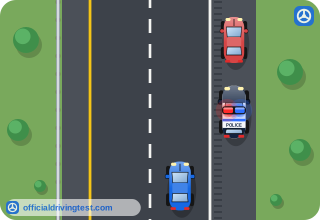
- Stop completely behind the vehicle
- Sound the horn to warn the vehicle
- Keep the same speed and stay in the lane
- Change lanes
Show answer
Correct answer: Change lanes
The law requires motorists to change lanes when approaching the listed stopped vehicles with flashing lights.
Source: Iowa Driver’s License Manual (July 2026), page 22
-
Under the Move Over or Slow Down Law, what must you do if a lane change is not possible, is prohibited by law, or is unsafe?
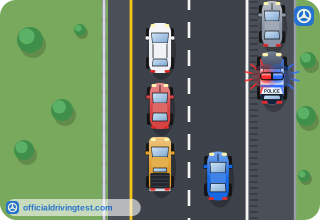
- Slow down and be prepared to stop
- Maintain your speed and sound your horn
- Move onto the shoulder and pass quickly
- Stop and wait until the vehicle leaves
Show answer
Correct answer: Slow down and be prepared to stop
If you cannot change lanes, you must slow down and be prepared to stop.
Source: Iowa Driver’s License Manual (July 2026), page 22
-
Under the Move Over or Slow Down Law, what kind of speed must you use when you cannot change lanes?
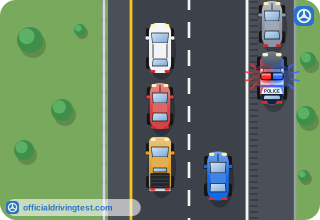
- A speed of 20 miles per hour or less
- Half of the posted speed limit
- A reasonable and proper speed for the conditions
- The exact posted speed limit for that road
Show answer
Correct answer: A reasonable and proper speed for the conditions
No speed is specified, but it must be reasonable and proper for the existing conditions.
Source: Iowa Driver’s License Manual (July 2026), page 22
-
Besides emergency and work vehicles, which stopped vehicle also triggers Iowa’s Move Over or Slow Down Law?
- Any vehicle parked at the curb with its lights off
- Any motor vehicle continually displaying hazard lights
- Only vehicles owned by a government agency
- Any vehicle that is moving slower than traffic
Show answer
Correct answer: Any motor vehicle continually displaying hazard lights
The law also covers any stopped motor vehicle, including a passenger vehicle, that is continually displaying hazard lights.
Source: Iowa Driver’s License Manual (July 2026), page 22
-
What may happen if you violate Iowa’s Move Over or Slow Down Law?
- Your license may be suspended for up to 30 days
- Your license may be suspended for up to 90 days
- Your license may be suspended for up to two years
- Your license may be suspended for up to one year
Show answer
Correct answer: Your license may be suspended for up to one year
Violating the law may result in your license being suspended for up to one year.
Source: Iowa Driver’s License Manual (July 2026), page 22
-
In a work zone, which of these requires you to stop?
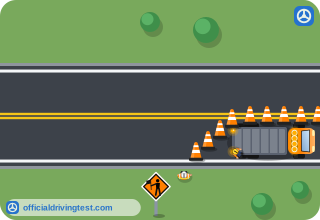
- An instruction from a work zone flagger
- An orange cone beside the road
- A truck passing you in the next lane
- A highway sign that warns of workers
Show answer
Correct answer: An instruction from a work zone flagger
You must always stop when instructed by a construction work zone flagger.
Source: Iowa Driver’s License Manual (July 2026), page 41
-
What should you do when engaging with a law enforcement officer?
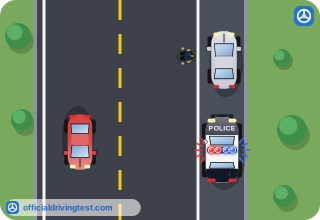
- Stay seated and look away
- Get out and approach the officer
- Remain calm and follow instructions
- Ask the officer to wait
Show answer
Correct answer: Remain calm and follow instructions
When engaging with a law enforcement officer, remain calm and follow instructions.
Source: Iowa Driver’s License Manual (July 2026), page 64
-
When a law enforcement vehicle signals you to stop, what should you do?
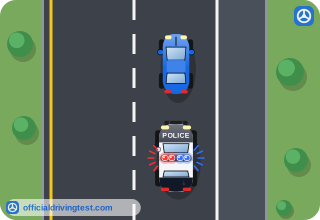
- Stop at once in the travel lane
- Carefully pull over to a clear area when it is safe
- Keep driving to your destination and pull over there
- Speed up to the next exit
Show answer
Correct answer: Carefully pull over to a clear area when it is safe
If you see a law enforcement vehicle signaling you to stop, carefully pull over to a clear area when it is safe.
Source: Iowa Driver’s License Manual (July 2026), page 64
-
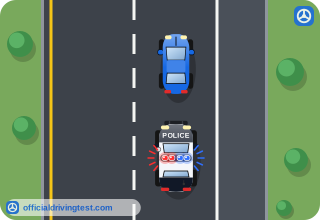
When signaled to stop by law enforcement, where must you not stop?
- On a less busy side street
- In a parking lot
- In a clear area
- In the travel lane
Show answer
Correct answer: In the travel lane
The manual says not to stop in the travel lane when signaled to stop by law enforcement.
Source: Iowa Driver’s License Manual (July 2026), page 64
-
On busy streets or highways, where may it be safest to pull over for a traffic stop?
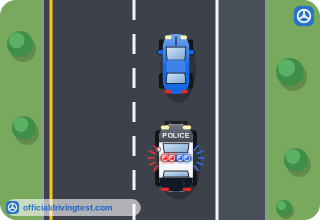
- Into a parking lot or on a less busy side street
- Onto the nearest bridge or overpass ahead
- Into the left lane
- Onto the grass of the center median
Show answer
Correct answer: Into a parking lot or on a less busy side street
On busy streets or highways, it may be safest to pull over into a parking lot or on a less busy side street.
Source: Iowa Driver’s License Manual (July 2026), page 64
-
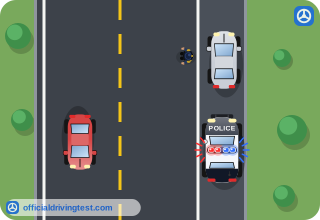
At a traffic stop, what should you do with your vehicle after pulling over?
- Leave the engine running
- Shift to reverse
- Turn it off
- Back up toward the officer
Show answer
Correct answer: Turn it off
At a traffic stop, turn off your vehicle, keep your hands visible, remain calm and follow the officer's instructions.
Source: Iowa Driver’s License Manual (July 2026), page 64
-
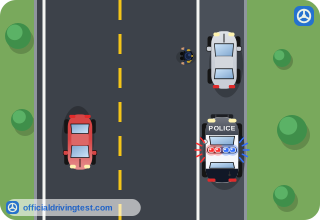
At a traffic stop, where should you keep your hands?
- Under the seat
- Visible, recommended on the steering wheel
- On the dashboard, where the officer can't see them
- Out of the window, waving
Show answer
Correct answer: Visible, recommended on the steering wheel
Keep your hands visible, recommended on the steering wheel.
Source: Iowa Driver’s License Manual (July 2026), page 64