Illinois: Right of way & turning — Part 3 Practice Test
Questions in this part include: “Before passing on a two-lane highway, what should be true of the left lane?” · “On a two-lane, two-way roadway, in which school zones is passing not allowed?”
Independent educational site · not affiliated with any government agency or DMV
Ready? Test yourself
- Instant feedback with an explanation
- Every answer cites its source in the manual
- Your best score is saved on this device
Questions are original and based on the official manual "Illinois Rules of the Road" (2026), Illinois Secretary of State.
All 19 questions in this practice test
Take the test above first, then use this list to study. Tap “Show answer” to see the correct answer and explanation.
Show the questions and answersHide the questions
-
Before passing on a two-lane highway, what should be true of the left lane?
- It is marked with a solid yellow line on your side of the road
- It has oncoming traffic no closer than 100 feet from your vehicle
- It is clearly visible and free of oncoming traffic far enough to pass
- It is the lane nearest a hill or curve, so you can pass quickly
Show answer
Correct answer: It is clearly visible and free of oncoming traffic far enough to pass
On a two-lane highway, the left lane should be clearly visible and free of oncoming traffic for a distance great enough to permit passing.
Source: Illinois Rules of the Road (2026), page 28
-
After passing a vehicle, when may you turn back into the right-hand lane?
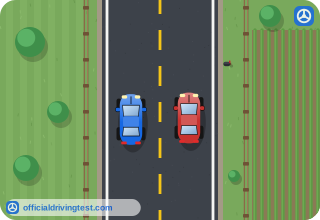
- As soon as your front bumper is just past the other vehicle's bumper
- When the entire vehicle you passed is visible in the rearview mirror
- When the other driver flashes the headlights or turn signals at you
- Only after you have driven at least one mile further in the left lane
Show answer
Correct answer: When the entire vehicle you passed is visible in the rearview mirror
Do not turn back into the right-hand lane until the entire vehicle you just passed is visible in the rearview mirror.
Source: Illinois Rules of the Road (2026), page 28
-
When passing, you must return to your lane before getting within what distance of an oncoming vehicle?
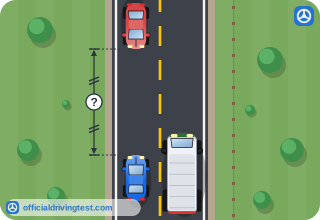
- 50 feet
- 100 feet
- 500 feet
- 200 feet
Show answer
Correct answer: 200 feet
You must return to your lane before getting within 200 feet of an oncoming vehicle.
Source: Illinois Rules of the Road (2026), page 28
-
Another vehicle is passing you. What must you not do?
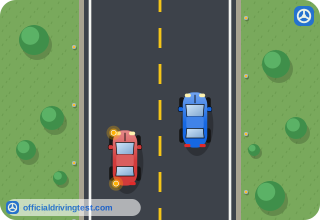
- Keep a steady speed
- Increase your speed
- Stay in your lane
- Watch your mirrors
Show answer
Correct answer: Increase your speed
The driver of the vehicle being passed must not increase speed until the passing maneuver is completed.
Source: Illinois Rules of the Road (2026), page 28
-
On a two-lane roadway with enough room, when may you pass another vehicle on the right?
- Whenever it is driving below the speed limit
- When you can use the paved shoulder to get by
- When it is making or about to make a left turn
- Whenever it is stopped for a school bus ahead
Show answer
Correct answer: When it is making or about to make a left turn
You may pass on the right on a two-lane roadway when there is enough room and the vehicle you are passing is making or about to make a left turn.
Source: Illinois Rules of the Road (2026), page 28
-
On which kind of road may you pass on the right?
- Any two-lane road, using the shoulder if the lane is narrow
- A one-way street or a road with two or more clear lanes each way
- Only a gravel road with no pavement markings at all
- Only a road marked with a solid yellow center line
Show answer
Correct answer: A one-way street or a road with two or more clear lanes each way
You may pass on the right on a one-way street or on a roadway with two or more clear lanes in each direction.
Source: Illinois Rules of the Road (2026), page 28
-
Who may use the shoulder when passing on the right?
- Any vehicle signaling
- Any driver in a hurry
- Motorcycles and mopeds
- Only authorized vehicles
Show answer
Correct answer: Only authorized vehicles
You may pass on the right, but not on the shoulder except for authorized vehicles.
Source: Illinois Rules of the Road (2026), page 28
-
At what kind of intersection may you pass on the right?
- Any one with a stop sign
- One widened for this purpose
- Any one with a railroad
- Any uncontrolled one
Show answer
Correct answer: One widened for this purpose
You may pass on the right at an intersection widened for this purpose.
Source: Illinois Rules of the Road (2026), page 28
-
On a two-lane, two-way roadway, when is passing on a hill or curve not allowed?
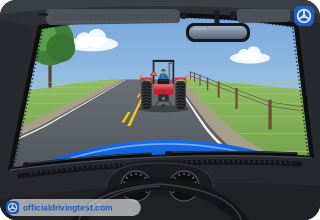
- When it is not possible to see oncoming vehicles
- Only at night, when headlights are required
- Only when a truck is the vehicle being passed
- Never; hills and curves have no passing rules
Show answer
Correct answer: When it is not possible to see oncoming vehicles
Passing is not allowed on a hill or curve where it is not possible to see oncoming vehicles.
Source: Illinois Rules of the Road (2026), page 29
-
When your view is blocked, passing is not allowed within what distance of a bridge, viaduct, or tunnel?
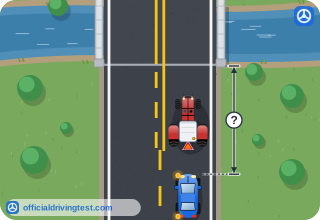
- 100 feet
- 50 feet
- 300 feet
- 500 feet
Show answer
Correct answer: 100 feet
Passing is not allowed when the view is blocked within 100 feet of any bridge, viaduct or tunnel.
Source: Illinois Rules of the Road (2026), page 29
-
On a two-lane, two-way roadway, in which school zones is passing not allowed?
- Only school zones inside city limits, and only when children are visible
- Only school zones on interstate highways during the morning drop-off
- None; passing is allowed in school zones if you stay under 20 mph
- Any school zone in an unincorporated area and any posted one in an incorporated area
Show answer
Correct answer: Any school zone in an unincorporated area and any posted one in an incorporated area
Passing is not allowed in any school zone located in an unincorporated area or in any posted school zone in an incorporated area.
Source: Illinois Rules of the Road (2026), page 29
-
Normally, which half of the roadway must you drive on?
- The left half
- The center
- Either half
- The right half
Show answer
Correct answer: The right half
You must drive on the right half of the roadway except in the situations the manual lists, such as when passing.
Source: Illinois Rules of the Road (2026), page 29
-
A blockage makes it necessary to drive to the left of the center line. What must you do first?
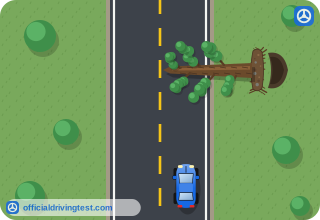
- Yield to oncoming traffic
- Turn on your high beams
- Speed up to pass quickly
- Stop and call the police
Show answer
Correct answer: Yield to oncoming traffic
When a blockage makes it necessary to drive to the left of the center line, you may drive on the left after yielding to oncoming traffic.
Source: Illinois Rules of the Road (2026), page 29
-
Which is one of the exceptions to the rule that you must drive on the right half of the roadway?
- Driving slower than traffic on a two-lane highway
- Driving at night on an empty two-lane rural road
- Crossing the center line to turn left into a driveway
- Following a vehicle closely to pass it later on
Show answer
Correct answer: Crossing the center line to turn left into a driveway
The exceptions include crossing the center line to make a left turn into or from an alley, private road, or driveway.
Source: Illinois Rules of the Road (2026), page 29
-
Which road layout is listed as an exception to the rule of driving on the right half of the roadway?
- A two-lane road with a solid yellow center line
- A narrow and winding two-lane rural roadway
- A roadway divided into three marked lanes for traffic
- A two-lane road that goes over a hill or curve
Show answer
Correct answer: A roadway divided into three marked lanes for traffic
The exceptions include a roadway divided into three marked lanes for traffic and a one-way street with two or more lanes.
Source: Illinois Rules of the Road (2026), page 29
-
On which kind of street may you drive on other than the right half of the roadway?
- A one-way street with two or more lanes
- A two-way street with one lane each way
- Any street in a posted school zone
- Any residential street at night
Show answer
Correct answer: A one-way street with two or more lanes
The exceptions to driving on the right half include a one-way street with two or more lanes of traffic.
Source: Illinois Rules of the Road (2026), page 29
-
On a multilane, two-way highway, when may you drive in a left lane instead of the right half?
- Whenever you want to drive above the posted speed limit
- Whenever the speed limit is 55 mph or more
- When directed to by traffic control signs and signals
- Whenever you are driving in a funeral procession
Show answer
Correct answer: When directed to by traffic control signs and signals
An exception is when you are directed to drive in a left lane by traffic control signs and signals on a multilane, two-way highway.
Source: Illinois Rules of the Road (2026), page 29
-
At an intersection with an All-Way STOP sign, which driver goes first?
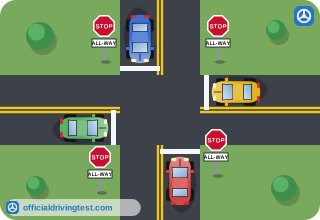
- The driver on the wider road
- The driver turning left
- The driver on the left
- The first driver to stop
Show answer
Correct answer: The first driver to stop
At an all-way stop, traffic from all directions must stop, and the first driver to stop is the first driver to go.
Source: Illinois Rules of the Road (2026), page 65
-
What should you do when approaching any rural intersection?
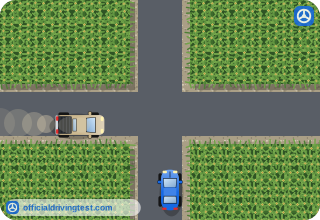
- Keep your speed if there is no stop sign
- Sound your horn and proceed
- Flash your headlights and go
- Slow down and look both ways before entering
Show answer
Correct answer: Slow down and look both ways before entering
Some rural intersections have no warning signs, so slow down and look both ways before entering any rural intersection.
Source: Illinois Rules of the Road (2026), page 87