Illinois: Right of way & turning — Part 2 Practice Test
Questions in this part include: “When turning at an intersection, to whom must you yield the right of way?” · “In which direction does traffic travel around the central island of a rotary or roundabout?”
Independent educational site · not affiliated with any government agency or DMV
Ready? Test yourself
- Instant feedback with an explanation
- Every answer cites its source in the manual
- Your best score is saved on this device
Questions are original and based on the official manual "Illinois Rules of the Road" (2026), Illinois Secretary of State.
All 19 questions in this practice test
Take the test above first, then use this list to study. Tap “Show answer” to see the correct answer and explanation.
Show the questions and answersHide the questions
-
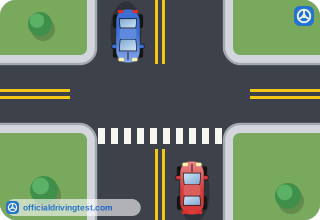
When may you enter an intersection or drive within a marked crosswalk?
- Whenever your light is green, even if traffic ahead is stopped in the way
- Whenever you are turning right, even if pedestrians are in the crosswalk
- Only when there is enough space for other vehicles and pedestrians to pass
- Any time, because stopping in a crosswalk is allowed during rush hour
Show answer
Correct answer: Only when there is enough space for other vehicles and pedestrians to pass
A driver may not enter an intersection or drive within a marked crosswalk unless there is enough space to allow passage of other vehicles and/or pedestrians.
Source: Illinois Rules of the Road (2026), page 26
-
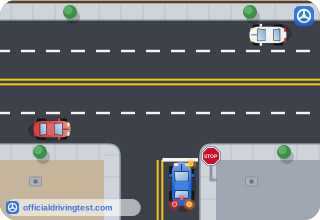
When making a right turn, from which direction should you check for approaching traffic?
- From the left
- From the right
- From behind only
- From straight ahead only
Show answer
Correct answer: From the left
The right-turn steps include checking traffic approaching from the left.
Source: Illinois Rules of the Road (2026), page 30
-
When turning at an intersection, to whom must you yield the right of way?
- Only pedestrians who are already inside a marked crosswalk
- Only vehicles that are turning in the same direction as you
- Pedestrians, emergency vehicles and vehicles in the intersection
- No one, once you have signaled from the proper turning lane
Show answer
Correct answer: Pedestrians, emergency vehicles and vehicles in the intersection
For both right and left turns, the manual says to yield the right of way to pedestrians, emergency vehicles and other vehicles in the intersection.
Source: Illinois Rules of the Road (2026), page 30
-
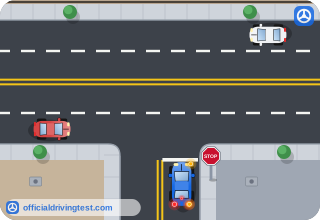
How should you position your vehicle while making a right turn?
- Swing wide into the left lane before starting the turn
- Follow the curve of the curb and stay as close to it as possible
- Stay near the center line to leave room for bicycles
- Keep at least one full lane width away from the curb
Show answer
Correct answer: Follow the curve of the curb and stay as close to it as possible
When turning right, follow the general curve of the curb and stay as close as possible to the curb.
Source: Illinois Rules of the Road (2026), page 31
-
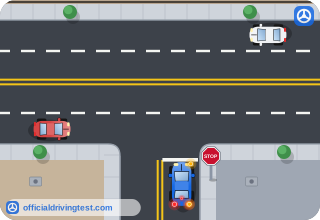
When you make a right turn, which lane of the new roadway should you turn into?
- The left-hand lane
- Any lane that is open
- The center lane
- The right-hand lane
Show answer
Correct answer: The right-hand lane
A right turn should be completed into the right-hand lane of the roadway you are entering.
Source: Illinois Rules of the Road (2026), page 31
-
While preparing to make a left turn, how should your front wheels be pointed?
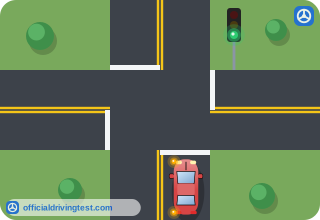
- Turned left, ready for the turn
- Turned right, toward the curb
- Straight ahead until you start the turn
- Turned slightly left, toward the lane
Show answer
Correct answer: Straight ahead until you start the turn
For a left turn, point the wheels straight ahead until you start making the turn.
Source: Illinois Rules of the Road (2026), page 31
-
When you complete a left turn, which lane should you turn into?
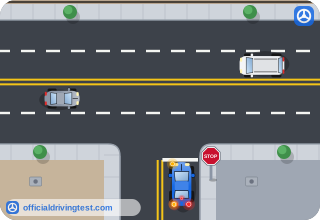
- The far right lane of the new roadway
- The lane closest to your intended direction
- Whichever lane has the least traffic
- The lane farthest from the center line
Show answer
Correct answer: The lane closest to your intended direction
A left turn should be completed into the lane closest to the intended direction.
Source: Illinois Rules of the Road (2026), page 31
-
You must not make a U-turn on a curve or hill unless you can see for at least how far in all directions?
- 200 feet
- 300 feet
- 500 feet
- 1,000 feet
Show answer
Correct answer: 500 feet
Turning around on curves and hills is not allowed unless you can see for at least 500 feet in all directions.
Source: Illinois Rules of the Road (2026), page 32
-
Who may prohibit U-turns on some roadways?
- Only the Illinois State Police
- Municipalities
- Only the U.S. Department of Transportation
- No one; U-turns are legal on every road
Show answer
Correct answer: Municipalities
The manual states that municipalities may prohibit U-turns on some roadways.
Source: Illinois Rules of the Road (2026), page 32
-
What is a two-way left turn lane used for?
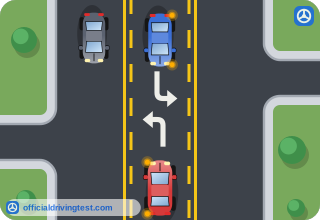
- Left turns at intersections or into or out of mid-block drives
- Buses and trucks traveling slower than the flow of traffic
- Emergency vehicles only, traveling in either direction
- Passing slower vehicles in either direction of travel
Show answer
Correct answer: Left turns at intersections or into or out of mid-block drives
The two-way left turn lane gives a safe area for cars turning left at intersections or into or out of a drive in the middle of the block.
Source: Illinois Rules of the Road (2026), page 32
-
In which direction does traffic travel around the central island of a rotary or roundabout?
- Clockwise
- Counter-clockwise
- Whichever way is shortest to your exit
- The direction posted at each entrance
Show answer
Correct answer: Counter-clockwise
A rotary or roundabout is an intersection where traffic travels around a central island in a circular, counter-clockwise direction.
Source: Illinois Rules of the Road (2026), page 32
-
Vehicles entering or exiting a roundabout must yield to whom?
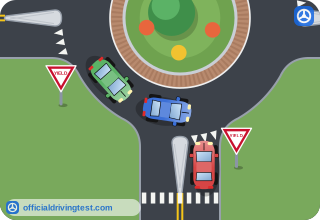
- Only vehicles already inside the circle
- Only vehicles entering from your right
- Only vehicles that are larger than yours
- All traffic, including pedestrians and bicycles
Show answer
Correct answer: All traffic, including pedestrians and bicycles
The manual says vehicles entering or exiting a roundabout must yield to all traffic, including pedestrians and bicycles.
Source: Illinois Rules of the Road (2026), page 32
-
How do you enter a roundabout?
- By turning right when it is safe
- By turning left when it is safe
- By stopping, then driving straight in
- By merging into the inside lane first
Show answer
Correct answer: By turning right when it is safe
When approaching a roundabout, enter it by turning right when it is safe to do so.
Source: Illinois Rules of the Road (2026), page 32
-
Which signal should you use to let other drivers know you are exiting a roundabout?
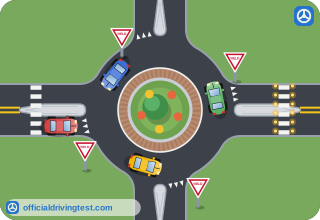
- Your left turn signal
- Your hazard lights
- Your right turn signal
- No signal is needed
Show answer
Correct answer: Your right turn signal
Use your vehicle's right turn signal to let other drivers know you are exiting the roundabout.
Source: Illinois Rules of the Road (2026), page 32
-
Why should you look for street and direction signs before entering a roundabout?
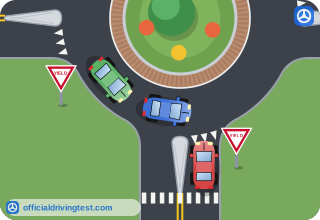
- To find out the roundabout's speed limit
- To determine which exit to take
- To learn which lane is reserved for trucks
- To see where pedestrians may cross
Show answer
Correct answer: To determine which exit to take
Street and direction signs posted before a roundabout help you determine which exit to take.
Source: Illinois Rules of the Road (2026), page 32
-
Before changing lanes or taking an exit in a roundabout, what should you expect?
- Traffic in the roundabout to stop and let you out
- Vehicles in the inner lane to always exit first
- Pedestrians to be walking on the center island
- Vehicles in blind spots that mirrors cannot show
Show answer
Correct answer: Vehicles in blind spots that mirrors cannot show
Check for vehicles continuing through the roundabout first, and expect vehicles to be in blind spots that cannot be seen in the mirrors.
Source: Illinois Rules of the Road (2026), page 32
-
In an urban area, where must you stop when coming out of an alley or driveway?
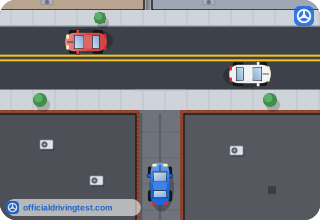
- Before entering the sidewalk area
- Only at the edge of the roadway
- Only if a vehicle is approaching
- After crossing the sidewalk area
Show answer
Correct answer: Before entering the sidewalk area
In urban areas, you must come to a complete stop when moving out of an alley, building, private road, or driveway and before entering the sidewalk area.
Source: Illinois Rules of the Road (2026), page 34
-
When leaving an alley or driveway where there is no sidewalk, where should you stop?
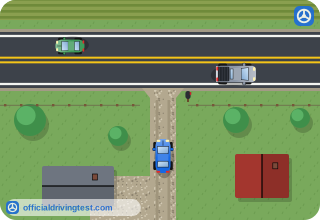
- At least ten feet back from the edge of the street
- No stop is needed when there is no sidewalk to cross
- At the point nearest the street with a view of traffic
- Partway into the first lane so you can see traffic
Show answer
Correct answer: At the point nearest the street with a view of traffic
If there is no sidewalk, stop at a point nearest the street or roadway where there is a view of approaching traffic.
Source: Illinois Rules of the Road (2026), page 34
-
After stopping when coming out of an alley or driveway, to whom must you yield the right of way?
- Only vehicles coming from the left
- Pedestrians and all vehicles
- Only pedestrians on the sidewalk
- Only vehicles that are very close
Show answer
Correct answer: Pedestrians and all vehicles
After stopping, you must yield the right of way to pedestrians and all vehicles.
Source: Illinois Rules of the Road (2026), page 34