Illinois: Right of way & turning — Part 1 Practice Test
Questions in this part include: “Which lights should motorists in a funeral procession have turned on?” · “What may local municipalities do to a vehicle that interferes with a funeral procession due to reckless driving?”
Independent educational site · not affiliated with any government agency or DMV
Ready? Test yourself
- Instant feedback with an explanation
- Every answer cites its source in the manual
- Your best score is saved on this device
Questions are original and based on the official manual "Illinois Rules of the Road" (2026), Illinois Secretary of State.
All 20 questions in this practice test
Take the test above first, then use this list to study. Tap “Show answer” to see the correct answer and explanation.
Show the questions and answersHide the questions
-
Besides police officers, whose traffic directions does the Illinois manual say you must obey when they are performing their duties?
- Uniformed adult school crossing guards
- Any adult standing at the corner
- Passengers riding in your own vehicle
- Drivers waiting at the same intersection
Show answer
Correct answer: Uniformed adult school crossing guards
The manual says to obey the orders of police officers, firefighters, highway authority officials, and uniformed adult school crossing guards directing traffic.
Source: Illinois Rules of the Road (2026), page 21
-
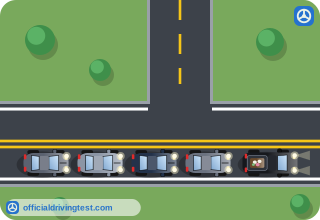
When you encounter a funeral procession, to which vehicles must you yield the right of way?
- Only the lead vehicle
- Only the hearse
- None; it must stop for traffic
- All vehicles in the procession
Show answer
Correct answer: All vehicles in the procession
Motorists encountering a funeral procession must yield the right of way to all vehicles in the procession.
Source: Illinois Rules of the Road (2026), page 26
-
Which lights should motorists in a funeral procession have turned on?
- Only the interior dome lights
- Headlights and hazard lights
- Only the parking lights
- High beams and fog lights
Show answer
Correct answer: Headlights and hazard lights
Motorists in a funeral procession should have their headlights and hazard lights turned on.
Source: Illinois Rules of the Road (2026), page 26
-
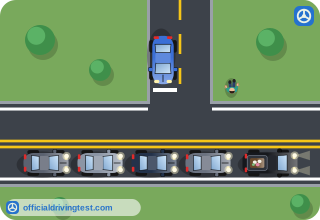
When may you drive between vehicles in an organized funeral procession?
- Whenever there is a large gap between two cars
- When your headlights and hazard lights are on
- Whenever the procession stops at a red light
- Only when directed by a law enforcement officer
Show answer
Correct answer: Only when directed by a law enforcement officer
Motorists should not drive between vehicles in an organized funeral procession except when directed by a law enforcement officer.
Source: Illinois Rules of the Road (2026), page 26
-
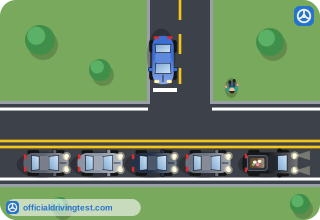
Which of these is prohibited when you meet a funeral procession?
- Joining it to secure the right of way
- Yielding to all vehicles in the procession
- Waiting until the procession has passed
- Driving between its vehicles when an officer directs you
Show answer
Correct answer: Joining it to secure the right of way
Vehicles are prohibited from joining a funeral procession to secure the right of way. Drivers must yield to all vehicles in the procession and may drive between them only when directed by a law enforcement officer.
Source: Illinois Rules of the Road (2026), page 26
-
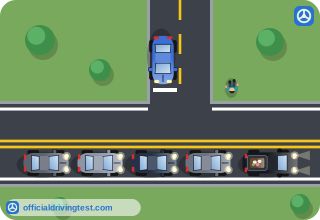
Where may you pass a vehicle in an organized funeral procession?
- Anywhere, as long as you signal and pass on the left
- On the right shoulder whenever the procession slows
- Only where a passing lane has been specifically provided
- At any intersection with a traffic signal showing green
Show answer
Correct answer: Only where a passing lane has been specifically provided
Vehicles are prohibited from attempting to pass any vehicle in an organized funeral procession, except where a passing lane has been specifically provided.
Source: Illinois Rules of the Road (2026), page 26
-
What may local municipalities do to a vehicle that interferes with a funeral procession due to reckless driving?
- Impound the vehicle
- Only issue a verbal warning
- Nothing; it is not an offense
- Remove its license plates
Show answer
Correct answer: Impound the vehicle
Local municipalities may impound a vehicle that interferes with a funeral procession due to reckless driving.
Source: Illinois Rules of the Road (2026), page 26
-
When making a right turn on a red light, what must you do?
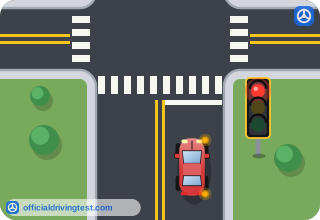
- Slow down and turn without stopping if no cars are coming from the left
- Stop, then go first, because the turning driver has the right of way
- Come to a complete stop and yield to other drivers, bicyclists, and pedestrians
- Sound your horn to warn pedestrians, then turn without stopping
Show answer
Correct answer: Come to a complete stop and yield to other drivers, bicyclists, and pedestrians
A driver must yield the right of way to other drivers, bicyclists, or pedestrians when making a right turn on a red light after a complete stop.
Source: Illinois Rules of the Road (2026), page 26
-
At a stop sign with no stop line, where should you stop?
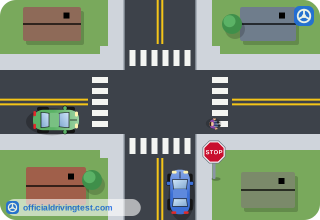
- In the crosswalk
- Before the crosswalk
- Past the crosswalk
- At the curb corner
Show answer
Correct answer: Before the crosswalk
If there is no stop line, stop before the crosswalk.
Source: Illinois Rules of the Road (2026), page 26
-
When may you make a left turn at a red light after stopping?
- From any two-way street onto any other two-way street, after you yield
- From a one-way street onto another one-way street with traffic moving left
- From a one-way street onto a two-way street, after coming to a stop
- Never; left turns on a red light are not allowed anywhere in Illinois
Show answer
Correct answer: From a one-way street onto another one-way street with traffic moving left
After stopping and yielding, you may turn left at a red light from a one-way street onto another one-way street with traffic moving to the left.
Source: Illinois Rules of the Road (2026), page 26
-
When more than one driver reaches a four-way stop intersection, who should go first?
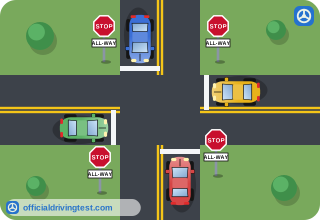
- The driver on the left
- The largest vehicle
- The driver going straight
- The first driver to stop
Show answer
Correct answer: The first driver to stop
When more than one driver reaches a four-way stop, the first driver to stop should be the first to go.
Source: Illinois Rules of the Road (2026), page 26
-
Two vehicles on different roadways arrive at a four-way stop at the same time. Which one should yield?
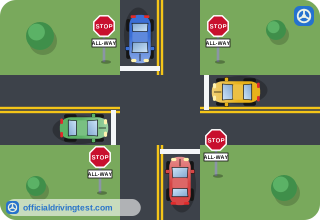
- The vehicle on the left yields to the vehicle on the right
- The vehicle on the right yields to the vehicle on the left
- The vehicle turning right yields to the vehicle turning left
- The smaller vehicle always yields to the larger vehicle
Show answer
Correct answer: The vehicle on the left yields to the vehicle on the right
When two vehicles on different roadways arrive at a four-way stop at the same time, the vehicle on the left should yield to the vehicle on the right.
Source: Illinois Rules of the Road (2026), page 26
-
Entering an intersection with a flashing yellow arrow, what must you do?
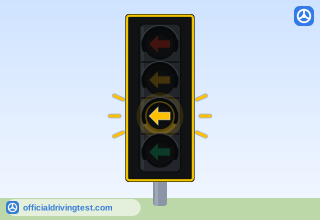
- Stop and wait for green
- Go; you have priority
- Yield the right of way
- Speed up to clear it
Show answer
Correct answer: Yield the right of way
A driver must yield the right of way when entering an intersection with a flashing yellow arrow.
Source: Illinois Rules of the Road (2026), page 26
-
Two vehicles on different roadways reach an uncontrolled intersection at the same time. Who should yield?

- The vehicle on the left
- The vehicle on the right
- The faster vehicle
- The vehicle going straight
Show answer
Correct answer: The vehicle on the left
At an uncontrolled intersection, the vehicle on the left should yield to the vehicle on the right.
Source: Illinois Rules of the Road (2026), page 26
-
You entered an intersection on a green light to turn left, and the light turns red while you wait for oncoming traffic. What may you do?
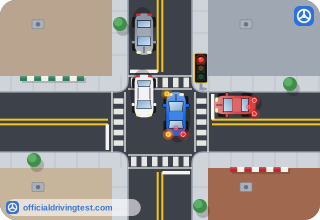
- Back out of the intersection
- Stay put until the next green
- Finish the turn once it is safe
- Go straight instead of turning
Show answer
Correct answer: Finish the turn once it is safe
When turning left into oncoming traffic you must yield, but if you entered the intersection while the light was green, you may finish the turn even though the light turns red.
Source: Illinois Rules of the Road (2026), page 26
-
When approaching a MERGE sign with through traffic, what must you do?
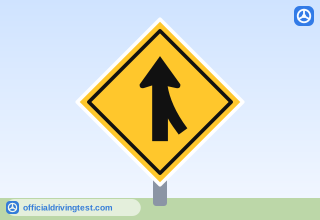
- Come to a full stop before merging at all times
- Increase or decrease speed to avoid a crash
- Keep your speed; through traffic must let you in
- Use the shoulder until a gap opens in traffic
Show answer
Correct answer: Increase or decrease speed to avoid a crash
When approaching a MERGE sign with through traffic, you must yield and increase or decrease speed to avoid a crash.
Source: Illinois Rules of the Road (2026), page 26
-
When approaching a YIELD sign, what should you do?
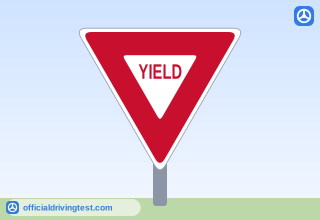
- Always come to a full stop, even if clear
- Keep your speed; others must yield to you
- Speed up to get ahead of cross traffic
- Slow down or stop to avoid a crash
Show answer
Correct answer: Slow down or stop to avoid a crash
When approaching a YIELD sign, you must yield the right of way and should slow down or stop to avoid a crash.
Source: Illinois Rules of the Road (2026), page 26
-
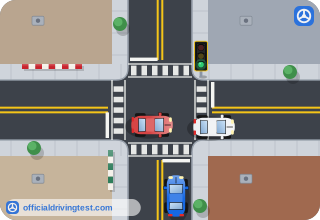
Your light turns green, but vehicles are still in the intersection. What must you do?
- Go at once, since the green light gives you the right of way
- Yield to the vehicles still in the intersection
- Sound your horn so they clear the intersection
- Pass around them on the right-hand shoulder
Show answer
Correct answer: Yield to the vehicles still in the intersection
A driver must yield the right of way even after the light turns green when there are vehicles in the intersection.
Source: Illinois Rules of the Road (2026), page 26
-
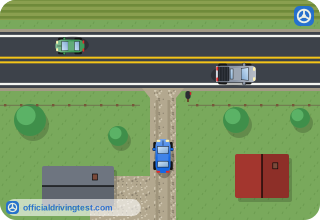
You are pulling out of a driveway onto a street. What must you do?
- Slow down and enter without stopping if the road looks clear
- Enter first, since vehicles on the street must yield to you
- Sound your horn and pull out, expecting traffic to stop
- Come to a complete stop and yield the right of way
Show answer
Correct answer: Come to a complete stop and yield the right of way
A driver must yield the right of way when emerging from an alley, building, private road, or driveway after coming to a complete stop.
Source: Illinois Rules of the Road (2026), page 26
-
At a "T" intersection with no traffic control signs or signals, who must yield?
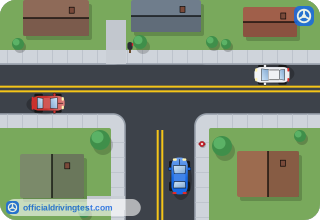
- The driver on the terminating highway crossing traffic
- The driver on the through road going straight
- Whichever driver is traveling at the higher speed
- Neither driver; both may proceed at the same time
Show answer
Correct answer: The driver on the terminating highway crossing traffic
A driver on the terminating highway of a "T" intersection with no traffic control signs or signals must yield to cross traffic.
Source: Illinois Rules of the Road (2026), page 26