Illinois: Railroad crossings Practice Test
Crossing signs, signals and gates, and what to do if you are stuck on the tracks.
Independent educational site · not affiliated with any government agency or DMV
Ready? Test yourself
- Instant feedback with an explanation
- Every answer cites its source in the manual
- Your best score is saved on this device
Questions are original and based on the official manual "Illinois Rules of the Road" (2026), Illinois Secretary of State.
All 31 questions in this practice test
Take the test above first, then use this list to study. Tap “Show answer” to see the correct answer and explanation.
Show the questions and answersHide the questions
-
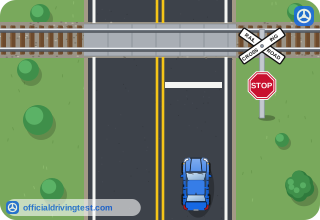
Who must you yield the right of way to at a railroad crossing?
- The vehicle that reached the crossing first
- Any approaching train or railroad equipment
- Vehicles already moving across the tracks
- Pedestrians waiting on the far side of the tracks
Show answer
Correct answer: Any approaching train or railroad equipment
The manual says you must yield the right of way to any approaching train or railroad equipment.
Source: Illinois Rules of the Road (2026), page 33
-
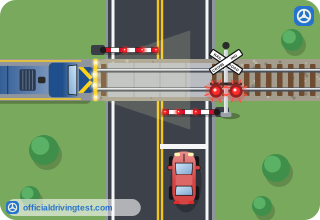
When a crossing gate is lowered or the signal is flashing, how far from the railroad crossing must you stop?
- Between 5 and 10 feet
- Between 50 and 100 feet
- Exactly 10 feet
- Between 15 and 50 feet
Show answer
Correct answer: Between 15 and 50 feet
You must stop within 15-50 feet if there is a posted stop sign, the electric signal is flashing, or the crossing gate is lowered.
Source: Illinois Rules of the Road (2026), page 33
-
Which of these situations requires you to stop at a railroad crossing?
- The crossing gate is lowered
- There is only a crossbuck and no train is coming
- The gate has gone all the way up
- The flagger has signaled traffic to proceed
Show answer
Correct answer: The crossing gate is lowered
You must stop if there is a posted stop sign, if the electric signal is flashing, or if the crossing gate is lowered.
Source: Illinois Rules of the Road (2026), page 33
-
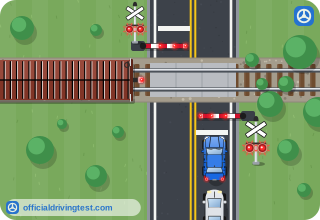
After stopping for a lowered railroad crossing gate, when may you proceed?
- As soon as the gate starts to rise
- When the gate is halfway up and no train is in sight
- After the gate is all the way up
- When the last car of the train reaches the crossing
Show answer
Correct answer: After the gate is all the way up
You may proceed only after the gate is all the way up, the lights are no longer flashing, or the flagger signals, and after checking all tracks for more trains.
Source: Illinois Rules of the Road (2026), page 33
-
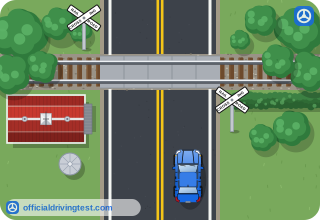
What should you do at a railroad crossing that has no warning devices or only a crossbuck sign?
- Always come to a full stop and wait 30 seconds
- Slow down, look both ways and listen for a train
- Speed up to cross the tracks as quickly as possible
- Sound your horn and continue at your normal speed
Show answer
Correct answer: Slow down, look both ways and listen for a train
At a crossing with no warning devices or only a crossbuck, slow down, look in both directions and listen, then proceed with caution if safe.
Source: Illinois Rules of the Road (2026), page 33
-
You may not enter a highway railroad crossing unless:
- A flagger is present to guide you across
- You can see at least 500 feet down the track
- Your vehicle's headlights are switched on
- There is room for your vehicle on the other side
Show answer
Correct answer: There is room for your vehicle on the other side
You may not enter a crossing unless there is enough space on the other side for your vehicle without blocking a train.
Source: Illinois Rules of the Road (2026), page 33
-
Which vehicles are required by law to stop at most railroad crossings?
- School buses, vehicles for hire, and hazardous-material haulers
- Motorcycles, mopeds, and vehicles pulling camping trailers
- All trucks and any vehicle with more than two axles
- Pickup trucks and vehicles with a manual transmission
Show answer
Correct answer: School buses, vehicles for hire, and hazardous-material haulers
The law requires vehicles carrying people for hire, school buses, and vehicles carrying hazardous materials to stop at most railroad crossings.
Source: Illinois Rules of the Road (2026), page 33
-
If your vehicle stalls on railroad tracks, what should everyone in the vehicle do first?
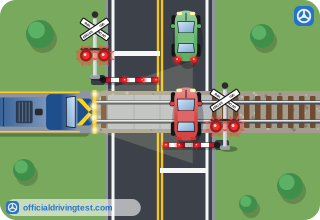
- Stay inside with seat belts fastened
- Try to restart the engine several times
- Get out immediately and call 911
- Push the vehicle off the tracks together
Show answer
Correct answer: Get out immediately and call 911
If your vehicle is stuck or stalls on the tracks, everyone should get out immediately, call 911, and move away from the tracks.
Source: Illinois Rules of the Road (2026), page 33
-
After leaving a vehicle stalled on railroad tracks, in which direction should you move away?
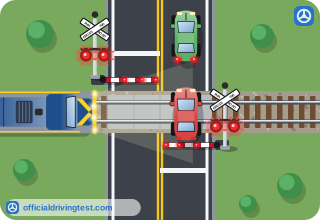
- At a 45-degree angle away from the approaching train
- At a 45-degree angle toward the direction of the train
- Straight along the tracks, away from the train
- Straight back the way you came, parallel to the road
Show answer
Correct answer: At a 45-degree angle toward the direction of the train
Move away from the tracks at a 45-degree angle in the direction of the train, which keeps you clear of debris thrown forward if the train hits the vehicle.
Source: Illinois Rules of the Road (2026), page 33
-
Where can you find the phone number for the railroad's Emergency Notification System?
- On a blue sign on the crossing post near the tracks
- Printed on the pavement before the crossing
- On the yellow advance warning sign up the road
- On the back of your vehicle registration card
Show answer
Correct answer: On a blue sign on the crossing post near the tracks
The Emergency Notification System number is on the blue sign affixed to the railroad crossing post near the tracks.
Source: Illinois Rules of the Road (2026), page 34
-
Once a train has passed a crossing, what should you always do before proceeding?
- Proceed right away; the crossing is now clear
- Wait exactly one minute, then cross
- Look for a second train on another track
- Sound your horn twice, then cross
Show answer
Correct answer: Look for a second train on another track
After a train passes, always look for a second train on another track before proceeding.
Source: Illinois Rules of the Road (2026), page 34
-
If your vehicle has a manual transmission, what should you do at a railroad crossing?
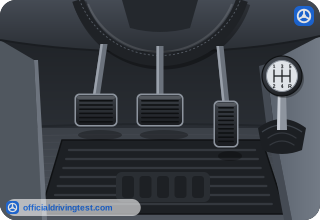
- Shift into neutral and coast across the tracks slowly
- Shift down before the tracks; do not change gears on them
- Shift up while crossing to clear the tracks faster
- Change to a lower gear while you are on the tracks
Show answer
Correct answer: Shift down before the tracks; do not change gears on them
With a manual transmission, shift down before reaching the tracks and do not change gears while crossing, to avoid stalling.
Source: Illinois Rules of the Road (2026), page 34
-
When you are behind a vehicle that is required to stop at railroad crossings, what should you do?
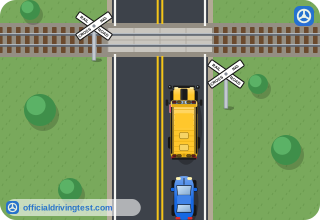
- Pass it before it reaches the tracks
- Follow closely so you both cross together
- Switch lanes to go around it at the tracks
- Be prepared to stop behind it
Show answer
Correct answer: Be prepared to stop behind it
Some vehicles, such as school buses, must stop at most crossings, so be prepared to stop when you are behind them.
Source: Illinois Rules of the Road (2026), page 34
-
On a two-lane, two-way roadway, passing is not allowed within how many feet of an intersection or railroad crossing?
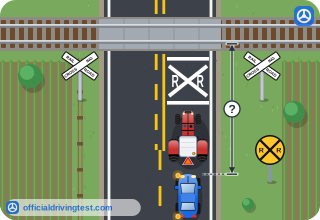
- 50 feet
- 200 feet
- 100 feet
- 500 feet
Show answer
Correct answer: 100 feet
Passing is not allowed within 100 feet of an intersection or railroad crossing.
Source: Illinois Rules of the Road (2026), page 29
-
Your license may be suspended upon conviction of which violation for failure to obey a railroad-crossing signal?
- The first violation
- The second violation
- Only the fifth violation
- Only the tenth violation
Show answer
Correct answer: The second violation
Conviction of a second violation for failure to obey a railroad-crossing signal is a suspension offense.
Source: Illinois Rules of the Road (2026), page 59
-
Nonpayment of how many railroad crossing violations may lead to a license suspension?
- One or more
- Five or more
- Ten or more
- Fifteen or more
Show answer
Correct answer: Five or more
Railroad Crossing Violation as a suspension offense is nonpayment of five or more violations.
Source: Illinois Rules of the Road (2026), page 60
-
What does a RAILROAD CROSSING advance warning sign look like?
- Yellow with a black crossbuck "X" and the letters "RR"
- White with a red crossbuck "X" and the word "TRAIN"
- Orange with a black crossbuck "X" and a train symbol
- Blue with a white crossbuck "X" and the letters "RR"
Show answer
Correct answer: Yellow with a black crossbuck "X" and the letters "RR"
RAILROAD CROSSING signs are yellow with a black crossbuck "X" and the letters "RR."
Source: Illinois Rules of the Road (2026), page 63
-
In rural areas, how far before the railroad crossing may the round RAILROAD CROSSING warning sign be placed?
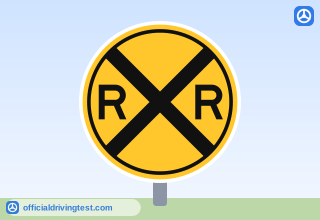
- Up to 250 feet
- Up to 400 feet
- Up to 750 feet
- Up to 1,500 feet
Show answer
Correct answer: Up to 750 feet
In rural areas, the advance warning sign may be up to 750 feet before the railroad crossing.
Source: Illinois Rules of the Road (2026), page 63
-
What should you do with your vehicle windows when approaching a railroad crossing?
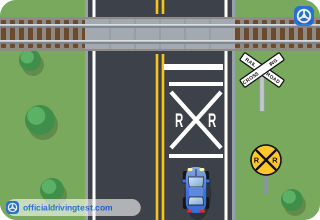
- Close them to reduce outside distractions
- Roll them down and listen for the sound of a train
- Keep them as they are and turn the radio up
- Close them only if a train is visible
Show answer
Correct answer: Roll them down and listen for the sound of a train
The manual says to roll down your vehicle windows and listen so other noises do not block out the sound of a train.
Source: Illinois Rules of the Road (2026), page 63
-
What should you do if a train is approaching a railroad crossing?
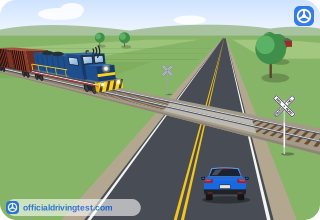
- Speed up to cross before the train arrives
- Sound your horn and cross quickly
- Cross if the gates are not yet fully down
- Stop and wait for the train to pass
Show answer
Correct answer: Stop and wait for the train to pass
If a train is approaching, stop and wait. Never race the train to the crossing.
Source: Illinois Rules of the Road (2026), page 63
-
What should you do when you see the round RAILROAD CROSSING advance warning sign?
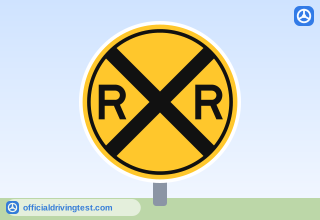
- Speed up to cross the tracks quickly
- Slow down, look, and stop if necessary
- Stop at the sign and wait for a signal
- Change lanes and keep your speed
Show answer
Correct answer: Slow down, look, and stop if necessary
The RAILROAD CROSSING sign means a railroad track will cross the roadway ahead: slow down, look, and stop if necessary.
Source: Illinois Rules of the Road (2026), page 63
-
What does a solid yellow line before a railroad crossing mean?
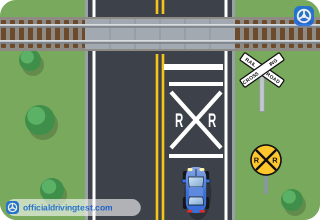
- Stop here only at night
- Trucks must stop
- The crossing is closed
- No passing
Show answer
Correct answer: No passing
A solid yellow line before a railroad crossing means no passing.
Source: Illinois Rules of the Road (2026), page 81
-
What do the white stop lines on each side of a railroad track show?
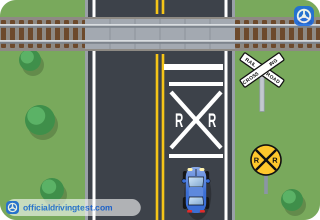
- Where trains must slow down
- Where to stop when a train is approaching
- The edge of the railroad property
- Where to wait for the crossing guard
Show answer
Correct answer: Where to stop when a train is approaching
White stop lines on each side of the track show motorists where to stop when a train is approaching.
Source: Illinois Rules of the Road (2026), page 81
-
If a railroad crossing has more than one track, where is the number of tracks shown?
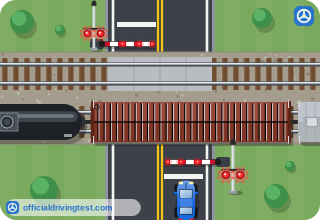
- On the pavement before the crossing
- On the advance warning sign
- On a sign below the crossbuck
- On the crossing gate arm
Show answer
Correct answer: On a sign below the crossbuck
When a crossing has more than one track, the number of tracks is on the sign below the crossbuck.
Source: Illinois Rules of the Road (2026), page 81
-
A railroad crossbuck sign is considered to be what kind of sign?
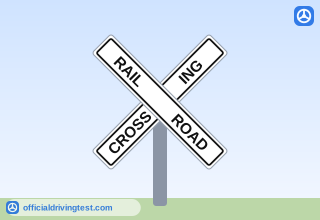
- A yield sign
- A stop sign
- A warning sign only
- A speed limit sign
Show answer
Correct answer: A yield sign
The crossbuck is considered a yield sign; you must yield to any oncoming trains and railroad equipment.
Source: Illinois Rules of the Road (2026), page 81
-
When the flashing light signals at a railroad crossing begin to flash, how long must you stay stopped?
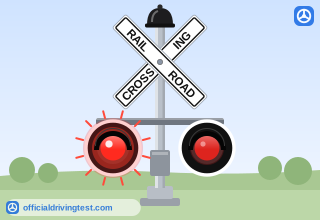
- Until you can see no train within a mile
- Until the gates begin to rise
- Until other drivers begin to cross
- Until the train passes and lights stop flashing
Show answer
Correct answer: Until the train passes and lights stop flashing
When crossing lights begin to flash, you must stop until the train has passed and the lights have stopped flashing.
Source: Illinois Rules of the Road (2026), page 81
-
At a railroad crossing with lowered gates, how long must you remain stopped?
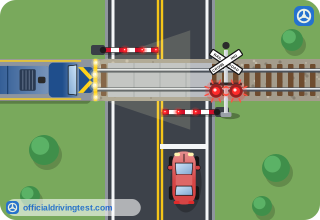
- Until the train's last car reaches the crossing
- Until the gates are raised and the lights stop flashing
- Until no train is visible in either direction
- Until the gates start to rise
Show answer
Correct answer: Until the gates are raised and the lights stop flashing
You must remain stopped until the lowered gates are raised and the lights are no longer flashing.
Source: Illinois Rules of the Road (2026), page 81
-
What does the manual say about crossing gates that are being lowered?
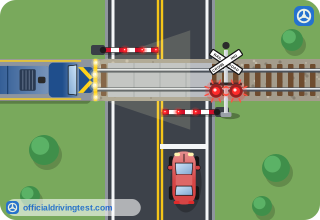
- You may go around them if no train is in sight
- You may pass them if you can clear the tracks quickly
- Do not try to beat them or go around them
- You may drive under them before they are fully down
Show answer
Correct answer: Do not try to beat them or go around them
Do not attempt to beat crossing gates as they are lowering, and do not go around lowered gates.
Source: Illinois Rules of the Road (2026), page 81
-
What may an automated railroad crossing enforcement system record when a driver commits a violation?
- The license plate number, time, date, and location
- A video of the driver's face and nothing else
- The driver's speed and seat belt use only
- The driver's name and license number only
Show answer
Correct answer: The license plate number, time, date, and location
The system may record an image of the vehicle license plate number, time, date, and location of any violation.
Source: Illinois Rules of the Road (2026), page 81
-
Drivers who commit violations at railroad crossings are subject to:
- A written warning only
- Community service only
- A new written driving exam
- Fines and possible suspension
Show answer
Correct answer: Fines and possible suspension
Drivers are subject to fines and possible suspension of their driving privileges for railroad crossing violations.
Source: Illinois Rules of the Road (2026), page 81
-
What is the purpose of the Emergency Notification System (ENS) sign at a highway-rail grade crossing?
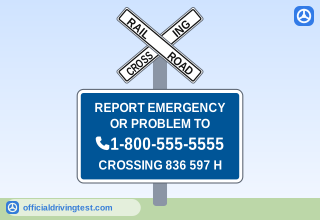
- To show the daily train schedule for the crossing
- To help people reach the railroad in an emergency
- To show drivers how many tracks the crossing has
- To warn that a crossing is about 750 feet ahead
Show answer
Correct answer: To help people reach the railroad in an emergency
The ENS sign lets the public reach the railroad responsible for the crossing and identify the specific crossing in an emergency.
Source: Illinois Rules of the Road (2026), page 81