Illinois: Pavement markings Practice Test
Yellow and white lines, turn lanes, crosswalks and other pavement markings.
Independent educational site · not affiliated with any government agency or DMV
Ready? Test yourself
- Instant feedback with an explanation
- Every answer cites its source in the manual
- Your best score is saved on this device
Questions are original and based on the official manual "Illinois Rules of the Road" (2026), Illinois Secretary of State.
All 22 questions in this practice test
Take the test above first, then use this list to study. Tap “Show answer” to see the correct answer and explanation.
Show the questions and answersHide the questions
-
On a two-lane, two-way roadway, which marking shows an area where passing is not allowed?
- A broken white line
- A broken yellow line
- A white edge line
- A solid yellow line
Show answer
Correct answer: A solid yellow line
Passing is not allowed in an area marked for no passing by a solid yellow line or with a DO NOT PASS or NO PASSING ZONE sign.
Source: Illinois Rules of the Road (2026), page 29
-
Which edge line marks the right edge of the roadway?
- Solid white
- Solid yellow
- Broken yellow
- Double yellow
Show answer
Correct answer: Solid white
Solid white edge lines are used on the right of the roadway edge.
Source: Illinois Rules of the Road (2026), page 79
-
On a divided street or roadway, which line marks the left edge?
- Broken white
- Solid white
- Double white
- Solid yellow
Show answer
Correct answer: Solid yellow
Solid yellow lines are used on the left edge of divided streets or roadways.
Source: Illinois Rules of the Road (2026), page 79
-
What do white lane lines separate?
- Traffic lanes moving in opposite directions
- Lanes of traffic moving in the same direction
- Parking spaces from the travel lanes
- Bike lanes from bus lanes
Show answer
Correct answer: Lanes of traffic moving in the same direction
White lane lines separate lanes of traffic moving in the same direction.
Source: Illinois Rules of the Road (2026), page 79
-
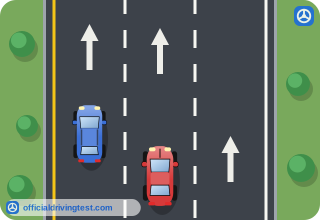
When may you cross a broken white lane line?
- Never, under any circumstances
- Only to pass on the shoulder
- Only when changing lanes or turning
- Only in an emergency
Show answer
Correct answer: Only when changing lanes or turning
Crossing a broken white line is only allowed when changing lanes or turning.
Source: Illinois Rules of the Road (2026), page 79
-
What does the manual say about crossing a single solid white lane line?
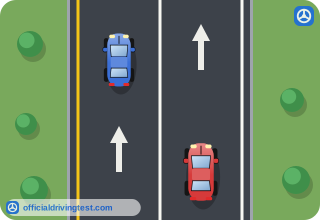
- It requires special care and is discouraged
- It is prohibited under all circumstances
- It is allowed only for trucks and buses
- It is the preferred place to pass other cars
Show answer
Correct answer: It requires special care and is discouraged
Crossing a solid white line requires special care and is discouraged.
Source: Illinois Rules of the Road (2026), page 79
-
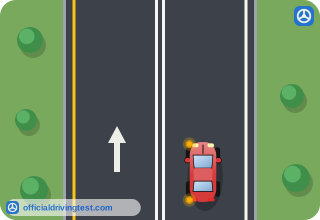
Crossing a double solid white line is:
- Allowed when passing
- Discouraged but legal
- Allowed only to turn
- Prohibited
Show answer
Correct answer: Prohibited
Double solid white lines separate lanes moving in the same direction, and crossing them is prohibited.
Source: Illinois Rules of the Road (2026), page 79
-
What do yellow center lines separate?
- Lanes moving in the same direction
- Traffic moving in opposite directions
- Bike lanes from travel lanes
- Parking areas from travel lanes
Show answer
Correct answer: Traffic moving in opposite directions
Yellow center lines separate lanes of traffic moving in opposite directions.
Source: Illinois Rules of the Road (2026), page 79
-
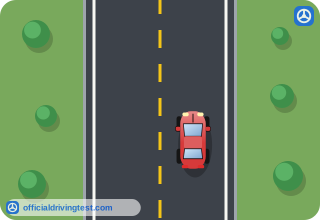
On a two-lane road with a broken yellow center line, passing is:
- Never allowed
- Allowed only for trucks
- Allowed
- Allowed only at night
Show answer
Correct answer: Allowed
Broken yellow lines separate single lanes moving in opposite directions, and passing is allowed.
Source: Illinois Rules of the Road (2026), page 79
-
When may you cross solid double yellow center lines?
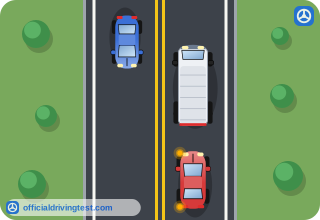
- To turn left into or out of a driveway or alley
- To pass a slower vehicle when the road ahead is clear
- To pass a vehicle traveling below the speed limit
- Never, for any reason at all
Show answer
Correct answer: To turn left into or out of a driveway or alley
Solid double yellow lines may be crossed to make a left turn to or from an alley, private road, driveway, or street.
Source: Illinois Rules of the Road (2026), page 79
-
What do solid yellow no passing lines indicate on a road where traffic moves in opposite directions?
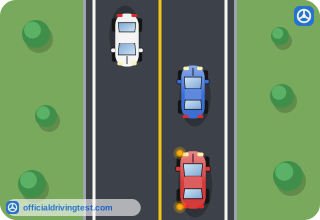
- Lanes reserved for left turns
- The edge of the pavement
- Where trucks may not pass
- Zones where passing is not allowed
Show answer
Correct answer: Zones where passing is not allowed
No passing lines are solid yellow lines that indicate zones where passing is not allowed.
Source: Illinois Rules of the Road (2026), page 79
-
When the solid yellow no passing line is on your side of the center line, when may you cross it to finish passing?
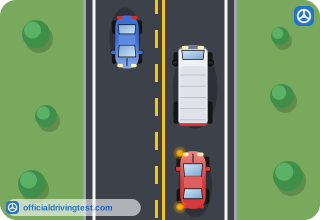
- Whenever no oncoming traffic is in sight
- When you began passing before the no passing zone started
- When the vehicle ahead is going under the speed limit
- Only during daylight hours
Show answer
Correct answer: When you began passing before the no passing zone started
You may cross the solid yellow line on your side to finish passing a vehicle you started to pass before the no passing zone began.
Source: Illinois Rules of the Road (2026), page 79
-
A solid yellow line and a broken yellow line separate two lanes moving in opposite directions. When may you pass?
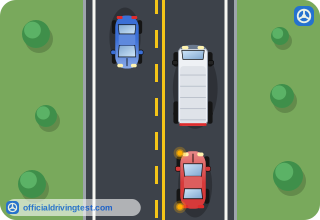
- Only when the solid line is nearest your lane
- Whenever the road ahead appears clear
- Only when the broken line is nearest your lane
- Never, from either lane
Show answer
Correct answer: Only when the broken line is nearest your lane
With a solid and a broken yellow line, you may pass only when the broken yellow line is nearest your lane.
Source: Illinois Rules of the Road (2026), page 80
-
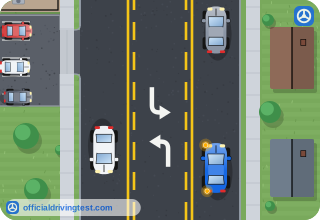
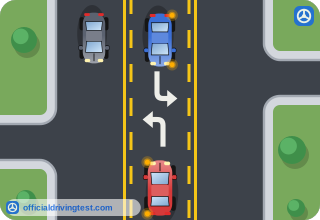
How are two-way left turn lanes marked?
- With yellow lines and white arrows
- With white lines and yellow arrows
- With double white lines only
- With red lines and white diamonds
Show answer
Correct answer: With yellow lines and white arrows
Two-way left turn lanes are marked with yellow lines and white arrows.
Source: Illinois Rules of the Road (2026), page 80
-
When a two-way left turn lane is provided, may you make a left turn from another lane?
- Yes, from any lane if traffic is light at the time
- Yes, but only from the lane next to the turn lane
- Yes, as long as you signal well before turning
- No, the left turn must be made from the turn lane
Show answer
Correct answer: No, the left turn must be made from the turn lane
A left turn may not be made from any other lane when a turn lane is provided.
Source: Illinois Rules of the Road (2026), page 80
-
Besides preparing for or making a left turn, when may you drive in a two-way left turn lane?
- To pass slower traffic
- To make a U-turn where allowed
- To get around a traffic jam
- To travel for up to one block
Show answer
Correct answer: To make a U-turn where allowed
You may drive in the lane only when preparing for or making a left turn, or a U-turn when permitted by law.
Source: Illinois Rules of the Road (2026), page 80
-
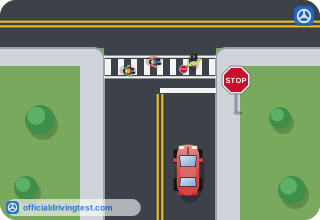
In an urban area, a white stop line is usually painted how far before the crosswalk?
- 1 foot
- 10 feet
- 4 feet
- 20 feet
Show answer
Correct answer: 4 feet
The white stop line is usually 4 feet before the crosswalk in an urban area.
Source: Illinois Rules of the Road (2026), page 80
-
When you stop at a white stop line for a stop sign or red light, where must your vehicle be?
- No part of the vehicle may cross the line
- The front bumper may extend over the line
- The front wheels must be on the line
- Up to half the vehicle may cross the line
Show answer
Correct answer: No part of the vehicle may cross the line
You must stop your vehicle before any part of it crosses the white stop line.
Source: Illinois Rules of the Road (2026), page 80
-
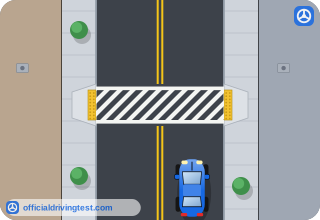
Why is the inside area of some white crosswalks marked with white diagonal lines?
- To show a school zone
- To mark a no parking zone
- To show where bicycles must stop
- For added visibility
Show answer
Correct answer: For added visibility
The inside area of a crosswalk is sometimes marked with white diagonal lines for added visibility.
Source: Illinois Rules of the Road (2026), page 80
-
When a crosswalk is located in the middle of a block, what is placed at the white lines?
- A stop sign on each side
- A flashing traffic signal
- A pedestrian crossing sign
- A raised speed bump
Show answer
Correct answer: A pedestrian crossing sign
Mid-block crosswalks have a pedestrian crossing sign located at the white lines.
Source: Illinois Rules of the Road (2026), page 80
-
What are yellow or white diagonal stripes used to mark?
- Fixed obstructions
- Bike lanes
- Loading zones
- Bus stops
Show answer
Correct answer: Fixed obstructions
Yellow or white diagonal stripes are used to mark fixed obstructions.
Source: Illinois Rules of the Road (2026), page 80
-
Solid white or yellow lines are sometimes used to:
- Mark the start of a school zone
- Show where a toll lane begins
- Mark the location of a bus stop
- Channel traffic around a hazard
Show answer
Correct answer: Channel traffic around a hazard
Solid white or yellow lines are sometimes used to channel traffic around a hazard.
Source: Illinois Rules of the Road (2026), page 80