Hawaii: Traffic signals — Part 1 Practice Test
Questions in this part include: “Where are standard three-color signals used primarily to stop and permit movement of traffic?” · “When may you turn left on a red light after stopping, if no sign prohibits it?”
Independent educational site · not affiliated with any government agency or DMV
Ready? Test yourself
- Instant feedback with an explanation
- Every answer cites its source in the manual
- Your best score is saved on this device
Questions are original and based on the official manual "Hawaii Driver's Manual" (2023), Hawaii Department of Transportation.
All 18 questions in this practice test
Take the test above first, then use this list to study. Tap “Show answer” to see the correct answer and explanation.
Show the questions and answersHide the questions
-
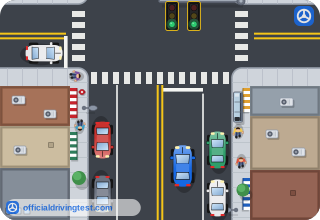
What is the primary purpose of traffic signals?
- To advise you of the speed limit
- To direct and regulate traffic
- To mark where passing is prohibited
- To guide you to your destination
Show answer
Correct answer: To direct and regulate traffic
Traffic signals serve primarily to direct and regulate traffic.
Source: Hawaii Driver's Manual (2023), page 39 · Open this page in the manual (Manual page 39)
-
Where are standard three-color signals used primarily to stop and permit movement of traffic?
- Where there is considerable conflict in the movement of vehicles
- Only where a railroad track crosses the highway or street
- Where there is a lane that changes direction during the day
- Only on roads that have a single lane in each direction
Show answer
Correct answer: Where there is considerable conflict in the movement of vehicles
Standard three-color signals are used primarily to stop and permit movement of traffic at locations where there is considerable conflict in the movement of vehicles.
Source: Hawaii Driver's Manual (2023), page 39 · Open this page in the manual (Manual page 39)
-
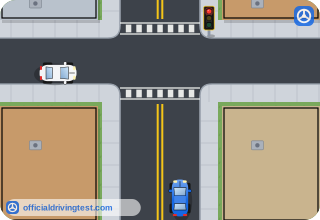
At a red light where there is no stop line, where must you stop?
- In the middle of the crosswalk
- Beyond the crosswalk, in the intersection
- Before entering any crosswalk
- Only when pedestrians are crossing
Show answer
Correct answer: Before entering any crosswalk
When there is no stop line, you must stop before entering any crosswalk.
Source: Hawaii Driver's Manual (2023), page 39 · Open this page in the manual (Manual page 39)
-
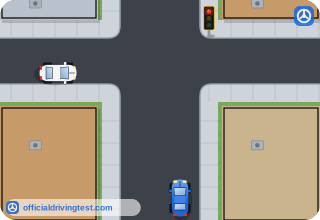
At a red light where there is no stop line or crosswalk, where must you stop?
- Halfway into the intersection
- Before entering the intersection
- Beyond the intersection
- At the nearest curb
Show answer
Correct answer: Before entering the intersection
When there is no stop line or crosswalk, you must stop before entering the intersection.
Source: Hawaii Driver's Manual (2023), page 39 · Open this page in the manual (Manual page 39)
-
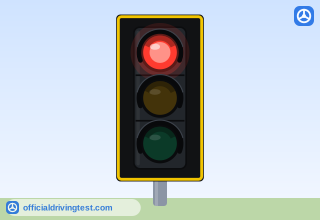
How long must you remain stopped at a red light?
- Until the yellow light is shown
- Until there are no pedestrians in sight
- For three seconds, and then proceed with caution
- Until the signal changes to green
Show answer
Correct answer: Until the signal changes to green
You must remain stopped until the signal changes to green.
Source: Hawaii Driver's Manual (2023), page 39 · Open this page in the manual (Manual page 39)
-
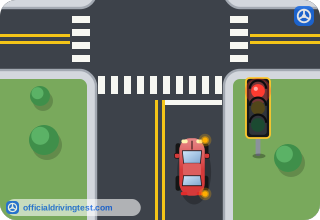
After stopping at a red light, what is true about turning right?
- You may never turn right on a red light
- You may turn right only when a police officer directs you
- You may turn right unless a sign prohibits it
- You may turn right only on a one-way street
Show answer
Correct answer: You may turn right unless a sign prohibits it
After stopping, you may turn right except when a sign prohibits such movement.
Source: Hawaii Driver's Manual (2023), page 39 · Open this page in the manual (Manual page 39)
-
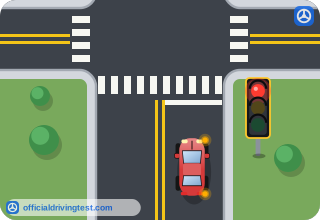
What must you do when turning right after stopping at a red light?
- Yield to all pedestrians and all vehicles
- Yield only to vehicles coming from the left
- Yield only to pedestrians in a crosswalk
- Turn without yielding if you stopped first
Show answer
Correct answer: Yield to all pedestrians and all vehicles
You must yield to all pedestrians and all vehicles when making a right turn on red.
Source: Hawaii Driver's Manual (2023), page 39 · Open this page in the manual (Manual page 39)
-
When may you turn left on a red light after stopping, if no sign prohibits it?
- From a one-way street into a two-way street where traffic moves both ways
- From any two-way street onto a one-way street with traffic moving left
- Only when no vehicle or pedestrian is in sight in either direction
- From a one-way street into a one-way street where traffic moves to the left
Show answer
Correct answer: From a one-way street into a one-way street where traffic moves to the left
After stopping you may turn left on a red light from a one-way street into a one-way street where traffic is moving to the left, except when a sign prohibits it.
Source: Hawaii Driver's Manual (2023), page 39 · Open this page in the manual (Manual page 39)
-
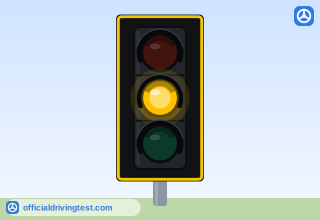
What does a yellow light mean?
- The signal will turn green in a few seconds
- The red light is going to be shown immediately thereafter
- You must stop at once, whatever the situation
- You must yield to oncoming traffic before proceeding
Show answer
Correct answer: The red light is going to be shown immediately thereafter
A yellow light means that the red light is going to be shown immediately thereafter.
Source: Hawaii Driver's Manual (2023), page 39 · Open this page in the manual (Manual page 39)
-
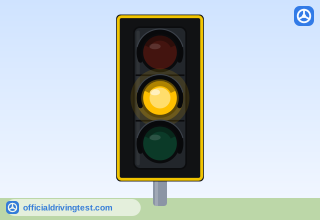
What should you do when a yellow light is shown?
- Avoid entering the intersection
- Speed up to clear the intersection
- Honk your horn and enter with caution
- Stop in the middle of the intersection
Show answer
Correct answer: Avoid entering the intersection
You should avoid entering the intersection when the yellow light is shown.
Source: Hawaii Driver's Manual (2023), page 39 · Open this page in the manual (Manual page 39)
-
What must you not do after the red light is shown?
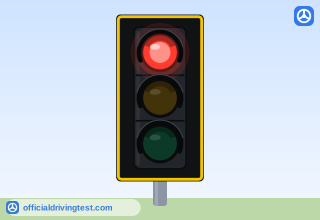
- Make a right turn after stopping
- Remain stopped at the stop line
- Enter the intersection
- Yield to pedestrians in the crosswalk
Show answer
Correct answer: Enter the intersection
You must not enter the intersection after the red light is shown.
Source: Hawaii Driver's Manual (2023), page 39 · Open this page in the manual (Manual page 39)
-
What does a green light mean?
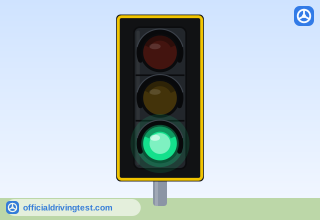
- Go straight ahead only, never turn
- Go straight ahead or turn, except when signs prohibit turns
- Go only after you have stopped and looked both ways
- Turn right only after stopping
Show answer
Correct answer: Go straight ahead or turn, except when signs prohibit turns
A green light means go straight ahead or turn except when signs prohibit turns.
Source: Hawaii Driver's Manual (2023), page 40 · Open this page in the manual (Manual page 40)
-
What must you do at a green light?
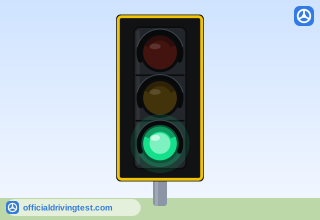
- Yield only to vehicles that are coming from your right side
- Speed up so that you can clear the intersection quickly
- Stop first, and then yield, if you intend to turn left
- Yield to all pedestrians and vehicles already in the intersection
Show answer
Correct answer: Yield to all pedestrians and vehicles already in the intersection
At a green light you must yield to all pedestrians and vehicles already in the intersection.
Source: Hawaii Driver's Manual (2023), page 40 · Open this page in the manual (Manual page 40)
-
What are lighted arrows sometimes used to control?
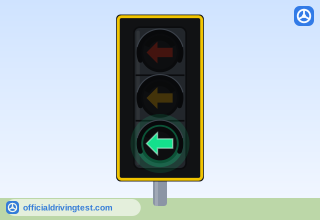
- Parking in a specific traffic lane
- The speed of traffic on a specific road
- Turns from a specific traffic lane
- Passing on a specific two-lane road
Show answer
Correct answer: Turns from a specific traffic lane
Lighted arrows are sometimes used to control turns from a specific traffic lane.
Source: Hawaii Driver's Manual (2023), page 40 · Open this page in the manual (Manual page 40)
-
What does a red arrow mean?
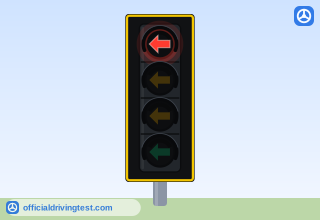
- The same as a red light for the indicated lane of traffic
- You may turn only in the direction of the arrow after stopping
- The same as a yellow light for the indicated lane of traffic
- You may proceed with caution in the indicated lane
Show answer
Correct answer: The same as a red light for the indicated lane of traffic
A red arrow has the same meaning as a red light for the indicated lane of traffic.
Source: Hawaii Driver's Manual (2023), page 40 · Open this page in the manual (Manual page 40)
-
What does a yellow arrow mean?
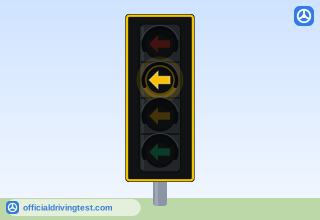
- The same as a red light for the indicated lane of traffic
- The same as a green light for the indicated lane of traffic
- You may turn in the direction of the arrow without yielding
- The same as a yellow light for the indicated lane of traffic
Show answer
Correct answer: The same as a yellow light for the indicated lane of traffic
A yellow arrow has the same meaning as a yellow light for the indicated lane of traffic.
Source: Hawaii Driver's Manual (2023), page 40 · Open this page in the manual (Manual page 40)
-
What must you do when a green arrow is shown for your lane?
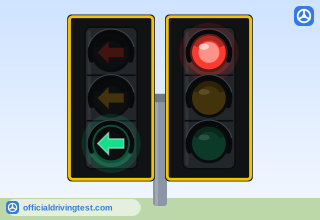
- Go in any direction that is not prohibited by a sign
- Turn or proceed only in the direction indicated by the arrow
- Stop first and then follow the arrow
- Yield to pedestrians only and then go straight
Show answer
Correct answer: Turn or proceed only in the direction indicated by the arrow
A green arrow has the same meaning as a green light, but you must turn or proceed in the direction indicated by the arrow.
Source: Hawaii Driver's Manual (2023), page 40 · Open this page in the manual (Manual page 40)
-
What do arrow signals combined with standard signals control?
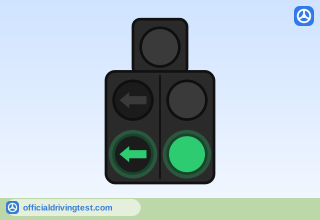
- The movement of vehicles in all traffic lanes
- Only the movement of vehicles in the left lane
- Only the movement of pedestrians
- Only the direction of traffic in a lane
Show answer
Correct answer: The movement of vehicles in all traffic lanes
Arrow signals combined with standard signals control the movement of vehicles in all traffic lanes.
Source: Hawaii Driver's Manual (2023), page 41 · Open this page in the manual (Manual page 41)