Hawaii: Speed and following distance — Part 2 Practice Test
Questions in this part include: “Where does the manual say special attention should be devoted?” · “To what must the proper safe vehicle speed be adjusted?”
Independent educational site · not affiliated with any government agency or DMV
Ready? Test yourself
- Instant feedback with an explanation
- Every answer cites its source in the manual
- Your best score is saved on this device
Questions are original and based on the official manual "Hawaii Driver's Manual" (2023), Hawaii Department of Transportation.
All 19 questions in this practice test
Take the test above first, then use this list to study. Tap “Show answer” to see the correct answer and explanation.
Show the questions and answersHide the questions
-
Where does the manual say special attention should be devoted?
- To conditions directly behind your vehicle
- To conditions far ahead of your vehicle
- To conditions only inside your vehicle
- To conditions at the sides of the road only
Show answer
Correct answer: To conditions far ahead of your vehicle
Special attention should be devoted to conditions at a considerable distance ahead of your vehicle.
Source: Hawaii Driver's Manual (2023), page 59 · Open this page in the manual (Manual page 59)
-
In the scanning pattern the manual describes, where should most of your attention be devoted?
- The rear view mirror
- The situation ahead
- The instrument panel
- The sides of the road
Show answer
Correct answer: The situation ahead
The scanning pattern puts most attention on the situation ahead, with glances to either side, in the mirror and at the instrument panel at regular and frequent intervals.
Source: Hawaii Driver's Manual (2023), page 60 · Open this page in the manual (Manual page 60)
-
According to the manual, what does a driver’s statement beginning “I didn’t see ....” often mean?
- “The road was poorly marked.”
- “The other driver was speeding.”
- “The sun was in my eyes.”
- “I wasn’t paying attention.”
Show answer
Correct answer: “I wasn’t paying attention.”
The manual says that in many cases “I didn’t see” means “I wasn’t paying attention.”
Source: Hawaii Driver's Manual (2023), page 60 · Open this page in the manual (Manual page 60)
-
What does the manual say happens to your field of vision as your speed increases?
- It gets wider
- It stays the same
- It is reduced
- It changes only at night
Show answer
Correct answer: It is reduced
Under the heading "Speed reduces your field of vision", the manual shows the field of vision getting narrower at higher speeds.
Source: Hawaii Driver's Manual (2023), page 59 · Open this page in the manual (Manual page 59)
-
According to the manual's figure, how wide is a driver's field of vision when the vehicle is stationary?
- About 45 degrees
- 180 degrees or more
- About 90 degrees
- About 120 degrees
Show answer
Correct answer: 180 degrees or more
The manual's figure shows a field of vision of 180 degrees or more when the vehicle is stationary.
Source: Hawaii Driver's Manual (2023), page 59 · Open this page in the manual (Manual page 59)
-
According to the manual's figure, at 60 mph your field of vision is reduced to approximately what?
- One-half
- Three-quarters
- One-tenth
- One-fifth
Show answer
Correct answer: One-fifth
The manual's figure shows the field of vision reduced to approximately one-fifth at 60 mph.
Source: Hawaii Driver's Manual (2023), page 59 · Open this page in the manual (Manual page 59)
-
To what must the proper safe vehicle speed be adjusted?
- The speed of the fastest vehicle in sight
- The power of your vehicle
- The experience of the driver behind you
- Traffic, weather and road conditions
Show answer
Correct answer: Traffic, weather and road conditions
The proper safe speed must be adjusted to traffic, weather and road conditions and should always be within the posted speed limits.
Source: Hawaii Driver's Manual (2023), page 66 · Open this page in the manual (Manual page 66)
-
Why should you keep pace with traffic?
- Slower vehicles are never involved in any type of crash
- It lets you follow other vehicles more closely
- Vehicles at the same speed in the same direction never collide
- It uses less fuel on every kind of road
Show answer
Correct answer: Vehicles at the same speed in the same direction never collide
Keeping pace is advised because vehicles moving in the same direction at the same speed never collide, while moving faster causes constant extra conflicts.
Source: Hawaii Driver's Manual (2023), page 67 · Open this page in the manual (Manual page 67)
-
What should you do if you cannot keep up with traffic?
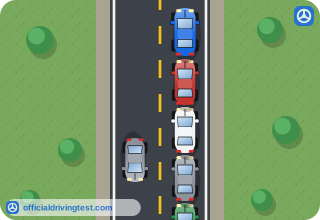
- Move as far to the right as possible
- Move to the center of the lane
- Stop on the shoulder until traffic clears
- Turn on your hazard lights and stay in the left lane
Show answer
Correct answer: Move as far to the right as possible
If you cannot keep up with traffic, you move as far to the right as possible.
Source: Hawaii Driver's Manual (2023), page 67 · Open this page in the manual (Manual page 67)
-
You note when the vehicle ahead is opposite a marker and count "one thousand one, one thousand two." You reach the word two before you pass the marker. What interval do you have?
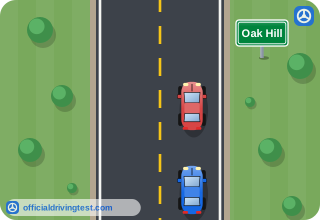
- At least a four second interval
- About a one second interval
- No interval at all
- At least a two second interval
Show answer
Correct answer: At least a two second interval
If you get to the word two before your vehicle reaches the marker, you have at least a two second interval, and you should never have less.
Source: Hawaii Driver's Manual (2023), page 67 · Open this page in the manual (Manual page 67)
-
One of the most common types of crashes is striking the vehicle ahead. What usually causes it?
- Driving too far to the right
- Following too closely
- Stopping too early
- Passing on the left
Show answer
Correct answer: Following too closely
Striking the vehicle ahead is one of the most common crashes and is usually caused by following too closely.
Source: Hawaii Driver's Manual (2023), page 67 · Open this page in the manual (Manual page 67)
-
How does following too closely affect you?
- It reduces your ability to see road and traffic conditions ahead
- It gives you more time to react to what is ahead
- It lets you pass the vehicle in front of you sooner
- It lowers your risk of being struck by a vehicle behind
Show answer
Correct answer: It reduces your ability to see road and traffic conditions ahead
Following too closely reduces your ability to see road and traffic conditions ahead, so you cannot avoid trouble when it develops.
Source: Hawaii Driver's Manual (2023), page 67 · Open this page in the manual (Manual page 67)
-
Why should you maintain a steady speed?
- It lets you become the fastest driver on the road
- Steady speed makes the posted speed limit lower
- Changing speed confuses other drivers about what you intend
- Other drivers will then know that you plan to pass them
Show answer
Correct answer: Changing speed confuses other drivers about what you intend
Constantly changing speed confuses other drivers as to your intentions, and bursts of speed and heavy braking are wasteful and dangerous.
Source: Hawaii Driver's Manual (2023), page 67 · Open this page in the manual (Manual page 67)
-
Why should you reduce your speed in poor road or weather conditions?
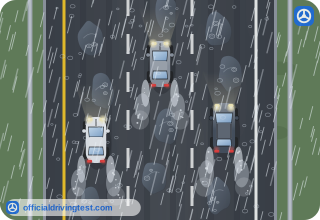
- You are allowed to follow the vehicle ahead more closely
- You keep better control and have more time to avoid danger
- Other drivers will pass you more quickly and safely
- The posted speed limit no longer applies to you then
Show answer
Correct answer: You keep better control and have more time to avoid danger
At slower speeds you can maintain better control of your vehicle and you have more time to avoid dangerous situations.
Source: Hawaii Driver's Manual (2023), page 67 · Open this page in the manual (Manual page 67)
-
According to the manual, what should never determine the speed of your vehicle?
- Traffic conditions
- Weather conditions
- Road conditions
- Your emotions
Show answer
Correct answer: Your emotions
The manual says to never let your emotions determine the speed of your vehicle and never to be in a hurry.
Source: Hawaii Driver's Manual (2023), page 67 · Open this page in the manual (Manual page 67)
-
What causes most of the weather-related driving problems in Hawaii?
- Snow
- Dense fog at low elevations
- Rain
- Extreme heat
Show answer
Correct answer: Rain
The manual says weather problems associated with driving in Hawaii are primarily due to rain.
Source: Hawaii Driver's Manual (2023), page 75 · Open this page in the manual (Manual page 75)
-
What two basic driving problems does rain cause?
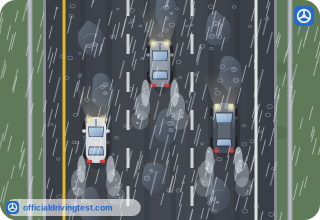
- It reduces engine power and wears out the tires
- It reduces the driver’s visibility and changes the road surface condition
- It weakens the head lamps and makes the horn sound quieter to others
- It slows reaction time and overheats the engine
Show answer
Correct answer: It reduces the driver’s visibility and changes the road surface condition
Rain reduces the driver’s visibility and changes the condition of the road surface.
Source: Hawaii Driver's Manual (2023), page 75 · Open this page in the manual (Manual page 75)
-
When are roads most slippery in the rain?
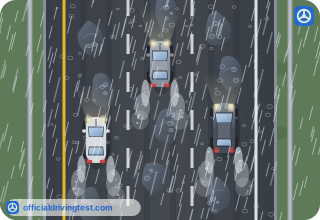
- After it has rained for several hours
- Once the road is completely flooded
- Just after the rain stops
- When the first few drops of rain fall
Show answer
Correct answer: When the first few drops of rain fall
Roads are most slippery at first because the oil dropped from passing cars has not been washed away.
Source: Hawaii Driver's Manual (2023), page 75 · Open this page in the manual (Manual page 75)
-
In the first moments of rain, how much following distance should you allow?
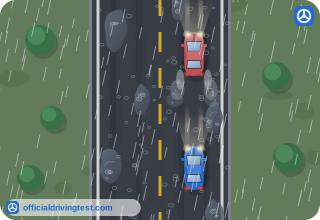
- The normal following distance, as long as you reduce speed
- Half the normal following distance
- At least twice the normal following distance
- Exactly the normal following distance with the wipers on
Show answer
Correct answer: At least twice the normal following distance
The manual says to reduce speed, use extra caution, and allow at least twice the normal following distance.
Source: Hawaii Driver's Manual (2023), page 75 · Open this page in the manual (Manual page 75)