Hawaii: Signals and vehicle controls — Part 6 Practice Test
Questions in this part include: “How should you prepare your eyes for night driving?” · “Besides being balanced, what should be true of a trailer load?”
Independent educational site · not affiliated with any government agency or DMV
Ready? Test yourself
- Instant feedback with an explanation
- Every answer cites its source in the manual
- Your best score is saved on this device
Questions are original and based on the official manual "Hawaii Driver's Manual" (2023), Hawaii Department of Transportation.
All 17 questions in this practice test
Take the test above first, then use this list to study. Tap “Show answer” to see the correct answer and explanation.
Show the questions and answersHide the questions
-
Which head lamp setting should you use when driving in fog?
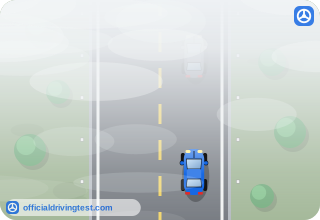
- Low beam
- High beam
- Parking lights only
- No change from normal
Show answer
Correct answer: Low beam
The manual says to sharply reduce speed and turn on low beam head lamps, and never to use the high beam in fog.
Source: Hawaii Driver's Manual (2023), page 76 · Open this page in the manual (Manual page 76)
-
What should you use when driving towards the rising or setting sun?
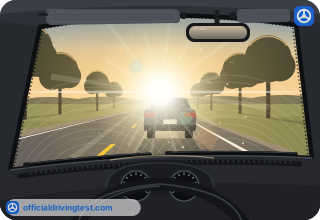
- High beam head lamps
- Hazard warning signals
- Sun visors and sun glasses
- Parking lights only
Show answer
Correct answer: Sun visors and sun glasses
When driving towards the rising or setting sun, use sun visors and sun glasses and keep the windshield absolutely clean.
Source: Hawaii Driver's Manual (2023), page 77 · Open this page in the manual (Manual page 77)
-
For a short period before sunrise and after sunset there is not enough light to see objects clearly. How should the head lamps be used?
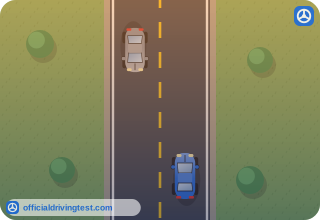
- On low beam so others can see you
- On high beam to light the road
- Off, since it is still daylight
- On parking lights only
Show answer
Correct answer: On low beam so others can see you
The manual says to turn the head lamps on low beam during this time so others can see you.
Source: Hawaii Driver's Manual (2023), page 77 · Open this page in the manual (Manual page 77)
-
What should you do with your high beam head lamps when approaching or following other vehicles at night?
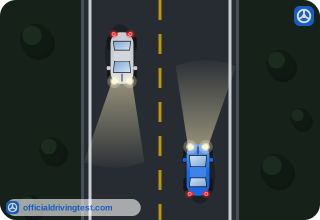
- Use them to be seen better
- Do not use them
- Use them only for a few seconds at a time
- Use them only when following
Show answer
Correct answer: Do not use them
The manual says not to use high beam head lamps when approaching or following other vehicles.
Source: Hawaii Driver's Manual (2023), page 77 · Open this page in the manual (Manual page 77)
-
If the lights of an approaching vehicle are too bright at night, where should you look?
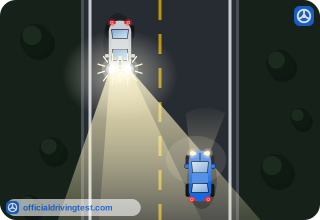
- Directly at the approaching head lamps
- At the center line
- At your rear-view mirror
- At the right edge of the road
Show answer
Correct answer: At the right edge of the road
The manual says to flash your high beams once and look at the right edge of the road, using lane markings or reflectors as a guide.
Source: Hawaii Driver's Manual (2023), page 77 · Open this page in the manual (Manual page 77)
-
How should you prepare your eyes for night driving?
- Expose them to alternating light and darkness before you drive
- Look at bright lights just before you drive
- Protect them from bright light for several hours before you drive
- Wear sun glasses while you drive
Show answer
Correct answer: Protect them from bright light for several hours before you drive
The manual says to protect your eyes from bright light for several hours before you drive.
Source: Hawaii Driver's Manual (2023), page 77 · Open this page in the manual (Manual page 77)
-
When towing, when must you have outside rear-view mirrors on both sides of your car?
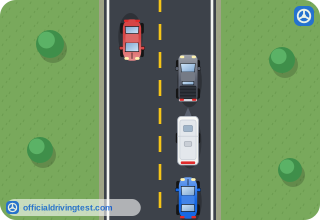
- When the trailer weighs more than half the weight of the towing vehicle
- When the trailer blocks your view in the inside mirror
- Whenever you tow any trailer at night
- When the trailer is longer than the towing vehicle
Show answer
Correct answer: When the trailer blocks your view in the inside mirror
If the trailer is large enough to obstruct your view through the inside rear-view mirror, you must have outside rear-view mirrors of proper size on both sides.
Source: Hawaii Driver's Manual (2023), page 87 · Open this page in the manual (Manual page 87)
-
When must a loaded trailer be equipped with brakes and breakaway protection?
- If it weighs more than the towing vehicle or is 5,000 pounds or more
- If it weighs more than a quarter of the towing vehicle or is 2,000 pounds or more
- If it is longer than the towing vehicle or weighs 6,000 pounds or more
- If it weighs more than half the weight of the towing vehicle or is 3,000 pounds or more
Show answer
Correct answer: If it weighs more than half the weight of the towing vehicle or is 3,000 pounds or more
A loaded trailer needs brakes and breakaway protection when it weighs more than half of the towing vehicle or is 3,000 pounds or more.
Source: Hawaii Driver's Manual (2023), page 87 · Open this page in the manual (Manual page 87)
-
To what must a trailer’s safety chains be attached?
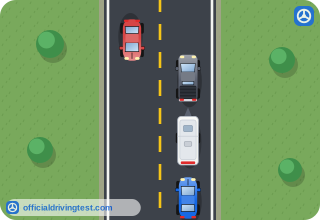
- A part of the trailer hitch
- The bumper of the towing vehicle and the trailer tongue
- The frame of the towing vehicle and the trailer
- The rear axle of the towing vehicle and the trailer
Show answer
Correct answer: The frame of the towing vehicle and the trailer
Safety chains must be attached to the frame of the towing vehicle and the trailer, not to a part of the trailer hitch.
Source: Hawaii Driver's Manual (2023), page 87 · Open this page in the manual (Manual page 87)
-
What does the manual say about relying on bumper hitches for towing trailers?
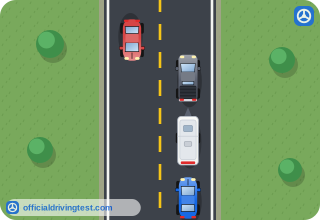
- They are fine for small trailers
- Don’t rely on them for any trailer
- They are required for large trailers
- They are best for heavy loads
Show answer
Correct answer: Don’t rely on them for any trailer
The manual says not to rely on bumper hitches for any trailer.
Source: Hawaii Driver's Manual (2023), page 88 · Open this page in the manual (Manual page 88)
-
About what share of the trailer weight should be on the vehicle’s trailer hitch?
- About 25% to 30%
- About 1% to 5%
- About 50%
- About 10% to 15%
Show answer
Correct answer: About 10% to 15%
About 10% to 15% of the trailer weight should be on the vehicle’s trailer hitch.
Source: Hawaii Driver's Manual (2023), page 88 · Open this page in the manual (Manual page 88)
-
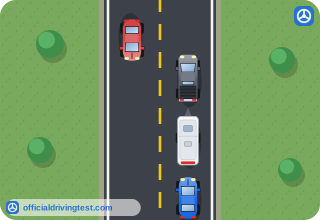
What happens if too little weight is on the trailer hitch?
- The trailer will “fishtail”
- The trailer tires will wear out faster
- The trailer brakes will lock up
- The load will shift forward
Show answer
Correct answer: The trailer will “fishtail”
If the weight on the hitch is too small, the trailer will “fishtail.”
Source: Hawaii Driver's Manual (2023), page 88 · Open this page in the manual (Manual page 88)
-
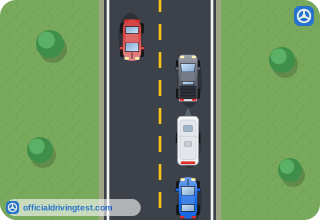
What happens if too much weight is on the vehicle’s trailer hitch?
- The trailer will lift up off the hitch ball
- The trailer lights will stop working properly
- You will have difficulty steering the vehicle
- The vehicle will accelerate much too fast
Show answer
Correct answer: You will have difficulty steering the vehicle
If the weight on the hitch is too great, you will have difficulty steering the vehicle.
Source: Hawaii Driver's Manual (2023), page 88 · Open this page in the manual (Manual page 88)
-
Besides being balanced, what should be true of a trailer load?
- It should be placed mostly over the rear axle
- It should be held securely in place
- It should be covered at all times
- It should be lighter than the towing vehicle
Show answer
Correct answer: It should be held securely in place
The manual says to be sure the load is held securely in place.
Source: Hawaii Driver's Manual (2023), page 88 · Open this page in the manual (Manual page 88)
-
What should cover the wheels of a trailer?
- Hubcaps or wheel covers
- Canvas or plastic covers
- Reflective tape strips
- Fenders or mud guards
Show answer
Correct answer: Fenders or mud guards
A trailer should have wheels properly mounted and lubricated, and covered with fenders or mud guards.
Source: Hawaii Driver's Manual (2023), page 88 · Open this page in the manual (Manual page 88)
-
What should the tires of a trailer be?
- Good tires properly inflated
- Matched to the tires of the towing vehicle
- Inflated to the maximum pressure whatever the load
- Slightly under-inflated for a softer ride
Show answer
Correct answer: Good tires properly inflated
The manual says a trailer should have good tires properly inflated.
Source: Hawaii Driver's Manual (2023), page 88 · Open this page in the manual (Manual page 88)
-
Which lamps should a trailer have?
- Headlamps, fog lamps and a roof-mounted beacon
- Hazard flashers, cornering lamps and a spotlight
- Tail, stop, turn signal and license plate lamps
- Parking lamps, fog lamps and a warning beacon
Show answer
Correct answer: Tail, stop, turn signal and license plate lamps
A trailer should have tail, stop, turn signal and license plate lamps and, if required, side marker lamps and reflectors.
Source: Hawaii Driver's Manual (2023), page 88 · Open this page in the manual (Manual page 88)