Hawaii: Signals and vehicle controls — Part 5 Practice Test
Questions in this part include: “Failure to cancel an electric turn signal is usually caused by what?” · “How is the operation of the hazard warning signals shown?”
Independent educational site · not affiliated with any government agency or DMV
Ready? Test yourself
- Instant feedback with an explanation
- Every answer cites its source in the manual
- Your best score is saved on this device
Questions are original and based on the official manual "Hawaii Driver's Manual" (2023), Hawaii Department of Transportation.
All 17 questions in this practice test
Take the test above first, then use this list to study. Tap “Show answer” to see the correct answer and explanation.
Show the questions and answersHide the questions
-
Why should you use extra care when downshifting on a slippery road surface?

- Unequal forces may cause vehicle control problems
- The brake lamps will not work on a slippery surface
- The clutch pedal will lock in the down position
- Automatic transmissions cannot downshift at all
Show answer
Correct answer: Unequal forces may cause vehicle control problems
Downshifting on a slippery surface develops unequal forces that may cause vehicle control problems.
Source: Hawaii Driver's Manual (2023), page 71 · Open this page in the manual (Manual page 71)
-
Which is an advantage of electric turn signals over hand signals?
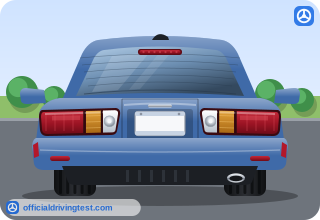
- They are usually not subject to failure
- They require that the driver’s window be open
- They can be used when the vehicle has no indicator lamp
- They allow the driver to use both hands to control the vehicle
Show answer
Correct answer: They allow the driver to use both hands to control the vehicle
Electric signals allow the driver to use both hands to control the vehicle while signaling.
Source: Hawaii Driver's Manual (2023), page 73 · Open this page in the manual (Manual page 73)
-
Failure to cancel an electric turn signal is usually caused by what?
- Using the hazard warning signals while the vehicle is moving in traffic
- Signaling for longer than 100 feet before the turn
- A turn or lane change too small to operate the self-cancelling mechanism
- A burned-out stop lamp
Show answer
Correct answer: A turn or lane change too small to operate the self-cancelling mechanism
Failure to cancel is usually caused by a turn or lane change too small to cause operation of the self-cancelling mechanism, and by the driver not observing the instrument panel indicator.
Source: Hawaii Driver's Manual (2023), page 73 · Open this page in the manual (Manual page 73)
-
What is an abnormal function of the turn signal indicator lamp a clue to?
- Improper operation of the signal system
- A fully charged battery
- That the self-cancelling mechanism is working
- That the hazard warning signals are on
Show answer
Correct answer: Improper operation of the signal system
The manual says any abnormal function of the indicator lamp is a clue to improper operation of the signal system.
Source: Hawaii Driver's Manual (2023), page 73 · Open this page in the manual (Manual page 73)
-
When is knowledge of the proper hand signals required of a driver?
- Only when driving on a freeway
- Only when driving at night
- Whenever the driver’s window is closed
- If the electric signals fail
Show answer
Correct answer: If the electric signals fail
The manual says knowledge of the proper hand signals is required if the electric signals fail.
Source: Hawaii Driver's Manual (2023), page 73 · Open this page in the manual (Manual page 73)
-
Which is a disadvantage of hand signals?
- They fail to cancel after a turn
- They require that the driver’s window be open
- They cannot be used if the electric signals fail
- They cannot be seen from the front of the vehicle
Show answer
Correct answer: They require that the driver’s window be open
One listed disadvantage of hand signals is that they require the driver’s window to be open.
Source: Hawaii Driver's Manual (2023), page 73 · Open this page in the manual (Manual page 73)
-
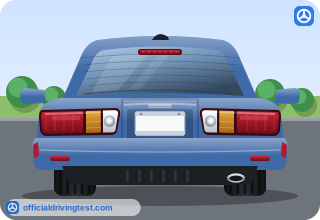
What are hazard warning signals (4-way flash) intended to do?
- Show that you are about to change lanes or turn at the next intersection
- Warn other drivers that a vehicle is in a hazardous position on the roadway
- Tell other drivers to pass you on the left
- Show that you are slowing in traffic
Show answer
Correct answer: Warn other drivers that a vehicle is in a hazardous position on the roadway
Hazard warning signals are intended to warn other drivers that a vehicle is in a hazardous position on the roadway.
Source: Hawaii Driver's Manual (2023), page 73 · Open this page in the manual (Manual page 73)
-
When should the hazard warning signal (4-way flash) never be used?
- When the vehicle is parked at night
- When the vehicle has broken down
- When the vehicle is in a hazardous position
- When the vehicle is moving
Show answer
Correct answer: When the vehicle is moving
The manual says the hazard warning signal should never be used when the vehicle is moving.
Source: Hawaii Driver's Manual (2023), page 73 · Open this page in the manual (Manual page 73)
-
How is the operation of the hazard warning signals shown?
- By the flashing of all turn signal indicators
- By the flashing of the stop lamps only
- By the flashing of the left turn indicator only
- By the head lamps flashing on and off
Show answer
Correct answer: By the flashing of all turn signal indicators
Operation of the hazard warning signal is shown by the flashing of all turn signal indicators.
Source: Hawaii Driver's Manual (2023), page 73 · Open this page in the manual (Manual page 73)
-
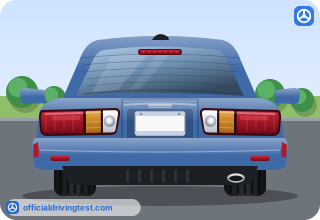
When are electric stop lamps automatically operated?
- When the turn signal is turned on
- When the accelerator is released
- When the service brake is used
- When the head lamps are turned on
Show answer
Correct answer: When the service brake is used
Electric stop lamps are automatically operated when the service brake is used.
Source: Hawaii Driver's Manual (2023), page 74 · Open this page in the manual (Manual page 74)
-
What may a driver use a hand signal to indicate, besides turns?
- That the vehicle is in a hazardous position
- That the vehicle is about to be parked
- That the high beams are on
- Either braking or slowing of the vehicle
Show answer
Correct answer: Either braking or slowing of the vehicle
The manual says a hand signal may be used to indicate either braking or slowing of the vehicle.
Source: Hawaii Driver's Manual (2023), page 74 · Open this page in the manual (Manual page 74)
-
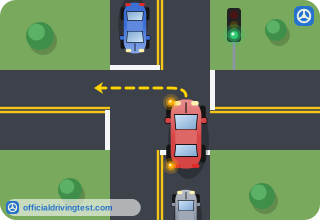
What does using a turn signal give you?
- The right of way to make the movement you have signaled
- It shows your intent but gives no right to make the movement
- Release from responsibility for the movement
- The right to change lanes without looking
Show answer
Correct answer: It shows your intent but gives no right to make the movement
The use of a signal does not give you the right to make the intended movement; you alone are responsible for making it safely.
Source: Hawaii Driver's Manual (2023), page 74 · Open this page in the manual (Manual page 74)
-
For at least how far before making every turn or lane change must you display a turn signal?
- 50 feet (15 meters)
- 200 feet (60 meters)
- 100 feet (30 meters)
- 300 feet (90 meters)
Show answer
Correct answer: 100 feet (30 meters)
Traffic regulations require a turn signal for at least 100 feet (30 meters) before every turn or lane change.
Source: Hawaii Driver's Manual (2023), page 74 · Open this page in the manual (Manual page 74)
-
If you must slow your vehicle before making a turn or lane change, when should you begin signaling?
- Before slowing your vehicle
- After you have finished slowing
- Just as you begin the turn
- Only when you are stopped
Show answer
Correct answer: Before slowing your vehicle
Begin signaling before slowing so other drivers are alerted that you might reduce speed.
Source: Hawaii Driver's Manual (2023), page 74 · Open this page in the manual (Manual page 74)
-
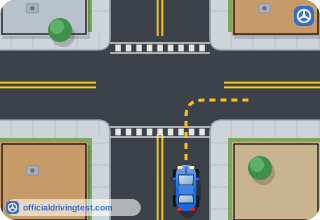
You are about to turn and it appears that no one is around to see your signal. What does the manual say?
- Skip the signal, since no one is there to see it
- Signal only after the turn has started
- Use the hazard warning signals instead
- Signal anyway; skipping it is a common signaling error
Show answer
Correct answer: Signal anyway; skipping it is a common signaling error
The manual lists failure to signal when it appears that there is no one to observe the signal as a common signaling error.
Source: Hawaii Driver's Manual (2023), page 74 · Open this page in the manual (Manual page 74)
-
According to the manual, what does failure to signal properly show?
- A lack of consideration and courtesy towards others
- That the vehicle’s signal system has failed
- Skill at merging into traffic
- A good defensive driving habit
Show answer
Correct answer: A lack of consideration and courtesy towards others
Failure to signal properly indicates driver ignorance, arrogance, or uncertainty and shows a lack of consideration and courtesy towards others.
Source: Hawaii Driver's Manual (2023), page 74 · Open this page in the manual (Manual page 74)
-
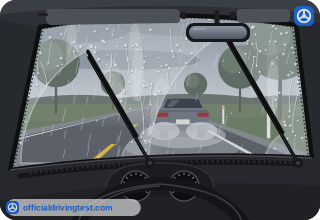
When heavy rain reduces your visibility, what lights should you turn on?
- Head lamps on high beam
- Hazard warning signals only
- Parking lights only
- Head lamps on low beam
Show answer
Correct answer: Head lamps on low beam
The manual says to reduce your speed and turn on your head lamps (low beam) so that others may see you.
Source: Hawaii Driver's Manual (2023), page 76 · Open this page in the manual (Manual page 76)