Hawaii: Right-of-way and turning — Part 5 Practice Test
Questions in this part include: “Where should you not attempt to pass another vehicle?”
Independent educational site · not affiliated with any government agency or DMV
Ready? Test yourself
- Instant feedback with an explanation
- Every answer cites its source in the manual
- Your best score is saved on this device
Questions are original and based on the official manual "Hawaii Driver's Manual" (2023), Hawaii Department of Transportation.
All 19 questions in this practice test
Take the test above first, then use this list to study. Tap “Show answer” to see the correct answer and explanation.
Show the questions and answersHide the questions
-
When should you use extra caution on curves and turns?
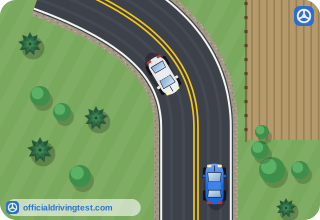
- In poor weather, or with gravel, sand or mud on the road
- Only at night, when your headlights are the only light
- Only on roads with a posted speed limit above 45 mph
- Only when you are towing a trailer or another vehicle
Show answer
Correct answer: In poor weather, or with gravel, sand or mud on the road
Use extra caution on curves and turns in poor weather conditions or when there is gravel, sand, or mud on the road.
Source: Hawaii Driver's Manual (2023), page 67 · Open this page in the manual (Manual page 67)
-
When making a right turn at an intersection, what must you not do?
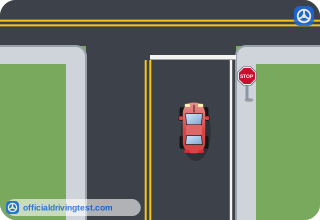
- Signal before you turn
- Slow down before you turn
- Look for pedestrians
- Drive in a bike lane
Show answer
Correct answer: Drive in a bike lane
The manual says that when making a right turn at an intersection, you do not drive in a bike lane.
Source: Hawaii Driver's Manual (2023), page 67 · Open this page in the manual (Manual page 67)
-
Why is passing hazardous on two or three lane roads?
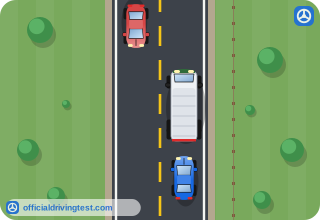
- It requires driving on the road shoulder to complete the pass
- It uses the opposing lane, and mistakes can cause a head-on collision
- Faster vehicles always follow closely right behind you
- The vehicle you pass can speed up without any warning
Show answer
Correct answer: It uses the opposing lane, and mistakes can cause a head-on collision
Passing on two or three lane roads uses a lane for opposing traffic, so improper procedures can cause a head-on collision.
Source: Hawaii Driver's Manual (2023), page 68 · Open this page in the manual (Manual page 68)
-
When should you pass the vehicle ahead?
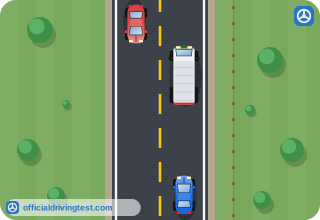
- Only if it is moving below the safe speed
- Whenever it is in front of you
- Whenever you can gain a few car lengths
- Whenever the lane to your left is empty
Show answer
Correct answer: Only if it is moving below the safe speed
You pass only if the vehicle ahead is moving below the safe speed, and not simply because it is there.
Source: Hawaii Driver's Manual (2023), page 68 · Open this page in the manual (Manual page 68)
-
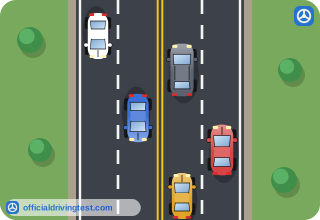
In moderate or heavy traffic, what does the manual say about passing vehicles merely to gain a few car lengths?
- It is allowed if you signal first
- It is allowed on the right only
- Don't attempt it
- It is required of slow drivers
Show answer
Correct answer: Don't attempt it
The manual says not to attempt to pass vehicles merely to gain a few car lengths in moderate or heavy traffic.
Source: Hawaii Driver's Manual (2023), page 68 · Open this page in the manual (Manual page 68)
-
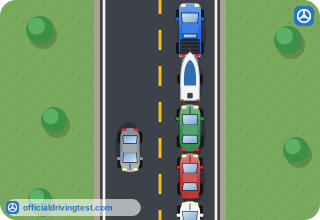
You are in a line of vehicles and want to pass. What should you do first?
- Pass the entire line of vehicles at the same time in one move
- Let the vehicles ahead pass the lead vehicle before you try to pass
- Move onto the road shoulder and pass the whole line on the right
- Sound your horn and pull out into the passing lane right away
Show answer
Correct answer: Let the vehicles ahead pass the lead vehicle before you try to pass
In a line of vehicles, you allow the vehicles ahead to pass the lead vehicle before you attempt to pass.
Source: Hawaii Driver's Manual (2023), page 68 · Open this page in the manual (Manual page 68)
-
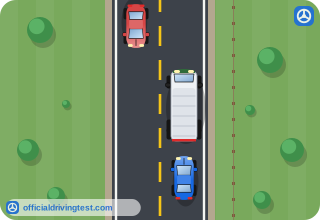
On which side should you normally pass, and what is the exception?
- On the right, except when the vehicle ahead is slowing or stopping
- On the left, except on roads that have only two lanes for traffic
- On the right, except when the road surface is wet from rain
- On the left, except if the vehicle ahead is about to turn left
Show answer
Correct answer: On the left, except if the vehicle ahead is about to turn left
You pass on the left except when the vehicle you are overtaking is making or about to make a left turn, which you pass carefully on the right.
Source: Hawaii Driver's Manual (2023), page 68 · Open this page in the manual (Manual page 68)
-
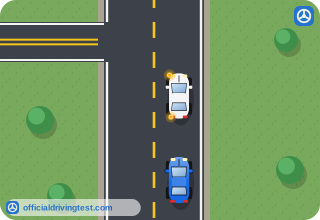
You are passing a vehicle that is making a left turn. What must you never do?
- Check for opposing or conflicting traffic first
- Signal your intention before you pass it
- Drive onto the road shoulder to pass it
- Allow ample following distance behind it
Show answer
Correct answer: Drive onto the road shoulder to pass it
The manual says never to drive onto the road shoulder to pass a vehicle making a left turn.
Source: Hawaii Driver's Manual (2023), page 68 · Open this page in the manual (Manual page 68)
-
Before you pass, how much following distance should you allow behind the vehicle you are overtaking?
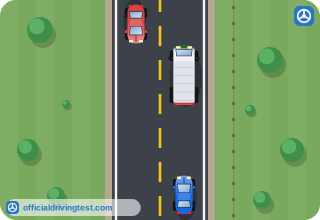
- Ample distance, so you can observe any opposing or conflicting traffic
- Only a few feet, so that you can pass as quickly as possible
- Exactly one car length, no matter how fast you are going
- Enough to stay in the other driver's blind spot the whole time
Show answer
Correct answer: Ample distance, so you can observe any opposing or conflicting traffic
You allow ample following distance so that you can observe any opposing or conflicting traffic.
Source: Hawaii Driver's Manual (2023), page 68 · Open this page in the manual (Manual page 68)
-
What should you physically check before moving left to pass?
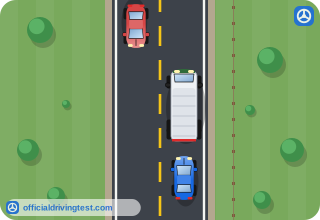
- That your fuel tank has enough gas to finish the pass
- That the lane to your right is empty of other vehicles
- That the vehicle ahead has sounded its horn at you first
- That no vehicles behind you are attempting to pass your vehicle
Show answer
Correct answer: That no vehicles behind you are attempting to pass your vehicle
You physically check behind to see that there are no vehicles attempting to pass your vehicle.
Source: Hawaii Driver's Manual (2023), page 68 · Open this page in the manual (Manual page 68)
-
In the passing procedure, what do you do to let the driver ahead know you are going to pass?
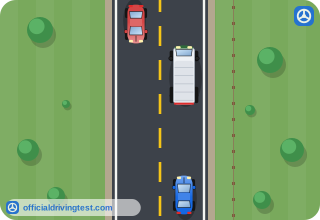
- Flash your high beams twice
- Sound your horn
- Turn on your hazard lights
- Wave from the window
Show answer
Correct answer: Sound your horn
The passing steps include sounding your horn so that the driver ahead knows you are going to pass.
Source: Hawaii Driver's Manual (2023), page 68 · Open this page in the manual (Manual page 68)
-
Where should you accelerate to passing speed?
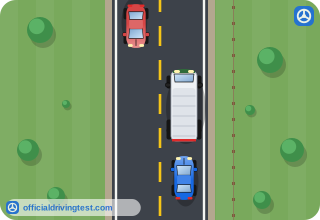
- In your lane of travel, before you move left
- After you move into the opposing lane
- On the road shoulder
- While you are beside the other vehicle
Show answer
Correct answer: In your lane of travel, before you move left
You accelerate to passing speed in your lane of travel, then move left and begin to pass.
Source: Hawaii Driver's Manual (2023), page 68 · Open this page in the manual (Manual page 68)
-
A conflict appears before you have finished passing. What should you do?
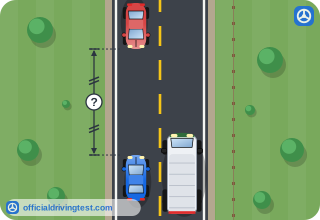
- Speed up as much as needed to finish passing the vehicle
- Move onto the shoulder on the right to get out of the way
- Brake sharply and return to the lane behind the overtaken vehicle
- Hold your position beside the vehicle and sound your horn
Show answer
Correct answer: Brake sharply and return to the lane behind the overtaken vehicle
You brake sharply and return to the lane behind the overtaken vehicle, because speed can be reduced more quickly by braking than increased by more power.
Source: Hawaii Driver's Manual (2023), page 68 · Open this page in the manual (Manual page 68)
-
When may you move back into the proper traffic lane after passing?
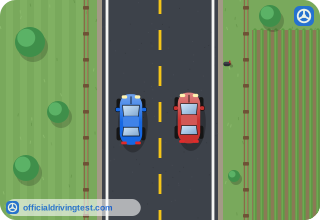
- As soon as the front of your car passes the overtaken vehicle's rear bumper
- When you see the overtaken vehicle in your interior rear-view mirror
- When the overtaken vehicle sounds its horn to let you in
- When you are about one car length ahead of that vehicle
Show answer
Correct answer: When you see the overtaken vehicle in your interior rear-view mirror
You move back into the proper traffic lane when you can see the overtaken vehicle in your interior rear-view mirror.
Source: Hawaii Driver's Manual (2023), page 68 · Open this page in the manual (Manual page 68)
-
On a road with two or more lanes for traffic moving in the same direction, how may you pass another vehicle?
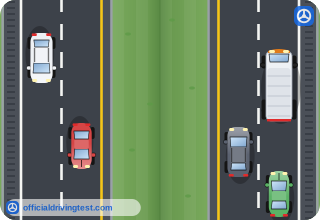
- Only on the left, by using the lane for opposing traffic
- Only on the right, by driving along the road shoulder
- Only when the other vehicle slows down to let you pass
- On either side, using the proper lane change procedures
Show answer
Correct answer: On either side, using the proper lane change procedures
You do not move into a lane for opposing traffic, and you may pass on either side by using the proper lane change procedures.
Source: Hawaii Driver's Manual (2023), page 68 · Open this page in the manual (Manual page 68)
-
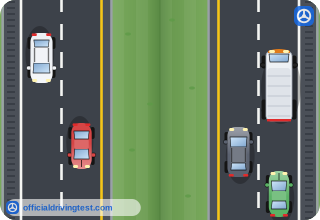
Why must you be extra careful when passing on the right?
- The road shoulder is usually narrower than the lane
- Drivers ahead of you do not signal when moving right
- You approach the overtaken vehicle in the driver's blind spot
- Passing on the right is allowed only during the night
Show answer
Correct answer: You approach the overtaken vehicle in the driver's blind spot
Passing on the right is dangerous because you will approach the overtaken vehicle in the driver's blind spot.
Source: Hawaii Driver's Manual (2023), page 68 · Open this page in the manual (Manual page 68)
-
Where should you not attempt to pass another vehicle?
- When approaching or moving through an intersection or crosswalk
- On any road that has three or more lanes in your direction
- When the vehicle ahead of you is moving very slowly in your lane
- When you are driving in the left lane of a multilane road
Show answer
Correct answer: When approaching or moving through an intersection or crosswalk
The manual says that in all passing situations you should not attempt to pass when approaching or moving through an intersection or crosswalk.
Source: Hawaii Driver's Manual (2023), page 68 · Open this page in the manual (Manual page 68)
-
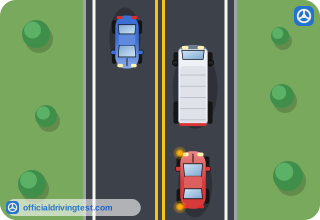
What must you obey when passing?
- Only the posted speed limit and nothing else on the road
- Only the signs that are posted on your side of the road
- Only the markings that are painted in yellow on the road
- All signs and lane markings that restrict or prohibit passing
Show answer
Correct answer: All signs and lane markings that restrict or prohibit passing
You obey all signs and traffic lane markings which restrict or prohibit passing.
Source: Hawaii Driver's Manual (2023), page 68 · Open this page in the manual (Manual page 68)
-
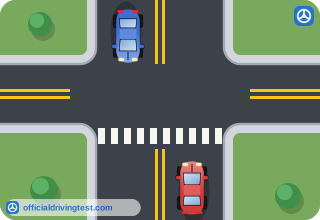
You must never drive into an intersection or a crosswalk unless what is true?
- Unless your turn signal is on before you enter it
- Unless you are the first vehicle in line at the light
- Unless the traffic light was green when you first saw it
- Unless there is space for your entire vehicle on the opposite side
Show answer
Correct answer: Unless there is space for your entire vehicle on the opposite side
You never drive into an intersection or crosswalk unless there is space for your entire vehicle on the opposite side.
Source: Hawaii Driver's Manual (2023), page 69 · Open this page in the manual (Manual page 69)