Hawaii: Right-of-way and turning — Part 4 Practice Test
Questions in this part include: “Where should you never change lanes?”
Independent educational site · not affiliated with any government agency or DMV
Ready? Test yourself
- Instant feedback with an explanation
- Every answer cites its source in the manual
- Your best score is saved on this device
Questions are original and based on the official manual "Hawaii Driver's Manual" (2023), Hawaii Department of Transportation.
All 19 questions in this practice test
Take the test above first, then use this list to study. Tap “Show answer” to see the correct answer and explanation.
Show the questions and answersHide the questions
-
On a road with three or more lanes in your direction, which lanes should you choose?
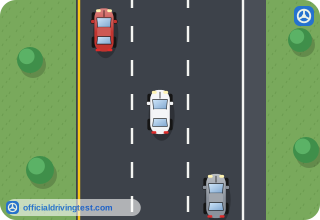
- The center lanes, because there are fewer traffic conflicts
- The right lane, because it is the safest to drive in
- The left lane, because it is the fastest to drive in
- Any lane, changing often to find the clearest path
Show answer
Correct answer: The center lanes, because there are fewer traffic conflicts
You choose the center lanes as there will be fewer traffic conflicts, leaving the right and left lanes for vehicles entering and leaving the roadway.
Source: Hawaii Driver's Manual (2023), page 65 · Open this page in the manual (Manual page 65)
-
On a road with three or more lanes in your direction, when should you use the right lane?
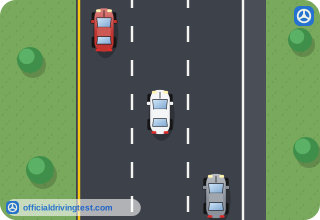
- When you want to pass other vehicles
- When traffic is moving faster than the limit
- When you are moving slower than other traffic
- When you plan to turn left soon
Show answer
Correct answer: When you are moving slower than other traffic
Use the right lane if you are moving slower than other traffic.
Source: Hawaii Driver's Manual (2023), page 65 · Open this page in the manual (Manual page 65)
-
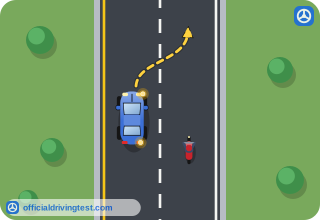
How should you check your blind spots before a lane change?
- Look only in your inside rear-view mirror before moving
- Look only in your side mirrors before you move over
- Sound your horn and watch for any reaction ahead
- Physically check them by turning your head and looking
Show answer
Correct answer: Physically check them by turning your head and looking
You use your rear-view mirrors and also physically check the blind spots by turning your head and looking.
Source: Hawaii Driver's Manual (2023), page 65 · Open this page in the manual (Manual page 65)
-
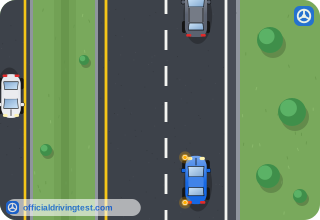
How should you move into the other lane once there is ample clearance?
- With a quick sharp turn of the wheel
- By speeding up as you cross
- With a gradual, steady movement
- By stopping first, then moving over
Show answer
Correct answer: With a gradual, steady movement
You make a gradual, steady movement into the other lane because abrupt movements may cause you to overcontrol or lose control of your vehicle.
Source: Hawaii Driver's Manual (2023), page 65 · Open this page in the manual (Manual page 65)
-
When changing lanes, which is better?
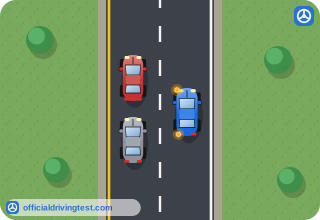
- Slow slightly and move in behind a vehicle
- Speed up and cut in ahead of a vehicle
- Stay beside the vehicle until it moves away
- Brake hard to leave a large gap behind you
Show answer
Correct answer: Slow slightly and move in behind a vehicle
It is best to slow slightly and move in behind a vehicle, because you always keep that vehicle in sight and annoy its driver less.
Source: Hawaii Driver's Manual (2023), page 66 · Open this page in the manual (Manual page 66)
-
What should you not do when vehicles are spaced at the minimum safe following distance or less?
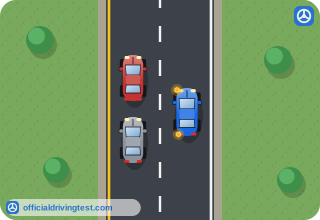
- Signal your intention to change lanes
- Wait for a larger gap in the lane
- Slow down and move in behind a vehicle
- Force your way into the space between them
Show answer
Correct answer: Force your way into the space between them
Forcing your way into such a space is discourteous and dangerous and causes other drivers to close the gap to deny you space.
Source: Hawaii Driver's Manual (2023), page 66 · Open this page in the manual (Manual page 66)
-
When changing lanes, who must yield?
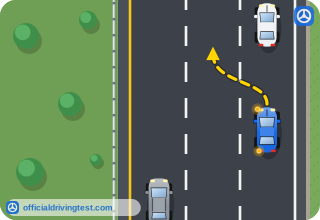
- Vehicles in the other lane must yield to you
- You must yield to vehicles in the other lane
- The faster vehicle must yield
- The vehicle with its signal on must yield
Show answer
Correct answer: You must yield to vehicles in the other lane
The manual states that you must always yield to vehicles in the other lane when changing lanes.
Source: Hawaii Driver's Manual (2023), page 66 · Open this page in the manual (Manual page 66)
-
If the lane you want to enter is congested, what should you do?
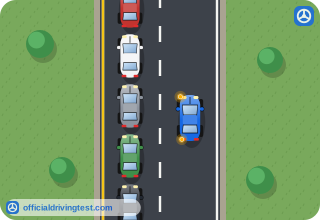
- Enter at the end of the line
- Run up ahead and crowd in
- Stay on the shoulder until it clears
- Enter beside the first vehicle that slows
Show answer
Correct answer: Enter at the end of the line
If the desired lane is congested, you enter at the end of the line and do not run up ahead and crowd in.
Source: Hawaii Driver's Manual (2023), page 66 · Open this page in the manual (Manual page 66)
-
You cannot make a lane change at the place you wanted. What should you do?
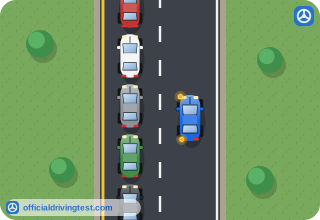
- Make the change anyway, with your signal on
- Slow down and make the change from the shoulder
- Remain in your lane until you can safely make the change
- Sound your horn and move over
Show answer
Correct answer: Remain in your lane until you can safely make the change
You remain in your lane until you can safely make the change, even if you are inconvenienced.
Source: Hawaii Driver's Manual (2023), page 66 · Open this page in the manual (Manual page 66)
-
Where should you never change lanes?
- On roads that have three or more lanes in one direction
- When approaching or moving through intersections and crosswalks
- On any road where traffic is heavy or moving slowly
- On roads where the speed limit is above 45 mph
Show answer
Correct answer: When approaching or moving through intersections and crosswalks
The manual says never to change lanes when approaching or moving through intersections and crosswalks.
Source: Hawaii Driver's Manual (2023), page 66 · Open this page in the manual (Manual page 66)
-
From which lane should you make a turn?
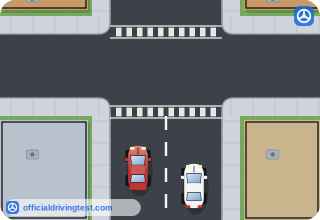
- The center lane, then swing over into the correct lane after the turn
- The lane with the least traffic, into the lane farthest from the turn
- The lane nearest the direction of the turn, into the nearest lane available
- Any lane, as long as you signal early, into whichever lane is open
Show answer
Correct answer: The lane nearest the direction of the turn, into the nearest lane available
You turn from the traffic lane nearest the direction of the turn and into the nearest traffic lane available.
Source: Hawaii Driver's Manual (2023), page 67 · Open this page in the manual (Manual page 67)
-
You are not in the proper lane for a turn you want to make. What should you do?
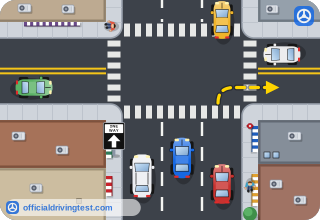
- Continue on and make the turn elsewhere
- Force your way into the proper lane
- Make an abrupt last minute lane change
- Stop and wait for traffic to let you over
Show answer
Correct answer: Continue on and make the turn elsewhere
If you are not in the proper lane, you continue on and make the turn elsewhere instead of forcing your way into the lane or making an abrupt last minute change.
Source: Hawaii Driver's Manual (2023), page 67 · Open this page in the manual (Manual page 67)
-
How should you make turns?
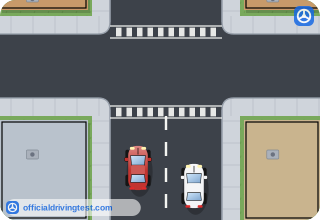
- Swing wide to the left before a right turn
- Cut short to save time when no one is near
- Enter the turn slowly, then speed up before the middle
- Make precise turns, without swinging wide or cutting short
Show answer
Correct answer: Make precise turns, without swinging wide or cutting short
The manual says to make precise turns and not to swing wide or cut short.
Source: Hawaii Driver's Manual (2023), page 67 · Open this page in the manual (Manual page 67)
-
When should you slow to a proper speed for a curve or turn?
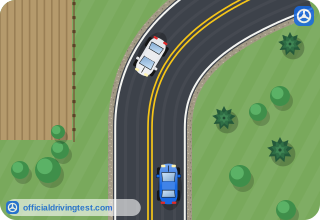
- After you are halfway through the curve
- Before you enter the curve or begin the turn
- Only when the road is wet
- Only when there are other vehicles nearby
Show answer
Correct answer: Before you enter the curve or begin the turn
You slow to a proper speed before you enter a curve or begin a turn and keep a steady speed while in it.
Source: Hawaii Driver's Manual (2023), page 67 · Open this page in the manual (Manual page 67)
-
What can braking or an abrupt change of speed in a turn or curve cause?
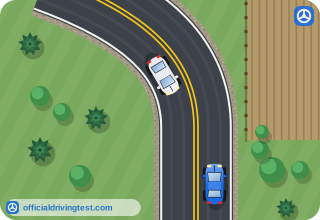
- You may lose control of your vehicle
- Your turn signal to stop working
- Your tires to wear evenly
- Following drivers to give you more room
Show answer
Correct answer: You may lose control of your vehicle
Braking or an abrupt change of speed in a turn or curve can cause you to lose control of your vehicle.
Source: Hawaii Driver's Manual (2023), page 67 · Open this page in the manual (Manual page 67)
-
Why should you avoid left turns and U-turns whenever possible?
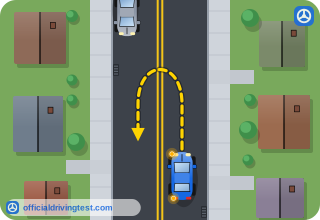
- They are prohibited by law at most intersections
- They need a longer turn signal than right turns do
- They conflict more with other traffic than right turns do
- They always take more time at a green light than right turns
Show answer
Correct answer: They conflict more with other traffic than right turns do
Left and U-turns conflict more with other traffic, are much more hazardous than right turns and also impede other traffic.
Source: Hawaii Driver's Manual (2023), page 67 · Open this page in the manual (Manual page 67)
-
You are waiting to turn left at an intersection with a red light, and the light turns green. What should you do?
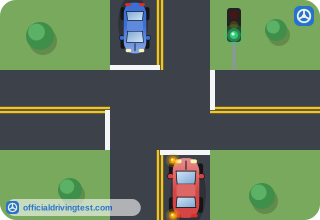
- Turn the wheels left while you wait, then go at once when green
- Move slowly into the intersection, wheels straight, and turn when clear
- Speed through before oncoming traffic arrives at the intersection
- Wait for the oncoming drivers to wave you through the intersection
Show answer
Correct answer: Move slowly into the intersection, wheels straight, and turn when clear
You move slowly into the intersection, keep the wheels pointing straight ahead and turn when the intersection is clear and it is safe to do so.
Source: Hawaii Driver's Manual (2023), page 67 · Open this page in the manual (Manual page 67)
-
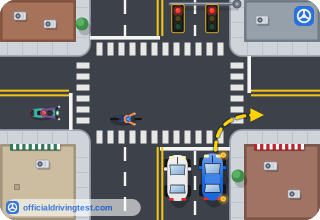
Why must you use great care watching for pedestrians, bicyclists and motorcyclists when making turns?
- They usually travel much faster than passenger cars do
- They are always visible to other drivers from far away
- They do not have to obey traffic signals and signs
- They may be hidden by other vehicles, darkness or poor weather
Show answer
Correct answer: They may be hidden by other vehicles, darkness or poor weather
Pedestrians, bicyclists and motorcyclists may be hidden by other vehicles, darkness or poor weather when you turn.
Source: Hawaii Driver's Manual (2023), page 67 · Open this page in the manual (Manual page 67)
-
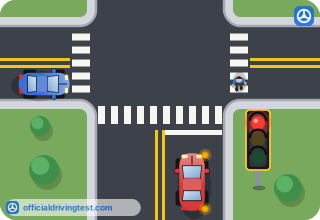
What must you always do before making a right turn when facing a red traffic signal?
- Slow down and turn if nothing is coming
- Honk to warn pedestrians
- Bring your vehicle to a complete stop
- Wait for the signal to turn green
Show answer
Correct answer: Bring your vehicle to a complete stop
You must always bring your vehicle to a complete stop before making a right turn when facing a red traffic signal.
Source: Hawaii Driver's Manual (2023), page 67 · Open this page in the manual (Manual page 67)